
Bottom Line: Writesonic is a competent AI writing platform with a real Generative Engine Optimization feature, but the GEO tools that justify the brand do not exist below the $249/month Professional plan. For solo content operators publishing under 15 articles a month, the entry tier is a generic AI writer competing with cheaper options. For agencies running multi-site portfolios, the project caps will push you into custom Enterprise pricing faster than you expect.
The pitch for Writesonic in 2026 is that it is no longer “an AI writing tool” but a Generative Engine Optimization platform that tracks how ChatGPT, Perplexity, Gemini, and Claude cite your brand. The marketing is good. The pricing is where the friction shows up.
A solo content operator who lands on Writesonic’s pricing page sees a $20 plan, a $99 plan, a $249 plan, and a $499 plan. The instinct is to start at the bottom and upgrade later.
The honest read is that the bottom plan is a generic AI writer with no GEO tracking, the $99 plan caps at 15 AI articles a month despite saying “unlimited words”, and the GEO feature most reviewers spend the marketing budget talking about lives behind the $249 wall.
I am going to walk through what you get at each tier, where the credit math falls apart for indie operators with portfolios, and the verdict on which tier (if any) is worth it for a solo publisher in May 2026.
What Writesonic Does in 2026
Writesonic is a multi-model AI writing platform with 100+ content templates, an AI Article Writer that drafts up to 5,000 words in one run, and a Generative Engine Optimization dashboard that tracks brand citations across AI search.
The product surface area has grown. The two halves to understand are the writing tools and the GEO platform. They are priced as if they were the same product, but they answer different needs.
On the writing side, you get Multi-Model Orchestration that lets you swap between GPT-4o, Claude 3.7 Sonnet, and Gemini 1.5 Pro inside the same interface. The AI Article Writer 6.0 handles long-form drafts with integrated real-time web research.
Chatsonic is the conversational layer with sub-agents for SEO, content, and LinkedIn. Botsonic builds custom chatbots from your knowledge base. There is also an AI Humanizer designed to scrub the “robotic” cadence from AI prose, mainly to help long-form pass AI detectors.
On the GEO side, the Visibility Dashboard tracks “share of voice” across ChatGPT, Perplexity, Claude, Gemini, and Google AI Overviews. The system monitors brand sentiment in AI answers, watches for citations on competitor sites, and (via a WordPress plugin) tracks AI bot traffic hitting your site.
This is the actual differentiator versus Jasper, Copy.ai, and the dozens of other AI writers, and it is the reason Writesonic’s CEO is pitching the company as a category-of-one for the AI-search-visibility problem.
Here is the catch I keep coming back to: the GEO features are mostly locked behind the $249 Professional plan. Below that, you have an AI writing tool competing on equal terms with cheaper options that have no GEO pretensions.
Writesonic Pricing After Adding Up the Real Costs
The pricing table looks like a normal SaaS tier ladder until you read the small print on AI articles, queries tracked, and unique domains. Most indie operators bounce off the cap rather than the headline price.
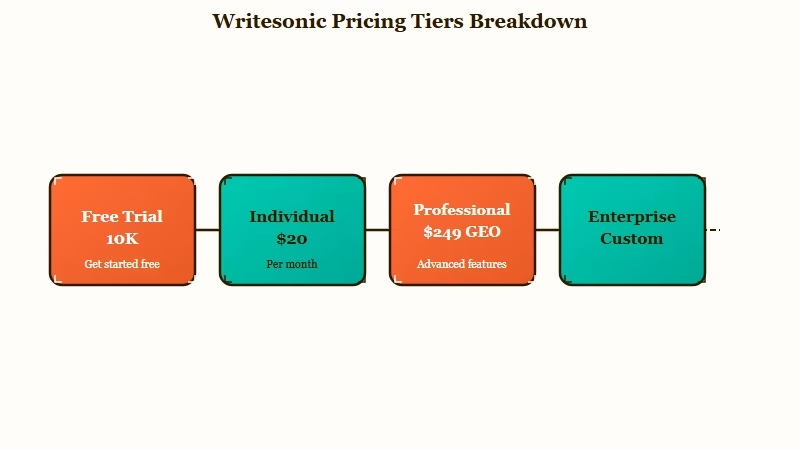
Here is the actual breakdown for May 2026, with monthly and annual pricing pulled from the live pricing page and cross-checked against G2’s listing.
| Plan | Monthly | Annual (effective/mo) | AI articles | AI queries tracked | Unique domains | GEO dashboard |
|---|---|---|---|---|---|---|
| Free trial | $0 (one-time) | NA | 10,000 words total | 0 | 0 | No |
| Chatsonic / Individual | $20 | $16 | Unlimited (100K words) | 0 | 0 | No |
| Standard / Starter | $99 | $79 | 15 | 50 | 1 | Limited |
| Professional / Basic | $249 | $199 | 25 | 100 | 2 | Full |
| Advanced / Growth | $499 | $399 | 50 to 75 | 200 | 2 | Full + API |
| Enterprise | Custom | Custom | Unlimited | Unlimited | Unlimited | Full + SSO |
Three things worth flagging from this table:
- The “unlimited words” claim at the $99 tier is misleading. The real cap is 15 AI articles a month. Solo bloggers publishing four times a week burn through that by the second week. The credit system makes you feel rich until you discover the article-count meter halfway through the month.
- GEO tracking starts at $249. If the reason you came to Writesonic is the AI-search-visibility pitch, $99 does not buy it. You can pay $99 a month indefinitely and never see the dashboard the brand is built around. Most reviewers gloss over this. It is a wall.
- The two-domain cap on Basic and Growth is the indie portfolio killer. A niche-site operator with three to ten small sites cannot use Writesonic as their single source of GEO data without going to Enterprise. Adding extra users is $50/month each on top. The economics break fast for anyone running more than two properties.
The headline math from the brand is “$20 to start, $249 for the real product.” The honest math for a solo operator with a portfolio is closer to “$249 for one site, $499 once you use the API, custom pricing past two domains.”
Where the AI Output Falls Short
The first-draft quality is fine for an AI writer, but the “real-time research” feature occasionally fabricates expert quotes and the long-form drafts trigger AI detectors at a rate that matters if you submit to clients or publications.
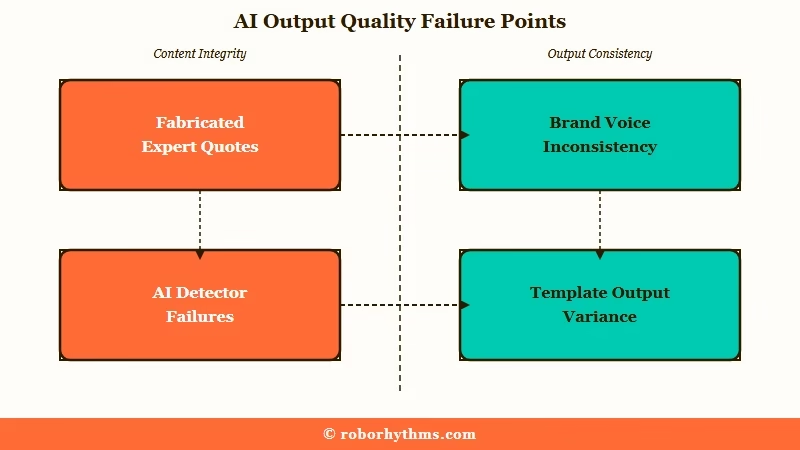
The output quality is the part most reviews talk around. Here is the honest framing: Writesonic produces a passable first draft about 80% of the time. The other 20% is what you spend editing-time fighting.
The fabricated-quote pattern is the most concerning. The AI Article Writer’s “real-time research” feature pulls quotes that look like expert citations but are sometimes invented or attributed to the wrong person.
A SEO-expert review on Selfmademillennials flagged this explicitly: the tool added “expert quotes” from competitor sites that were not real expert quotes, and the reviewer had to manually verify and delete them. If you are publishing content where a fabricated quote is a credibility-killer (industry analysis, finance, health, anything client-facing), this is the failure mode that bites hardest.
The AI-detector pass rate is the second issue. Long-form drafts frequently flag on Originality, GPTZero, and similar detectors.
The AI Humanizer feature exists specifically to scrub the robotic cadence and help content pass, but using it adds an editing step the marketing copy does not advertise. For client work where the deliverable will be detector-checked, plan on either humanizing every draft or doing a manual rewrite pass.
The third issue is brand-voice consistency. Writesonic supports custom brand voice training, but the consistency across templates is uneven.
A blog-post template will produce content that sounds different from a LinkedIn-post template using the same voice profile. Solo operators with a strong editorial voice spend more time editing back to “their” voice than the workflow saves.
Vague: “Write a blog post about productivity tools.”
Specific: “Write a 1,500-word blog post about productivity tools for solo founders. Brand voice: direct, slightly skeptical of trendy SaaS, first-person. Open with one concrete tool I should not buy. Include a comparison table covering price, primary use case, and biggest weakness for three tools. End with a one-paragraph verdict on what tool to choose. Cite no statistics you cannot link to a primary source.”
The specific prompt gets you closer. None of this is unique to Writesonic, but the platform makes it easy to forget you need to write the specific prompt because the templates encourage one-click generation.
Pros and Cons for a Solo Content Operator
Pros (numbered list, minimum 4):
- Multi-model swapping in one interface. Being able to draft with Claude 3.7 Sonnet, switch to GPT-4o for ad copy, and try Gemini 1.5 Pro for product descriptions without changing tabs is a real workflow win.
- GEO Visibility Dashboard is unique. No other writing platform tracks brand mentions across ChatGPT, Perplexity, Claude, Gemini, and Google AI Overviews in one view. If AI search is part of your distribution strategy, this is genuinely useful.
- AI Humanizer measurably changes the cadence. Output runs through the humanizer reads noticeably less robotic. It does not get every draft past detectors, but it shifts the floor.
- Real-time web research grounds the drafts. Writesonic pulls fresh data into long-form drafts in a way most pure-LLM writers do not. The pages it cites are real (the quotes it puts in them are not always).
- 100+ content templates cover the breadth. From Amazon descriptions to LinkedIn posts to email subject lines, the template library is wide enough that most use cases are covered without prompt engineering.
Cons (numbered list, minimum 4):
- GEO features locked behind $249/month. The differentiator the brand is built on is not available on the two cheapest tiers. If you bought the $99 plan expecting AI-search visibility, you bought the wrong thing.
- “Unlimited words” caps at 15 articles on $99. Credit anxiety is real once you understand the article meter is the actual constraint, not the word count.
- Two-domain limit on Basic and Growth. Solo operators running portfolios get pushed to Enterprise faster than the public pricing implies.
- Fabricated quotes in long-form research. The “expert citations” pulled by real-time research are sometimes invented. Manual verification is required for any publishable use.
- Inconsistent brand voice across templates. Same voice profile produces different-sounding output depending on which template you start from.
- Pricing complexity itself. Six tiers, two billing cycles, per-user add-ons, project caps, article caps, query caps. The cognitive overhead of just understanding what you are paying for is real.
How Writesonic Compares to the Honest Alternatives
For solo operators evaluating Writesonic against the rest of the AI writing market, here is the short read on the competitors I see come up most often:
- Jasper AI, higher first-draft quality, weaker GEO, similar pricing band. Best if quality is the constraint.
- Copy.ai, better for marketing teams collaborating on short-form copy. Lighter long-form tool.
- Rytr, the cheap option for occasional creators who just need decent drafts.
- Frase, SEO-focused writing tool with strong content-brief features. Better if your workflow starts at keyword research.
- Surfer SEO, on-page optimization specialist, not a writer. Pairs with another writer.
- Peec AI, newer GEO-specific platform with deeper AI-search tracking than Writesonic for less.
If your need is genuinely “I want to track my brand’s AI search visibility AND draft content in one tool”, Writesonic is the most consolidated option at $249/month. If your need is “I want better AI drafts than ChatGPT produces”, Jasper is the cleaner pick and roughly the same price. If your need is “I want a cheap AI writer”, Rytr or the Writesonic Individual plan are interchangeable.
For anyone working in the broader AI-writing or content-ops space, the piece on building agents that do real workflows covers the next layer up the stack: when an AI writer is not enough and you need an agent that orchestrates the writing, editing, and publishing steps.
Who Should Pay for Writesonic in 2026
Pay for it if you publish 15-plus articles a month AND need GEO tracking AND run one or two sites. Skip it if you publish less than 10 a month, do not care about AI-search visibility, or run a portfolio.
The “buy” case in 2026 is narrower than the marketing suggests. Specifically:
- Pay for Professional ($249/month) if you run one or two sites, publish 20-plus articles a month, and the AI-search visibility dashboard matters to your client reporting or your own strategy. This is the only tier where the brand promise lines up with what you pay for.
- Pay for Individual ($20/month) if you want a multi-model AI writer with templates and do not need GEO. At this price, you are competing with ChatGPT Plus ($20/month) which gives you raw model access without the template scaffolding. Pick based on whether template scaffolding or raw flexibility is more valuable to you.
- Skip $99 Starter. The 15-article cap is too tight for serious publishing, and the absence of GEO tools makes the price hard to justify against the $20 Individual plan above and the $249 Professional plan below. It is the worst-value tier.
- Skip Advanced ($499/month) unless you specifically need API access. The article count goes from 25 to 50-75 but the GEO query cap only doubles, and most solo operators do not need API at this stage.
- Skip if you run a portfolio. The two-domain cap on Basic and Growth is a hard ceiling. Enterprise pricing for multi-site is opaque and expensive. You will spend less on dedicated tools per site than on one consolidated Writesonic subscription.
The Writesonic affiliate program is also worth noting if you write about AI tools: 30% recurring lifetime commission with no cap is one of the better recurring structures in the AI tooling space.
For comparison, our Kit/ConvertKit review covers the email-marketing side of the creator stack, and the GetResponse review covers a related platform with longer-tail commission economics. The recently-shipped Google Gemini Enterprise Agent Platform piece covers how the AI search layer is being consolidated by hyperscalers, which is the broader context Writesonic’s GEO bet is trying to land in.
The Writesonic affiliate program will get added to the active program list on this site once sign-up completes. If you are reading this and considering signing up, do it through your own affiliate first if you have one, or directly through Writesonic until our active link is live.
Final Verdict
Writesonic is a $249/month product wearing $20 pricing on its homepage. The cheap tiers exist to funnel you toward the Professional plan, where the actual GEO feature lives. For solo operators who fit the narrow “one or two sites, 20+ articles a month, AI-search visibility matters” profile, the Professional plan is worth the money. For everyone else, the answer is “pick a cheaper writer or pick a dedicated GEO tool.”
The platform is competent. The output is fine. The differentiator (GEO) is real and useful if you fit the use case.
The pricing structure pushes too many indie operators into the wrong tier, and the article and domain caps catch portfolio owners off guard. Walk in knowing the constraint, pick the right tier, and Writesonic earns its place. Default to the homepage’s price ladder and you will end up paying $99 for the worst-value plan in the catalog.
Frequently Asked Questions
Is Writesonic worth it in 2026?
Writesonic is worth it for solo operators who publish 15+ articles a month AND need AI-search visibility tracking AND run one or two sites. The $249 Professional plan is the only tier where the brand promise (GEO) lines up with the price. The $99 Starter plan is the worst-value tier in the catalog because it caps articles without giving GEO access.
What is Writesonic’s free tier?
The free tier is a one-time 10,000-word trial with no credit card required. It includes basic templates, the AI writer, and a limited AI Humanizer. It does not include GEO tracking or the AI Article Writer 6.0, and once the 10,000 words are used the free tier ends.
Does Writesonic content pass AI detectors?
Raw long-form drafts frequently trigger AI detection on tools like Originality and GPTZero. The AI Humanizer feature scrubs the robotic cadence and helps content pass detectors, but using it adds an editing step. For client work that will be detector-checked, plan on humanizing every draft or doing a manual rewrite pass.
How does Writesonic compare to Jasper AI?
Jasper produces higher first-draft quality but has weaker GEO tracking and similar pricing. Writesonic produces passable first drafts plus unique AI-search visibility tracking at the $249 tier.
Pick Jasper if quality is the constraint. Pick Writesonic if GEO is the constraint and you can afford the Professional plan.
Can I use Writesonic for multiple sites?
The Basic ($249) and Growth ($499) plans cap you at two unique domains for site tracking. Adding more domains requires Enterprise pricing, which is custom and not published. For portfolio owners running 3-10+ sites, Writesonic forces you toward Enterprise faster than the public pricing implies.
What does Writesonic’s GEO feature do?
The Generative Engine Optimization dashboard tracks how often your brand is mentioned and cited across ChatGPT, Perplexity, Claude, Gemini, and Google AI Overviews. It monitors share of voice, sentiment, and (via a WordPress plugin) AI bot traffic to your site. It does NOT directly improve your ranking; it gives you visibility data so you can react.
