
My Take: The AI trust collapse is not a perception problem. It is a product problem. When 55% of Americans say AI does more harm than good, up 11 points in 11 months, they are not misunderstanding AI. They are reporting their actual experience with it. The industry is diagnosing this wrong, which means they are about to fix the wrong thing.
A Quinnipiac University poll conducted March 19-23, 2026 found that 76% of Americans trust AI-generated information only rarely or sometimes. More striking: 55% say AI will do more harm than good in their daily lives, up 11 percentage points since April 2025. That is not noise. That is a trend with momentum.
The industry’s standard response to this kind of data is predictable. Better communication. More transparency. Responsible AI messaging. I have read these press releases. They will not work, because they misidentify the problem.
The Mainstream View (And Why It Falls Short)
The mainstream view is that AI distrust is a communication failure, that people would trust AI more if they understood it better. This view is wrong.
Sam Altman and OpenAI have spent years on the message that AI is a tool that can “benefit humanity” with proper guardrails. Marc Andreessen has argued that AI pessimists are the ones causing harm by slowing beneficial technology.
The dominant industry framing is: people who distrust AI lack context.
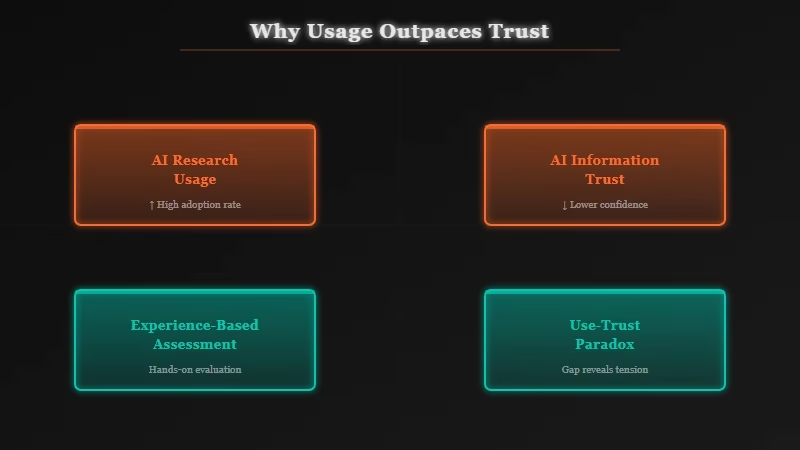
The Quinnipiac data breaks this framing. The use-trust paradox in the data is the most important number the headlines missed. 51% of Americans now use AI for research. Usage went up. Trust did not. That is not ignorance. That is experience.
If low trust were a knowledge problem, usage and trust would move together. They are moving in opposite directions. More Americans are using AI more often, and more of them are arriving at negative assessments of its net impact.
What’s Actually Happening
What’s actually happening is that real-world AI performance is not matching the promises that created expectations, and Americans who use AI regularly are the ones most likely to notice the gap.
From what I’ve seen in actual usage patterns, the trust data reflects specific categories of failure. Hallucinations in research tools. Overconfident answers in high-stakes contexts.
Job displacement that arrived faster than the promised “new jobs” offset. AI-generated content in elections, lawsuits, and medical advice that turned out to be wrong in ways that mattered.
The 11-point jump in “more harm than good” is not driven by people who have never used AI. The data shows AI usage is up across every category. This is the judgment of people who have used it and reached a verdict.
From my own experience building with AI tools, the capability gaps are real. The gap between benchmark performance and deployment reliability for tasks outside the training distribution is something every practitioner runs into within their first month.
The production failure modes of AI agents are not edge cases. They are the normal experience for anyone building seriously with these tools.
The Part Nobody Wants to Admit
The part nobody wants to admit is that the AI industry optimized its products for impressive demos and capability benchmarks, not for reliability in the situations that matter to actual users in their actual jobs.
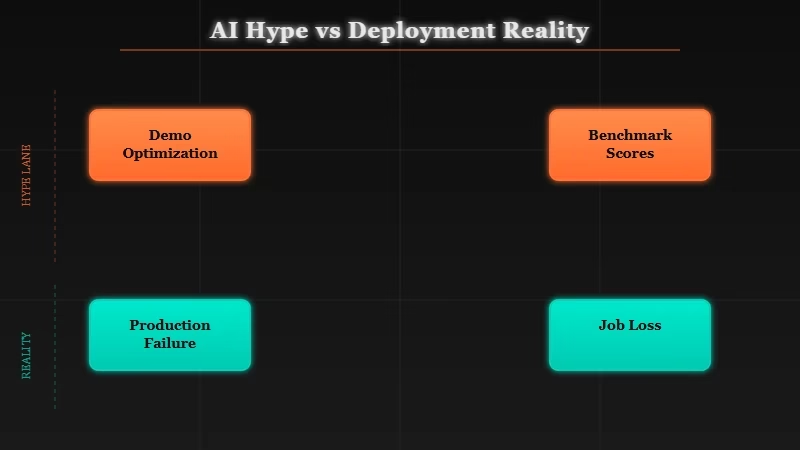
The benchmark race is real. GPT-5.4 shipped with a 75% OSWorld score and 33% fewer hallucinations than its predecessor. These are meaningful improvements. What they do not address is the deployment experience of someone using AI to do their job and discovering that “usually right” is not the same as “reliably right” in contexts where wrong has consequences.
The jobs data makes this concrete. 70% of Americans expect AI to reduce job opportunities. 30% of employed Americans are worried about their own specific job. These are not abstract fears. They are people watching what is happening around them in real industries.
The industry response to job displacement anxiety has been consistently optimistic: AI creates new categories of work, productivity gains mean more overall jobs. This messaging lands badly when the person hearing it has already seen colleagues replaced. The optimism is not wrong in principle. It is delivered into a context where its timing is demonstrably off.
What I find most telling: only 15% of Americans in the Quinnipiac poll said they would be comfortable having an AI boss. The discomfort is not with using AI as a tool. It is with AI having authority. That is a boundary the industry keeps pushing against without acknowledging why the resistance exists.
For more context on how individual builders are responding to this environment, the AI agents are winning for solo operators piece covers why the trust gap looks different for people who control their own AI tools versus people who have AI deployed on them.
Hot Take
The 55% of Americans who say AI does more harm than good are not a problem to be solved through better communication. They are the early adopters of a realistic view that the rest of the country will arrive at in about 18 months. The AI industry should treat the Quinnipiac poll not as a PR challenge but as the most accurate user research they have received all year, delivered for free.
