
My Take: Mustafa Suleyman’s 18-month timeline for white-collar automation is wrong, not because the models cannot do the work, but because the deployment bottleneck is integration and approval workflows, not capability. The Stanford 51-deployment study showed the productivity gap between top-quartile AI adopters and the rest is 71 percent versus 40 percent, and that gap exists with identical models. A better model does not close the gap. A different management posture does. The timeline that matters is how fast CEOs ship the human approval gate, not how fast the labs ship the next benchmark.
Microsoft AI chief Mustafa Suleyman went on Fortune this month and told the world that white-collar work has 18 months left before AI automates the lot.
The clip went viral, the layoff stories chased it through the cycle, and most of the discourse since has been pretending the question is whether the models are smart enough to do the work.
That is the wrong question. The models are already smart enough. They have been for over a year.
What is gating the productivity gain at most companies is not the capability of GPT-5.5 or Claude Sonnet 4.6 or Gemini 3.5. It is the layer of human approval, internal review, and “let me run this by legal” friction that sits between the model output and any action that moves a business outcome.
The way I see it, the 18-month timeline is the kind of prediction a model vendor makes when they want the policy conversation to focus on capability instead of deployment, because deployment is the part their product does not solve. The capability story is more flattering.
The deployment story is the part where someone has to sign off on letting an AI do something irreversible without checking with a human first.

The Mainstream View And Why It Falls Short
The mainstream view that AI capability will automate white-collar work on a tight timeline rests on benchmark scores, not deployment data.
Suleyman’s pitch on Fortune is the cleanest example of the genre: the models can do the work, therefore the work is going to be done by the models, therefore the workers are 18 months from displacement. Each step in that chain sounds intuitive and the chain itself is broken.
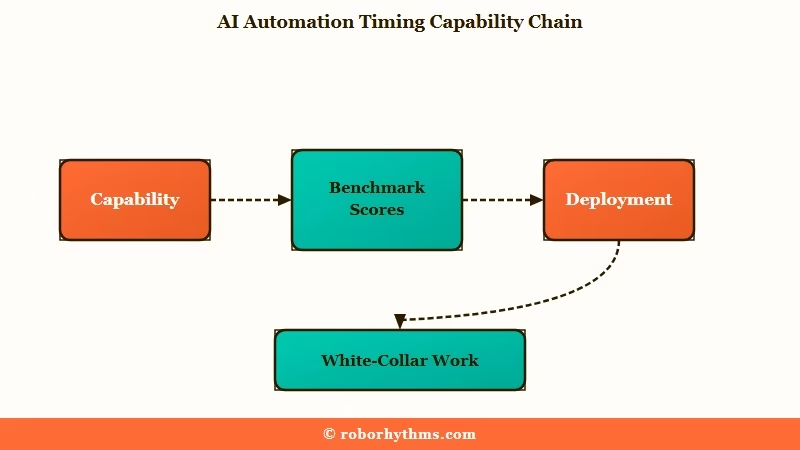
Suleyman is not wrong about capability. GPT-5.5 produces legal memos that pass review. Claude Sonnet 4.6 builds production codebases.
Gemini 3.5 Flash does data analysis at 76 percent on SimpleBench, just behind the top-tier reasoning models. The benchmark numbers all point at “the models can do the white-collar work.” That is the steel-manned version of the mainstream argument and it is also the version that loses to the deployment data.
The deployment data tells a different story. According to the Fortune coverage of Suleyman’s claim, the prediction is grounded in model trajectory, not in observed organizational adoption.
That is the gap. Trajectory is not the same as adoption. A capability that ships in a lab in May does not become a workflow change in a Fortune 500 by November. The shipping is the hard part, and the labs do not do the shipping.
What the mainstream view misses is that the 71 percent productivity gain achievable from AI is already in the hands of companies running 2024 models. The companies achieving it are not the ones with the best models. They are the ones with the most permissive approval workflows. That is a leadership variable, not a technology variable, and Suleyman’s 18-month prediction misses it entirely.
What Is Happening With AI Adoption
Real AI adoption splits cleanly into a 71-percent-gain group and a 40-percent-gain group based on whether companies removed the human approval gate, not on which models they bought.
The Stanford 51-deployment study (Pereira, Graylin, Brynjolfsson) published in March 2026 examined 51 real-world AI deployments and found this gap is the central productivity story, and the gap exists with identical access to the same frontier models. The management-not-model finding covers the data in depth.
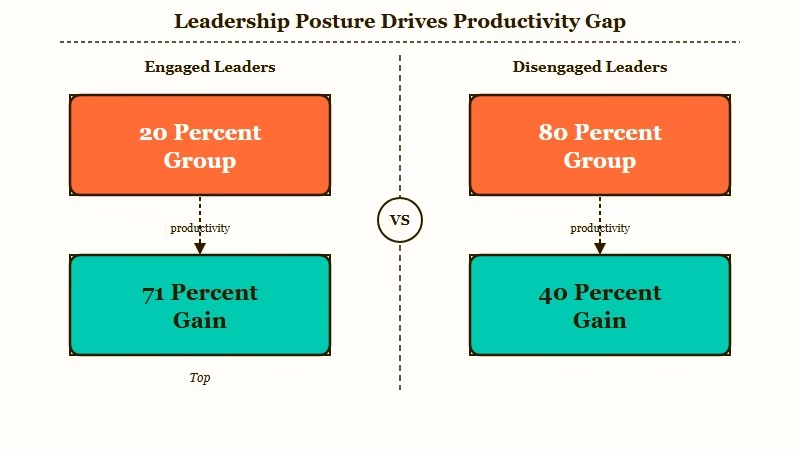
The split is simple in shape. About 20 percent of the studied companies let AI own tasks end-to-end without a human approval gate. They saw the 71 percent gain.
The remaining 80 percent kept a human approval gate in front of every meaningful AI action and saw the 40 percent gain. Both groups had identical access to GPT-5.5, Claude, and Gemini. The difference was entirely in deployment posture.
What is happening in the 71 percent group is the part Suleyman’s framing ignores. Those companies are not buying better models, they are buying organizational courage.
Supermarket chains let AI agents own buying decisions and waste dropped 40 percent. Security operations centers let AI triage every incoming alert and processing capacity went from 1,500 alerts per month to 40,000 per month. Both cases used commodity models. The unlock was the absence of the approval loop, not the presence of a smarter model.
The GitHub PR auto-fix agent build walks through what an autonomous-deployment posture looks like for a smaller team. The pattern is the same at scale: structured fail-closed mode, clear success criteria, recoverable errors, and the removal of the per-action human review.
The companies achieving the 71 percent gain run their AI agents the way startups run their CI/CD pipelines. The companies stuck at 40 percent run their AI agents the way banks run their compliance reviews.
| Adoption posture | Productivity gain | Bottleneck | Time to capture gain |
|---|---|---|---|
| AI as a tool with human approval per action | 40 percent | Approval queue depth | Plateaus, will not climb |
| AI as a hire with human kill-switch only | 71 percent | Leadership courage to ship | 6 to 12 months from posture change |
| AI as a fully autonomous deployment | Higher in theory | Recoverability of errors | Limited to recoverable use cases |
What Suleyman is selling as “AI capability automates white-collar work in 18 months” is what the data shows in practice: AI capability has already automated white-collar work in 20 percent of companies, and the other 80 percent are stuck on approval posture, not on the next model release. The 18-month timeline applies to the labs. The deployment timeline is whenever a given company’s CEO decides to ship.
The Part Nobody Wants to Admit
The integration bottleneck is a leadership problem, not a technology problem, and acknowledging that makes the AI-automation conversation politically harder, which is why model vendors keep ducking it.
Suleyman talking about capability is comfortable. Suleyman talking about why his enterprise customers will not let the models do anything truly autonomous would be uncomfortable, because the answer is “because their CEOs are afraid of a single bad headline.”
What the 40 percent companies are protecting against is not error rate. The autonomous deployment error rates in the Stanford study were measurably lower than the human-with-approval-gate error rates.
What they are protecting against is attribution. A human-approved error is a human’s mistake. An AI-autonomous error is a leadership decision to deploy AI autonomously, and that decision has a name attached to it.
This is the dynamic the Anthropic productivity-gap research pointed at, and the AI bubble crash warning piece covered the financial-market read of the same gap. The valuations of the AI labs assume that the 40 percent companies will become 71 percent companies.
The data suggests they will not, because the obstacle is not the next model, it is the next CEO. A different CEO would ship today on the current models. The same CEO will not ship in 18 months on a better model.
The other thing nobody wants to admit is what 71 percent productivity gain looks like in practice in practice. It does not mean white-collar workers get replaced one-to-one. It means a company with 100 workers in 2025 produces the same output with 60 workers in 2026 and reinvests the 40 in new work, OR it means the same 100 workers produce 71 percent more output. Both have happened.
The pure-displacement story Suleyman is telling is empirically rarer than the augmentation-plus-reinvestment story. Suleyman’s framing sells better, the augmentation story is what the deployment data shows.
The companies catching the 71 percent gain are also the ones investing the most in human-AI integration roles, not the ones cutting them.
The AI agent production patterns covers the labor pattern that produces the gain: small teams with deep AI deployment expertise replacing large teams running manual workflows. That is a labor-market shift, not a labor-market collapse, and the difference matters for any reader trying to plan a career on this.
Hot Take
The 18-month timeline for white-collar automation is wrong, and the reason it is wrong is that the bottleneck has not been capability for over a year and Mustafa Suleyman knows it.
The labs are shipping ahead of what their customers are deploying. The 20 percent of companies achieving the 71 percent gain did it with 2024 models and the right management posture, not 2026 models and a different approval workflow.
The 80 percent stuck at 40 percent will be stuck at 40 percent in November 2027 too, because their constraint is the boardroom, not the benchmark. Suleyman’s prediction is a vendor’s prediction. Treat it like one.
What I would predict instead: 18 months from now, the gap between 71-percent-gain companies and 40-percent-gain companies will be wider, not narrower, because the 20 percent will keep shipping autonomous deployments and the 80 percent will keep adding committee reviews. The labs will release at least three more frontier models in that window and none of them will close the gap.
The companies that change their approval posture in the next quarter will pull ahead of the ones that wait for “AI capability” to do the closing for them.
