
What’s Changed: SillyTavern is a free, open-source app you install on your own computer to chat and roleplay with AI characters, and it ships with no AI of its own. You plug in a model, so the model you pick sets both your bill and your privacy. Version 1.19.0 landed on September 14, 2026, with support for newer models such as Claude Sonnet 5.
What is SillyTavern? It is a chat interface for AI roleplay that you install on your own computer and point at whatever AI model you like. The official documentation calls it “a locally installed user interface,” and it has no model of its own.
That design is why the name keeps coming up among Janitor AI users. After a mid-September update, a refugee-forum thread describes users losing the ability to fork, or start a fresh chat from, unlisted and deleted bots, a change Janitor reportedly called a bug.
Another September thread asks outright why everybody is swapping to SillyTavern.
My short answer is that SillyTavern trades convenience for control, and you pay for that control in setup time, model fees and security chores.
This guide covers what it is, what it costs to run, how safe it is, what comes with you from Janitor AI and who should skip it.
What Is SillyTavern?
SillyTavern is a free, open-source frontend for AI roleplay, a chat screen and control panel that runs on your own machine and sends your messages to an AI model you connect.
It started in February 2023 as a fork of TavernAI 1.2.8, and the docs now credit “over 300 contributors.”
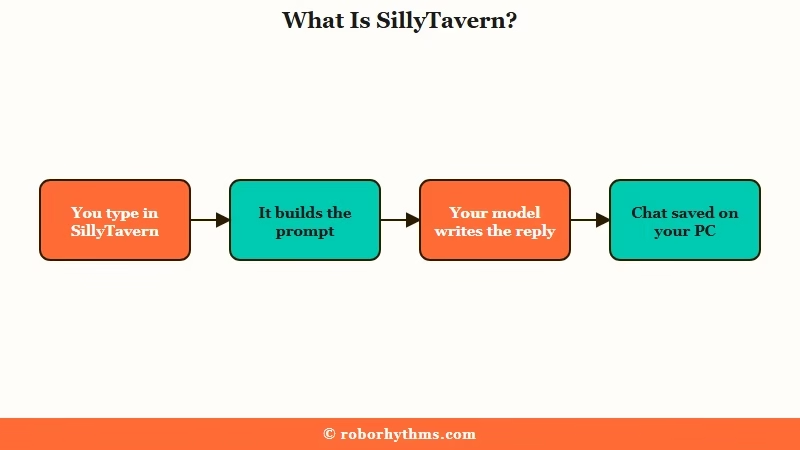
What is a frontend: The part of an app you see and type into. With SillyTavern, the AI that writes the replies lives somewhere else, on a paid service or on your own graphics card.
If you want card-style roleplay with nothing to install, a hosted app like Nectar AI handles the model and the setup for you. SillyTavern is the opposite bet: you run everything, and nothing is decided for you.
The project lives on GitHub under the AGPL-3.0 license, with 33.9k stars and 6.4k forks on September 28, 2026. It describes itself as an “LLM Frontend for Power Users,” and the docs openly embrace “the steep learning curve as part of the fun.”
Everything a Janitor AI user knows is there in some form: character cards, lorebooks (called World Info), group chats with several bots, plus image generation and text-to-speech if you wire them up.
To me, that feature list is a toolbox, and a toolbox only helps if you want to build something.
What Is the Point of SillyTavern?
The point of SillyTavern is ownership, because your bots, chats and settings sit in files on your computer where no site update, ban or outage can reach them.
It also lets you send the same card to any model you like.
Replies in the refugee thread give the practical reasons. The app runs locally, so site outages stop mattering, a ban cannot take your bots, and prompts can be tuned separately for each model.
On a hosted site, one moderation change can reshape every chat you have. I would rather be the only person who can change my setup, and SillyTavern gives me that.
Is SillyTavern Free, and What Does It Cost to Run?
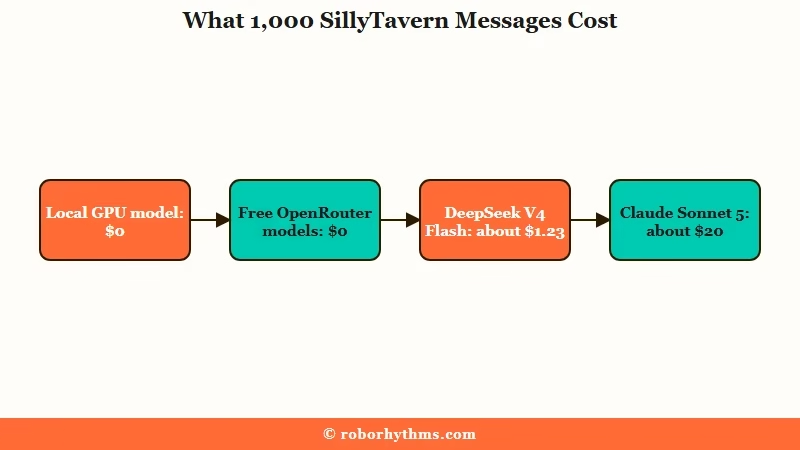
SillyTavern itself is free, but the AI model behind it usually is not: at September 28, 2026 prices, 1,000 messages cost about $1.23 on DeepSeek V4 Flash and about $20 on Claude Sonnet 5.
What is OpenRouter: A service that sells access to hundreds of AI models through one account and one API key, and one of the backends SillyTavern connects to.
The docs put it plainly: “Since SillyTavern is only an interface, you will need access to an LLM backend.” That backend is where the money goes, and the cost scales with how much text you send per message, since every reply resends the card, any lorebook entries and the recent chat.
Here is the math at a realistic roleplay size. DeepSeek V4 Flash’s listed rates on OpenRouter are $0.14 per million tokens in and $0.28 per million out, against $2 and $10 for Claude Sonnet 5:
Assumption: 8,000 tokens sent per message (card, lorebook, recent chat), 400 tokens back
DeepSeek V4 Flash: 8,000 x $0.14 per million + 400 x $0.28 per million = $0.00123
Claude Sonnet 5:   8,000 x $2.00 per million + 400 x $10.00 per million = $0.02000
Per 1,000 messages: about $1.23 versus about $20| Route | Cost per 1,000 messages | Trade-off |
|---|---|---|
| Local model on your own GPU | $0 | Needs a GPU with at least 6GB of VRAM, and the docs say local models write worse than top paid ones |
| Free models on OpenRouter | $0 | OpenRouter listed 17 free models on September 28, and the list changes |
| DeepSeek V4 Flash | About $1.23 | Your messages go to the provider |
| Claude Sonnet 5 | About $20 | The same, at roughly 16 times the price |
Cheap models are where I start anyone new, because a badly written card burns money at any price. The OpenRouter setup guide walks through the free route, and DeepSeek V4.1 Flash for roleplay covers the cheapest paid step up.
Is SillyTavern Safe to Use?
SillyTavern is safe enough on its default local-only settings if you keep it updated. It has 12 published vulnerabilities, 11 of them from 2026, and its own docs say the server “is not secure enough for exposure to the public internet.”
The administration docs state that warning in full: “Despite following many security best practices, the SillyTavern server is not secure enough for exposure to the public internet.”
Out of the box it only answers the computer it runs on, because listen is off and the IP whitelist holds just 127.0.0.1 and ::1.
The vulnerability record is real. One flaw fixed in version 1.18.0, CVE-2026-44650, let a request wipe your installed extensions with “no authentication” needed in the default configuration. All 12 are patched in current releases, and the project’s security page lists its advisories.
Extensions worry me more than the core app. In a May 3, 2026 notice, the maintainers said a third-party extension called Bot Browser exploited an old flaw “to exfiltrate API keys,” and that “all versions of SillyTavern prior to 1.17.0 are considered insecure.”
These are the habits I keep with any self-hosted tool, and the first three come straight from that notice:
- Stay on the release branch and update promptly.
- Delete extensions you do not use, and be wary of any hosted outside the SillyTavern GitHub organization.
- Set the lowest spending limit your API key allows, and rotate the key if usage looks odd.
- Leave
listenoff unless you need phone access, and add a password before you turn it on. - Turn on host whitelisting if other devices reach the app, because that fix ships switched off.
The last step is one line in config.yaml, and it switches on the DNS-rebinding protection added in version 1.13.4, which blocks a trick that lets a malicious website reach your SillyTavern through your browser:
Before:
hostWhitelist.enabled: false, the default the project kept for older setups.After:
hostWhitelist.enabled: true, with the hostnames you use listed underhostWhitelist.hosts.
Is SillyTavern Private?
SillyTavern is private only as far as your model is, since the app stores everything locally but sends each message to whichever AI you connect.
The docs say it directly: with paid services, “Everything is logged on their server,” while a self-hosted model means “Total privacy.”
The weak link is often the middleman. A September warning about a model reseller called Hapuppy describes unreliable models and a service that ran every output through its own moderation model.
I treat any cheap reseller as a stranger reading my chats, and I pick providers with that in mind.
Can You Move Your Janitor AI Bots to SillyTavern?
You can move your own Janitor AI bots into SillyTavern by copying their definitions into new character cards, but Janitor’s bot search stays behind, and other creators’ private lorebooks likely do too.
The Janitor refugee thread covers both halves. One reply says you “can just copy paste your Janitor bots to [SillyTavern].” The original post doubts that the private lorebooks on other creators’ public bots can be exported, which would mean rewriting them by hand.
| On Janitor AI | In SillyTavern |
|---|---|
| Bot search and the public catalog | Not included, you import cards yourself |
| Your own bots | Copy the definitions into a character card |
| Lorebooks you wrote | Rebuild them as World Info entries |
| Other creators’ private lorebooks | Likely stay behind, so plan to rewrite them |
| Janitor’s built-in model | Not included, you connect your own |
A moved bot feels different. A character-card explainer on r/ChatbotRefugees explains why, even when every field copies over: “the model never sees the card. It sees whatever prompt the app decided to build out of the card.”
I rerun two or three old scenes before judging whether a move worked, because the first reply after a switch rarely tells you much.
Lorebooks deserve a second look after the move, because every triggered entry is resent with each message and adds to the bill above. Lorebook token usage on Janitor explains the same mechanic, and I trim mine hard before switching models.
Phones are the other catch. iPhones and iPads cannot run SillyTavern, so you open it in a browser while it runs on a computer on your home Wi-Fi. Android can run it through Termux, a terminal app, which the docs say is not officially supported.
Is SillyTavern Worth It for a Casual User?
SillyTavern is worth it if you write your own bots, run long roleplays or want nobody able to take your chats away. For a casual user who talks to one or two public bots, the setup is a poor trade.
A casual user loses bot discovery and gains chores, which is the trade the thread’s own original poster worried about. My rule is to switch once a site decision has already cost you a bot or a chat.
If you want companionship chat with no setup at all, Candy AI is the hosted app I point casual users to instead. Its free tier ends after 5 messages, so the trade is a subscription in place of setup, and you lose the choice of model.
More alternatives without an API skip the key entirely.
If you do want to try it, this is the order I follow for a first setup:
- Install Node.js 20 or newer, the main requirement the docs list.
- Download SillyTavern from the release branch on GitHub and run its start script.
- Open it in your browser and connect one backend, such as an OpenRouter key.
- Import a character card and set your persona.
Quick Takeaways
- SillyTavern is a free, open-source roleplay frontend that runs on your computer and has no AI model of its own.
- The model is the real cost, at about $1.23 per 1,000 messages on DeepSeek V4 Flash versus about $20 on Claude Sonnet 5.
- It has 12 published vulnerabilities, and the maintainers call every version before 1.17.0 insecure, so update and prune extensions.
- Your own Janitor AI bots move over by copy and paste, while bot search stays behind, and other creators’ private lorebooks likely do too.
- Casual users who chat with one or two public bots are better off on a hosted app.
