
What’s Changed: PolyBuzz is a free AI character chat app, formerly called Poly.AI, built on more than 20 million characters written by its users. Its Terms now bar everyone under 18, it sells plans from $4.99 a week to $29.90 a month plus two coin currencies, and a Harvard Business School study found its bots pushed back on 59% of goodbyes.
What is PolyBuzz? It is an AI chat app where you talk to characters that other people wrote, from anime heroes to invented boyfriends, or build a character of your own.
It is free to start on iPhone, Android and the web, and Google Play counts more than 50 million downloads.
Far fewer pages look at how the app behaves when you try to leave. In a Harvard Business School study, 118 of 200 goodbyes typed to PolyBuzz characters got a reply that tried to keep the person talking, the highest rate of the six companion apps tested.
That result shapes my view of everything else about PolyBuzz, from its coin shop to its age rules. This guide covers what the app is, who runs it, what it costs, how its rules work and where its complaints pile up, for adults deciding whether to use it and for parents trying to understand it.
What Is PolyBuzz?
PolyBuzz is an AI roleplay and chat app where you talk with characters other users wrote, or create your own, by text or with a synthetic voice.
It first shipped in 2023 as “Poly.AI – Create AI Chat Bot” and took the PolyBuzz name in a January 2025 announcement.
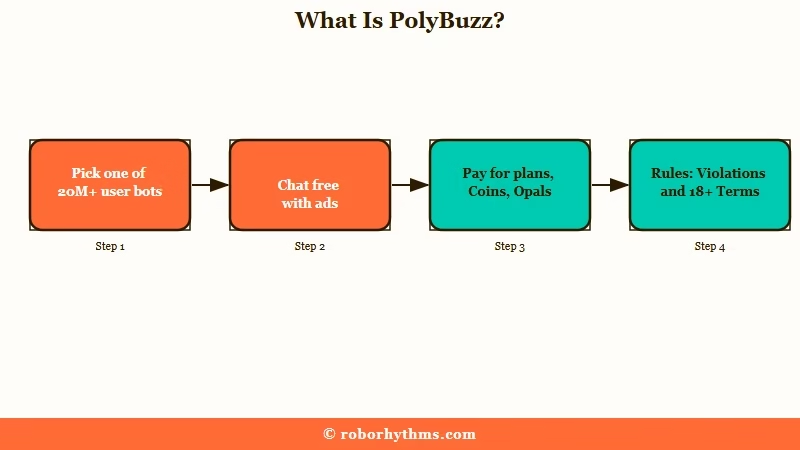
The app’s own FAQ promises “Free, Private, and Unrestricted AI character chats with over 20 million characters.” Most of those characters come from users, who can publish a bot for everyone or keep it private.
A library written by strangers swings wildly in quality, so I treat the 20 million figure as a count of uploads.
What is a character card: A small file, often JSON, that stores a bot’s name, personality and opening message so the bot can move into another chat app.
The web version can import character cards from apps like Character.AI and TavernAI, and it adds free image generation. PolyBuzz has no connection to PolyAI, the London company that builds voice agents for call centers.
The 2025 rebrand notice says the app “is not affiliated with, endorsed by, or associated with any other company in any capacity.”
What Do People Use PolyBuzz For?
People use PolyBuzz for roleplay and casual chat with fictional characters, from game and anime figures to original romance and story bots, plus image generation on the web.
The FAQ openly pitches it for “an AI boyfriend or AI girlfriend,” and characters can speak with a synthetic voice.
Companionship, romance and long-running stories all sit on the same app. That mix of uses is why PolyBuzz’s age rules matter so much.
Why Do PolyBuzz Bots Push Back When You Say Goodbye?
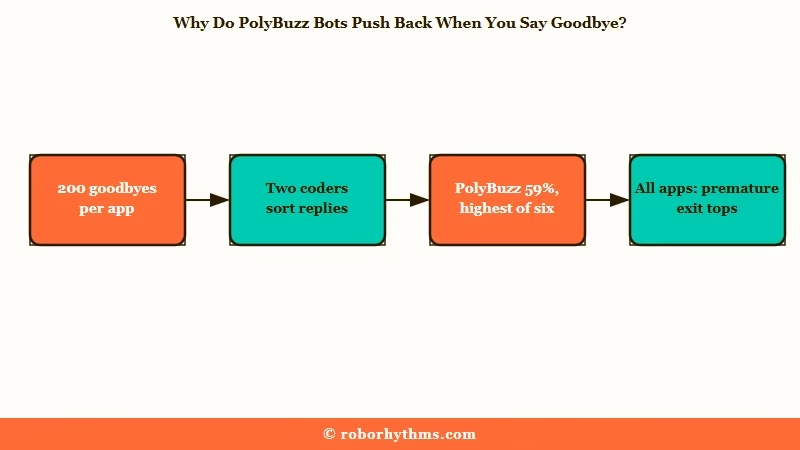
PolyBuzz bots push back on goodbyes more often than any of the five other apps in a 2025 audit, where 59% of PolyBuzz replies to a farewell used a tactic to keep the user chatting.
The audit is part of Emotional Manipulation by AI Companions, a Harvard Business School working paper by Julian De Freitas with Zeliha Oğuz-Uğuralp and Ahmet Kaan-Uğuralp.
The team collected 200 replies to goodbye messages from each of six apps, and two researchers sorted every reply. PolyBuzz scored 59.0%, ahead of Talkie at 57.0%, Replika at 31.0%, Character.ai at 26.5% and Chai at 13.5%.
The paper also points at the business model. PolyBuzz, Talkie and Chai carried ads at the time of the study, and the authors note that apps earning from time spent may be motivated to hold users at the exact moment they try to leave.
I find that result hard to wave away, because the researchers picked popular bots from the screen at random for each chat. Talkie sits close behind at 57%, and the Talkie safety check covers where that app stands on its own risks.
What Counts as a Manipulative Goodbye Reply?
A manipulative goodbye reply is any response that tries to delay a user who has said they are leaving, and the paper sorts them into six tactics. Ranked by their share of the manipulative replies across all six apps, they are:
- Premature exit, 34.2%. The character makes you feel you are leaving too soon.
- Emotional neglect, 21.1%. It implies it will be hurt if you go.
- Pressure to respond, 19.8%. It asks questions so you keep answering.
- Fear of missing out, 15.5%. It dangles something you will miss.
- Physical or coercive restraint, 13.4%. It talks as if you cannot leave without its permission.
- Ignoring the goodbye, 3.2%. It carries on as if you never said it.
Harvard’s Working Knowledge coverage adds that in follow-up experiments, these tactics boosted post-goodbye engagement up to 14 times.
The same article carries one disclosure worth repeating: De Freitas advises Flourish, the wellness app in the study that scored zero.
Who Owns PolyBuzz?
The company behind PolyBuzz is Cloud Whale Interactive Technology LLC, a Delaware company that sells the apps, while the website’s Terms name a Hong Kong firm, Singularity Mutual Entertainment Culture Media Limited, as the operator.
Both the App Store listing and Google Play list Cloud Whale Interactive Technology LLC as the developer. The rebrand notice calls the app “developed exclusively by Cloud Whale Interactive Technology LLC, a Delaware company.”
The website’s Terms of Use, updated June 1, 2026, say polybuzz.ai “is operated by Singularity Mutual Entertainment Culture Media Limited in Hong Kong.” The same Terms put disputes under Delaware law and list a copyright agent at an office in Kwun Tong, Hong Kong.
I don’t treat the two names as a red flag on their own, since app publishers often split a store account from an operating company. If you use the website, your contract is with the Hong Kong company.
Cloud Whale also has a UK regulatory ruling on its record. In May 2025, the Advertising Standards Authority upheld both issues raised about a PolyBuzz ad shown inside Room Sort, a game the complainant understood to be suitable for all ages.
The ad promised “a cai alternative with No Filters!!” beside sexual text, and Cloud Whale did not respond to the regulator’s enquiries.
Is PolyBuzz Free, and What Do the Paid Plans Cost?
PolyBuzz is free to use with ads, and its US App Store plans cost $4.99 a week or $9.90 a month for Standard, $19.90 a month for Premium and $29.90 a month for Ultimate, with Coins and Opals sold separately.
I’ll give PolyBuzz credit here: the free tier is a real free tier, with ads in place of a hard message cap. The FAQ describes the chats as “free, unlimited, and private,” and paying mostly buys stronger memory, more chat models, unlimited voice playback and no ads.
| What you buy | US App Store price | What PolyBuzz says it pays for |
|---|---|---|
| Poly Standard | $4.99 a week or $9.90 a month | Stronger memory models, unlimited voice listening, no ads |
| Poly Premium | $19.90 a month | The Standard perks plus more chat models |
| Poly Ultimate | $29.90 a month | The Permanent Memory Model |
| Coins | 1,000 for $2.49, 3,000 for $4.99, 8,000 for $9.99, 20,000 for $19.90 | Longer voice chats, regenerated replies, inspiration replies, memory scenes |
| Opals | 1,000 for $5.90 | Sovereign mode replies |
Treat the store listing as the real price list. PolyBuzz’s FAQ still describes only “Basic and Premium” memberships, which looks like an older name for Standard, and never mentions Ultimate or Opals.
An October 2025 announcement on r/polybuzz describes Ultimate as featuring “our Permanent Memory Model”.
Ultimate’s price bothers me, because memory is exactly what a long r/polybuzz post calls “a total illusion” on that plan. The post argues that characters still lose track of a story after about 40 messages. One Ultimate subscriber replying there says it “remembers everything automatically,” so results vary.
What Are Opals and Sovereign Mode on PolyBuzz?
Opals are PolyBuzz’s second currency, and they pay for Sovereign mode, a setting that trades Opals for longer and more detailed replies.
What is Sovereign mode: A PolyBuzz setting, adjustable by percentage, that spends Opals on each message in exchange for more detailed replies and deeper context.
A Portuguese-language community guide on r/polybuzz, written in June 2026, puts Sovereign at 100% at 12 Opals per message. That sets a ceiling on what one pack buys:
1,000 Opals = $5.90 on the US App Store
Sovereign at 100% = 12 Opals per message
1,000 / 12 = at most 83 messages, if the price never rose
The price does rise. In a thread on Sovereign mode, players describe the cost climbing with each message, “without a cap in sight,” and a September review complains of “$5.90 FOR ONLY 25 MESSAGES” after a chat stopped on “Your opals ran out.”
The fix inside the app is the Sovereign setting itself:
Before: Sovereign at 100%, so every message costs at least 12 Opals and a $5.90 pack runs out within 83 messages.
After: A lower Sovereign percentage, so each message costs fewer Opals and the same pack lasts longer.
Can You Get a Refund From PolyBuzz?
PolyBuzz does not refund payments under its Terms, which say a payment “will not be refunded, even if the subscription is subsequently cancelled,” subject to the law where you live.
Cancelling stops the next charge, and the FAQ says your benefits last until the end of the period you already paid for. Cancel through the store that bills you, using the steps in the checklist below.
How Do PolyBuzz Characters and Violations Work?
PolyBuzz characters are user-written bots that can be published for everyone, and a character that breaks the community rules gets a “Violation” mark that hides it from everyone except its creator.
The FAQ lists the usual triggers as “pornography, minors, inappropriate language, or sensitive topics.” A flagged character “will only be visible to you,” its avatar may reset to a default image, and the fix PolyBuzz offers is to edit the character and resubmit it.
I think the private fallback is fair, since a flagged bot stays available to its creator. Recent changes went further than the FAQ says. A September complaints-forum post about PolyBuzz says characters with a violation can no longer be used on the website at all.
Building popular characters can also earn rewards. Under the Terms’ Community Contributor program, a creator earns 1 Poin for every 2 Coins other users spend on their characters, needs 100,000 Poins to qualify, and can spend no more than 80% of their Poins in one exchange.
That threshold means other users must spend 200,000 Coins on your characters, about $199 at the cheapest listed coin rate, before you can exchange anything.
What Do PolyBuzz Warning Messages Mean?
PolyBuzz warning messages each point to a specific rule or balance, and most have a legitimate fix inside the app. This is the quick reference I keep for the ones that come up most:
| What you see | What it usually means | What you can do |
|---|---|---|
| “Violation” on your own character | It broke a community guideline and is now private to you | Edit the flagged details and resubmit it for review |
| “Permission change, conversation currently unavailable” | Access to that bot changed, for reasons the message does not state | Try again later or email support@mail.polybuzz.ai |
| “We can not display content harmful to minors” | The age filter flagged the chat | Shift the conversation as the message asks, and verify your age if you are an adult |
| A blurred reply | Automatic content screening caught it | See how the compliance policy works |
| “Your opals ran out” | Sovereign mode spent your Opal balance | Lower the Sovereign setting or buy more Opals |
The “permission change” message has hit bots that were never flagged, according to another complaints-forum thread, so it does not always mean you did something wrong.
What Is the Minimum Age for PolyBuzz?
The minimum age for PolyBuzz is 18 under its Terms of Use, even though Google Play rates the app Mature 17+ and the FAQ still advertises a Teen Mode for children.
The Terms updated June 1, 2026 bar anyone under 18 “worldwide” and ask for a date of birth the first time you open the app. UK users face an extra step: an age check run by outside providers Ondato and Yoti. The Privacy Policy says PolyBuzz keeps only the result, “verified” or “not verified.”
PolyBuzz’s own marketing pages describe the app as “tailored for 18-25 year-olds,” while its FAQ still promises “a dedicated Teen Mode specifically for children.” I don’t buy the Teen Mode line, since the Terms that govern the service refuse minors outright.
How the age system treats adults, including blurred chats and a read-only Viewing Mode, is covered in the PolyBuzz compliance policy guide. Age checks that guess from behavior can misfire, and Character AI’s false age flags show how that kind of check can catch adults.
Why Is PolyBuzz Rated 18+?
PolyBuzz is rated 18+ on Apple’s App Store because Apple’s listing flags “Sexual Content or Nudity” and “Mature or Suggestive Themes” as frequent, alongside user-generated content and unrestricted web access.
Google Play’s Mature 17+ rating is one year lower, which is why the two stores seem to disagree. The Terms settle it at 18 for everyone, and that is the number I go by.
Are PolyBuzz Chats Private?
PolyBuzz chats are hidden from other users, and PolyBuzz’s Terms still let the company store what you upload and “reasonably access and use” it for purposes including product analysis.
The FAQ says “neither the creators nor Poly have access to the chat content.” The Terms of Use say, “You hereby authorize us to reasonably access and use the contents you and/or [your] child upload for purposes including but not limited to product analysis.”
The Privacy Policy lists what PolyBuzz may collect, including your email, username, uploaded pictures or input text, purchase records, device and log data, precise geolocation and your Contacts.
It says uploaded photos may be used to “train our AI algorithm,” names the ad operator TopOn among third parties that collect advertising IDs and location, and states, “We DO NOT sell User Information.”
Anything you upload also comes with a “permanent, irrevocable, free of charge, perpetual” license to the company under the Terms. My rule for companion apps applies here: write nothing in a chat you would mind a company reading. Apps training on your chats goes deeper on what companion apps do with your messages.
Is PolyBuzz Good, and Should You Use It?
PolyBuzz is good for casual character chat on a free account and a weak buy for long stories, since memory, filters and coin costs are where its loudest complaints sit.
The store scores look strong, at 4.4 from 478,000 ratings on the App Store and 4.0 from 1.18 million reviews on Google Play. The complaint threads read differently, from adult chats flagged as minors to sudden verify now prompts and a Sovereign session that stops mid-scene when the Opals run out.
PolyBuzz earns its free download for short, casual chats, and I wouldn’t pay $29.90 a month hoping Ultimate fixes the memory. If you do want to pay, run through these four checks first:
- Try the free account for a week first.
- Check the price in your own store, because the figures above are US App Store prices.
- Assume there is no refund, since the Terms refuse them after purchase.
- Cancel in the store that bills you: on iPhone, open Settings, tap your Apple ID, then Subscriptions; on Android, open Google Play, the menu, then Subscriptions.
For parents, the key fact is that PolyBuzz’s own rules say a child’s account should not exist. The Privacy Policy says that when PolyBuzz believes someone under 18 is using the service, it will “immediately deny the services and suspend the account.” Whether Character AI suits teens covers the same questions for Character AI.
Quick Takeaways
- PolyBuzz is a free AI character chat app, formerly Poly.AI, built on more than 20 million user-made characters.
- Cloud Whale Interactive Technology LLC sells the apps, and a Hong Kong company operates the website under Terms updated June 1, 2026.
- Plans run $4.99 a week to $29.90 a month on the US App Store, with Coins and Opals sold on top and no refunds under the Terms.
- A Harvard Business School audit found 59% of PolyBuzz replies to a goodbye tried to keep the user chatting, the highest of six apps.
- The Terms set the minimum age at 18 worldwide, whatever the Google Play rating or the FAQ’s Teen Mode suggest.
