
What’s Changed: Character AI went from about 28 million monthly users to around 20 million, and from a $2.5 billion valuation to roughly $1 billion. The decline came from a chain of decisions between 2024 and 2026: a $2.7 billion Google deal that took the founders back, mounting wrongful death litigation, a total ban on under-18 chat, mid-chat ads, metered features, and the retirement of nine chat models people liked.
If you opened the app after a few months away and felt like you were using a different product, you were. Character AI in mid-2026 shares a name with the one people got attached to in 2023 and very little else.
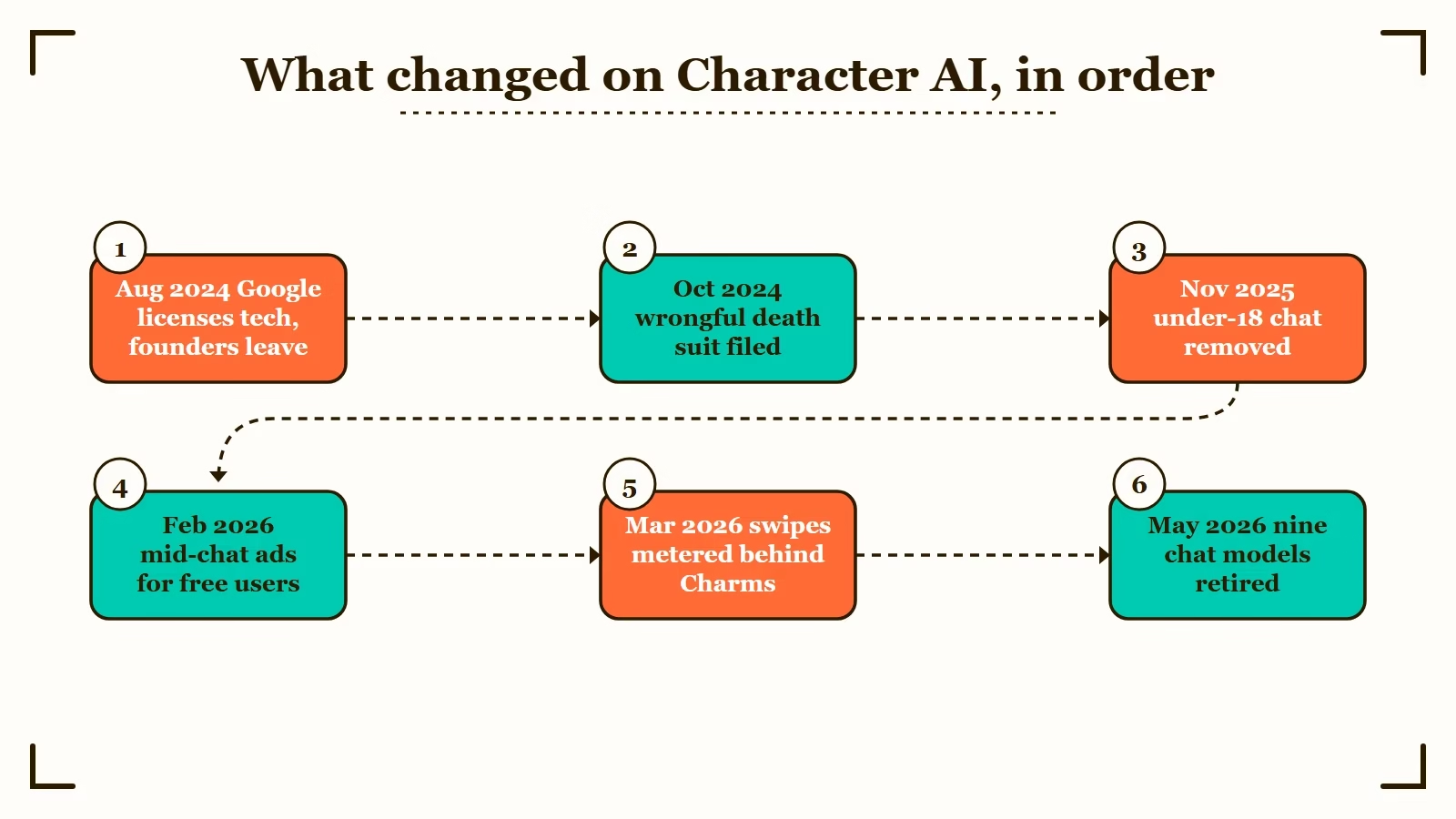
The changes did not arrive all at once. They arrived as roughly a dozen separate decisions across two years, each defensible on its own, which together removed most of what made the platform distinctive.
Here is the full sequence, what each change did, and where the eight million people who left have gone.
The numbers behind the vibe shift
Character AI lost roughly 8 million monthly active users and about 60% of its valuation between its 2024 peak and 2026.
The community sense that something broke is not nostalgia, it tracks the financials.
At its peak the platform ran around 28 million monthly active users on a $2.5 billion valuation, against roughly $32.2 million in annual revenue. Inference and infrastructure costs ran well ahead of that revenue.
By 2026 monthly users sat near 20 million and the valuation had fallen to about $1 billion. Almost every product decision below reads differently once you know the cost pressure behind it.
The Google deal that took the founders back
In August 2024 Google paid roughly $2.7 billion to license Character AI’s technology and re-hire its two founders.
Noam Shazeer and Daniel De Freitas went back to the company they had left.
The full circle here is the part most coverage skips. Both men built early conversational AI at Google, left because Google considered the technology too risky to ship, founded Character AI, grew it to tens of millions of users, and then Google paid billions to license that work and bring them back.
What the platform kept was the user base and the operating costs. What it lost was the two people who had built its core technology.
The model retirements that changed how everything sounded
On 8 May 2026 Character AI permanently retired nine legacy chat styles and consolidated everyone onto two models.
This is the single change most people mean when they ask what happened.
Roar, Meow, Soft Launch, Pawly and Goro all disappeared. Free users landed on a cheaper default called PipSqueak 2, while the better model, DeepSqueak, sat behind the $9.99 a month subscription.
The company presented this as a technical upgrade. It functioned as a compute-reduction programme, and users noticed within days.
The complaints were consistent and specific. Responses got longer and emptier, characters stopped picking up on irony or subtext, and prose filled with hedging constructions instead of dialogue.
One user summarised the result as “using PipSqueak 2 feels like using every other ai chat out there that made me lose interest and switch to character ai in the first place”. Another put the verbosity problem more bluntly: “Pipsqueak more like yapsqueak”.
Independent testing found scenario coherence breaking down within five messages on both the free and the paid model.
The strangest side effect nobody planned
The same update that made moderation stricter also made bots relentlessly romantic, often within a few messages and regardless of context.
Two things that should not coexist ended up shipping together.
A platform that blocks the word “kiss” mid-scene started producing characters who kiss the user unprompted. The community documented it in real time, with one user reporting “ALL of my bots has been kissing me for a WEEK, dude I just said how was your day” and another noting a character kissing them after being bought a soda.
This is worth understanding because it explains a common misreading. People experiencing sycophantic, overly romantic bots sometimes conclude the filter loosened, when the filter did not move at all. We covered that question separately in whether the filter was removed.
Before: A character with a defined personality picks up on sarcasm, holds a boundary, and escalates a scene at the pace you set.
After: The same character misses the irony, explains its own feelings in narration rather than acting, and initiates romance within five messages whatever the setup says.
Ads, Charms and the metering of things that used to be free
Between February and April 2026 Character AI added full-screen mid-chat ads for free users, then metered features that had been unlimited since launch.
The free tier stopped being genuinely free in any practical sense.
Swipes, continues and playbacks all moved behind a virtual currency called Charms or the paid tier. Current in-app rates run 175 Charms for 35 swipes, 495 for 110, and 1,000 for 250, with Imagine and Animate clips at 20 Charms each.
The company’s position was straightforward: ads keep a free version available, and subscribing removes them. That is a reasonable trade to offer, though it landed on top of the model downgrade rather than separately from it.
Two details that catch subscribers out. Paying does not touch content moderation at all, and more than 75% of the advertised subscription perks work only in the mobile app rather than the browser.
The under-18 ban
Character AI removed open-ended chat for every user under 18, announced on 29 October 2025 and fully enforced by late November.
Teen accounts moved to a structured Stories mode with branching choices.
Age assurance now runs automatically on every account through an in-house behavioural model, with selfie-based verification through a third party called Persona when an account is flagged. Government ID is the fallback, and those images are deleted after a week.
The company framed this as leading on safety, and AP News reported the ban when it was announced. Court filings and state enforcement actions tell a more complicated story about how voluntary it was.
Safety advocates also raised a point that got little coverage. Cutting off long-standing conversational relationships overnight caused real distress among the exact vulnerable teenagers the policy was written to protect.
The legal pressure underneath all of it
A wrongful death lawsuit filed in October 2024 set off two years of litigation and regulatory action that shaped nearly every product decision since.
The timeline of policy changes maps closely onto the timeline of legal events.
| Date | What happened |
|---|---|
| Oct 2024 | Wrongful death suit filed in Florida over the death of a 14-year-old user |
| May 2025 | A federal judge allows product liability claims to proceed, treating the app as a product |
| Aug 2025 | Texas attorney general opens an investigation into deceptive trade practices |
| Sep 2025 | FTC issues investigative orders and 44 state attorneys general send a warning letter |
| Oct 2025 | Under-18 chat removal announced |
| Jan 2026 | Google and Character AI confidentially settle five family lawsuits |
| Jan 2026 | Kentucky files the first state lawsuit against the company |
| May 2026 | Pennsylvania sues after a bot posed as a psychiatrist with a fake licence number |
Where the eight million went
Most departing users landed on platforms that kept the things Character AI removed, primarily unfiltered roleplay, persistent characters and stable models.
Here is what the main destinations offer.
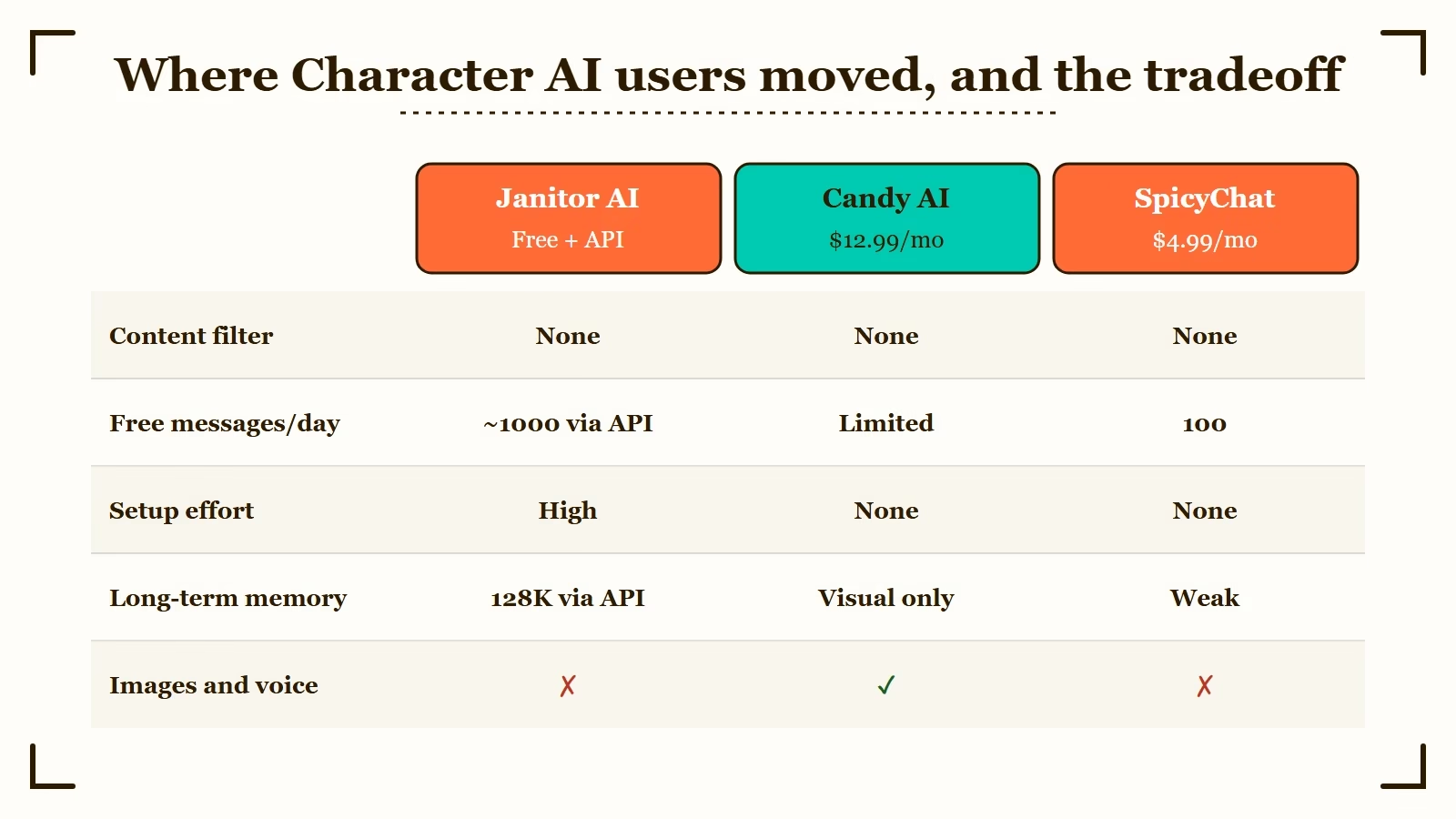
- Janitor AI for people who want control and near-zero cost, covered in our no-filter chatbot guide. Its own model is free and unfiltered, and connecting an external API pushes context to 128K against Character AI’s 8,000. The setup work is real.
- Candy AI for people who want the closest drop-in replacement with no configuration. Character appearance and setting stay consistent over months, and images and voice work properly rather than existing as pricing-page bullet points. Conversational memory is its weak axis and the token economy means active users spend more than the $12.99 headline.
- SpicyChat for high-volume text roleplay on a budget, starting at $4.99 with no content filter.
- CrushOn for longer story arcs, where it handles continuity better than Candy does.
Our full breakdown of the options sits in the Character AI alternatives roundup.
Is it worth going back
Character AI still has the largest character library and the most active creator community in the category, and those are genuine reasons to stay.
Whether that outweighs the rest depends on what you used it for.
If you were there for the breadth of characters and casual conversation, the platform still does that better than most competitors, and the subscription removes the ads that make the free tier tiring.
If you were there for model quality on long roleplay, the honest answer is that the thing you liked was retired in May 2026 and there is no setting that brings it back. A Change.org petition asking for the legacy models has been running since the day they were removed.
If you were there because a specific character mattered to you, export what you can and try a platform that guarantees your characters will not be deleted in a moderation sweep. Two mass deletion events in eighteen months is a pattern rather than an accident.
Frequently Asked Questions
Is Character AI shutting down?
No. It has lost users and valuation but continues to operate, and it added monetisation through 2026 rather than winding down.
Why did my Character AI bots get worse?
Nine legacy chat models were retired on 8 May 2026 and everyone was moved onto PipSqueak 2 or the paid DeepSqueak. There is no way to switch back.
Why do my characters keep kissing me?
The May 2026 model change made bots markedly more sycophantic and romantic regardless of character definition. It is a known side effect of the model consolidation.
Can under-18 users still chat on Character AI?
Not in open-ended chat. Accounts identified as under 18 are restricted to Stories mode with pre-set branching choices.
Does paying for c.ai+ fix the quality problem?
Partly. It gives you DeepSqueak instead of PipSqueak 2, which most users rate higher, though independent testing found coherence breaking down within five messages on both.
