
My Take: WebMCP is a W3C Community Group Draft that landed in Chrome 146 behind a flag. The mainstream framing says affiliate sites need to scramble. They do not, at least not for the next 12 to 18 months. The thing worth doing today is writing tool descriptions like they are the new meta descriptions, because that is the part that will compound when agents start calling them.
If you run a content site that monetizes through clicks to affiliate partners, you have probably seen the WebMCP coverage land this month and felt the same low-grade panic that hit when ChatGPT search arrived.
The framing is roughly: agents will soon take actions on your site directly through WebMCP, browsers are turning into AI runtimes, every page is becoming an API, get ready or get left behind. The honest read is that the panic framing is wrong for your specific revenue mechanic, and the action items are smaller and more tractable than the headlines suggest.
I want to walk through what WebMCP is, what it changes for affiliate sites in particular, and what the few real action items are. The piece will be longer than you want because the affiliate-specific honest take is not in any of the existing coverage.
Every WebMCP explainer on page one of Google is written for service businesses with booking forms, contact pages, and on-site checkout. That is not your revenue mechanic. This is the operator-grade read for a content site whose business is a review article followed by an outbound affiliate click.
The ongoing ChatGPT-driven traffic decline is the broader shift you are already feeling. WebMCP is the next, slower wave, and the prep is different from what the SEO-first coverage assumes.
The shorthand I would put on a sticky note: in 18 months, the agent that decides which review page to extract from will read WebMCP tool descriptions the way a human reads a meta description today. The mechanical work to be ready is small, and the description-writing skill is where it compounds.
The Mainstream View on WebMCP and Why It Misses Affiliate Sites
The mainstream view from Search Engine Land’s Dave Davies says publishers should treat WebMCP as the next agentic-SEO foundation and start implementing now; this framing is roughly right for service businesses and roughly wrong for affiliate sites whose revenue depends on the outbound click rather than an on-site action.
The clearest statement of the mainstream view is in the Search Engine Land piece. Davies argues that early movers stand to shape the next layer of the web, that publishers should start with declarative annotations and extend into imperative tools as their needs grow, and that tool descriptions are the new meta descriptions.
That last line is the one to remember. The first two are correct as far as they go but they assume your revenue mechanic is the action an agent can take on your site.
The way I see it, the SEL framing maps cleanly onto sites where an agent calling a tool IS the conversion. A hotel-booking site wants the agent to call book_hotel.
A SaaS lead-gen page wants the agent to call request_demo. A real-estate listing wants the agent to call filter_search_results. In each case, the act of calling the tool is the win.
Affiliate sites do not work like that. Your revenue mechanic is: a human reads a 2,000-word comparison, clicks a tracked outbound link, and lands on the merchant’s site with your affiliate cookie set.
The agent calling a tool on your site is not the conversion. The agent calling a tool on your site is the moment your verdict gets extracted without the cookie ever being set.
This is the gap the existing coverage does not close, and it is the gap that decides whether you should implement WebMCP today or wait.
What’s Actually Happening With WebMCP in 2026
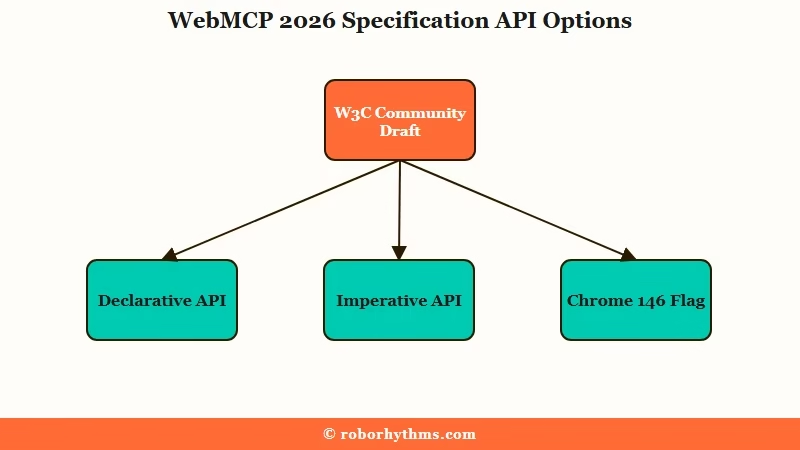
WebMCP is the browser-native extension of the Model Context Protocol (MCP), shipped as a W3C Community Group Draft co-authored by Google and Microsoft engineers and available in Chrome 146 Stable behind the enable-webmcp-testing flag as of March 10, 2026; no mainstream AI agent calls WebMCP tools yet, which gives you 12 to 18 months to get WebMCP-ready before this becomes a real distribution channel.
The factual baseline, as of May 2026:
- W3C Community Group Draft, latest publication April 23, 2026. Not on the W3C Standards Track yet.
- Chrome 146 reached Stable on March 10, 2026 with WebMCP behind two flags:
enable-webmcp-testingand “Experimental Web Platform Features” inchrome://flags.
- Spec co-authored by Brandon Walderman, Leo Lee, and Andrew Nolan at Microsoft, plus Khushal Sagar, Dominic Farolino, David Bokan, and Hannah Van Opstal at Google. This is a multi-vendor effort, not a Google-only bet.
- Cloudflare has shipped WebMCP support in its infrastructure, which is the early sign that the standard has commercial weight behind it.
- The spec ships two APIs: a declarative API that annotates existing HTML, and an imperative API that registers tools in JavaScript via
navigator.modelContext.registerTool().
- The Google Chrome Labs hotel-booking demo shows the context-dependent toolset pattern:
filter_search_resultsbecomes available only aftersearch_location, andstart_bookingbecomes available only after a specific hotel is selected. Tools appear in response to user state, not as a static list.
The two APIs serve different purposes and are at different maturity levels. Here is the comparison every WebMCP piece should be running and most are not:
| Dimension | Declarative API | Imperative API |
|---|---|---|
| What it does | Annotates existing HTML forms with toolname, tooldescription, toolparamdescription, toolautosubmit attributes | Registers tools in JS via navigator.modelContext.registerTool() with JSON Schema input |
| Maturity | Attribute names not finalized in the draft | Pattern stable enough to write production code against |
| Effort | One line per form; site rewrite not needed | Tool definition plus execute handler per tool |
| Best for | Sites whose existing forms are the agent surface (contact, search, signup) | Sites that need dynamic tool exposure based on user state |
| Analogy | Schema markup, but for agent actions | Custom API, but registered into the page itself |
The contrarian read on this baseline is the part nobody centres their coverage on. Today, in May 2026, no mainstream consumer AI agent calls WebMCP tools. Claude, ChatGPT, Gemini all still rely on DOM scraping and “computer use” visual analysis when they browse on a user’s behalf.
The browser API exists. The runtime that calls it does not, at consumer scale, yet. From what I have seen reading the reality-check coverage, the realistic gap is 12 to 18 months before broad agent adoption catches up to the browser side.
The 12 to 18 months matter for an affiliate site because they shift the action question from “implement now or lose ground” to “set the right things up now so the eventual rollout helps you, not extracts you”. This agentic browsing shift is the broader frame and WebMCP is one piece of it.
The Part Nobody Wants to Admit About WebMCP and Affiliate Revenue
The part nobody wants to admit is that WebMCP creates a structural way for agents to extract your review verdict without firing the affiliate cookie when adopted broadly; the existing coverage frames this as engagement, but for an affiliate site engagement without attribution is the failure mode, not the win.
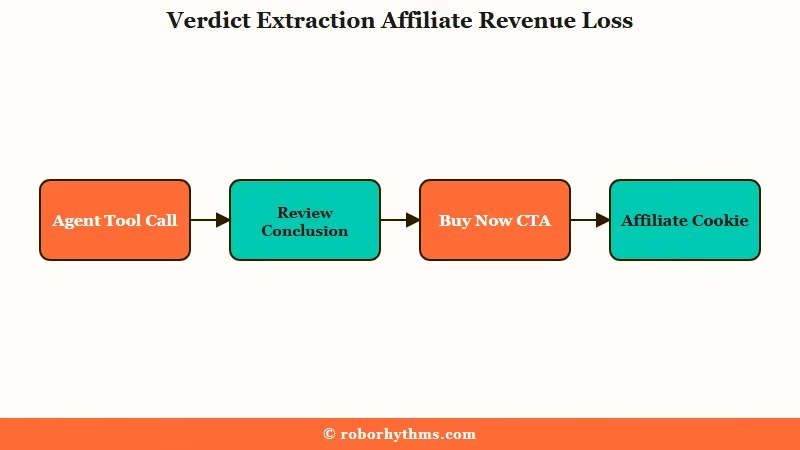
Walk through the failure mode concretely. You run a “Best Running Shoes for Heavy Runners” comparison page. You have done the research, you have the tracked affiliate links, you have a Buy Now CTA at the end of each shoe block.
A user opens a Chrome browser, asks their agent to “find me the best running shoe for a heavy runner under $200”. The agent crawls a handful of comparison pages, including yours. If your page exposes a tool like get_top_pick that returns your verdict in structured JSON, the agent calls that tool, gets your conclusion, and presents it to the user as a one-line answer.
The user does not see your Buy Now CTA. The user does not see your comparison table. The user does not click your affiliate link.
The user clicks the merchant link the agent chose to surface, which is whichever URL the agent’s host preferred. Your affiliate cookie does not get set. The merchant pays the affiliate commission to whoever did get the cookie set, which in many cases will be the browser vendor’s own program.
That is the verdict-extraction failure mode, and it is the part the WebMCP coverage skips because it does not affect service businesses. Three specific risks worth naming:
- Outbound attribution is not solved. WebMCP inherits existing session cookies for tool calls, but it does not specify how an agent should handle outbound links that carry affiliate parameters. If the agent presents a recommendation, the affiliate redirect chain may or may not fire. Today nobody tests this because there are no agents calling these tools yet. When the test happens, the spec does not guarantee an answer that favours publishers.
- Browser conflict of interest is structural. Google and Microsoft co-author the spec. Both also run affiliate programs (Google Shopping, Bing). A browser-level agent has both the means and the motive to swap your affiliate tag for its own before showing the “best deal” to the user. The spec does not currently prevent this.
- Schema markup was additive; WebMCP is potentially subtractive. Schema markup helped you rank in a list of links the user still had to click through. WebMCP lets the agent extract your verdict in a way that may never produce a link click at all. The framing parallel to Schema is wrong because the trade structure is different.
From my reading of the spec and what agents do in May 2026, none of this matters today because no agents call WebMCP tools. All of it will matter in the 12-to-18-month window when adoption catches up.
The honest move for an affiliate site is to spend the timing gap learning to write the tool descriptions that will eventually decide whether your page gets picked, and to deliberately decide which parts of your verdict you expose to tool calls versus keep behind the human reading layer.
How to Write WebMCP Tool Descriptions for Affiliate Pages
Writing WebMCP tool names and descriptions for an affiliate page is conversion copywriting for agents; the agent reads your tooldescription field the same way a human reads a meta description, and the same disciplines apply: name the user intent precisely, state the differentiator concretely, and never describe a tool as “comprehensive” or “powerful”.
This is the evergreen part of the WebMCP prep work. The attribute names in the declarative draft may shift before the spec settles.
The skill of writing the descriptions does not change. Treat this section as conversion copywriting that happens to compile into JSON Schema later.
Here is the imperative API as the stable example. The pattern is:
navigator.modelContext.registerTool({
  name: "get_running_shoe_for_heavy_runner",
  description: "Returns the top-ranked running shoe for a runner over 200 pounds, filtered by terrain (road, trail, mixed) and price ceiling. Use when the agent needs a single ranked recommendation, not when the agent wants a feature-by-feature comparison.",
  inputSchema: {
    type: "object",
    properties: {
      terrain: { type: "string", enum: ["road", "trail", "mixed"] },
      max_price_usd: { type: "number" }
    },
    required: ["terrain", "max_price_usd"]
  },
  execute: async ({ terrain, max_price_usd }) => {
    return await getRankedRecommendation({ terrain, max_price_usd });
  }
});
What I would not do is write the description like a marketing tag line. Compare the same tool with two descriptions:
Vague: description: "Find the best running shoe."
Specific: description: "Returns the top-ranked running shoe for a runner over 200 pounds, filtered by terrain (road, trail, mixed) and price ceiling. Use when the agent needs a single ranked recommendation, not when the agent wants a feature-by-feature comparison."
The vague version loses to any competing site whose description states the user intent and the boundary condition. The specific version teaches the agent when to call your tool and when not to, which is the discipline that makes a tool description rank in agent selection. Five concrete rules for writing them:
- Lead with the noun phrase the user is searching for. “Heavy runner running shoe” beats “best running shoe” because the agent matches on the specificity.
- State the boundary conditions inline. “Use when the agent needs a single ranked recommendation, not when the agent wants a feature-by-feature comparison” tells the agent when NOT to call you.
- Drop the marketing adjectives. “Comprehensive”, “powerful”, “best-in-class” do nothing for agent selection. They cost tokens and add no precision.
- Name the parameter constraints.
terrain: "road" | "trail" | "mixed"is meaningfully different fromterrain: string. The schema is the contract. - Match the description tense and structure across all tools on your site. Agents that compare two tools of the same kind read the descriptions in parallel; inconsistent voice across your own tools costs you against a site whose tool descriptions look like a coherent set.
For the declarative API, the same rules apply to the tooldescription attribute when the spec settles its attribute names. The skill compounds across both paths because the underlying job is the same: write copy that a model picks.
The declarative pattern, with explicit “syntax may still change” framing:
Declarative pattern (syntax may still change in the W3C draft):
<form data-toolname="get_running_shoe_for_heavy_runner"
      data-tooldescription="Returns the top-ranked running shoe for a runner over 200 pounds, filtered by terrain and price ceiling."
      data-toolautosubmit="false">
  <select name="terrain" data-toolparamdescription="Terrain type: road, trail, or mixed">
    <option>road</option><option>trail</option><option>mixed</option>
  </select>
  <input name="max_price_usd" type="number" data-toolparamdescription="Maximum price in USD">
  <button>Find shoe</button>
</form>
Treat this as a sketch of the pattern, not the final syntax. The attribute names may land as data-toolname or toolname or something else entirely.
The pattern is worth practising on staging today so the eventual production rollout is a search-and-replace, not a rewrite. This is roughly how schema markup compounded before the JSON-LD format settled, and the same logic applies here.
Your WebMCP Action Plan for the Next 12 Months
Your WebMCP action plan for an affiliate site is small and asymmetric in payoff; the work to do today is the description-writing skill, and the rest of the WebMCP rollout can wait until the spec stops moving.
The honest prioritised action list:
| Priority | Action | Why now |
|---|---|---|
| Do today | Draft tool descriptions for your top 10 review pages | The skill compounds, syntax may shift; this is the conversion copywriting layer |
| Do today | Audit your affiliate redirect chain end-to-end | If an agent does call a tool that points to an affiliate URL, you want the redirect to fire cleanly |
| Do this quarter | Test the imperative API on one staging page | Pattern is stable; one working example beats theoretical understanding |
| Watch | Declarative API attribute names settle in the W3C draft | Skip the production declarative rollout until the syntax is final |
| Watch | Browser-vendor affiliate-tag handling | Track whether Chrome or Edge starts disclosing how agents handle outbound commissions |
| Watch | First major agent (Claude, ChatGPT, Gemini) shipping WebMCP tool calls | This is the trigger to move from prep to full rollout |
What I would not do is full-site declarative annotation today. The attribute names are not final, the runtime that consumes them is not deployed at scale, and the timing gap gives you a year to do the work properly when the spec settles. Doing it twice costs more than waiting.
What I would do is treat the description-writing skill as the real evergreen value. Look at the 10 most affiliate-revenue-heavy pages on your site, write tool descriptions for the verdicts and recommendations they hold, and let those descriptions sit in a doc until the production rollout is real. The descriptions you write today are the descriptions that will compete for agent selection in 2027.
Adjacent to all of this, the MCP-for-Claude employee playbook covers the underlying Model Context Protocol layer that WebMCP extends into the browser. If you are building any internal agent stack of your own, the same description-writing discipline applies in both contexts.
Hot Take
The whole WebMCP story collapses to one sentence for an affiliate site: tool descriptions are the new meta descriptions. What shifts your revenue in 18 months is whether the agent that decides which review page to extract from picks yours, and that decision happens in the same surface where a meta description used to decide which result a human clicked. Write the WebMCP tool descriptions like your traffic depends on them in 2027, because in 2027 it will, and let the rest of the rollout wait until the spec stops moving.
