
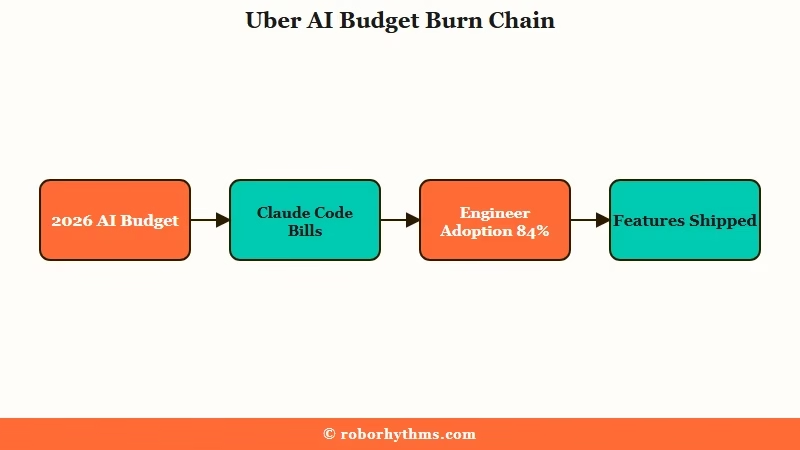
What Happened: Uber COO Andrew Macdonald went on the Rapid Response podcast on May 23, 2026 and called the company’s AI spending a head-exploding moment. The full 2026 AI budget was burned in four months, mostly on Claude Code, and he openly admitted he cannot connect the token consumption growth to actual features shipped.
The most senior executive at a Fortune 100 company just stood up and said the quiet part out loud about AI spending. Andrew Macdonald, the president and COO of Uber, told the Rapid Response podcast that watching his engineering organization burn through the entire 2026 AI budget by April was a head-exploding moment. He then admitted he cannot draw a line from the rising token bills to a corresponding rise in features shipped to riders and drivers.
That admission landed in late May 2026 across Fortune, Yahoo Finance, Cybernews and Breitbart, and the story trended across the AI community within a day. The reason it hit so hard is that everyone working with paid AI tools recognized the situation. The math that worked at the old per-seat SaaS pricing does not work when the bill is a function of how many tokens each engineer chooses to spend.
This article walks through what Macdonald said in the interview, why per-token pricing breaks every budget model built for the cloud era, and what an indie operator or small team can do today to avoid a smaller-scale version of the same burn.

What Did Uber’s COO Say On The Rapid Response Podcast?
Uber’s COO Andrew Macdonald told the Rapid Response podcast he cannot link Claude Code token consumption to new shipped features.
His exact quote:
“That link is not there yet, right? I think maybe implicitly there is more that is getting shipped, but it’s very hard to draw a line between one of those stats and, okay, now we’re producing 25 percent more useful consumer features.”
That quote arrived alongside CTO Praveen Neppalli Naga’s earlier admission that he is back to the drawing board because the AI budget he thought he would need is already blown.
The way I read the two statements together, this is a coordinated walk-back of the engineering productivity story Uber told the market in March 2026, when 84 percent of engineers were classified as agentic coding users and 70 percent of committed code was AI-generated.
Fortune covered the COO quote on May 26, with Cybernews and Breitbart picking it up the next day. The numbers behind the burn are equally specific. Individual engineer Claude Code bills landed in the $500 to $2,000 per month range, with Naga himself reportedly spending $1,200 in a two-hour personal demo of the tool.
Uber rolled out AI access to its full 5,000-engineer organization in December 2025, and 11 percent of live backend updates at the company are now being written by AI agents with no human in the loop. The productivity is real. The budget arithmetic is broken.
The earlier framing of how Anthropic is winning enterprise AI procurement is covered in Claude overtaking ChatGPT in business, which used the same Uber engineer adoption curve as proof point. The May 2026 update from Macdonald is what happens when the next budget meeting hits.
Why The Per-Token Pricing Model Breaks Enterprise Budgets
Per-token pricing breaks enterprise budgets because the bill scales with engineer behavior, not headcount.
Traditional SaaS forecasting multiplies seats by per-seat price and adds a forecasting buffer. Agentic AI tools throw out the seat assumption entirely, because a single engineer running Claude Code as an autonomous agent can consume thousands of dollars of tokens in one afternoon session.
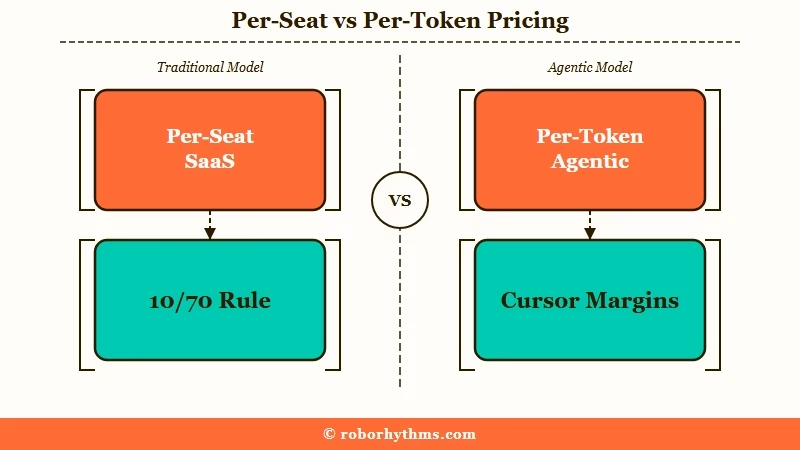
From what I have seen running paid AI tools on my own work, the pattern compounds in a way that finance teams do not yet model. The Product Curious analysis of the Uber burn called it the 10/70 rule of mature AI deployments: 10 percent of users generate 60 to 75 percent of all tokens consumed.
That handful of engineers running multi-hour, multi-step agents are the ones who blow the model. The other 90 percent look exactly like the conservative per-seat assumption finance built the forecast on.
Cursor’s own numbers tell the same story from the vendor side. The startup reportedly runs about $1 billion in annual revenue at minus 30 percent gross margins, paying roughly $1.30 in API fees to Anthropic and OpenAI for every $1.00 it collects in subscription revenue.
That subsidy cannot continue indefinitely, which means the per-seat plans every AI coding tool currently offers will either reprice to usage-based or push their power users to enterprise contracts with usage caps. The Uber bill is what enterprise customers see before that repricing fully happens. The Cursor margin context is documented in our Cursor review.
A second compounding factor showed up at Meta. Reports of an internal “leaderboard incident” describe employees deliberately leaving agents running with no real task, purely to climb internal AI-usage rankings. Token consumption became a status game inside the company before finance noticed.
| Cost pattern | What it looks like | Why it breaks budgets |
|---|---|---|
| Per-seat assumption | $20 to $200 per engineer per month, flat | Ignores token-scaling behavior of the top 10% of users |
| Agentic burst | $500 to $2,000 per engineer per month | A 10x to 100x range that the spreadsheet cell cannot hold |
| Vendor subsidy expiration | Cursor at minus 30 percent margins today | Re-pricing forces customers into usage-based contracts that match the underlying cost |
| Adoption-metric gaming | Agents left running for hours with no task | Procurement incentives create the spend they were measuring |
| Single-engineer outlier | $1,200 in a two-hour demo | A reasonable demo budget multiplies by team size and frequency |
Why The Macdonald Walk-Back Matters Beyond Uber
The Macdonald statement matters beyond Uber because it is the most senior public admission yet that AI productivity gains are not closing the budget gap.
The Atlan analysis of recent Gartner data shows a 2.5x revenue satisfaction gap between organizations classified as AI leaders versus laggards, with leaders investing at a 1.78x foundations-to-tools ratio.
That means leaders spend roughly 60 percent of the AI budget on data quality and governance and only 40 percent on the models and tools themselves. Uber’s burn pattern suggests the opposite ratio.
The way I see it, McKinsey’s read of the same period is the more important framing because it predicts what comes after the burn. McKinsey treats productivity gains as table stakes that competition will erode within 18 to 24 months.
The real durable value in their model comes from reshaping business workflows and reducing transaction costs, not from saving engineer hours. If McKinsey is right, the engineer-hours-saved math that justified Uber’s 2026 AI budget was always going to flatten, regardless of how clever the underlying models got.
IDC forecasts over $500 billion in 2026 AI-related investments globally, but pairs the number with a buyer behavior shift they call precision over promise. Procurement is asking for ROI quantified at the use-case level instead of accepting platform-wide adoption metrics.
Macdonald going public is what precision over promise sounds like when it reaches the executive level at a Fortune 100. The wider macro on AI capex stress is covered in the AI bubble crash warning.
Uber is not alone in walking back AI-adoption pressure. Duolingo CEO Luis von Ahn publicly admitted that the company had initially pushed employees to use AI in ways that did not fit the actual work, and reversed course toward measurable outcomes. Meta’s leaderboard incident is now an internal cautionary tale.
The pattern across all three is the same. Adoption was set as the metric, the metric got gamed or chased without underlying business impact, and an executive eventually had to stand up and reset.
What This Means For Indie Operators And Small Teams In 2026
Indie operators and small teams should treat per-token AI costs the way they would treat a per-mile delivery cost, not a fixed subscription line.
The mistake Uber made at scale is the same mistake a two-person team makes when they assume a $20 Cursor seat or a $20 Claude Pro subscription will cover serious agentic work. The first time a single autonomous session ramps to thousands of API calls, the cost blows the assumption.
Here is the sequence I would walk through this week if you run on paid AI tools:
- Pull the actual token consumption logs from your primary AI tool (OpenAI dashboard, Anthropic console, Cursor usage page, Claude Code analytics) for the last 30 days.
- Identify the top 10 percent of sessions by token volume. The 10/70 rule says these are eating 60 to 75 percent of your spend.
- Cap those sessions with hard limits. Set a per-task token ceiling, or move them to a cheaper model for the verbose-but-low-value steps.
- Implement a semantic cache layer if your workflow is API-driven. Redis published cache results showing up to 73 percent cost reduction on workloads with high query similarity.
- Re-forecast monthly AI spend at 3x your current month’s actual, not at the per-seat list price. The 3x buffer is what the Uber finance team wishes they had built in March.
For comparison, here is what the same pattern looks like with two example workloads:
Vague: “I’ll keep my Claude Pro subscription at $20 a month and use it for my agent prototype.”
Specific: “I’ll log every Claude API call from the prototype, set a per-run ceiling of $0.50 for routine extractions and $5.00 for full multi-step research runs, and use Sonnet 4.6 instead of Opus 4.7 for any step that is just summarization. Monthly cap on the OpenAI account at $300 with email alerts at $200.”
The specific version sounds bureaucratic for a one-person operation. It is also what stops you from waking up to a $1,200 token bill from a single overnight run.
The same discipline that Uber needed and did not have at 5,000 engineers is what an indie operator needs and rarely has at one engineer. The good news is the controls take an hour to set up and they stick.
The agent-memory architecture context that drives a lot of the token consumption is covered in our agent memory architecture piece. The wider question of whether AI productivity is translating to measurable output is covered in the AI productivity gap piece.
What Comes Next For Uber And The Broader Market
Expect Uber to publicly restructure its 2026 AI budget within the next 60 days with formal token-usage governance.
Macdonald’s framing already telegraphs the move. When a COO says the link is not there yet, the operational next step is to demand a measurable link or cut the spend. The cleanest path is per-team caps on agentic tool usage with mandatory cost-impact justification for anything above the cap.
On the vendor side, watch for Anthropic to introduce more granular usage tiers and Claude Code seat plans with predictable token caps. The current pricing model is unsustainable for both sides.
Anthropic wants enterprise revenue stability and Uber wants budget predictability, and the structure that meets both needs is a usage cap with overage pricing rather than uncapped per-token billing. OpenAI is likely to follow with similar enterprise tiers on the ChatGPT business and Codex product lines.
For the broader Fortune 500, I would expect at least three more public AI-budget walk-backs before Q3 2026. The Duolingo, Meta and now Uber pattern is too consistent for it to be three isolated stories.
The next one is probably already happening inside a CFO Office and will surface the moment it leaks. The underlying issue is that adoption metrics were set as the success criterion at most companies in 2025 and the metric is now blowing past the budget.
Quick Takeaways
- Uber COO Andrew Macdonald publicly admitted on May 23, 2026 that the 2026 AI budget was burned in four months and that he cannot link token consumption to features shipped.
- The 10/70 rule of mature AI deployments says 10 percent of users generate 60 to 75 percent of all tokens. Cap those sessions with hard limits or your forecast will miss by 5x to 10x.
- Cursor running at minus 30 percent gross margins is the canary for vendor subsidy expiration. Per-seat plans for agentic coding tools will reprice to usage-based within 12 months.
- For an indie operator, the safe forecast for 2026 AI spend is 3x your current monthly actual, with per-task ceilings on any agentic workflow and a semantic cache layer if your workload is API-driven.
- This is the third Fortune 500 public AI-adoption walk-back in 2026 after Duolingo and Meta. Expect at least three more before Q3.
