
What’s Changed (updated 15 September 2026): Complaints about the “please change your topic” prompt spiked in late August 2026, the same week Talkie shipped version 2.59.004, with reviewers saying it fired on “hi”, “Okay” and even a single dot. The filter had already tightened earlier in 2026, when the app pivoted toward a family-friendly model. This covers why it happens, the workarounds that hold up, and where to go if you are done fighting it.
If the Talkie AI filter feels too strict lately, you are not imagining it. People are getting hit with “please change your topic” on chats that contain nothing remotely against the rules, sometimes on the word “hello.”
That whiplash is new for 2026. The app made a deliberate turn toward a family-friendly model this year, and the content filter that came with it is aggressive enough to interrupt ordinary roleplay and flag mundane topics like gardening.
Here is what I want to walk through. Why the filter trips on innocent messages, why the obvious fix of swapping words usually fails, the workarounds that hold up in practice, and the honest call on whether it is worth migrating.
Why the Talkie AI Filter Is Too Strict Now
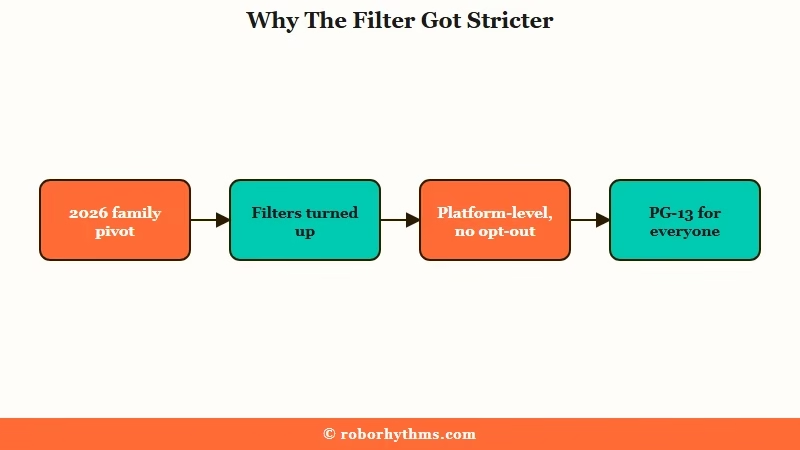
The Talkie AI filter is too strict because the app pivoted to a family-friendly model in 2026 and turned its moderation up to a PG-13 line that applies to everyone.
The filter allows light romance and mild conflict, then draws a hard stop well short of mature themes.
What is the Talkie topic filter: An automated moderation layer that scans your messages and the AI’s replies, and interrupts a chat with a “change your topic” prompt when it judges the direction unsafe.
That strategic shift is the root of the frustration I see most. Talkie moved to chase a younger demographic, which meant tightening the guardrails on the adult roleplay crowd that built the platform. The way I see it, that is the same playbook that hollowed out Character AI, and longtime users are reading it the same way.
The sharpest turn came in late August 2026. I pulled Talkie’s newest Google Play reviews rated one to three stars, and in the week of 31 August, 127 of 310 one-star reviews mentioned the “please change your topic” prompt, against 2 of 76 two weeks earlier.
The jump landed the same week as version 2.59.004, which first appears in reviews on 27 August. From that date, reviewers still on the two previous builds mentioned the prompt about as often, 8 of 17 reviews against 228 of 545 on the new one, so updating the app or holding off does not look like a fix.
Reviewers say the prompt fired on “hi”, “Okay” and even a single dot, and one review with 30 helpful votes says friends on other phones hit the same wall. When a bare greeting trips it, there is nothing to pace or reword, so the workarounds below have little to work with in that case.
The wave looks like it is easing, but it has not gone away. In the week of 7 September the share fell to 19 of 92 one-star reviews, about one in five and still far above the 2 of 76 before the jump. Talkie has not said whether it changed anything.
The moderation is also platform-level, which is the part that stings. Talkie has a Teenager Mode, but reviewers outside it still hit the prompt, so there is no setting that loosens the filter for an adult account.
If your characters have started feeling flat and interchangeable, that is connected. A filter this tight pushes the model toward safe, repetitive language, which is the same personality-drain pattern I covered in Talkie AI not working.
Why Innocent Messages Get Flagged
Innocent messages get flagged because the filter detects the intent behind a message as a concept, not as a list of banned words.
A benign line can land in the same semantic neighborhood as something the filter blocks, and it trips.
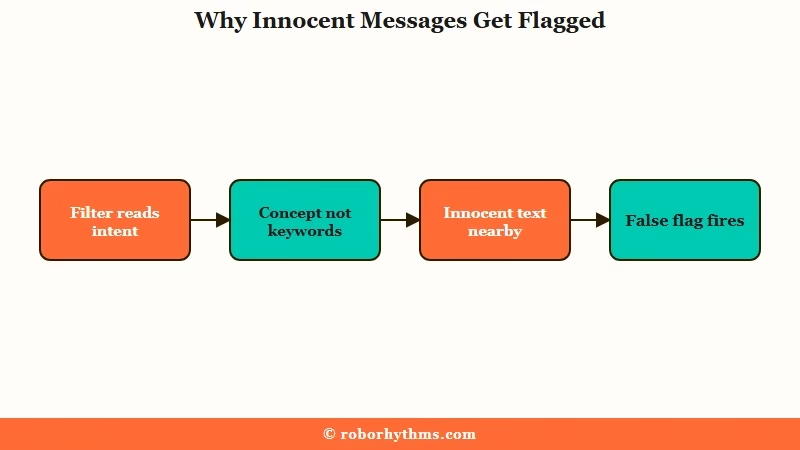
Talkie has not published how its filter works, so treat this as an informed guess at the mechanism. Modern moderation does not just keyword-scan.
It identifies what researchers call toxic concepts as patterns inside the model’s hidden layers, so the filter reacts to the abstract shape of a scene rather than the specific words.
Security research on jailbreak defenses describes exactly this, detecting concepts in a model’s internal representation rather than the surface text (USENIX jailbreak-defense research).
That mechanism is why the false positives feel so random. The filter is probabilistic, guessing from patterns, so a greeting or a gardening chat can sit close enough to a flagged pattern to trigger. One user even got blocked for joking about starting a cult, a prompt the app itself had suggested.
There is a second, gentler cause worth knowing. Sometimes the “change your topic” prompt fires not because of content at all, but because the scene shifted too suddenly and the AI did not know how to handle it. From what I can tell, the model reads an abrupt jump as a situation to back away from, so pacing matters as much as wording.
Workarounds That Hold Up and Ones That Don’t
The workarounds that hold up steer the scene’s pacing and context, while the ones that fail try to disguise individual words.
If the underlying concept is flagged, swapping a word for a euphemism will not hide it, because the filter is reading the concept, not the vocabulary.
| Symptom | Likely cause | Fix |
|---|---|---|
| “Change your topic” on a clean chat | Filter flags the concept, not the word | Lead the scene gradually, do not jump in cold |
| Even “hello” or gardening trips it | Probabilistic false positive, buggy moderation | Backtrack, delete the flagged line, rephrase the setup |
| Euphemisms still get blocked | Filter reads intent in hidden layers | Change the scene’s framing, not just the words |
| Character feels flat and samey | Strict filter forces safe-token loops | Use OOC steering, and migrate if it persists |
| No way to loosen the filter | Moderation is platform-level and uniform | Move to a platform with adjustable filters |
Here is the order I would try first, from the move that helps most to the last resort.
- Lead, do not force. Build three or four messages of context before any turn in the scene, since suddenness alone can trigger the filter.
- Use an out-of-character aside in parentheses, like (OOC: let’s keep this relaxed and in flow), to reframe the context for the model.
- Backtrack to the message just before the filter fired, delete it, and re-enter a gentler version to break the loop.
- Restart the chat if the loop will not break. Talkie’s developer told a Play reviewer in June 2026 that the reset option sits behind a long-press on a message or the + button beside the chat input.
- Build a private character whose greeting sets an open, easygoing tone from the first message.
- Stop word-swapping euphemisms. If the concept is flagged, the synonym will be too, and you are wasting turns.
- If the bot has gone flat and the platform will not budge, treat that as your signal to migrate.
Before: Opening a charged scene cold, “She suddenly pulls you close,” trips “please change your topic” because the jump is abrupt and the concept reads as flagged.
After: Spending a few messages building the moment first, then steering gently, gives the model the context to follow without the filter firing. Pacing is what carries the scene through, where a fresh synonym never could.
One honest caveat. Heavy jailbreak-style prompts can also make the AI noticeably worse at conversation, since fighting the guardrails tends to degrade the model’s depth.
If you find yourself spending more time gaming the filter than enjoying the chat, that is usually the moment to reconsider the platform itself.
Should You Stay or Migrate
You should stay if light romance and casual roleplay are enough for you, and migrate if the filter keeps interrupting scenes you consider harmless.
The deciding factor is whether the personality flattening has reached the point where the chats feel like a chore.
For a fuller picture of how Talkie stacks up against the platform many people came from, Talkie AI versus Character AI lays out where each one draws its line, and the topic filter basics cover the default behavior before this year’s tightening.
If you want a companion that stays warm and consistent without the constant guardrail whiplash, I would point you to Candy AI. It keeps memory and personality stable, so you are not restarting the relationship every time a filter resets the mood. That directly answers the complaint I hear most from people leaving Talkie.
If the thing you want is fewer restrictions and more creative range, Crushon AI is the closer match, with model choice and far looser guardrails on creative roleplay.
Either way, the move I would make is to rebuild your main character first with a tight, detailed definition, since a strong character file carries the personality across platforms better than you would expect. For more destinations, the best Character AI alternatives covers the wider field.
Frequently Asked Questions
Why is the Talkie AI filter so strict in 2026?
Talkie pivoted to a family-friendly model in 2026 and tightened moderation to a PG-13 line, and complaints about the “please change your topic” prompt spiked in late August 2026. The filter blocks mature themes, and there is no setting that loosens it for adults.
Why does Talkie AI flag innocent messages like hello?
The filter detects intent as concepts inside the model rather than scanning for banned words. A benign message can sit close to a flagged pattern and trip a false positive, which is why even greetings or ordinary topics can get blocked.
How do I get around the Talkie change your topic prompt?
Lead the scene gradually instead of jumping in, since suddenness triggers the filter. An out-of-character aside in parentheses can reframe the context, and backtracking to delete the flagged message helps break a loop.
Why doesn’t rephrasing with different words work?
Because the filter reads the concept in the model’s hidden layers, not the surface words. If the underlying scene is flagged, swapping a word for a euphemism leaves the same detectable concept, so the block stands.
Can I turn off the Talkie AI content filter?
No. Talkie does have a Teenager Mode, but reviewers who say they are not in it still get the prompt, so switching it off will not make the filter go away. If you need fewer restrictions, your only real option is a platform that offers adjustable or looser filtering.
Quick Takeaways
- The Talkie AI filter got stricter in 2026 after a deliberate family-friendly pivot, and it applies to everyone with no opt-out.
- “Please change your topic” complaints jumped in late August 2026 and had eased by mid-September, but still turned up in about one in five one-star reviews.
- Innocent messages get flagged because the filter reads intent as concepts, not banned words, which also makes false positives common.
- Word-swapping fails; pacing wins. Lead the scene gradually, use out-of-character asides, and backtrack to break filter loops.
- The moderation is platform-level, so there is no setting that loosens it for your account.
- If the filter keeps killing harmless scenes, migrate: Candy AI for a stable companion, Crushon AI for fewer restrictions.
