
The Verdict: Talkie AI vs Character AI comes down to voice against text depth. Pick Talkie AI if real-time voice calls matter most to you, and pick Character AI if you want longer memory and deeper text roleplay. Neither one is built for no-filter chat, so if that is your goal, look further down this page.
Talkie AI vs Character AI is a choice between two free apps that look similar on the surface and behave very differently once you spend real time inside them.
One was built for voice. The other was built for text. Most comparison posts skip the two numbers that really decide it.
Here they are. Character AI’s official memory box holds just 400 characters per character, and the model reliably tracks only about 3,200 characters of a character definition before it starts contradicting itself. Talkie AI’s headline feature, real-time voice calls, is capped at 2 minutes for free users and 10 minutes if you pay.
That gap tells you almost everything. Character AI invests in keeping a long text conversation coherent, while Talkie AI invests in making a short spoken one feel alive. I have used both, and the right pick depends entirely on which of those two experiences you care about.
Before you finish reading, you will know which app fits how you chat day to day, what each one costs, why Talkie’s ban reputation is worth taking seriously, and where to go if you find both of them too restrictive.
Where Talkie AI and Character AI Differ Most
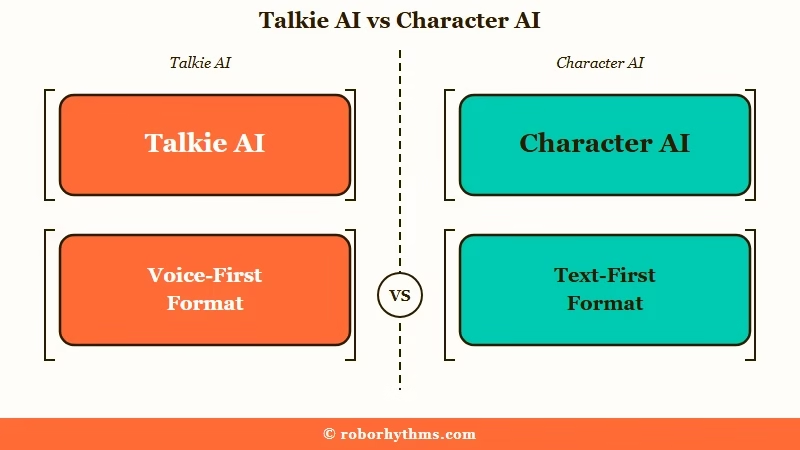
Talkie AI and Character AI differ most on format. Talkie AI leads on voice and visual character collection, while Character AI leads on text memory, scale, and built-in image generation. Everything else flows from that split.
Character AI is the giant here. It carries more than 28 million monthly active users and processes roughly 10 billion messages a month, and after a $2.7 billion Google deal its valuation reached around $10 billion. Talkie AI is far smaller, drawing closer to 827,000 monthly web visits in mid-2025.
What surprised me most is how often people get the feature sets backwards. Talkie leans hard into anime aesthetics and an Outfit system, yet it is Character AI that ships in-chat image generation. Talkie cannot generate images inside a chat at all.
Here is the side-by-side I wish every comparison led with.
| Feature | Talkie AI | Character AI |
|---|---|---|
| Free messaging | Limited, around 50 per day on some accounts | Unlimited, slower at peak hours |
| Voice calls | 2 min free, 10 min on premium | Functional, less immersive |
| Official memory | Unstable across voice and text | 400-char box plus Story Memory |
| Image generation | Not available in chat | Built in |
| Content filter | Flexible by mode, no-filter content still banned | Strict, family-friendly |
| Languages | 95 plus | English-centric |
Which One Has Better Memory
Character AI has better long-term memory than Talkie AI. Its memory is purpose-built for ongoing text narratives, while Talkie’s memory tends to wobble the moment you move between chat and a voice call.
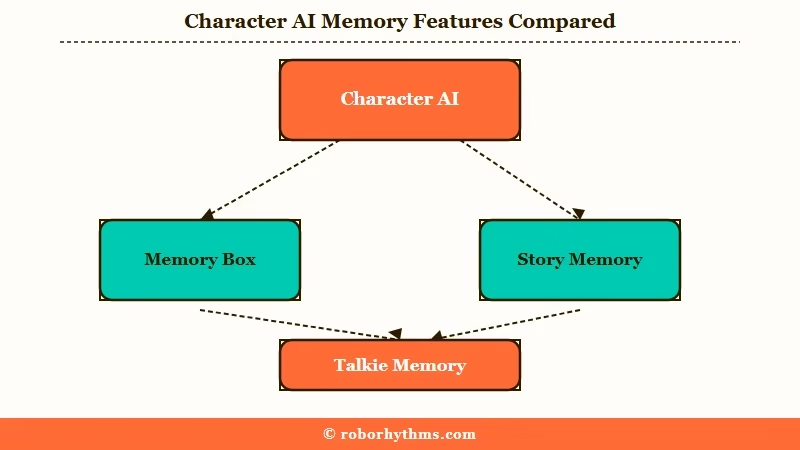
What is Story Memory: Character AI’s 2026 system that lets you pin backstory and key messages so they stay protected as a conversation grows past the model’s normal recall window.
The honest part nobody likes is that both apps forget things. Character AI’s official Chat Memories box gives you only 400 characters per character, which is enough for core traits and not much else. Past roughly 3,200 characters of definition, I have watched it lose track of details it confirmed an hour earlier.
Character AI’s May 2026 Smarter Memory update softened this with Story Memory for pinned context, an auto-capturing Facts feature, and a memory usage view. One catch is that the Facts auto-memory is locked to the paid c.ai+ tier. If you are diagnosing recall problems, the Character AI memory breakdown pairs well with this section.
Talkie’s problem is different and, the way I see it, more frustrating. Its memory is effectively blind between modes, so a plot point you established in text can vanish once you start a voice call. For a voice-first app, that is the feature most likely to break immersion right when it matters.
Which One Is Better for Voice
Talkie AI is clearly better for voice. Real-time voice calls are its flagship feature, and Character AI’s voice tools feel functional rather than immersive by comparison.
What I like about Talkie’s calls is the emotional range. The voices carry tone shifts that make a two-minute exchange feel closer to a phone call than a text-to-speech readout. That emotional layer is the single best reason to pick Talkie over anything else in this category.
The limit is the catch. Free users get 2 minutes per call, and even premium subscribers top out at 10 minutes, so a long spoken scene means restarting and hoping the memory holds. From my testing, the restart is where Talkie’s voice-to-text memory gap does the most damage.
Character AI offers voices too, but they sit on top of a text-first experience. If voice is a nice extra for you rather than the main event, that tradeoff is fine. If voice is the whole point, Talkie wins this one without much argument.
How Much Do Talkie AI and Character AI Cost
Talkie AI and Character AI both start free and charge about $9.99 a month for their standard premium tier. The real difference is what the free tier gives you, not the headline price.
Here is how I would read the pricing before paying for either.
| Plan | Talkie AI | Character AI |
|---|---|---|
| Free tier | Limited messages, 2-min calls | Unlimited messages, slower at peak |
| Standard premium | $9.99/mo or $95.99/yr | $9.99/mo or $94.99/yr |
| Higher tier | Talkie+ Pro at $24.99/mo | No higher consumer tier |
| Best for | Voice immersion | Heavy text use |
Character AI’s free tier is genuinely generous on volume. Unlimited messaging means a free user can run an all-day text roleplay and only feel the squeeze as slower responses during peak hours. That alone makes it the better free pick for people who chat in long sessions.
Talkie’s free tier is tighter, with daily message caps on some accounts and that hard 2-minute call ceiling. What I would tell most people is that Talkie only makes financial sense if you are paying, because the free experience is more of a demo than a daily driver. If you are weighing a paid companion either way, the Candy AI pricing breakdown is a useful reference point for what mid-tier money buys elsewhere.
Is Talkie AI Safe or Will You Get Banned
Talkie AI is generally safe to use, but it has a real reputation for sudden permanent bans with no warning and no refund. That risk is the strongest mark against it in 2026.
What is platform risk: The chance that an app deletes your account, bans you, or shuts down a feature, taking your characters and chat history with it and offering no appeal.
Multiple user reports describe accounts getting permanently banned for tripping Talkie’s content filters, which vary unpredictably by region. The part that stings is the money. People have lost paid subscriptions along with months of built characters, with no refund and little explanation.
There is a structural wrinkle here too. After being pulled from the U.S. App Store in 2024, Talkie operates on iOS under the rebranded name Talkie Lab with a 17+ rating, which signals the kind of moderation pressure that produces aggressive automated bans. Talkie is owned by Singapore-based SUBSUP and backed by Shanghai’s MiniMax, so your data sits under a different legal regime than Character AI’s U.S. footprint.
If you do use Talkie, here is the sequence I would follow to lower the ban risk:
- Keep paid time short, monthly rather than annual, until you trust your account’s stability.
- Avoid pushing the content filter, since the line moves by region and the penalty is permanent.
- Screenshot or export anything you would hate to lose, because there is no character export and no recovery after a ban.
Character AI carries its own platform risk, mostly through safety-driven feature changes rather than account wipes. If metering and limits are your main worry there, the Character AI swipe limit guide covers how those caps work.
Who Should Choose Talkie AI
Choose Talkie AI if voice immersion and visual character collecting are what you want most. It is the better pick for short, emotionally rich spoken scenes and for non-English speakers.
The way I see it, Talkie is for the person who wants to hear their character, not just read them. The 95-plus language support with improved cultural handling also makes it the stronger choice if you roleplay in a language Character AI treats as an afterthought.
You should be comfortable paying, though. The free tier is too thin to judge the app fairly, and the voice cap means the real experience lives behind the subscription. Go in knowing the ban risk and keep your expectations honest about memory holding across modes.
Who Should Choose Character AI
Choose Character AI if you want deep text roleplay, longer memory, and a huge library of characters. It is the safer, more stable home for long-running stories.
From what I have seen, Character AI is the better daily driver for most people because the free tier carries the full experience. Unlimited text, Story Memory for continuity, and built-in image generation add up to a platform you can settle into without paying.
It is stricter, and that matters. The filter keeps everything family-friendly, so if you find Character AI’s guardrails too tight, the next section is for you. For a wider set of options, the Character AI alternatives guide maps the rest of the field.
Example scenario: Say you spend Monday building a slow-burn storyline with a character. On Character AI, you pin the key beats with Story Memory and they hold through the week. On Talkie AI, you start a voice call on Tuesday and the character has forgotten the Monday plot point, because its memory does not carry cleanly from text into voice.
What If You Want Fewer Restrictions Than Either
Neither Talkie AI nor Character AI allows no-filter content. Character AI is strict by design, and Talkie officially bans it too and enforces that with permanent bans, so the common belief that Talkie is the unrestricted option is wrong.
This is the myth I most wanted to clear up. People switch to Talkie expecting a no-filter playground and walk straight into the same wall, often losing an account in the process. If you want fewer restrictions, both of these apps are the wrong tools.
For unrestricted roleplay with strong memory, I would point you toward companions built for it instead. Candy AI is the alternative I recommend most here, because it pairs persistent memory with far more flexible roleplay than either app in this comparison allows. It remembers context across sessions the way Talkie wishes it could, and it does not punish you for the kind of scenes both of these platforms forbid.
For a second option with strong cross-mode persona persistence, Nectar AI is the one I would test next. It holds a consistent character across long conversations and gives you room these two apps do not. If you want to see how the two stack up before choosing, the Candy AI vs Nectar AI breakdown shows which fits which use case.
Frequently Asked Questions
Which has fewer content restrictions, Talkie AI or Character AI?
Neither one is a no-filter app. Character AI is strictly family-friendly, and Talkie AI restricts unrestricted content and enforces it with permanent account bans. People who want fewer limits generally move to companions like Candy AI or Nectar AI instead.
Does Talkie AI or Character AI have better memory?
Character AI has better long-term memory. Its Story Memory and pinning features are built for ongoing text narratives, while Talkie’s memory often resets or degrades when you switch between text and voice calls.
Will I get banned on Talkie AI?
You can, and it is a real risk. Talkie AI is known for sudden permanent bans tied to its content filters, often with no warning and no refund for paid subscriptions, so keep backups and avoid pushing the filter.
Is Talkie AI or Character AI free?
Both have free tiers. Character AI offers unlimited free messaging, while Talkie AI limits free users to a daily message cap on some accounts and 2-minute voice calls, so its real experience lives behind the paid plan.
Which one is better for voice chat?
Talkie AI is better for voice. Real-time voice calls are its flagship feature, with more emotional range than Character AI’s voices, though free calls are capped at 2 minutes and premium calls at 10 minutes.
Can I move my characters between Talkie AI and Character AI?
No. There is no official way to export or transfer characters between the two platforms, and if your account is banned or deleted, that character data is typically lost for good.
Quick Takeaways
- Pick Talkie AI for voice immersion and Character AI for deeper text memory and unlimited free chat.
- Character AI’s memory caps at a 400-character box and roughly 3,200 characters of context, but it still beats Talkie’s cross-mode memory.
- Talkie AI’s permanent-ban reputation is real, so keep backups and avoid annual plans until your account proves stable.
