
My Take: The QuitGPT movement had the right instinct. Claude is the stronger ethical choice and the writing quality gap is real. What the viral switch guides left out is the short list of things that will surprise you in week one.
In March 2026, more than 2.5 million people had canceled their ChatGPT subscriptions, pledged to stop using the app, or posted their boycott publicly.
Claude shot to the top of the US App Store for the first time, right after Anthropic refused the Pentagon deal that OpenAI accepted hours later.
Every major tech outlet published a guide that week. TechCrunch, Tom’s Guide, Android Authority. All of them covered how to transfer your chat history and set up your new account.
None of them covered what switching is like in week two, when the novelty wears off and you’re living inside the product.
That’s what this is. I’ve been through the switch. Here’s what the guides left out.

Is QuitGPT Just a Virtue Signal?
The QuitGPT movement is more than a virtue signal because it landed on top of a genuine product quality gap that predated the Pentagon story.
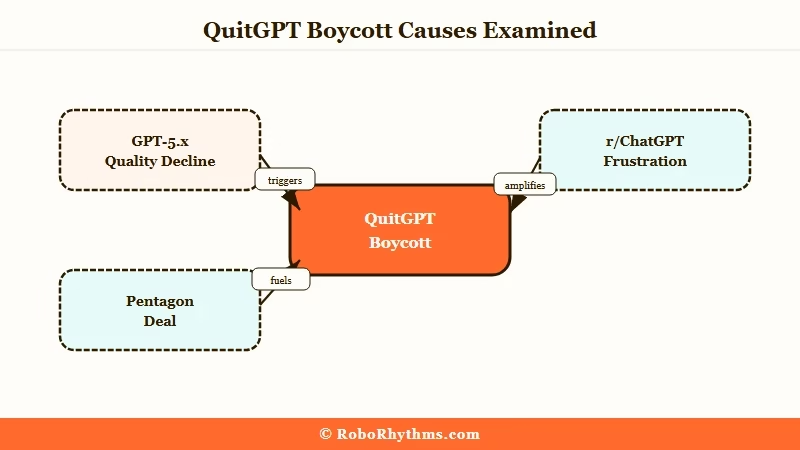
The mainstream framing, as MIT Technology Review reported in February 2026, is that ethics drove the exodus. Dario Amodei refused the Pentagon deal on principle. Sam Altman took it.
Users chose sides. Clean story.
From what I’ve seen, that story misses a layer. The r/ChatGPT thread titled “The enshittification of GPT has begun” hit 2,500+ upvotes before anyone knew what the Pentagon deal was. “Bring back o3 and 4o” threads were cresting at the same time.
The boycott gave millions of already-frustrated users a principled reason to do what they were already considering, which is why it stuck instead of fading like most tech boycotts do.
The ethics objection is real and it matters. The timing was also perfect for Anthropic because the product frustration was already there.
What Does Switching to Claude Look Like in Week One?
Switching to Claude is a clear writing quality upgrade with three friction points that no one warned you about.
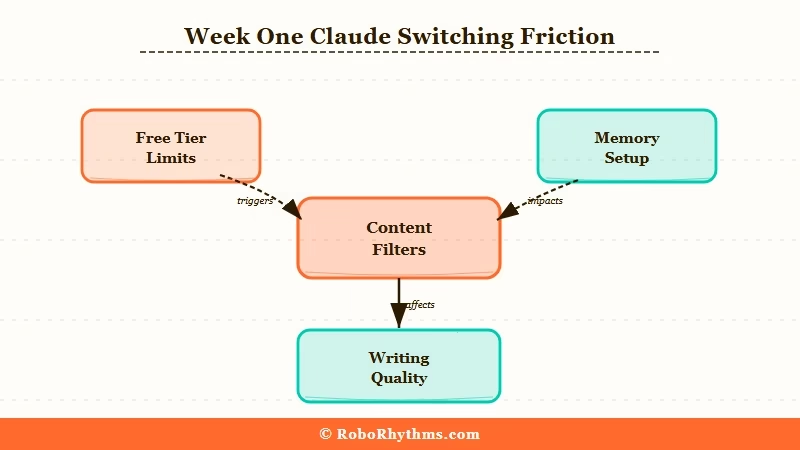
Here are the five things I wish someone had told me before I made the switch:
- Claude’s free tier is worse than ChatGPT’s. Claude runs on a five-hour rolling message window with usage limits that reset periodically. ChatGPT’s free tier is less restrictive. If you’re moving from free ChatGPT to free Claude, you are getting a tighter experience, not a looser one.
- Claude is verbose by default. Responses are longer, more caveated, and more thorough. This is often a strength. For quick tasks, it slows you down until you learn to prompt around it with “no explanation needed.”
- Memory requires intentional setup. ChatGPT’s persistent memory is visible in the UI and automatic. Claude’s Projects feature does something similar, but the mental model is different and the setup is not passive. New users regularly lose context they expected to carry over.
- Claude refuses more edge cases. The content filter is strict. Anything remotely sensitive gets declined more often than it would on GPT. For creative or research work with grey-zone topics, expect more friction.
- The writing quality difference is real. This is the one that keeps people. Claude’s writing output is noticeably stronger, more voice-forward, and less “AI-sounding” than GPT-5.x across the board. I’d recommend giving it one writing-heavy task in your first session because the gap is immediately obvious.
Here is what that gap looks like in practice:
Example scenario: Paste a 500-word rough draft into both and ask for a flow improvement. ChatGPT returns a leaner version with minor tweaks and no explanation. Claude returns a rewrite that explains three structural changes it made, then offers two alternatives. Claude’s output is better. If you wanted a quick pass, add “edit inline only, no commentary” to your prompt.
| Feature | ChatGPT (GPT-5.x) | Claude (Sonnet 4.6 / Opus 4.6) |
|---|---|---|
| Free tier limits | More generous, fewer caps | 5-hour rolling window, hits limits faster |
| Writing quality | Declined in GPT-5.x, flatter voice | Noticeably stronger, more natural |
| Memory | Persistent, automatic, visible in UI | Projects feature, requires setup |
| Coding / tool use | GPT-5.3-Codex strong here | Claude Code better for agents |
| Content filters | Aggressive in GPT-5.x | Also aggressive, more refusals |
| Paid plan price | $20/month (Plus) | $20/month (Pro) |
Why Are Millions of People Switching from ChatGPT to Claude?
Millions are switching from ChatGPT to Claude because the QuitGPT trigger landed on top of a product quality divergence that was already pushing users out.
From what I can tell, the ongoing ChatGPT quality complaints that had been building for months came to a head when OpenAI rolled out GPT-5.x. Responses got shorter. Personality got flatter.
Reddit posts comparing the new model to a “lobotomized drone” went viral for a reason. The boycott accelerated a migration that was already starting, not one it invented.
The 60% growth in Anthropic’s free users since January tells a different story than the paid subscriber doubling. Free tier growth means trial installs, people who downloaded the app during the App Store surge, and are now discovering the message limits in their first session.
The paid subscriber doubling is the real signal, because those people committed with their wallets.
Where the migration sticks is writing, analysis, and long-form reasoning work. For anyone doing agentic coding or wanting to compare all three frontier models, the Claude vs GPT vs Grok breakdown tells a more nuanced story.
The Part Nobody Wants to Admit
The part nobody wants to admit is that most power users are going to end up with accounts on both products within six months.
I’d argue the QuitGPT narrative frames this as a binary choice with a moral dimension, which makes it emotionally difficult to land on the obvious conclusion. Claude wins on writing quality, reasoning depth, and ethical alignment.
GPT still wins on tool use, coding autocomplete speed, and the plugin ecosystem breadth.
A solopreneur running content and automation workflows needs both, and pretending otherwise is wishful thinking.
The deeper uncomfortable truth connects to why Americans increasingly distrust AI. Both models hallucinate. Both have regressed in some task categories compared to their earlier versions.
Switching from one imperfect product to a different imperfect product is a partial solution, not a complete one. Anthropic’s track record on safety is genuinely better and that matters.
But it doesn’t make Claude a perfect product, and people discovering the free tier limits in week one are going to feel like the hype oversold it.
| Category | ChatGPT (GPT-5.x) | Claude (Sonnet/Opus 4.6) | Verdict |
|---|---|---|---|
| Writing quality | Declined in GPT-5.x, flatter voice | Noticeably stronger, more natural voice | Claude |
| Coding / tool use | GPT-5.3-Codex leads here | Claude Code better for agentic tasks | Tie (use-case dependent) |
| Free tier | More generous limits | 5-hour rolling window, tighter caps | ChatGPT |
| Ethics stance | Accepted Pentagon deal | Refused Pentagon deal on principle | Claude |
| Memory | Persistent, automatic, visible in UI | Projects feature, requires manual setup | ChatGPT (for new users) |
| Paid plan price | $20/month (Plus) | $20/month (Pro) | Tie |
Hot Take
The QuitGPT boycott was better for OpenAI than it was for Anthropic.
The QuitGPT movement is the best thing that has happened to OpenAI in six months. Nothing forces a product team to take quality regression seriously faster than 2.5 million cancellations in a week. Sam Altman got something every CEO quietly wants: a crisis with a clear external cause that justifies a complete internal product reset.
Watch for a “GPT Classic” mode or a public context-window rollback within 60 days. The boycott didn’t hurt OpenAI. It gave them the pressure to fix what Reddit had been screaming about for months.
