
The Verdict: Suno wins on ease of use, variety, and 10 a month entry pricing. Udio wins on vocal realism and producer-grade output. If you are making background tracks for videos, pick Suno. If you are trying to fool a listener into thinking a human sang it, pick Udio.
I spent the last ten days running the same set of song prompts through Suno and Udio to answer a question a reader emailed me last week: which one is worth paying 10 bucks a month for if you can only pick one? Both platforms are good enough to be scary.
Both launched in 2023 and both have serious money behind them. What separates them in practice is smaller and weirder than the marketing suggests.
Short answer up front: they are not the same product any more. Suno is chasing breadth and accessibility. Udio is chasing fidelity. The right pick depends on what you are trying to make.

How Suno and Udio Differ Under the Hood
Suno is optimised for variety and control across genres, with better metadata and style tags, while Udio uses a stronger vocal synthesis pipeline that produces more realistic singing but offers less genre range at the same price tier.
Both platforms take a text prompt, let you attach or generate lyrics, and return a full song with vocals, instrumentation, and production. From that point the similarities stop.
Suno’s v4 model favours clarity and mix cleanliness. Tracks come out cleanly mastered, well-balanced across frequencies, and genre-faithful enough that a pop prompt gives you a pop song rather than a hybrid.
The weakness is vocals. Suno’s singers still carry a slight robotic tail on sustained notes and a uniform delivery style.
Udio’s v1.5 model flips that trade. Vocals are the strongest feature by a wide margin. Singers breathe, slide into notes, and shift register the way real singers do.
The cost shows up in inconsistency: one in three generations comes back with an arrangement that does not match the prompt genre or a mix that needs work.
The funding and team behind each platform matters because it tells you where the roadmap is pointing. Suno is Boston-based with backing from Lightspeed, Nat Friedman, and Andrej Karpathy.
Udio was founded by former Google DeepMind researchers with backing from Andreessen Horowitz and will.i.am. Suno’s 125 million Series B at a 500 million valuation signals they are pushing toward scale. Udio is playing a longer fidelity game.
The practical consequence for you as a user: pick Suno if you want consistent output across 40 genres, pick Udio if you want the best vocals money can buy in a generator under 30 a month.
Pricing and Commercial Rights Compared
Both platforms start at 10 a month for their entry paid tier, but Udio gives more credits per dollar at the Standard level while Suno is cheaper at the high-volume Premier tier.
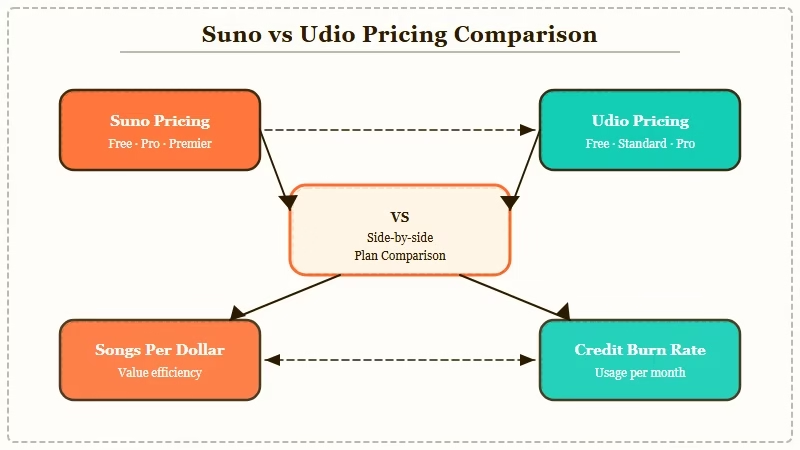
Both have free tiers but they are not meant for serious work. Here is how the paid tiers stack up:
| Plan | Suno | Udio |
|---|---|---|
| Free tier | 10 songs per day | ~10 songs per month |
| Entry paid | 10 USD per month (500 songs) | 10 USD per month (1200 credits, ~300 songs) |
| Mid paid | Not offered | N/A |
| High-volume paid | 30 USD per month (2000 songs) | 30 USD per month (4800 credits, ~1200 songs) |
| Commercial use on paid tiers | Yes | Yes |
| Commercial use on free tier | No | No |
| Maximum song length | 4 minutes on free, extendable on paid | 2 minutes 10 seconds per generation, extendable |
| API access | Pro users only | Not public |
The numbers get misleading if you only glance at them. Suno’s 500 songs per month at 10 USD is more songs per dollar than Udio’s 1200 credits.
Udio uses a credit system where each generation, remix, or extension burns credits individually, so you spend faster than the number implies.
Commercial use is identical in principle: both platforms let paying users monetise tracks. Neither platform lets free-tier users sell what they make, and both have rolling updates to their music licensing language that are worth skimming before you build a revenue stream on top of either.
A Head-to-Head Test I Ran
I generated the same three song briefs on both platforms and compared them blind. Suno won on genre-faithfulness and mastering. Udio won on vocals and emotional delivery. On the third prompt they tied.
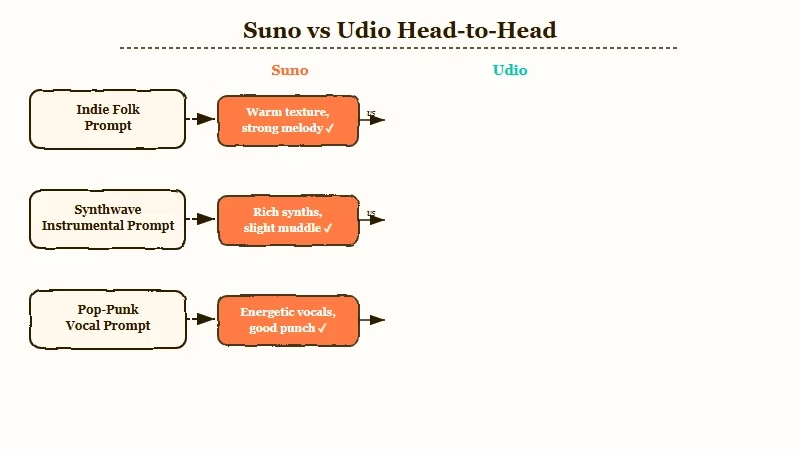
I pushed three prompts through both platforms and asked two producer friends to rank the outputs without telling them which song came from where. Prompts were:
- Indie folk, female vocal, acoustic guitar and soft strings, melancholy tone, 2 minutes 30 seconds. Suno delivered a clean, radio-ready mix with a slightly robotic vocal. Udio delivered a raw, breathy vocal that sold the melancholy but had a drum bus that was too loud in the pre-chorus. Both testers picked Udio first for emotion, Suno first for mix quality. Draw.
- Synthwave instrumental, no vocals, 1980s arcade vibe, 3 minutes. Suno nailed the genre references instantly. Udio struggled with the synth selection and returned something closer to modern electronic than synthwave on two of three generations. Clear Suno win.
- Pop-punk with aggressive male vocal, big choruses, 2 minutes 40 seconds. Udio’s vocal performance was the best thing either platform produced across all tests. Suno’s version was cleaner but felt like a demo next to Udio’s finished-record feel. Clear Udio win.
Net tally: Suno 1, Udio 1, draw 1. The difference is not which platform is better overall, it is which platform matches the specific thing you are trying to make.
If you are doing creative workflow orchestration around music generation, the same patterns that work for automating content briefs with AI agents apply here. Script the generation loop, generate 5 variants per prompt, and pick the best one downstream.
Who Should Choose Suno
Suno is the right pick for creators making background music at volume, YouTubers who need licensed tracks for videos, podcasters, app developers, and anyone who wants consistent genre output without hand-holding the generator.
You should pick Suno if any of these fit you:
- You are generating music for video backgrounds, podcasts, or social content where quantity matters more than each track being a standout.
- You work across many genres and want a model that handles all of them competently rather than excelling at one or two.
- You want cleaner mastering out of the box and less time spent tweaking mixes.
- You are price-sensitive at the high end and want 2000 songs a month for 30 USD.
- You want a web interface polished enough that non-technical collaborators can use it.
- You want public API access for workflow automation (Pro tier only).
Suno is the safer default choice for most creators. It rarely produces a bad song outright. The ceiling is lower than Udio’s, but the floor is much higher.
For anyone building an AI-powered creative workflow more broadly, the same infrastructure questions I raised in the is human coding really over piece apply to music too. Generation is cheap; curation is the bottleneck.
Who Should Choose Udio
Udio is the right pick for songwriters, producers, and creators who need the most realistic vocals money can buy, who are making fewer but higher-stakes tracks, and who are willing to accept a higher miss rate on non-vocal arrangements.
You should pick Udio if any of these fit you:
- You are writing songs where the vocal performance carries the track, not the arrangement.
- You are a producer or songwriter who wants demo-grade vocals to test lyrics before recording a real singer.
- You make fewer than 100 tracks a month and care more about peak quality than volume.
- You work primarily in pop, R&B, folk, or any vocal-forward genre where expressive singing matters.
- You are willing to regenerate 2 to 3 times per prompt to get the arrangement right, knowing the vocal will land.
Udio is the right pick when you need a song that fools a listener into thinking a human wrote and sang it. It is the wrong pick for volume, background use, or genre-faithful output.
Final Verdict
Across the criteria that matter most for the average creator, Suno wins on 5 of 8 categories and Udio wins on 3. The result flips for creators who prioritise vocal realism over variety.
Here is how each platform scores across the criteria I found mattered most after testing:
| Criterion | Suno | Udio | Winner |
|---|---|---|---|
| Vocal realism | 7/10 | 9/10 | Udio |
| Genre variety | 9/10 | 7/10 | Suno |
| Mix cleanliness | 8/10 | 7/10 | Suno |
| Arrangement accuracy | 8/10 | 6/10 | Suno |
| Peak quality (best output) | 7/10 | 9/10 | Udio |
| Consistency (average output) | 8/10 | 6/10 | Suno |
| Commercial pricing value | 8/10 | 7/10 | Suno |
| Emotional delivery | 6/10 | 9/10 | Udio |
My personal pick: I subscribed to Suno at 10 a month because 80% of my use case is workflow background tracks where consistency beats peak fidelity.
If I were a songwriter shopping for a vocal demo tool, Udio would be the obvious choice. If I could afford both, I would run both and route each brief to the right platform.
For broader context on where AI generation fits in the current tool stack, I ran through this in more depth when the Kimi K2.6 release raised the same “which frontier model is right for the job” question for coding.
The answer is the same for music: there is no single winner, there are use-case winners.
Frequently Asked Questions
Can I use Suno or Udio songs commercially?
Yes on the paid tiers of both platforms. Both Suno’s Pro and Premier plans and Udio’s Standard and Pro plans grant commercial use rights to the music you generate. Free-tier output on both is for personal use only and cannot be monetised.
Which one sounds more like a real song?
Udio, on vocals. Suno, on overall mix quality. If you played two tracks side by side to a listener who had never heard either platform, Udio’s vocal would sell the “this is real” illusion faster, while Suno’s track would sound more radio-ready as a finished mix.
Is the free tier of either platform enough for testing?
Suno’s free tier of 10 songs per day is meaningful enough to evaluate the platform properly. Udio’s free tier of roughly 10 songs per month is too thin to form a real opinion. If you are price-comparing, start on Suno’s free tier and only pay Udio if vocals are the thing you are trying to optimise for.
Do either of these replace hiring a real musician?
Not yet, but the gap is closing fast. For background music in videos, podcasts, and social content, both platforms are a drop-in replacement for a stock music subscription. For original songs where a human performer matters to the audience, neither platform is there yet. The vocals are the last thing that still gives away AI origin to a trained listener.
Can I edit individual parts of a generated song?
Partially on both. Suno has a clip-extend feature that lets you continue a track and a limited edit feature to revise sections. Udio has stem separation and more granular section editing on paid tiers. Neither platform yet offers the level of surgical control a real DAW would give you, but Udio is closer.
Will Suno or Udio face legal trouble over training data?
Both platforms are currently defending copyright lawsuits filed in 2024 by major record labels. The outcomes are unresolved as of 2026. Paid-tier users on both platforms get indemnification clauses in their terms, meaning the platform absorbs legal risk, not you.
