
The Verdict: Sora 2 wins on length and creative narrative pacing. Veo 3 wins on audio fidelity, 4K resolution, and the official API. The real decision is the cost per usable minute, where Veo’s higher hit rate beats Sora’s cheaper per-clip price for production work.
Sora 2 vs Veo 3 is the AI video comparison most short-form creators and corporate marketers are running in 2026. The two flagship models from OpenAI and Google sit on opposite ends of the tradeoff curve.
One ships longer clips with built-in editing tools. The other ships shorter clips but with native synchronised audio and a proper API.
Most published comparisons stop at the spec sheet. They list resolutions, durations, and monthly prices, then declare a winner based on whichever the writer used last. That misses the question that decides the budget: what does it cost to ship one finished minute of usable video on each platform.
The way I see it, the spec sheet decides the demo, but the yield rate decides the bill. A $0.10-per-second model that needs four attempts to land an audio-heavy shot is more expensive than a $0.15-per-second model that lands it on the first try. That single fact reorders most of the published recommendations.
This comparison covers audio, length, resolution, pricing, API access, region availability, character consistency across multiple clips, and the cost-per-usable-minute math the spec-sheet articles skip.
According to Statista’s AI video market projection, generative video is on track to be one of the fastest-growing AI segments through 2027, which makes the Sora 2 vs Veo 3 split the most important production decision in the category right now.
Which Wins on Audio Between Sora 2 vs Veo 3
Veo 3 wins on audio between Sora 2 vs Veo 3 because it generates native synchronised dialogue, ambient sound, and music during the initial diffusion pass.
Sora 2 added experimental native audio in 2025 but still trails Veo on consistency and lip-sync quality.
The Tom’s Guide head-to-head test scored Veo 3.1 at 5 wins to Sora 2’s 1 win across seven audio-heavy prompts.
From my read of the test, Veo handled acoustic transitions (the way sound shifts when a character walks from an alley into a stairwell) and complex crowd-PA interactions in ways Sora simply could not match.
What is native synchronised audio: Audio generated during the same diffusion pass as the video, so dialogue, ambient sound, and effects line up frame-by-frame with the visuals without separate post-production.
Sora 2 did win one audio test: the “car window” physics test, where rolling a window down inside the clip correctly changed the ambient sound from inside-cabin to street-level. That is a meaningful signal that Sora’s physics modelling is stronger, even if its raw audio quality is weaker.
What I would tell a stranger reader who cares about audio is simple: if your output needs dialogue, music, or layered ambient sound to land, Veo 3 is the safer pick. Sora 2 will cost you a post-production pass.
Which Wins on Length and Resolution
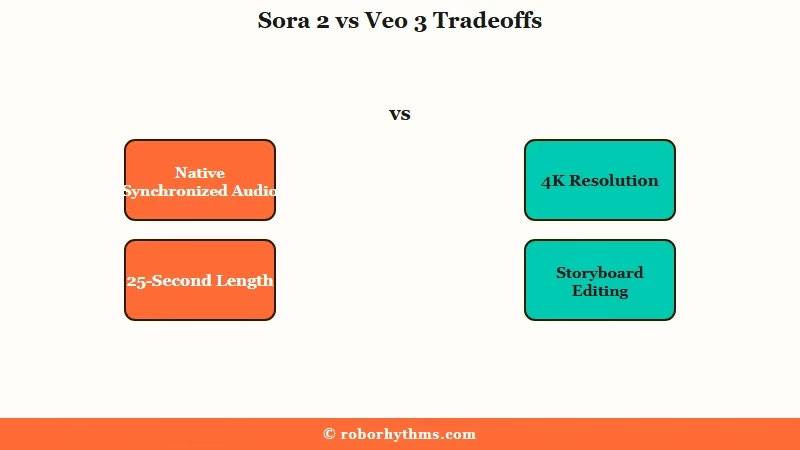
Sora 2 wins on length with 20 to 25 second continuous clips, while Veo 3 wins on resolution with true 4K at 60fps in 8-second bursts.
The two models are not really competing on the same axis here.
The length-versus-resolution tradeoff splits the user base cleanly. A TikTok creator who wants a 20-second narrative cuts in a single generation picks Sora. A corporate marketer who needs a 4K hero shot for a broadcast spot picks Veo.
Here is how the spec gap breaks down on the dimensions that matter:
| Spec | Sora 2 | Veo 3 / 3.1 |
|---|---|---|
| Max continuous length | 20 to 25 seconds | 8 seconds at 4K, up to 2 minutes at lower res |
| Max resolution | 1080p | 2160p (true 4K) at 60fps |
| Native audio | Experimental, inconsistent | Polished, synchronised, includes dialogue |
| Built-in editing | Remix, Recut, Blend, Loop, Storyboard | None comparable |
| Character consistency | Strong across multi-shot Storyboard | Moderate, varies by prompt |
Sora’s built-in editing suite is the lever most reviewers underweight. Remix, Recut, Blend, Loop, and Storyboard let a creator stay inside the platform for an entire short-form workflow.
Veo offers nothing comparable, so corporate workflows tend to combine Veo with an external editor like DaVinci or Premiere.
For readers wanting the broader video-generation picture, the Higgsfield vs Kling AI comparison covers the next tier of contenders below Sora and Veo.
How Sora 2 vs Veo 3 Pricing Compares
Sora 2 starts at $20 a month via ChatGPT Plus and unlocks fully at $200 a month via ChatGPT Pro. Veo 3 starts at $19.99 a month via Google AI Pro and tops out at $249 a month on the Ultra tier.
Per-second API pricing favours Veo slightly at $0.09 versus Sora’s $0.15 through Atlas Cloud.
The monthly subscription pricing reads similar on paper. The real difference is what each tier unlocks:
| Tier | Sora 2 (OpenAI) | Veo 3 (Google) |
|---|---|---|
| Entry | $20 ChatGPT Plus, 720p, 5-second clips | $19.99 AI Pro, watermarked |
| Pro | $200 ChatGPT Pro, full 1080p, 20-second clips | $249 Ultra, watermark-free 4K |
| API per second | $0.15 (third-party, Atlas Cloud) | $0.09 to $0.40 (official Gemini API) |
| API status | No official OpenAI API | Official Gemini API and Vertex AI |
What I would flag here is that the entry tier for Sora is harder to live with than Veo’s. A 720p 5-second clip is a demo, not a production asset.
Veo’s entry tier ships watermarked 1080p clips that are at least usable for personal projects.
For creators on a tight budget, Sora’s $20 tier is a trap. You will hit the resolution and length walls in your first session and feel pushed to the $200 Pro tier. Veo’s $19.99 tier holds up longer for casual use.
What About API Access and Region Availability
Veo 3 has an official Google API via Gemini and Vertex AI, while Sora 2 has no official OpenAI API and must be accessed through third-party platforms like Atlas Cloud.
Veo is the only enterprise-ready option for programmatic use.
The API gap is the single biggest reason Veo wins corporate deployments right now. If you want to embed video generation into a custom marketing pipeline, an internal tool, or a SaaS product, Veo is the only platform with a documented, supported API. Sora 2 forces you onto a reseller, which carries terms-of-service risk for production work.
Region availability is the other corporate blocker:
- Sora 2 is not available in the UK, EU (EEA), or Switzerland due to regulatory hurdles.
- Veo 3 launched US-only but has rolled out globally through 2025 and into 2026.
- Global marketing agencies running unified pipelines across regions are forced toward Veo for that reason alone.
- Third-party Sora 2 workarounds exist for EU users but carry compliance risk for any commercial use.
The region split matters more than the spec gap for any team with international workflows. If half your operation is in Berlin and Paris, Sora is out of consideration whether you like its output or not.
Which Holds Character Consistency Across Multiple Clips
Sora 2 holds character consistency across multiple clips better than Veo 3 thanks to its Storyboard tool and director-frame approach, while Veo 3 produces cinematic single shots that often drift between cuts.
The published consensus has Sora rated High and Veo rated Moderate on this dimension.
From what I have read of the testing, the gap shows up most in three-cut and five-cut sequences. Sora’s Storyboard tool explicitly tracks character identity across cuts, so a protagonist’s face and outfit hold from clip 1 to clip 5 with minor drift. Veo’s cinematic-first approach optimises each clip individually and treats consistency as a prompt-engineering problem the user has to solve.
Example scenario: Generate a five-clip sequence of a woman in a red coat walking through a city. On Sora 2 via Storyboard, the coat colour, hairstyle, and bag style stay stable across all five clips with minor lighting variation. On Veo 3 without explicit consistency prompting, the coat shade shifts noticeably between clip 1 and clip 3, and the bag changes shape entirely by clip 4. Both models produce stunning individual frames; only one produces a coherent sequence without manual intervention.
That said, Veo 3’s individual-clip cinematic quality is higher. A single 4K hero shot from Veo will out-render Sora on lighting and colour grading. The consistency gap matters only when you need multiple cuts of the same character.
The Cost Per Usable Minute Nobody Calculates
The cost per usable minute on Sora 2 vs Veo 3 depends on hit rate, not headline pricing.
Veo 3’s audio-heavy prompts succeed roughly 25 percent of the time on the first try, meaning a one-minute usable output may need 3 to 5 regenerations to land. That changes the real cost calculus.
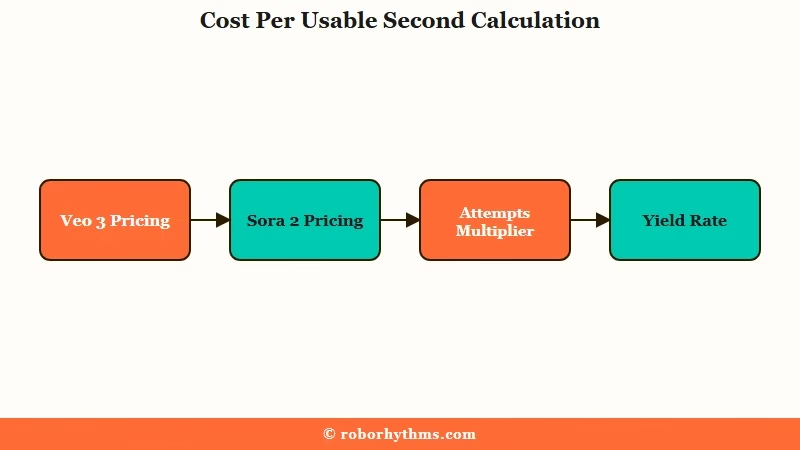
The headline per-second pricing makes Veo look cheaper at $0.09 vs Sora’s $0.15. The yield-adjusted math tells a different story.
If Veo needs four attempts to nail a complex shot, that $0.09 effectively becomes $0.36 per usable second. Sora at $0.15 with a 50-percent hit rate becomes $0.30. The cheaper-on-paper model becomes the more expensive one in production.
Here is the yield-adjusted math I would run before committing budget:
Before: $0.09 per second on Veo 3 looks cheaper than $0.15 per second on Sora 2.
After: $0.09 per second times 4 attempts equals $0.36 per usable second on Veo for audio-heavy work; $0.15 per second times 2 attempts equals $0.30 per usable second on Sora for the same prompt class. Sora wins on cost-per-finished-minute for high-iteration scenes, even though Veo wins per-attempt.
The reverse holds for simple cinematic shots. Veo’s first-try success rate on landscape and product hero clips is roughly 70 percent in the published tests.
Sora’s first-try rate on the same prompt class is closer to 60 percent. For that workload, Veo is genuinely cheaper.
What I would do in practice is segment your shots: high-iteration audio-heavy sequences go to Sora 2 in Pro, cinematic single hero clips go to Veo 3 Ultra or the Gemini API. Running one pipeline for everything wastes money.
For a deeper dive on how OpenAI is positioning Sora 2 as a social video app, the Sora 2 social app coverage covers the consumer-facing strategy side.
Who Should Choose Sora 2
Choose Sora 2 if you create short-form narrative content, want built-in editing tools, need 20-second continuous clips, or care about character consistency across multiple cuts.
Sora is the natural pick for TikTok creators, narrative short filmmakers, and anyone building social-first content workflows.
The Sora 2 reader profile I would describe:
- TikTok or Reels creator producing 15 to 25-second clips with character continuity across cuts.
- Narrative short filmmaker who needs Storyboard to plan multi-clip scenes inside one tool.
- Creator already in the ChatGPT Pro ecosystem who wants video generation in the same workflow.
- Anyone outside the EU and UK who can access the platform without third-party workarounds.
Skip Sora 2 if you need 4K output, official API access, native audio fidelity, or you operate in the EU. Those four constraints disqualify it for most corporate deployments regardless of how good its output looks.
Who Should Choose Veo 3
Choose Veo 3 if you need 4K resolution, native synchronised audio, official API access, or you run a global pipeline that must work in the EU.
Veo is the corporate-friendly option and the better pick for cinematic single-shot work.
The Veo 3 reader profile:
- Corporate marketer producing 4K hero spots for broadcast, paid social, or web video.
- Developer building automated video pipelines via the Gemini API or Vertex AI.
- Studio that needs polished native audio without a separate sound-design pass.
- Team operating in the EU, UK, or globally where Sora’s regional availability rules it out.
Skip Veo 3 if your workload is high-iteration narrative content with built-in editing needs. Veo’s per-clip quality is higher but its workflow is bare-bones compared to Sora’s editing suite. You will end up exporting to DaVinci or Premiere for anything beyond a single hero clip.
Final Verdict on Sora 2 vs Veo 3
The final verdict on Sora 2 vs Veo 3 is that they win different production roles, not the same role.
Treating this as a binary winner question misses the actual answer, which is that serious teams run both.
Here is the head-to-head verdict across the criteria that decide most decisions:
| Criterion | Sora 2 | Veo 3 |
|---|---|---|
| Audio quality | Experimental, inconsistent | Native, synchronised, polished |
| Video length | 20 to 25 seconds | 8 seconds 4K, 2 minutes lower res |
| Resolution | 1080p max | True 4K at 60fps |
| Character consistency across cuts | High, via Storyboard | Moderate, prompt-dependent |
| Official API | None, third-party only | Yes, Gemini and Vertex AI |
| Region availability | No UK, EU, or Switzerland | Global rollout in 2025 and 2026 |
| Entry pricing | $20 ChatGPT Plus, $200 Pro | $19.99 AI Pro, $249 Ultra |
For anyone running a mixed workload, the Sora 2 vs Runway Gen 4 comparison covers the third major contender in the space, and the Wan 2.2 vs Veo 3 breakdown covers Alibaba’s open challenger.
Frequently Asked Questions
Is Sora 2 or Veo 3 better for TikTok creators?
Sora 2 is better for TikTok creators. The 20 to 25 second clip length matches the platform’s preferred duration, and the built-in editing suite (Remix, Recut, Blend, Storyboard) lets you finish a clip without exporting to another tool.
Does Sora 2 have native audio yet?
Yes, but it is experimental and inconsistent. OpenAI added native audio in 2025 but Veo 3.1 still produces noticeably more polished dialogue, ambient sound, and music in head-to-head tests.
How much does Veo 3 cost compared to ChatGPT Pro?
Veo 3 Ultra costs $249 a month versus ChatGPT Pro at $200. Per second of generated video, Veo is cheaper at $0.09 via the official API versus Sora’s $0.15 via Atlas Cloud, but yield rate flips that math for audio-heavy prompts.
Can I use Sora 2 if I live in the EU?
Not directly. Sora 2 is unavailable in the UK, EU (EEA), and Switzerland due to regulatory hurdles. Third-party workarounds exist but carry compliance risk for any commercial use. Veo 3 is the supported alternative for EU users.
Which has the better API for developers?
Veo 3 has the better API. It is officially available through Google’s Gemini API and Vertex AI with documented pricing. Sora 2 has no official OpenAI API in 2026 and must be accessed through third-party resellers like Atlas Cloud.
Which model produces more consistent characters across multiple clips?
Sora 2 produces more consistent characters across multiple clips. Its Storyboard tool explicitly tracks identity across cuts, while Veo 3 optimises each clip individually and tends to drift on coat colour, hairstyle, and accessory details between shots.
