
What Happened: Sen. Bernie Sanders and Rep. Alexandria Ocasio-Cortez introduced the AI Data Center Moratorium Act on March 25, 2026. The bill would freeze all new data center construction nationwide until Congress passes separate laws on AI safety, worker protections, and energy costs. It won’t pass in the current Senate, but it moves the political ceiling on AI regulation in a way nothing has before.
Bernie Sanders and Alexandria Ocasio-Cortez dropped a bill yesterday that would put every new AI data center project in the country on hold. Not slow it down. Freeze it entirely.
The AI Data Center Moratorium Act, introduced on March 25, 2026, calls for an immediate federal moratorium on new data center construction. The pause only lifts once Congress passes comprehensive legislation on AI safety, worker protection, and energy pricing. Given where Congress stands on AI regulation, that could mean years.
The bill has almost no path through the current Senate. That doesn’t make it unimportant.
What the Bill Does
The AI Data Center Moratorium Act is a federal bill that would immediately ban construction of any new AI data centers in the United States until three separate regulatory conditions are met.
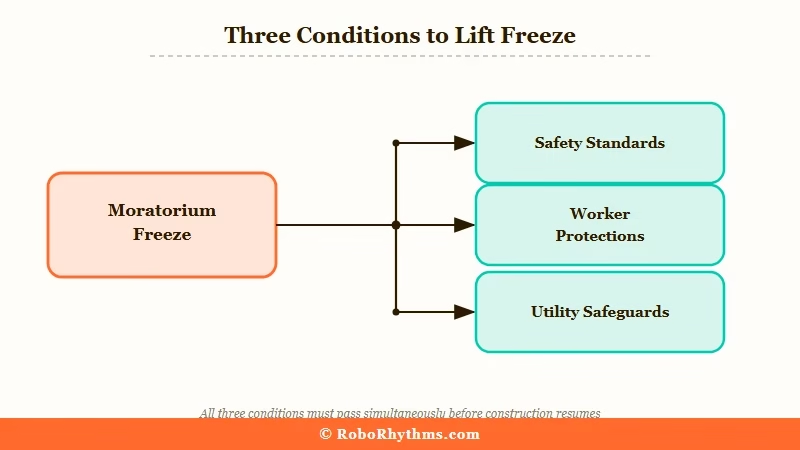
Sanders and AOC introduced the legislation jointly on March 25, 2026. The bill specifies three conditions that must all be satisfied before the freeze can lift:
- Congress passes a law establishing that AI products cannot harm public health, privacy, or civil rights
- Federal legislation guarantees that AI economic gains reach workers, not just tech executives
- Laws protect communities from AI-driven electricity price increases and environmental damage
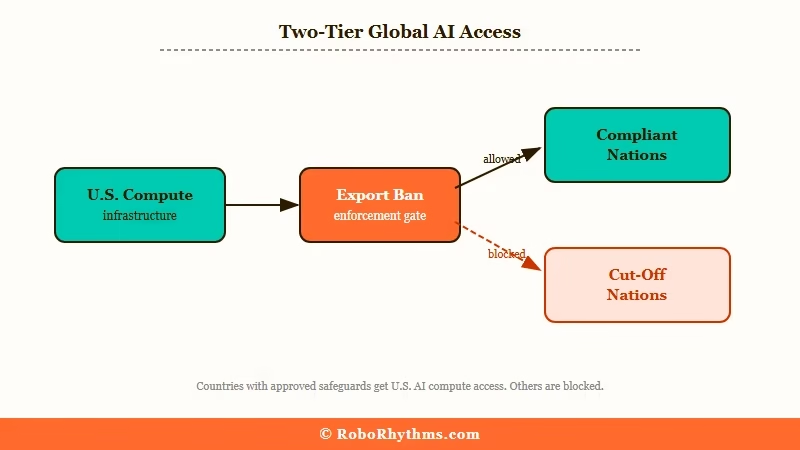
The bill also includes an export ban. U.S. companies would be barred from exporting AI computing infrastructure to any country that lacks equivalent safeguards on AI safety, worker protection, and environmental standards.
Sanders framed it directly: “We cannot sit back and allow a handful of billionaire Big Tech oligarchs to make decisions” reshaping the economy and democracy. Ocasio-Cortez added: “Congress has a moral obligation to stand with the American people and stop the expansion of these data centers.”
This didn’t come out of nowhere. Over 100 local communities and 12 states have already enacted or proposed their own data center moratoriums. The federal bill tries to nationalize what has been a patchwork of local resistance.
Why This Is a Bigger Deal Than It Sounds
The AI Data Center Moratorium Act matters not because it will pass, but because it moves the political ceiling on how aggressively Congress can challenge Big Tech infrastructure buildout.
The bill won’t become law. The math in the current Senate makes that clear. What it does is shift the Overton window on AI regulation in a way that previous bills haven’t managed.
Before this bill, the legislative debate focused mostly on disclosure requirements, model transparency, and watermarking. Freezing construction is an entirely different category of intervention.
Saying “you can’t build” is a harder political line than “you must disclose.” This bill plants that flag, and now it’s on the record.
There’s also a practical pressure angle. As PBS reported, data center projects could be on hold for years if even a diluted version of these conditions became law. That uncertainty changes how companies plan and how lenders think about permitting risk.
A credible legislative threat doesn’t need to pass to slow projects down. The Elon Musk Terafab buildout announced this month is exactly the kind of project this bill targets.
That project was framed as urgency wrapped in patriotism. Sanders and AOC are now offering the counter-narrative.
What This Means for You
For AI tool users and builders, any version of this moratorium translates directly into tighter compute capacity, higher API costs, and slower model releases.
Every major AI model release over the last three years was possible because companies could expand compute faster than demand grew. That assumption is baked into every pricing model and every “coming later this year” roadmap from the major labs.
Freeze new data center construction and that assumption breaks. Capacity becomes a ceiling instead of a floor.
The way Sam Altman’s metered intelligence model works only holds if the infrastructure keeps expanding. A moratorium changes that math fast. From what I’ve seen, the pricing pressure would hit smaller companies and independent builders first, not the hyperscalers who already have capacity locked in.
There’s also the export ban provision worth watching. If U.S. AI compute infrastructure can’t flow to countries without approved regulatory frameworks, that affects global AI tool availability.
The best AI agent tools 2026 are largely built on U.S.-hosted compute. Supply chain disruption at the infrastructure level ripples up through every layer of the stack.
What Comes Next
The AI Data Center Moratorium Act will stall in committee. But the political pressure behind it is not going away.
From what I’ve seen, progressive legislators have been building toward exactly this kind of legislation for two years. The 2023 open letter where over 1,000 industry leaders called for a six-month AI pause was the first signal.
The local and state moratoriums were the second wave. This federal bill is the third, and it comes with a level of mainstream political backing the earlier efforts didn’t have.
Watch for committee hearings, not a floor vote. If this bill gets a hearing, AI executives will be forced to testify publicly on data center energy use, environmental impact, and worker displacement. That testimony becomes ammunition whether the bill passes or not.
The industry’s natural response is to accelerate everything before the political window closes. The AI production failures that plague production systems get worse if compute capacity is constrained. The companies racing to build have every incentive to build faster now.
| Provision | What it requires | Realistic timeline |
|---|---|---|
| AI safety law | Congress defines harm standards for AI products | 2-5 years at current pace |
| Worker protection law | AI economic gains must flow to workers | No current bill in progress |
| Energy protection law | Prevents utility price hikes from data centers | Some state-level activity only |
| Export ban | Bars AI compute exports to countries without safeguards | Would require executive enforcement |
Quick Takeaways
- Sanders and AOC introduced the AI Data Center Moratorium Act on March 25, 2026
- The bill freezes all new AI data center construction until Congress passes three separate laws on safety, workers, and energy
- An export ban on AI computing infrastructure to countries without equivalent protections is also included
- The bill won’t pass in the current Senate, but creates real permitting uncertainty for projects already in planning
- For AI tool users: any version of this passing would mean higher API costs and slower model releases
