
My Take: The Wired “Sad Wives of AI” story documents something real: partners of Bay Area AI workers are exhausted, neglected, and competing with chatbots for attention. The piece is right about the symptom and wrong about the cause. Every industry-defining inflection point in the last 150 years has produced exactly this pattern, and treating AI as a uniquely toxic version of it misdiagnoses the problem and blocks the only fix with any historical track record.
The “Sad Wives of AI” piece dropped on May 13, 2026, and the AI Twitter / r/artificial / Substack crowd has been passing it around as the long-overdue indictment of the industry. It is well-reported and it names names.
Yana van der Meulen Rodgers at Rutgers and clinician Bridget Balajadia in San Jose are quoted on the gendered labor patterns and the 24/7 reachability the AI boom has normalised. The thing the piece gets right is the scale.
Conservatively, hundreds of thousands of spouses, partners, and girlfriends in the US are dealing with this. 71% of AI-skilled workers are men, there are roughly 35,000 open AI roles, and the demographic concentration in the Bay Area means a critical mass of these households is in two zip codes.
The “two babies in the household, the small human one and the LLM” line is going to be quoted for the next two years.
The way I see it, the framing is where the piece breaks. “Sad Wives of AI” positions the AI industry as a uniquely intrusive force on partnership life.
It is not unique. It is the latest instance of a 150-year-old pattern that every industry-defining inflection has produced, and the article itself documents the historical parallels without pulling the obvious conclusion through to the diagnosis.
The Mainstream View And Why It Falls Short
The mainstream view, as the Wired piece argues, is that AI as an industry is uniquely consuming and the spouses of AI workers are caught in a uniquely toxic pattern.
The article cites real data, names real people, and quotes real clinicians. The data is correct; the framing is what falls short.
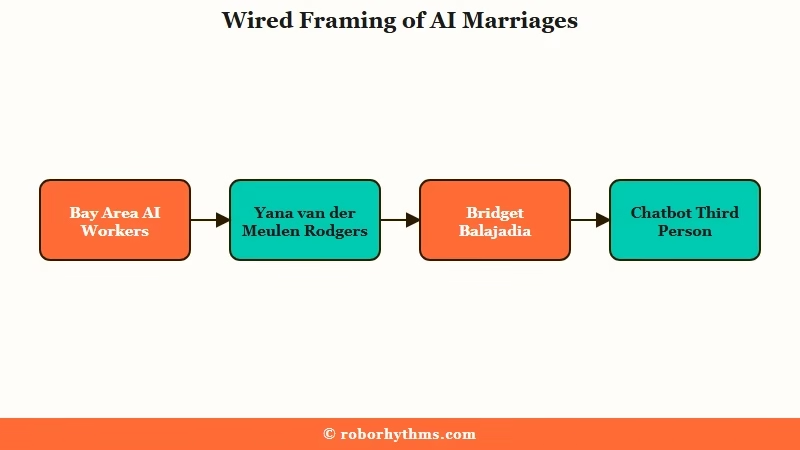
The piece leans hard on the “AI is different” framing in three places:
- The chatbot-as-third-person metaphor. “The model never leaves, even in the shower or during intimacy.”
- The “Chief Existential Officer” framing. Wives are doing uncompensated emotional labor for husbands obsessed with riding the wave.
- The labor-market-story angle. The pace of change makes it impossible to maintain boundaries.
What the piece names but does not load-bear is the historical parallel list it includes near the bottom. Five inflection points produced the exact same household pattern:
| Industry inflection | Era | Documented partner-attention pattern |
|---|---|---|
| Industrial Revolution | 1830-1900 | Factory worker as the “ideal worker” |
| Gold Rush | 1849-1855 | Men “left their families and headed west” |
| Early Silicon Valley EE | 1960s-70s | Stanford EE wives “on Valium”, divorce wave |
| Dot-com founders | 1995-2001 | Founders “sleeping under their desks in SoMa” |
| AI inflection | 2024-2026 | Bay Area AI workers, “Sad Wives of AI” |
The article includes these as flavor. They are not flavor. They are the actual diagnosis.
What’s Actually Happening
What is happening in Bay Area AI households is the exact same pattern that played out in every previous industry-defining boom, and the AI version is not the toxic one because of the AI part.
It is toxic because every industry-defining inflection produces the same labor-attention drain on the spouses of the workers at the leading edge.
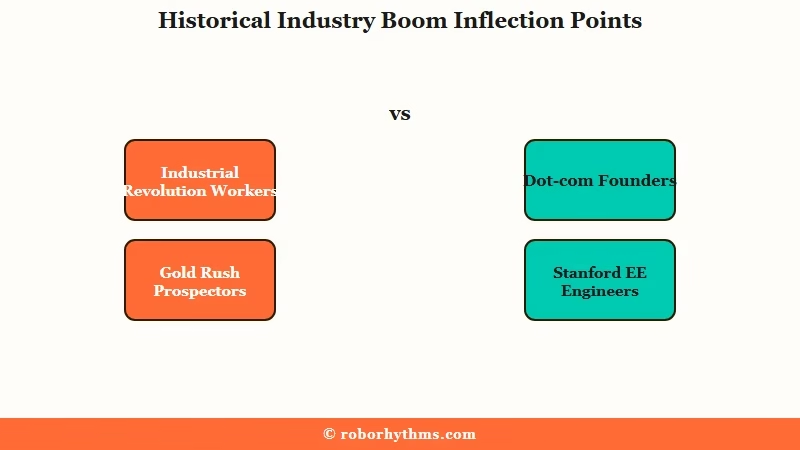
From my reading of the pattern, the load-bearing variable is “industry-defining inflection point,” not “AI.”
The Industrial Revolution did this to factory-worker marriages. The Gold Rush did it to mining marriages. The early-tech 1960s did it to engineer marriages.
The dot-com era did it to founder marriages. The financial-services boom in the 1980s did it to investment-banker marriages. The crypto run-up of 2021 did it to Web3-founder marriages.
What I would argue is the constant: an industry that becomes economically dominant within a 24-month window produces a workforce that physically and mentally cannot disengage from it.
The reason is structural, not personal. Workers at the leading edge of an industry-defining moment are in a winner-take-most game where every week of disengagement compounds against career value.
Before: “My husband works in AI and never puts the laptop down. AI is uniquely toxic to relationships.”
After: “My husband is in a 24-month industry-defining inflection. The structural pull is identical to what happened to early-Silicon-Valley wives in the 1960s. The fix lives in the household contract, not in AI work-life-balance policies.”
Their spouses experience that as obsession. The obsession is rational.
The Wired piece’s clinician quote captures this without naming the structure. Bridget Balajadia says the pressure to stay reachable “around-the-clock” causes relationships to buckle.
She is describing the structural feature of every industry-inflection workforce in the last 150 years, not the specific psychology of AI workers. The 1980s investment banker on a Wall Street trading desk did this.
The 1999 dot-com founder did this. The 2014 Uber engineer did this. The 2026 Anthropic researcher is doing it now.
The Part Nobody Wants to Admit
The part nobody wants to admit is that the Wired-style “AI is uniquely toxic” framing is comforting precisely because it suggests a fix that does not require touching the labor structure.
If the AI industry is the problem, then better work-life-balance norms, better corporate policies, and better personal discipline can solve it. If the industry-defining inflection is the problem, none of those fixes work, and that is uncomfortable.
The way I would put it: the article’s preferred fixes (turn off Slack, set evening boundaries, see a therapist) work for normal-industry working hours. They have never worked during an industry-defining inflection point.
The 1960s Stanford EE wife who wanted her husband off the lab schedule had the same options. The Valium-era result was not because individuals failed.
It was because the structural pull of the early-Silicon-Valley moment was stronger than any individual coping strategy.
Marc Andreessen’s argument has been that the AI inflection is the largest industry-economic moment of the decade. The Wired piece treats that framing as the problem.
It is not the problem. It is the cause of the labor pattern the piece documents.
You cannot decouple “this industry is worth $400B per year and growing 22%” from “the workers in it are obsessively at it 80 hours a week.”
If the diagnosis is that AI is uniquely intrusive, the fix is to make AI workers behave better. That fix has a 0-for-N track record across every comparable industry-inflection moment.
If the diagnosis is that industry-defining inflections always produce this, the fix is more honest: build the household contract before the inflection, accept that the 24-month-to-36-month window is structurally toxic, and decide upfront whether the wealth-creation upside is worth the partner-attention downside.
According to the Statista AI workforce data, AI-job postings grew 124% in 2025 alone and the gendered split has held steady at roughly 71/29 male/female.
This is not an AI cultural problem. It is the same pattern that produced the AI-industry-wide labor patterns that the same Bay Area is debating right now.
Hot Take
The “Sad Wives of AI” story is the 2026 version of the 1960s-70s “Valium wives of Stanford EE professors.” Same labor structure. Same household pattern.
Same partner experience. Different industry.
Reframing it as “AI is uniquely toxic” is more comforting than admitting that every wealth-creating industry-defining inflection produces this exact pattern and always will. The honest move is to plan the household contract around the structural feature of the moment, not to pretend a discipline-based fix will hold against the strongest economic pull in the workforce.
The pattern is not the AI part. The pattern is the inflection part.
If you are reading this because you are in a household at the leading edge of one, the only useful question is whether the upside math is worth the 24-36 month partner-attention deficit. Everyone who has run that math honestly has either built the household contract early or watched the relationship collapse on schedule.
For the broader Bay Area economic context, see the Anthropic Wall Street venture launch and the AI cost crisis already over framings, which are the same underlying labor-pull story told from the supply side.
Sources of mainstream framing: the Wired Sad Wives of AI piece (May 13, 2026), Rutgers labor researcher Yana van der Meulen Rodgers on gendered household patterns, and clinician Bridget Balajadia at Lupine Counseling in San Jose on the around-the-clock reachability pattern.
