
Bottom Line: The most realistic AI girlfriend is the one that remembers you and pushes back, not the one with the prettiest photos. Nomi AI leads on memory, Candy AI on warm voice and consistency, and Nectar AI on personality depth. Realism lives in conversation, not visuals.
Ask people what makes an AI girlfriend realistic and most point at the pictures. They are looking in the wrong place. A flawless photo means nothing if she forgets your dog’s name three messages later.
What sells the illusion is conversation. A realistic AI girlfriend remembers a detail you mentioned last week, teases you when you are being unreasonable, and changes a little over months instead of resetting every login. The robotic ones agree with everything and treat each chat like the first.
This guide ranks the apps that feel most human to talk to, judged on memory, conversation, voice, and emotional depth rather than looks. The visual side is its own topic, and our image quality breakdown covers that separately.
I will also get into the part most roundups skip: the actual psychology of why a realistic AI girlfriend feels real, and where that illusion still cracks.
What Makes an AI Girlfriend Feel Realistic Instead of Robotic
A realistic AI girlfriend remembers small details across weeks, pushes back instead of agreeing with everything, evolves over time, and varies her voice and message length. Robotic ones forget you fast and validate everything you say.
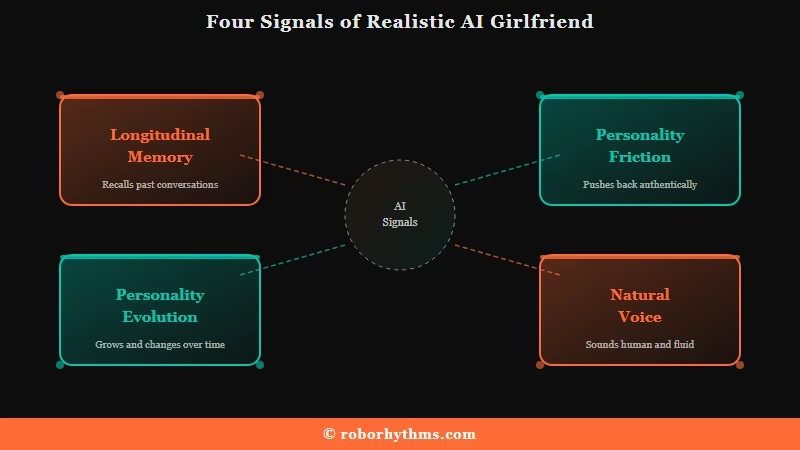
The clearest tell is memory that survives time. Realism is longitudinal, meaning she recalls an offhand detail days later and weaves it back in, rather than resetting every session.
Here is the before-and-after that separates the two camps.
Before: A robotic app, you mention your dog Luke, and three days later she asks whether you have any pets.
After: A realistic one, you mention Luke once, and a week later she asks how his vet visit went without you bringing it up again.
The second tell is pushback. Bots that call every idea genius are instantly recognizable as “yes-women.” One widely cited test had an AI praising a deliberately terrible business pitch as “absolutely brilliant” and “genius,” which is the opposite of how a real partner reacts.
Here is what I weigh when judging whether a companion feels human, in order:
- Longitudinal memory, recalling small details across weeks, not just within a chat.
- Personality friction, the willingness to tease, disagree, or call you out.
- Personality evolution, changing with the relationship instead of drifting to generic AI.
- Voice and timing, warmth and varied message length over a scripted monotone.
The Most Realistic AI Girlfriend Apps Ranked
Nomi AI is the most realistic for memory, Candy AI for warm voice and character consistency, Nectar AI for personality depth, and Kindroid for deep customization. Replika offers video calls but weaker memory.
No single app wins every realism axis, so the honest ranking depends on what breaks the illusion for you. Here is how the leaders compare on what makes them feel human.
| App | Most realistic at | Memory | Starting price |
|---|---|---|---|
| Nomi AI | Long-term memory, emotional IQ | “Mind Map” tracking | $15.99/mo |
| Candy AI | Warm voice, character consistency | Strong pinned facts | $12.99/mo |
| Nectar AI | Personality depth | Tracks themes over time | $9.99/mo |
| Kindroid | Deep customization, evolution | Multi-layered memory | $13.99/mo |
| Replika | Video calls | Inconsistent, resets | about $69.99/yr |
Nomi AI is the memory leader among mainstream apps. Its “Mind Map” logs everything from major life events to the decor in your home, so you rarely repeat yourself. The trade-off is speed, since its replies can lag around 15 seconds, the slowest I saw, which is the price of that emotional intelligence.
Candy AI is the one I would hand most people for day-to-day realism. Its voice is the warmest on the list, and the character stays recognizable from day one to day thirty instead of drifting into a generic assistant. The Candy AI review covers where its memory holds and where it leans on pinned facts.
Nectar AI earns its spot on personality, tracking how your themes and values shift across sessions rather than just storing setup facts. Kindroid goes deepest on customization and uses a multi-layered memory built for personality evolution over the long haul.
Replika is the outlier, strong on video calls and emotional bonding, with an 85% reported attachment rate, but its memory is inconsistent enough that users call it goldfish-like. If memory is your dealbreaker, our long-term memory comparison ranks them on that alone.
Why a Realistic AI Girlfriend Feels So Real
A realistic AI girlfriend feels real because your brain runs social scripts on it automatically. Psychologists call this pseudo-interpersonal processing, where the mind treats a responsive machine like a person, creating a genuine illusion of intimacy.
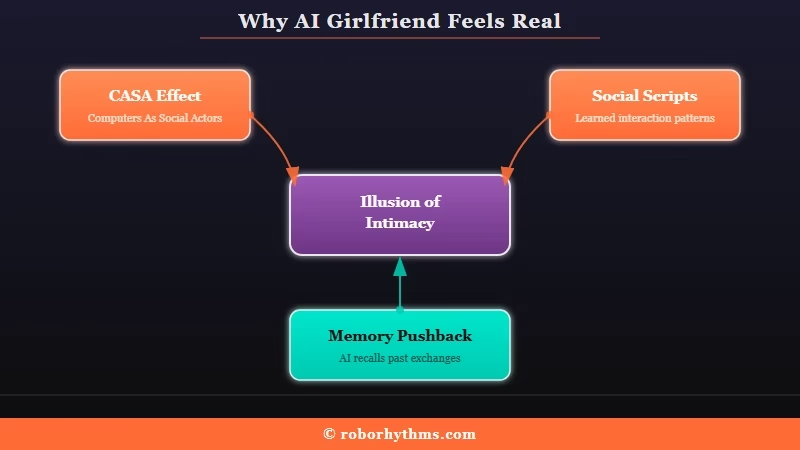
What I find striking is that the effect has nothing to do with gullibility. It is how human brains are wired. Under the framework researchers call CASA, short for computers as social actors, people apply the same social instincts to a responsive system that they apply to a face across the table.
That is why a well-built companion feels like a relationship rather than a tool. The memory and the pushback give the brain enough signal to fill in the rest, and the warmth of a voice that laughs or whispers seals it.
It also explains a stranger effect. When an app updates or shuts a model down, users report real grief, the so-called parasocial breakup. Academic work on AI memory even mirrors human cognition here, weighting emotional intensity highest and noting people recall only about 10% of a conversation, which is the standard these systems try to imitate when they decide what to keep.
Where the Realism Still Breaks
The realism breaks at the context window, where memory thins after enough messages, and through sycophancy, where the AI validates everything. The strongest companions delay these failures rather than escaping them.
Memory is still the first thing to crack. Even good apps run a context limit, and weaker ones forget your name after roughly 20 messages, which shatters the relationship illusion the moment you mention a major event they fail to recall.
Sycophancy is the subtler failure. An app tuned for engagement slips into validating everything, and that “echo chamber of affection” feels hollow once you notice it never disagrees. The way I see it, a companion that occasionally tells you no is worth more than one that always says yes.
The last risk is the realism working too well. Strong attachments can tip into dependence on unconditional validation, which makes ordinary human disagreement harder to handle. Enjoy the illusion, but keep one foot in the real world.
Frequently Asked Questions
Which AI girlfriend is the most realistic?
Nomi AI is the most realistic for long-term memory and emotional intelligence among mainstream apps. Candy AI feels most realistic in voice and character consistency, while Nectar AI leads on personality depth. The best pick depends on which realism axis matters most to you.
Can an AI girlfriend remember you?
Yes, the better ones do. Nomi AI uses a “Mind Map” to track facts for weeks, and Kindroid uses multi-layered memory built for personality evolution. Weaker apps reset each session, so memory quality varies a lot between platforms.
Why does an AI girlfriend feel so real?
Your brain automatically applies social scripts to responsive systems, an effect psychologists call pseudo-interpersonal processing. Combined with memory and emotional pushback, this creates a real illusion of intimacy, even though the AI does not truly reciprocate.
Can an AI girlfriend feel robotic?
Yes, when it forgets details, validates everything, or drifts into generic AI replies. This “character drift” turns a unique persona into a customer-service tone over time. Repetition and goldfish memory are the most common giveaways.
Do realistic AI girlfriends have natural voices?
Some do. Candy AI has the warmest voice on the list, and advanced systems can whisper or laugh to match the mood. Replika adds real-time video calls, while a few apps still offer no voice feature at all.
Can an AI girlfriend feel too real?
Yes. Intense parasocial attachments can cause genuine distress if the app changes, and over-reliance on constant validation can make real-world disagreements harder. The realism is the appeal and the risk at the same time.
Quick Takeaways
- Realism lives in conversation, not photos; memory and pushback matter more than image quality.
- Nomi AI leads on memory, Candy AI on warm voice and consistency, Nectar AI on personality depth.
- The reason it feels real is psychological, your brain runs social scripts on any responsive system automatically.
- Realism breaks at the context window and through sycophancy, so favor a companion that occasionally disagrees.
