
What Happened: Pope Leo XIV released his first encyclical Magnifica Humanitas on May 25, 2026 at the Vatican Synod Hall. Anthropic co-founder Christopher Olah was the only AI industry figure on stage. The Vatican publicly endorsed interpretability research as the AI safety practice that protects human dignity.
This is one of those days where the press release is more interesting than the document. Pope Leo XIV released Magnifica Humanitas this morning at the Vatican Synod Hall, his first encyclical and the first papal encyclical specifically on artificial intelligence. The text itself reads the way you would expect: dignity, faces and voices, the human person not reducible to its outputs.
What everyone is talking about is the stage. Sitting next to Cardinal Víctor Manuel Fernández (doctrine) and Cardinal Michael Czerny (development), with Cardinal Pietro Parolin (Secretary of State) delivering closing remarks, was Christopher Olah, co-founder of Anthropic and the company’s Director of Research on the Interpretability of Artificial Intelligence.
No one from OpenAI. No one from Google DeepMind. No one from Meta or Microsoft.
The way I see it, the guest list at a Vatican launch like this is the message. The Church just told 1.4 billion Catholics that one specific safety practice, interpretability research, is the one it considers protective of the human person. I think this re-prices the AI safety conversation in a way most coverage will miss.
What the Magnifica Humanitas Encyclical Says
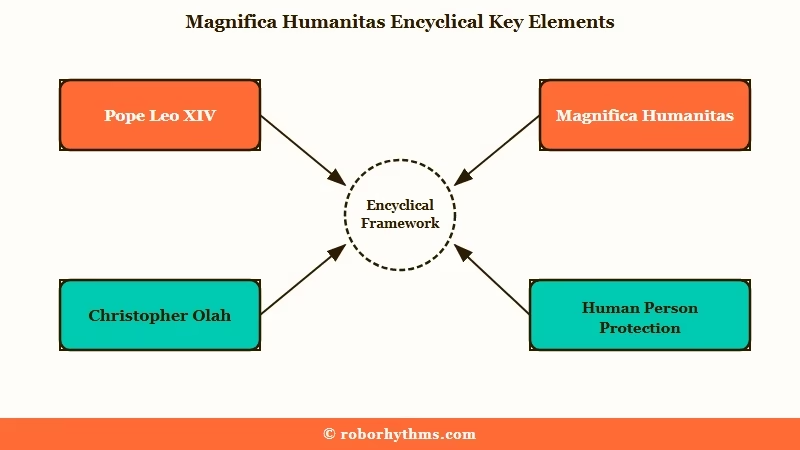
The Magnifica Humanitas encyclical is Pope Leo XIV’s first encyclical and the first papal encyclical on AI, released May 25, 2026 at the Synod Hall with Anthropic’s Christopher Olah as the sole AI industry voice on stage. Catholic doctrine and development chiefs, plus two academic theologians, joined them.
The full roster surfaced over the weekend through Vatican briefings and confirmation from the National Catholic Reporter and PBS NewsHour.
Headline speakers at the Synod Hall, in the order they appeared on the printed program:
- Cardinal Víctor Manuel Fernández, prefect of the Dicastery for the Doctrine of the Faith
- Cardinal Michael Czerny, prefect of the Dicastery for Promoting Integral Human Development
- Cardinal Pietro Parolin, Vatican Secretary of State, delivering closing remarks
- Anna Rowlands, professor of political theology and social doctrine at the University of Durham
- Léocadie Lushombo, professor of theological ethics at the Jesuit School of Theology, Santa Clara University
- Christopher Olah, co-founder of Anthropic and its Director of Research on the Interpretability of Artificial Intelligence
The document the Vatican released uses unusually direct language. Three lines have already been published in precursor materials. Read them as the editorial position the Pope is staking out:
“We need faces and voices to speak for people again. We need to cherish the gift of communication as the deepest truth of humanity.”
“The challenge is not technological, but anthropological. Safeguarding faces and voices ultimately means safeguarding ourselves.”
“By simulating human voices and faces, wisdom and knowledge, consciousness and responsibility, empathy and friendship, the systems known as artificial intelligence not only interfere with information ecosystems, but also encroach upon the deepest level of communication, that of human relationships.”
The third line is the load-bearing one. From what I read in the prepared text, the Church is not framing AI as a tool that can be regulated or misused. It is framing AI’s mimicry of human signal (face, voice, empathy) as the harm itself, regardless of intent. That is a much higher bar than the secular AI policy world has been working from.
The secular AI safety debate covers how this maps to the conversation that has been running parallel for the past two years.
Why This Is a Bigger Deal Than It Sounds
The selection of Anthropic over OpenAI is the strongest public endorsement of interpretability research to date.
Olah does not run product or sales. He runs the lab that tries to read what is going on inside model weights.
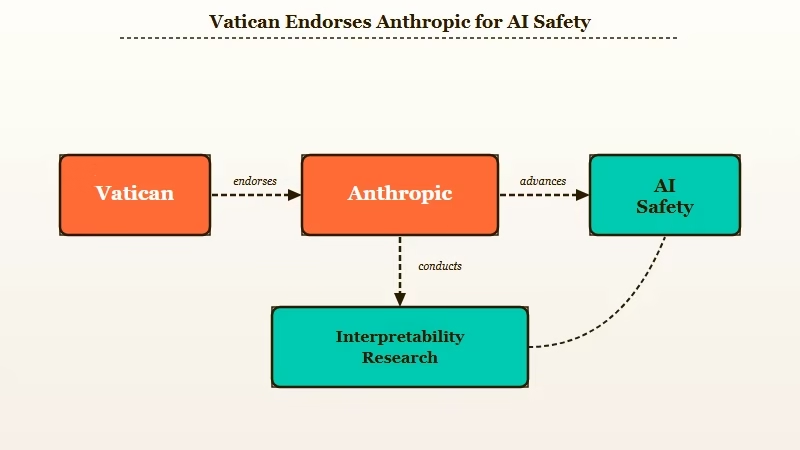
Inviting him specifically signaled which strand of AI safety the Vatican considers credible.
The way I see it, the Vatican gave its reason out loud. From the briefing materials surfaced in eWeek’s coverage, the official framing for the Anthropic pick reads: “Anthropic’s very name, an adjective for that which is human-related, is an affirmation of its priorities in AI development, which significantly align with those expressed by the Vatican.”
Two other reasons came up repeatedly in Vatican briefings: the company’s refusal to allow Claude to be used for mass domestic surveillance of Americans, and its refusal to allow Claude in fully autonomous weapons systems.
Here is the framing shift in one block:
Before: AI ethics was a Silicon Valley conversation, mostly run between OpenAI’s policy team, academic AI safety researchers, and a handful of EU bureaucrats.
>
After: AI ethics has a 1.4-billion-strong constituency, and Anthropic is the in-house voice for “AI safety done correctly.”
The Pope is not arbitrating who has the better model. He is arbitrating which safety culture deserves cultural legitimacy. That distinction matters because cultural legitimacy is exactly what the AI industry has been short of for two years.
There is also the political subtext. In March 2026, the Pentagon designated Anthropic a “supply chain risk,” reportedly because Anthropic refused to relax safeguards around lethal autonomous weapons and mass surveillance.
U.S. District Judge Rita Lin blocked that designation on March 26 in a 43-page ruling that, per CBS News reporting, called the administration’s move “Orwellian” and noted that amicus briefs framed the measures as “attempted corporate murder.”
Less than eight weeks after that ruling, the same company is the one on stage with the Pope. The narrative repositioning is hard to overstate.
Anthropic vs OpenAI enterprise share is now running on two engines: market position and institutional legitimacy.
What This Means for You
For AI tool users and builders, today is a permission-slip moment. The Vatican just elevated a specific kind of safety work, interpretability and refusal-of-weaponization, as the practices a 1.4-billion-person community considers consistent with human dignity.
From what I have seen, that gives anyone using or building with Anthropic’s tools a defensible answer to “is this ethical.”
The way I would think about the practical fallout:
| If you are… | What today’s news shifts |
|---|---|
| A solo creator or operator | Adopting Claude in client work just got an institutional cover story competitors using OpenAI tools cannot match yet. |
| An enterprise buyer | Procurement has a non-technical, non-EU, non-American legitimacy signal to point at when defending an Anthropic-first stack. |
| An AI policy person | The “interpretability is the right safety frame” argument moved from a research subculture position to a globally endorsed one. |
| A skeptic of AI hype | The encyclical is the first major institutional voice that names AI’s mimicry of human signal as the harm, not just AI’s misuse. |
| A Catholic in any of the above roles | You now have a doctrinal document you can cite in your own decision-making about which AI tools to use and how. |
The deeper signal, from what I have seen of how Catholic social teaching has moved historically, is that Magnifica Humanitas is not a one-document statement. It is the start of a doctrinal stack.
The precursor Antiqua et nova was published January 28, 2025 by the Doctrine for the Faith dicastery and set the philosophical scaffolding (the distinction between ratio and intellectus, why AI can do one and not the other). The Pope also approved a new interdicasterial commission on AI earlier this month to coordinate Vatican-wide policy. Today’s encyclical sits on top of both.
In other words: this is not a press moment. It is the public release of a multi-year work product. Anthropic’s longer strategic positioning becomes very different to think about when one of the largest non-state institutions on Earth has publicly aligned with its safety posture.
What Comes Next
Three follow-on shoes are likely to drop within the next 12 months: Anthropic adds a religious-traditions advisory body to its safety org, EU AI Act enforcement starts citing the encyclical in alignment context, and OpenAI plus Google publish their own ethics-and-religion engagement playbooks to close the legitimacy gap.
Per Anthropic’s May 19 statement reported in America Magazine, the company has been “organizing dialogues with groups whose work and traditions bear on the questions raised by AI” and its “first round of discussions has been with wisdom traditions, including scholars, clergy, philosophers, and ethicists from more than 15 religious and cross-cultural groups.” Translation: the Vatican was not a one-off press event. It was the highest-profile stop on a deliberate institutional tour.
What I would watch from here: the interpretability research thread getting more funding and more public surface area, the Vatican AI commission’s first formal output (probably a set of usage guidelines for Catholic-run schools, hospitals, and dioceses, arriving inside Q3 2026), and whether Olah is invited to subsequent Vatican events. If he is, the relationship has moved from one-off to standing.
What I will be watching personally is whether the encyclical reframes EU AI Act enforcement around “anthropological harm” rather than just “model misuse.” That would be the moment the document crosses from religious doctrine into actual regulatory leverage.
