
The Bottom Line:
- Free, unlimited AI image generation with no account, no credits, and no paywalls
- Built and funded entirely by one solo developer with a mission to make creative AI accessible
- Image quality competes with paid tools like Midjourney and DALL-E 3 for most casual and creative use cases
- Content filters are far less restrictive than competitors like Google Gemini, giving users real creative freedom
- Character chat works well for short sessions but lacks the depth of dedicated platforms like Candy AI or Nectar AI
- The open generator framework lets the community build and share niche tools that do not exist anywhere else
- Long-term sustainability depends on one person’s resources and motivation, so save your work locally and use the platform while it thrives
Every week, a new AI image generator launches with the same pitch. Free to try, easy to use, no experience needed. Then you sign up, burn through five free credits, and hit a paywall before you have made anything worth keeping.
The cycle is so predictable that most people have stopped believing “free” actually means free.
Perchance breaks that cycle. This browser-based platform lets you generate unlimited AI images without creating an account, entering a credit card, or watching a countdown timer drain your daily allowance.
You open the page, type a prompt, and download what it gives you. No watermarks. No premium tier dangled in front of you. No catch that reveals itself three sessions in.
What makes this even harder to believe is the story behind it. Perchance is not backed by a startup with venture funding or a tech company testing a loss leader strategy.
One solo developer built the entire platform, maintains it, and pays for the servers out of pocket. The project runs on minimal advertising and a philosophy that access to creative AI tools should not depend on your wallet.
The platform has quietly built a dedicated following, especially on Reddit, where users discuss it with a mix of genuine enthusiasm and almost anxious protectiveness. People do not just like Perchance.
They worry about what happens if too many people find out about it. That kind of loyalty tells you something no feature list ever could.
This review covers how the platform actually performs, where it falls short, how it compares to paid alternatives, and whether a one-person passion project can survive in a space dominated by companies burning through millions in funding.
If you have been curious about Perchance or skeptical that anything this generous can actually deliver, this is the breakdown you need.

What Perchance AI Offers and How It Works
Perchance is a web-based creative platform built around a simple idea. Give people free tools and let them build on top of them. The most popular feature right now is AI image generation, but the platform goes well beyond that.
It hosts character chat, story generators, random list tools, and a growing library of community-built generators that cover everything from fantasy name creation to full interactive fiction.
The image generator is the main draw. You visit the page, type a text prompt describing what you want, and the system produces an image in seconds.
There is no queue, no token system, and no daily cap. You can generate fifty images in a row without the platform slowing you down or asking you to upgrade. The output quality is competitive with tools that charge monthly subscriptions, which is exactly why the platform has gained such a loyal user base.
What separates Perchance from most competitors is its open framework. The platform is not just a product you consume. It is a system you can build on. Any user can create their own generator using a lightweight scripting language, publish it on the site, and share it with others.
This means the tool library keeps expanding without the solo developer needing to build every feature personally. Some generators are polished and well-maintained. Others are rough experiments.
That unevenness is the tradeoff of an open system, but it also means you will find niche tools on Perchance that simply do not exist anywhere else.
The character chat feature deserves its own mention. While it launched as a secondary feature alongside image generation, it has grown into a legitimate alternative to dedicated AI chat platforms.
Users can create characters, define personalities, and engage in open-ended conversations without the rigid guardrails that frustrate users on bigger platforms.
The experience is not as refined as what you get from purpose-built tools like Candy AI or Nectar AI, but the zero-cost, no-account entry point makes it a strong starting option for anyone exploring AI character interaction for the first time.
How Perchance Handles Content Freedom Differently Than Competitors
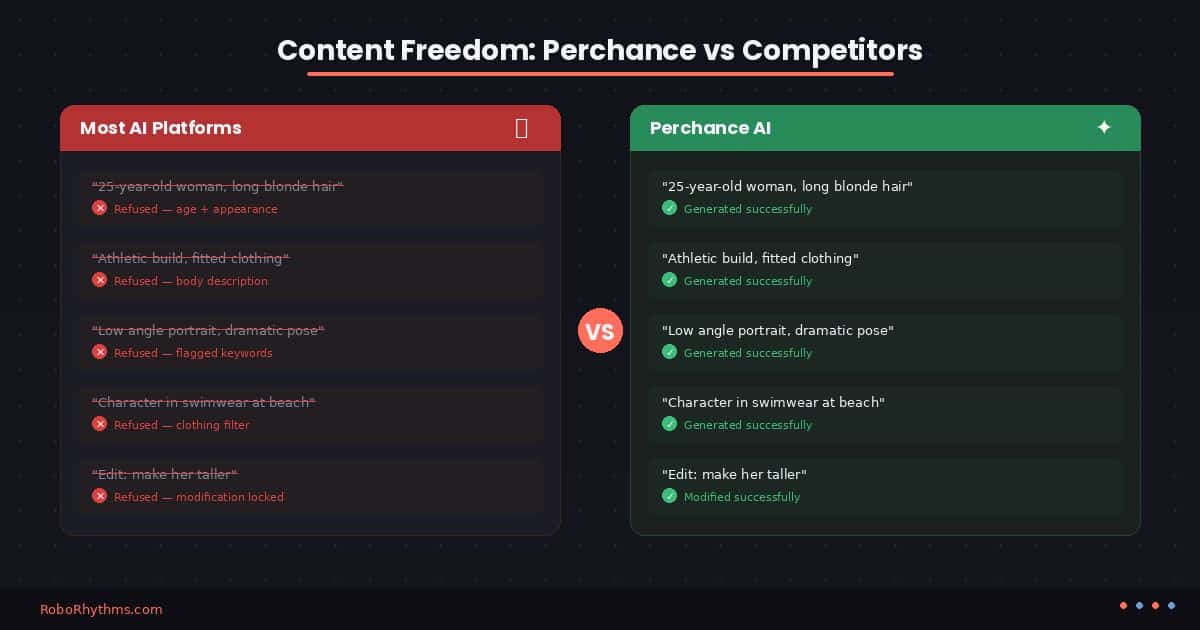
One of the biggest reasons users stick with Perchance is something that rarely shows up in feature comparison charts. Creative freedom.
Most AI image generators apply aggressive content filters that block not just explicit material, but perfectly ordinary prompts that happen to contain certain words.
The problem is widespread. Try describing a character’s physical appearance on platforms like Google Gemini and you will often hit a wall.
Words related to body shape, age, clothing fit, or basic anatomy trigger refusals or locked outputs, even when the request is completely innocent. One well-known frustration involves asking Gemini to generate a young adult character with specific features and being given either an elderly figure or an outright refusal.
The filters on many platforms do not distinguish between harmful intent and normal creative direction, which punishes the vast majority of users who are simply trying to describe what they want accurately.
Perchance takes a different approach. The platform trusts its users to make their own creative choices and does not lock prompts behind keyword blacklists.
You can describe characters with specific physical traits, request particular clothing styles, and explore a wide range of artistic themes without the generator freezing up or demanding payment to continue.
This does not mean there are zero guidelines, but the overall philosophy leans heavily toward creative openness rather than preemptive restriction.
That philosophy matters beyond personal convenience. Artists, writers, game designers, and hobbyists all rely on AI image tools to prototype ideas quickly.
When a platform blocks basic descriptive language, it does not just create a minor inconvenience. It breaks the creative workflow entirely.
Perchance avoids that problem, and for many users, that single quality is enough to make it their default tool regardless of what other features competitors might offer.
One Solo Developer Changes Everything About This Platform
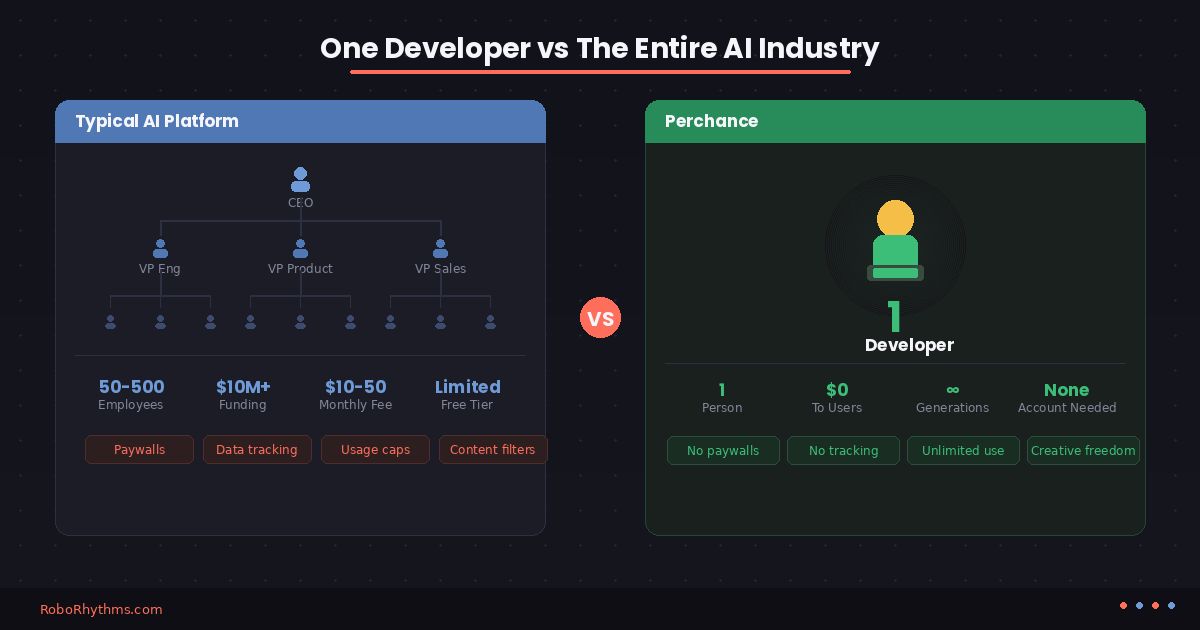
Most AI platforms are built by teams of engineers, designers, and product managers backed by millions in funding. Perchance runs on the opposite model entirely.
One person built it, one person maintains it, and one person pays the server bills. That single fact shapes everything about how the platform feels, operates, and evolves.
The developer has kept a low profile, but their philosophy is well documented. Perchance exists to inspire people who are interested in coding.
The open generator framework is not just a product feature. It is a teaching tool. Anyone can look at how existing generators work, learn from them, and build their own.
That educational mission is baked into the platform at a structural level, which is rare for any tool in this space.
Running a platform this way creates real advantages that users notice immediately:
- No corporate incentives to monetize aggressively. There is no board of investors pushing for subscription tiers, usage caps, or premium paywalls. The developer makes enough through small, non-intrusive ads to keep things running.
- No bloated feature roadmap. Features get added because they are useful, not because a product team needs to justify its headcount or hit a quarterly milestone.
- No data harvesting. With no account required, there is no profile to build, no usage data to package, and no personal information to sell to third parties.
- No committee-driven content policies. Content guidelines reflect one person’s judgment rather than a legal team’s worst-case scenario planning, which is why the platform feels less restrictive than corporate alternatives.
The downside is just as real, though. One person means one point of failure. If the developer gets sick, burns out, or simply loses interest, the entire platform could stall or disappear.
There is no support team to contact when something breaks. Updates happen on one person’s schedule. The community knows this, and it fuels a quiet anxiety underneath all the enthusiasm.
People love Perchance partly because they know it could vanish, which makes them value it more while it lasts.
How Perchance Compares to Paid AI Image Generators
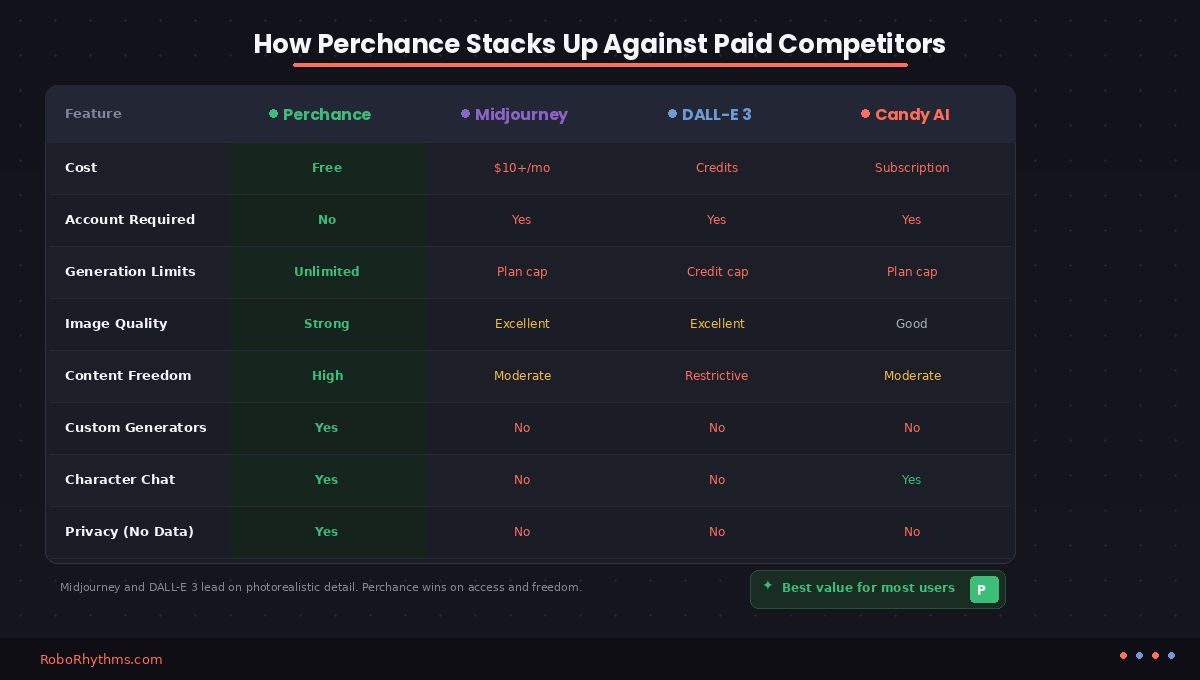
Perchance exists in a market crowded with well-funded competitors, and the honest question most people have is whether free and unlimited actually means a drop in quality.
The short answer is that Perchance holds up surprisingly well, but it does not beat every paid tool in every category.
Here is how it stacks up across the areas that matter most:
| Feature | Perchance | Midjourney | DALL-E 3 | Candy AI |
|---|---|---|---|---|
| Cost | Free | Starts at $10/month | Credits-based | Subscription |
| Account required | No | Yes | Yes | Yes |
| Generation limits | Unlimited | Plan-dependent | Credit-dependent | Plan-dependent |
| Image quality | Strong | Excellent | Excellent | Good |
| Content flexibility | High | Moderate | Restrictive | Moderate |
| Custom generators | Yes | No | No | No |
| Character chat | Yes | No | No | Yes |
| Mobile app | No | Yes | Yes | Yes |
Midjourney and DALL-E 3 still produce higher-fidelity images on complex prompts, especially for photorealistic output and fine detail work.
If you need portfolio-grade visuals or production-level assets, those tools earn their price tags. Where Perchance closes the gap is on creative flexibility, volume, and accessibility.
You can experiment freely without worrying about wasting credits on a prompt that does not land the way you hoped.
For character chat specifically, Candy AI and Nectar AI offer more polished conversation experiences with deeper memory and personality consistency over long sessions.
Perchance chat works well for casual interaction and short creative scenarios, but it can fall into repetitive phrasing loops during extended conversations.
The tradeoff is that Perchance lets you start chatting instantly without handing over an email address, which matters to users who prioritize privacy.
The real value of Perchance is not that it beats every paid tool feature for feature. It is that the platform removes every barrier between you and your first result. No sign-up friction. No payment anxiety. No credit math.
For exploration, experimentation, and casual creative work, that frictionless entry point is worth more than a marginal bump in output quality.
How to Get the Best Results From Perchance Image Generation
The gap between a mediocre Perchance output and a great one almost always comes down to how you write the prompt.
The platform responds well to detail, and users who invest a few extra seconds in their descriptions get dramatically better results.
A strong prompt on Perchance follows a loose structure that covers these elements:
- Subject. What is in the image? Be specific. “A woman standing in a forest” produces something generic. “A tall woman in a dark green cloak standing between birch trees at dusk” gives the model something to work with.
- Style. Name an art style or visual reference. Watercolor, oil painting, anime, cyberpunk, studio photography, and comic book art all push the output in distinct directions.
- Lighting and mood. Words like “soft golden hour light,” “dramatic shadows,” or “overcast and moody” shape the atmosphere of the image more than most people expect.
- Composition. Tell the generator what the camera is doing. Close-up portrait, wide landscape, overhead view, and low-angle shot all change the framing significantly.
- Negative prompts. If the generator supports them, specify what you do not want. “No text, no watermark, no extra fingers” can clean up common AI artifacts.
Beyond prompting, take time to explore the generator library. The main image generator is the most popular, but community members have built specialized tools tuned for anime portraits, fantasy landscapes, pixel art, and realistic photography.
Each one interprets prompts slightly differently, so switching generators can sometimes fix an output problem that no amount of prompt editing will solve.
One practical habit worth building early: download everything you like immediately. Perchance does not save your history. Close the tab, and your generations are gone.
There is no gallery, no cloud backup, and no account to log back into. What you do not save, you lose.
Is Perchance AI Sustainable Long Term
This is the question that hangs over every conversation about the platform. A free, unlimited AI tool funded by one person sounds too good to last, and the community knows it.
The current model works because the developer keeps costs lean. Minimal advertising covers server expenses, and the open generator framework means the community builds most of the new features without needing to be paid.
There is no office, no staff, and no investor expecting a return. That simplicity is the reason Perchance can offer what it does at zero cost.
The risk is scale. Every new user adds server load, and AI image generation is not cheap to run. A single viral moment from a large content creator or social media post could send traffic spiking beyond what the current infrastructure can handle.
The community has expressed this concern repeatedly, with many users actively discouraging people from sharing Perchance too widely.
There is also the question of longevity on a personal level. One developer means one person’s motivation, health, and financial situation hold the entire project together.
There is no succession plan, no open-source codebase that others could fork, and no public roadmap promising long-term commitment.
The developer has said Perchance exists to inspire others interested in coding, which is a generous mission, but not one that guarantees the platform will still be here in five years.
None of this means Perchance is about to disappear. The platform has been running steadily and the developer has shown consistent dedication.
But anyone building a creative workflow around Perchance should treat it as a powerful tool that exists right now rather than a guaranteed permanent resource.
Use it fully, appreciate what it offers, and keep local copies of anything you create.

Perchance had over 40 million visitor last month with a longer than average time on site. this is an insane amount of money for one person to foot the bill. i theorize that they site is run by frontier ai companies who need real world examples of how humans interact with their models. Being secretive about it makes sense.
Makes a lot of sense!