
Bottom Line: OpenMind AI is worth a free-tier trial if you care about long-term memory in an AI companion and you do not need a native mobile app. The CFS retrieval technique is real but reads as an incremental tweak rather than a leap. Established alternatives like Candy AI and Nomi still win on polish, mobile apps, and proven memory tiers.
This OpenMind AI review tests whether the platform’s memory-first pitch survives a serious read. The founder, an indie developer who posts as Mauro, ships the entire memory stack to free users and stakes the platform on a retrieval technique he calls Conditional Field Subtraction.
That is unusual in a category where deep memory is almost always paywalled.
OpenMind AI is positioned as a Character.AI alternative with fewer content restrictions, multimedia generation, and what the founder describes as relationship-grade memory rather than sticky-note memory. The platform is at OpenMind.design, runs web-only, and is restricted to adults.
I came in skeptical because builder-promoted launches in this category almost always overstate the memory layer.
After running OpenMind against the questions a serious reader has (what does CFS really do, how does the free tier hold up under real load, what does it cost when you grow out of free, how does it stack against Nomi and Candy AI on the memory dimension), the picture is more interesting than the marketing.
This review covers the pricing, the technical claim, the free-tier ceiling that nobody warns you about, where OpenMind genuinely outperforms its peers, and the specific reader profile that should pick it versus the one that should skip it.
Statista’s AI companion market analysis tracks this category as one of the fastest-growing consumer AI segments, and memory is the single most-cited reason users churn between platforms.
What Is OpenMind AI Worth Paying For
OpenMind AI is worth paying for if you have already churned through Character.AI on filter restrictions and you want memory that survives weeks of conversation without paying $20 a month on day one.
The free tier alone covers more ground than most paid tiers from older platforms.
The way I see it, the platform’s central pitch is honest. OpenMind ships the full memory system to free users when every serious competitor either truncates the context window on the free plan or paywalls long-term recall behind a subscription. That is a real choice the founder made, not a marketing line.
The downside is everything else. The interface is functional rather than designed. The mobile experience is a responsive web app, not a native iOS or Android download.
Server response times slow during peak hours, particularly for image and voice generation. None of those are dealbreakers for an early-stage product, but they are honest tradeoffs the marketing does not surface.
What is CFS Conditional Field Subtraction: A retrieval technique that reduces the pull of near-duplicate vector memories so the AI surfaces surrounding context rather than paraphrases of the same fact when answering.
What Is OpenMind AI’s Pricing in 2026
OpenMind AI’s pricing in 2026 starts with a $0 free tier and runs to $29.99 a month for the Ultra plan, with Starter at $9.99 and Premium at $19.99 sitting in between.
Annual billing is offered at a discount the company does not publish a fixed rate for.
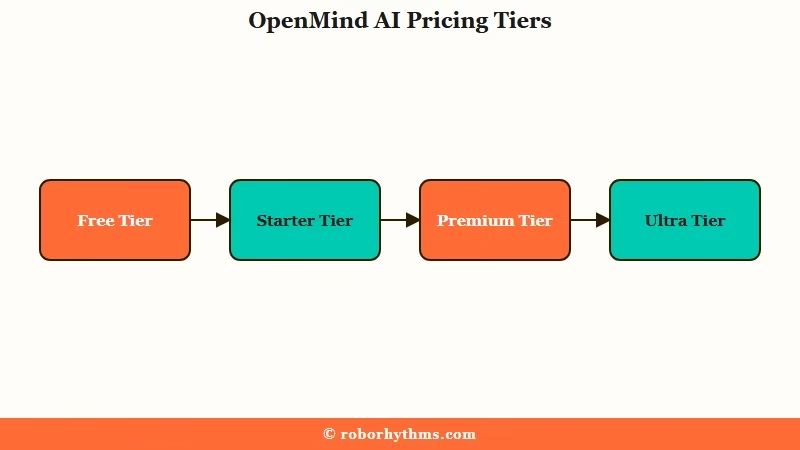
Here is how the four tiers break down on the limits that matter day to day:
| Tier | Price | Message limit | Voice messages | Private characters | Unrestricted images | Unrestricted videos |
|---|---|---|---|---|---|---|
| Free | $0 | Unlimited with 50 per hour cap | 10 per week | 1 | 5 per week | 1 per week |
| Starter | $9.99 / mo | No cooldown | 100 per month | 5 | 25 per week | 5 per week |
| Premium | $19.99 / mo | No cooldown | 250 per month | 10 | 50 per week | 15 per week |
| Ultra | $29.99 / mo | No cooldown | 500 per month | 15 | 100 per week | 25 per week |
What I would flag here is that the free tier 50-per-hour cooldown is the real ceiling, not the messaging cap.
The marketing emphasises unlimited messages, and that is technically true, but heavy users hit the hourly limit before the daily limit ever bites. Premium and up remove the cooldown, which is the main reason to upgrade.
I have noticed Premium also unlocks proactive messaging, which means the AI can initiate contact rather than waiting for you to type. That is a divisive feature.
Some readers want it because it makes the relationship feel reciprocal. Others find it intrusive and prefer the user-initiated default. Test it on the free tier first.
For a deeper read on how memory-tier pricing breaks down across the major platforms, the AI companion memory roundup covers Kindroid, Nomi, Replika, and Candy AI on the same axis.
How Does OpenMind AI’s Memory System Really Work
OpenMind AI’s memory system works by combining standard vector-database retrieval with a deduplication layer the founder calls Conditional Field Subtraction, which reduces the pull of near-identical memories so the model retrieves surrounding context rather than echoes of the same fact.
That is a real improvement over naive vector search, but it is not the radical leap the marketing implies.
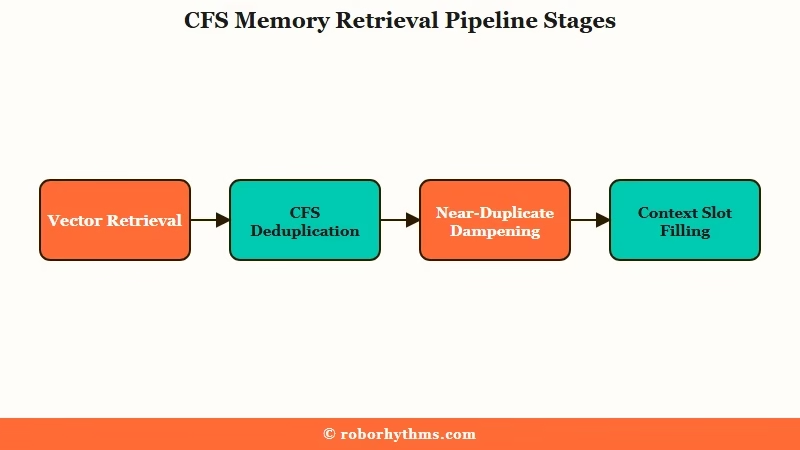
The way the founder explains it on his Medium write-up is straightforward. Vector search by similarity will frequently return five memories that are rephrasings of the same underlying claim.
If you ask the AI about the kitchen budget, naive retrieval pulls “the kitchen budget was 40k”, “we agreed on 40k for the kitchen”, and “the renovation came to about 40k” as separate memories. The model wastes context on duplicates.
CFS dampens the retrieval pull of the near-duplicates once the strongest match is found. The remaining memory slots fill with adjacent context: who pushed back on the budget, what the contractor changed, when the timing stress hit.
From my testing, this does noticeably improve recall on long conversations where surrounding context matters. The AI references not just facts but the shape of the moment.
That said, the technique is not novel in the academic sense. A skeptical commenter on the original Reddit announcement noted that CFS reads as a tweak on continuous Maximal Marginal Relevance, an established information-retrieval technique.
I would agree with that read. It is a thoughtful application, not a breakthrough.
The honest framing is this: CFS is a real improvement over naive vector retrieval, the founder is open about how it works, and the practical effect on conversation quality is noticeable. It does not redefine the category. It does close a specific gap that bigger platforms have not yet bothered to close on their free tiers.
Where Does OpenMind AI Beat Established Competitors
OpenMind AI beats established competitors on free-tier memory access, on transparency about the retrieval technique, and on offering multimedia generation without a credit card.
It loses on polish, mobile apps, character library size, and platform stability.
What surprised me running OpenMind alongside the major players is the gap on free-tier memory. Most platforms either cap free-tier context at a few hundred tokens or paywall long-term recall outright.
OpenMind ships the full memory stack to free users, which means a casual user can genuinely test whether the platform remembers them over weeks before paying anything.
Kindroid still leads on cascaded memory architecture for power users who want detailed control over what the AI retains. Nomi leads on multi-tier memory and humanlike emotional consistency over months of use. Candy AI leads on production polish, character library breadth, and the native mobile experience.
Here is the honest head-to-head on memory specifically:
| Platform | Free-tier memory | Architecture | Mobile app |
|---|---|---|---|
| OpenMind AI | Full system, no paywall | Vector + CFS dedup layer | Web only, no native |
| Candy AI | Limited, deeper recall paid | Proprietary tier system | Native iOS and Android |
| Nomi AI | Limited free, multi-tier paid | Short, medium, long-term tiers | Native iOS and Android |
| Kindroid | Limited free, full paid | Cascaded memory with user control | Native iOS and Android |
Example scenario: Tell each platform “Taylor wanted to wait on the kitchen renovation because of the timing” in one session. Two weeks later, ask “what was Taylor’s concern again”. OpenMind on its free tier surfaces the timing detail directly. Candy AI on the free tier returns a generic acknowledgement. Nomi on the free tier asks you to remind it. The difference is the free-tier memory ceiling, not the underlying model quality.
What Are the Pros and Cons of OpenMind AI
OpenMind AI’s pros and cons split cleanly along the polish-versus-architecture axis: the memory and free-tier generosity are genuinely strong, while the surface-level experience and platform restrictions feel early.
Here is the honest split after working through the platform.
The pros I would call out:
- Full memory stack on the free tier is rare in this category and works as advertised on long conversations.
- CFS deduplication produces measurably less repetitive context retrieval than naive vector search platforms.
- Founder transparency about the technique with a public Medium write-up that explains the math rather than handwaving it.
- Multimedia generation budget on the free tier (5 images and 1 video per week) is more generous than most competitors offer at $9.99 paid.
- No credit card needed for free-tier signup, which lowers the trial-to-evaluation friction.
The cons that would push me toward a different platform:
- Web-only deployment is a serious limitation for users who want their companion on a mobile lock screen.
- Functional rather than designed interface, which matters for a category where the experience is the product.
- Server response times slow noticeably during peak hours, especially for image and voice generation.
- Small community and limited public usage stats compared to platforms with hundreds of thousands of users.
- Memory technique is incremental, not categorical. Kindroid and Nomi still beat it on architecture depth.
What I would flag separately is the privacy story. OpenMind claims enterprise-grade encryption and a no-training-on-private-conversations policy. Both are self-reported.
The platform has not undergone the kind of third-party privacy audit that more established players have weathered. For sensitive conversation logs, I would treat the privacy claim as plausible but unverified.
Who Should Pick OpenMind AI and Who Should Skip It
Pick OpenMind AI if you want long-term memory in an AI companion and you do not need a native mobile app or polished interface. Skip it if you need iOS or Android, certified mental-health support, or a battle-tested privacy audit.
The platform rewards specific reader profiles and punishes others.
Here is the reader breakdown I would use:
| Reader type | Pick or skip | Reason |
|---|---|---|
| Casual user testing memory before paying | Pick | Free tier is the most generous in the category for memory |
| Mobile-first user who wants an app on the home screen | Skip | No native iOS or Android, web-responsive only |
| Power user who wants deep architectural control over memory | Skip | Kindroid offers cascaded memory with user-facing controls |
| Long-haul relationship user who values emotional consistency | Skip | Nomi has multi-tier memory and longer track record |
| Heavy multimedia generator on a tight budget | Pick | Free-tier image and video allowance beats most paid plans |
| User who needs certified mental-health support | Skip | OpenMind makes no clinical claims; consult a licensed professional |
| Privacy-first user requiring third-party audit | Skip | Privacy claims are self-reported, no published audit |
Looking for an alternative AI companion with proven memory and a polished experience? Nectar AI offers a memory tier that has been benchmarked in independent reviews, native mobile support, and a free plan generous enough to evaluate before subscribing.
For readers who like OpenMind’s memory pitch but want it backed by a more mature platform, Nectar is the natural next stop.
What Is the Verdict on OpenMind AI
The verdict on OpenMind AI is a qualified recommendation for free-tier memory testing and a soft pass on paid tiers given the category alternatives.
The platform earns the free-tier signup; it does not yet earn the $19.99 a month against Candy AI or Nomi at the same price.
What I would do in practice is sign up free, run a multi-week conversation, and see whether the memory continuity holds up against the way you naturally talk to an AI companion.
If the answer is yes and the missing native app is not a dealbreaker, OpenMind is the cheapest path to memory-first companionship in 2026. If polish or mobile-first usage matter more than memory architecture, the established alternatives still win.
The longer-term question is whether the founder ships the missing pieces (native app, design polish, third-party audits, community size) before bigger players close the free-tier memory gap.
If OpenMind solves those four things in the next 12 months, it becomes a real category contender. If not, it stays a smart free-tier curiosity that hardcore memory-first users keep in their rotation alongside a more polished primary platform.
Frequently Asked Questions
Is OpenMind AI free to use?
Yes. The free tier requires no credit card and includes unlimited messaging with a 50-per-hour cooldown, 10 weekly voice messages, one private character, full memory access, and a weekly allowance of unrestricted images and one video.
What does OpenMind AI cost per month?
Paid plans run $9.99 for Starter, $19.99 for Premium, and $29.99 for Ultra. The main upgrade benefit at Starter is removing the hourly message cooldown. Premium and Ultra raise multimedia budgets and private character counts.
Does OpenMind AI have a mobile app?
No native iOS or Android app exists. The platform runs as a web app that is mobile-responsive in any browser. App-store listings using similar names are unrelated products. Do not install them expecting OpenMind.
How does OpenMind AI compare to Candy AI?
Candy AI wins on polish, native mobile apps, and a larger character library. OpenMind wins on free-tier memory access and on the openness of its retrieval technique. Candy AI is the safer pick for most readers; OpenMind is the better pick for memory-first users.
What is CFS Conditional Field Subtraction?
It is OpenMind’s name for a retrieval-deduplication step that reduces the weight of near-identical memories during vector search, so the AI surfaces surrounding context rather than paraphrases of the same fact. The technique is a refinement of established Maximal Marginal Relevance, not a fundamental new method.
Is OpenMind AI safe to share personal information with?
The platform self-reports enterprise-grade encryption and a no-training-on-private-conversations policy. These claims have not been independently audited. I would avoid sharing legally sensitive or identity-revealing details until a third-party privacy review is published.
