
Quick Answer: OpenAI shut down Sora on March 24, 2026, pulling the app, the API, and sora.com entirely. Disney’s $1 billion investment and three-year licensing deal collapsed as a result. If you had Sora API integrations in production, migrate before the shutdown completes.
The app that was supposed to make AI video generation mainstream is gone. OpenAI shut down Sora on March 24, 2026, ending the standalone app, the API, and sora.com in one move, roughly six months after the product’s high-profile public launch.
The timing lands hard. Disney had agreed to a three-year deal in December 2025, licensing some of its most iconic characters (Mickey Mouse, Cinderella) to OpenAI for use in Sora-generated content, and planned a $1 billion equity stake in the company.
That arrangement is now cancelled.
What I find most telling is the reaction in tech communities: the dominant response was not grief. It was “did anyone even use this?” That sentiment says more about the product’s real trajectory than any official announcement.
If you were using Sora or had plans to build on its API, here is what you need to know.
What Actually Happened
Sora’s shutdown is a complete product discontinuation covering the app, the developer API, and the sora.com domain.
OpenAI confirmed on March 24 that the entire Sora product line is being wound down. This is not a pivot, a rebrand, or a merger into another product.
The app is gone, the API is closing, and sora.com is being shut down.
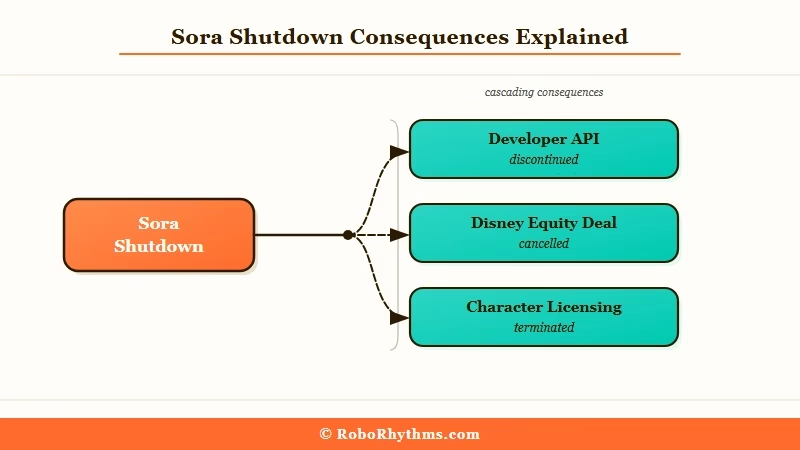
Here is the full scope of what is being discontinued:
- The Sora consumer app (text-to-video generation)
- The Sora API (developer and enterprise access)
- The sora.com web experience
- Disney’s $1 billion planned equity stake in OpenAI
- The three-year Disney character licensing deal, announced December 2025
The Disney angle is not a footnote. A $1 billion deal collapsing within three months of its announcement suggests the relationship had already become complicated before the shutdown made it official.
Variety and Bloomberg both confirmed the deal is cancelled as a direct consequence of Sora’s discontinuation.
One piece of Sora survives: the internal research team continues work on what OpenAI is calling “world simulation” research, aimed at robotics applications.
That project has nothing to do with the video product you were using. OpenAI has explicitly framed it as infrastructure research, not a future consumer product.
This also fits a pattern I have covered before. OpenAI has a history of discontinuing products that no longer fit its revenue roadmap, and the timing here, ahead of a planned IPO, follows the same logic.
Why This Is a Bigger Deal Than It Sounds
Sora’s shutdown is not just a product failure. It is OpenAI publicly conceding an entire AI category to competitors it dismissed at launch.
When Sora debuted in 2024, the demos were extraordinary. Posts on r/singularity hit hundreds of thousands of views. The consensus was that OpenAI had, again, leapfrogged every competitor overnight.
Runway, Pika, and Kling were all supposed to become irrelevant.
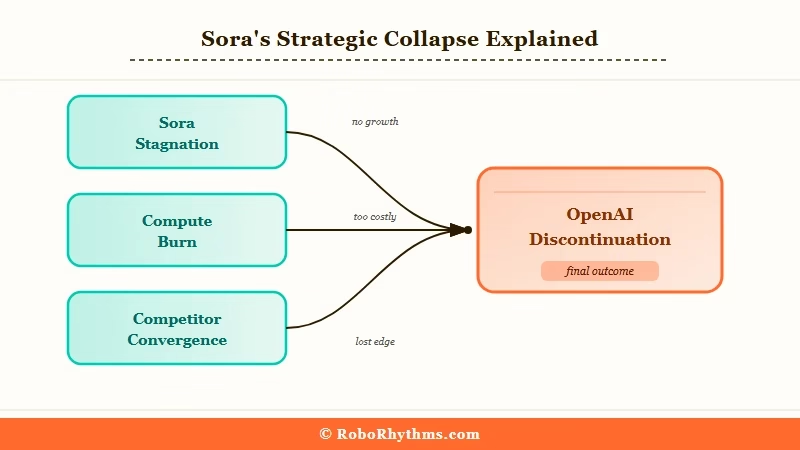
What followed was a product that launched publicly and then stagnated. Runway Gen-4 kept shipping. Kling 3.0, developed by Kuaishou, closed the quality gap faster than most analysts expected.
Google Veo accumulated compute advantages that OpenAI could not easily match in a category that was not its core revenue driver.
The compute math is what stands out most. Analysts estimated Sora was burning roughly $15 million per day in compute costs at peak usage.
For a company focused on its pre-IPO financials, that is an extremely hard line item to justify when the models that drive revenue (the GPT-5 family, operator APIs, enterprise contracts) need more investment, not less.
There is also the deepfake problem. TechCrunch described Sora as “the creepiest app on your phone” in their shutdown coverage, referencing the cameo feature that let users place real people into AI-generated scenarios.
The backlash from that feature was significant, and from what I have seen, it created a reputational drag that made the shutdown decision easier than it would otherwise have been.
The industry implication is now clear: Runway, Kling, and Google Veo are the serious players in AI video, and the strategic uncertainty that OpenAI’s presence created for every competitor is resolved.
What This Means for You
If you were using Sora or integrating its API, you need to act now. The shutdown timeline is immediate.
| User type | Sora dependency | Recommended action |
|---|---|---|
| API developer | Production integrations on Sora API | Migrate to Runway Gen-4 API or Kling 3.0 API before full shutdown |
| Content creator | Used sora.com for regular video work | Switch to Runway, Pika, or Kling (breakdown below) |
| Enterprise user | Active Sora enterprise contract | Contact OpenAI enterprise support; negotiate refund or migration path |
| Casual experimenter | Tried it once or twice | No urgent action needed |
The three tools most ready to absorb Sora’s former user base right now:
- Runway Gen-4 – the closest technical match to Sora’s cinematic quality ambitions, with a mature API and active developer community. Best for long-form professional video work.
- Kling 3.0 – Kuaishou’s model has become the community favourite for realistic motion and is what most former Sora users are recommending in migration threads. Developer API available.
- Pika 2.0 – faster, cheaper, and more accessible than either of the above. Plans start around $8 per month. Best for content creators who prioritise speed over cinematic quality.
If your primary use case was avatar or talking-head video rather than pure generative footage, the tool decision looks different.
My March 2026 breakdown of HeyGen vs Kling covers that specific call in detail.
If you are rebuilding your AI stack more broadly, this breakdown of paid AI tools worth keeping in 2026 is a practical starting point.
What Comes Next
The AI video market is about to consolidate, and prices are going up.
With OpenAI out of the picture, Runway, Kling, and Google Veo are no longer competing in a market where a well-capitalised newcomer could reset everyone’s pricing expectations overnight.
That changes the business dynamics for every remaining player.
What I would expect over the next six months:
- Runway raises its subscription prices. Demand will spike as Sora users migrate, and Runway has been operating below what its competitive position would justify. Reduced threat from OpenAI gives them a clear opening to reprice.
- Google Veo gets a more aggressive consumer push. Google has been deliberately quiet about Veo’s public rollout. The addressable market just became more clearly defined. Expect a more prominent consumer product before the end of 2026.
- Kling targets the enterprise deals Disney’s departure opened up. Kuaishou has been building Kling as a professional-grade product. There are enterprise relationships now available that the OpenAI-Disney deal had effectively closed off.
One outcome I would not expect: OpenAI re-entering AI video as a consumer product. The internal signal points to video being reclassified as robotics infrastructure research, and the window for a comeback is shorter than the company’s typical development cycle.
From what I have seen across every AI category, the company that wins is the one that compounds iterations over time, not the one that launches the best demo. Sora peaked at its demo. Runway has been compounding for three years.
If you are reassessing your OpenAI tools more broadly, our breakdown of whether ChatGPT Plus is still worth paying for in 2026 covers the value questions subscribers are working through right now.
FAQs
The most common questions about the OpenAI Sora shutdown cover timeline, migration options, and what the Disney deal collapse means.
Is the Sora app still available to use as of March 2026?
As of March 24, 2026, Sora is being discontinued. OpenAI has not published a specific final-access date for all users, but the shutdown process is underway. Do not rely on continued access for any production work.
What is the best replacement for Sora for API developers?
Runway Gen-4 has the most mature and stable developer API among AI video tools right now. Kling 3.0 also offers API access and is widely recommended in developer migration threads. Test both before committing to a full migration.
Why did Disney cancel its $1 billion investment in OpenAI?
Disney’s investment and three-year licensing deal were tied directly to the Sora product line, which included rights to use Disney characters in AI-generated video. With Sora discontinued, the licensing arrangement lost its basis. Both parties cancelled, per Bloomberg and Variety.
What happens to OpenAI’s internal Sora research team?
The team continues working on world simulation research aimed at robotics. No consumer or developer video product will come from this work. OpenAI has framed it as infrastructure research, not a product roadmap item.
Is this a sign that OpenAI is pulling back from consumer products overall?
OpenAI has been explicit about concentrating pre-IPO resources on enterprise software, coding tools, and agentic products. The Sora shutdown fits that pattern directly.
Is Google Veo now the best Sora alternative?
Veo is technically strong, but Runway Gen-4 and Kling 3.0 are more accessible and better-supported for developers and content creators right now. For most users making the switch today, Runway or Kling is the more practical choice.
