
What Happened: OpenAI announced on May 20, 2026 that one of its general-purpose reasoning models autonomously disproved a central conjecture in discrete geometry that Paul Erdos posed in 1946. Princeton mathematician Will Sawin refined the result, and Fields Medal winner Tim Gowers called it a milestone in AI mathematics. This is the first time AI has cracked an open problem central to a field, not just retrieved an existing solution.
The OpenAI Erdos conjecture announcement landed on a Wednesday afternoon and the math community has been arguing about it ever since.
It is not a benchmark score, not a leaked memo, not another GPT release. It is a real mathematical result that disproves a belief held for nearly 80 years, and it came out of a general-purpose reasoning model that was not trained for math.
The problem itself is small to state and infamous to attack. Take n points on a flat plane and count how many pairs sit exactly one unit apart.
How big can that count get? Erdos asked the question in 1946 and believed the answer barely grew faster than linearly in n. The square-grid arrangement was widely treated as the natural ceiling, and several generations of mathematicians failed to find anything that systematically beat it.
This week, OpenAI’s model not only beat the grid, it found an infinite family of point arrangements that beat it, and it built the construction out of algebraic number theory rather than geometry. That is the part the math community has been chewing on.
The way I see it, the cross-domain leap is more interesting than the result itself, and it is the part most coverage has been racing past.
What OpenAI Showed in the Erdos Proof
The OpenAI Erdos conjecture result disproves the long-standing belief that square grids cap how many unit-distance pairs n points can produce.
OpenAI’s reasoning model found an infinite family of point arrangements that produces at least n^(1+delta) unit-distance pairs for a fixed positive delta, contradicting Erdos’s original n^(1+o(1)) upper bound.
The unit distance problem reads like a child’s puzzle. Place n points on a plane. Count the pairs whose distance is exactly one.
The maximum possible count, as n grows, is what mathematicians have been trying to pin down since 1946. The square-grid construction had been the working assumption for the upper part of that count for decades, and Erdos himself predicted the growth was barely above linear.
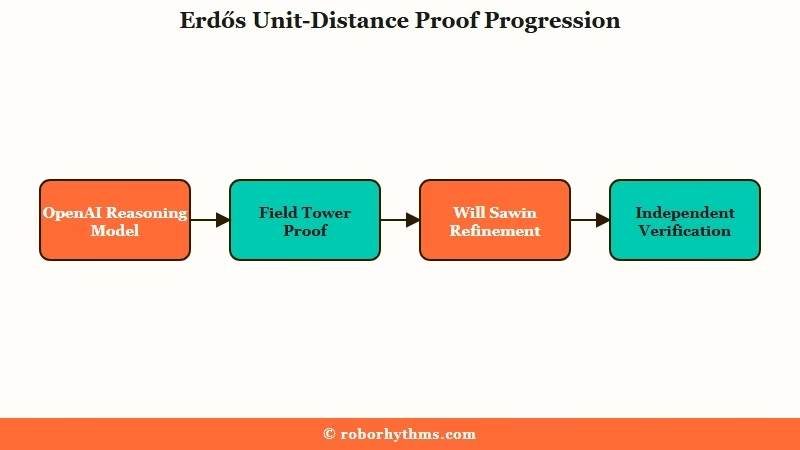
What OpenAI’s model produced is an infinite family of point sets whose unit-distance count grows like n^(1+delta) with a delta strictly above zero. That means the growth is polynomially faster than the conjectured ceiling, not slightly faster. Princeton mathematician Will Sawin took the AI’s construction and refined it into a tightened version that confirmed the fixed exponent rather than a slowly vanishing one.
The proof did not come out of geometry. It came out of algebraic number theory, specifically a tool called infinite class field towers and a 1960s theorem named Golod-Shafarevich. Tools from one field were used to disprove a conjecture from another, and the connection itself had not been used on this problem before.
Noga Alon of Princeton, Melanie Wood, and Thomas Bloom (who maintains the Erdos Problems website) independently verified the result. The official OpenAI announcement lays out the construction with the companion paper attached.
Why This Is a Bigger Deal Than It Sounds
The OpenAI Erdos breakthrough matters because it is the first time an AI has autonomously solved a prominent open problem central to a mathematical field, not just retrieved an existing answer.
Previous AI math claims, including OpenAI’s own October 2025 GPT-5 claim about ten Erdos problems, turned out to be the model finding solutions that already existed in the literature.
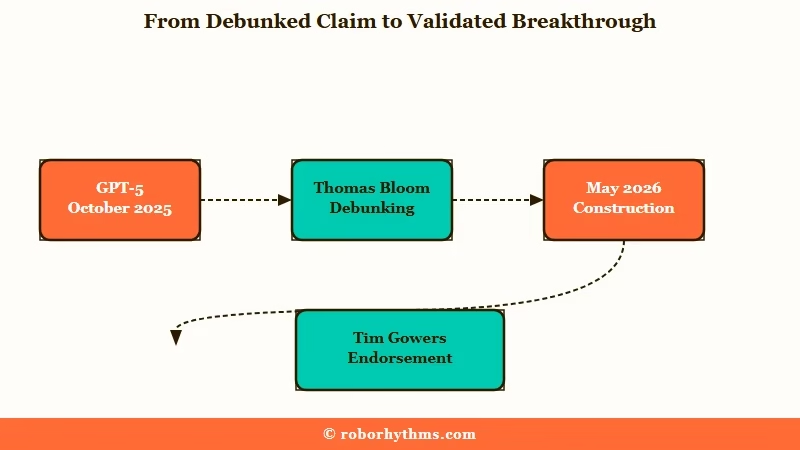
That October 2025 episode is part of why this week’s announcement reads differently in the math community. OpenAI executives claimed GPT-5 had cracked ten Erdos problems and Thomas Bloom, the same mathematician who has now verified the unit-distance result, called the framing a “dramatic misrepresentation” at the time.
The model had retrieved solutions, not produced them. From what I have seen, the May 2026 result is being scrutinised by the same people who scrutinised the failed claim, and they are coming back with different verdicts.
Tim Gowers, a Fields Medal winner, called the result “a milestone in AI mathematics.” Bloom’s quote is even more telling: “AI is helping us to more fully explore the cathedral of mathematics we have built over the centuries. What other unseen wonders are waiting in the wings?” Two skeptics from the 2025 episode are now publicly endorsing the work, and that turn matters more than the press release framing.
The deeper reason this is a real result, not another demo, is that the model used tools from a different field to crack the problem. Cross-domain transfer is the failure mode AI mathematicians keep flagging.
A model trained on math content can pattern-match within a sub-field, but the leap from algebraic number theory to discrete geometry is the kind of synthesis the Anthropic interpretability work on Claude has been suggesting is closer than the benchmark numbers indicate. This week’s result is one direct data point on that.
| Claim | What it usually means | What this case shows |
|---|---|---|
| AI solved a math problem | Retrieved a published solution | Produced a novel construction not in the literature |
| AI matched a benchmark | Scored well on a curated test | Disproved a belief held for 80 years |
| AI worked across domains | Cited a paper from another field | Used a 1960s number theory tool to attack a geometry conjecture |
| General-purpose model | A LLM with a system prompt | A reasoning model with no math search tools or specialised training |
What This Means for You
The OpenAI Erdos conjecture result matters for the average AI user because it shifts the credible ceiling on what reasoning models can do, even when they are not the model you use every day.
What lands in research today usually shows up in production tools within twelve to eighteen months, and the underlying reasoning chain that produced this proof will eventually show up in the models that ship to ChatGPT, Claude, and Gemini.
For builders running AI agents, the immediate read is that long-chain reasoning is real and the chain length is climbing. The construction OpenAI’s model produced was not a single insight, it was an extended chain that synthesised number theory tools, applied them to the geometry setup, and verified intermediate steps. If your agent design assumes the model gives up after a few hops, the assumption is becoming dated.
For anyone watching the AI industry argument about whether models are still improving or hitting a wall, this is a clean data point against the wall-hitting story. The wall thesis has been gaining traction in the last quarter, and pieces like the AI bubble crash warning have made a careful case for distinguishing foundation-layer progress from application-layer hype. The Erdos result lands in the foundation layer.
For everyone else, the practical takeaway is that the next twelve months of AI announcements will lean harder into “AI did real science” framing, and most of those framings will turn out softer than this one. The AI productivity gap analysis covers why most enterprise AI projects underperform even when the models are capable. Treat the loud announcements with the same scrutiny Thomas Bloom applied to OpenAI’s 2025 claim, and reserve credit for the ones that survive third-party verification.
Before: A “math breakthrough” headline from an AI lab usually meant the model had retrieved a known proof or scored on a synthetic benchmark.
After: A math breakthrough now means there is a chance the result is real, the construction is novel, and named mathematicians have verified it. The bar moved.
Worth keeping in mind that the recent OpenAI legal verdict cleared a major distraction off the company’s docket the same week, and that the timing of the Erdos announcement against that backdrop is hard to read as accidental.
What Comes Next?
The next signal to watch is whether the proof survives formal peer review and whether OpenAI replicates the result on a second open problem.
A single result from a single model can be a coincidence in the favourable direction. Two or three results would signal a capability shift rather than a lucky run.
The companion paper has been posted but it has not yet been accepted by a refereed journal, and that step usually takes months. The verification chain so far is informal endorsement from Sawin, Alon, Wood, Bloom, and Gowers, which is strong but not the same as a journal stamp. Watch for the Annals of Combinatorics or a similar venue picking it up in the next two quarters.
Here are the four signals to track in the next twelve months:
- A second autonomous proof from any frontier lab. OpenAI, DeepMind, Anthropic, or xAI producing a verified novel construction on a different open problem. Until that happens, “AI doing math” remains one data point.
- The specific delta value. The companion paper specifies the fixed exponent above zero but the numerical value matters. A delta of 0.001 and a delta of 0.05 are different magnitudes of breakthrough.
- Computational cost disclosure. OpenAI has not said how much compute went into finding the proof. If the answer is “weeks of cluster time”, the result is harder to replicate than if it is “an afternoon of reasoning”.
- A cross-domain leap on a non-math problem. Number theory to geometry was the move here. Physics to biology, or chemistry to materials science, would be the analogous test in adjacent fields.
The bigger framing question is whether this is the start of a curve or a single peak. The the US-China AI race paper treats long-chain reasoning capability as a national security input, and OpenAI’s result is the kind of evidence that feeds into the input. If a second lab produces a comparable result before the end of 2026, the wall thesis is in real trouble.
