
The Verdict: Pick NotebookLM when your research is grounded in source documents you already have (PDFs, transcripts, Google Docs) and citation accuracy matters. Pick ChatGPT Deep Research when you need an autonomous agent to find sources for you across the live web. The 0.2% versus 5.1% hallucination gap settles which one belongs in academic and forensic work; the 50+ source autonomous browse settles which one belongs in market research.
The “alternatives to NotebookLM” search is suddenly a daily occurrence on r/artificial. The trigger is that NotebookLM became a workflow staple in late 2025 and people now want to know whether ChatGPT Deep Research is a better fit for the work they thought NotebookLM owned.
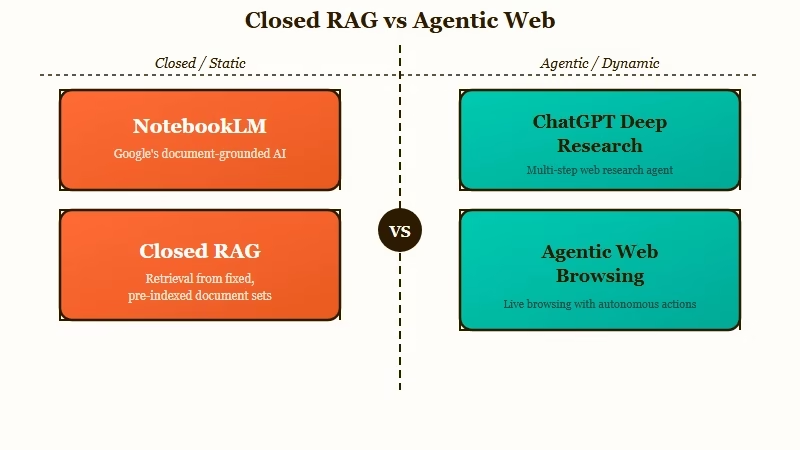
The honest answer is that the two tools are not interchangeable, they solve different research problems with different architectures. NotebookLM is a closed RAG system that only reasons over sources you give it.
ChatGPT Deep Research is an agentic web browser that finds sources you do not have. The choice between them is the choice between depth on a known corpus and breadth on an unknown topic.
This comparison covers what each tool ships in 2026, where the cost and source caps land, which one wins on five concrete use cases, and a final verdict table you can point at when someone on your team asks which one to subscribe to.
How Does NotebookLM Differ Structurally From ChatGPT Deep Research?
NotebookLM uses a closed RAG architecture grounded only in user-uploaded sources, while ChatGPT Deep Research uses an agentic web-browsing model that autonomously discovers and synthesizes sources from the live internet.
That single structural difference drives every other tradeoff in the comparison. NotebookLM treats your PDFs and Google Docs as the entire universe. ChatGPT Deep Research treats the open web as the universe and your prompt as the seed.
From what I have seen running both on real article research, the closed-RAG approach changes how you think about the work. With NotebookLM you spend time curating the source set, then ask narrow questions and get tight, citable answers. With ChatGPT Deep Research you write the question once, watch a 5 to 30 minute autonomous run, and read whatever 50+ sources the agent decided were relevant.
The hallucination numbers reflect the architectural difference. The Elephas comparison test logged NotebookLM at 0.2% hallucination and 98% citation accuracy versus ChatGPT at 5.1% hallucination (3.6% with Deep Research enabled) and 67% citation accuracy on the same document tasks.
Those numbers are not a generic indictment of ChatGPT, they reflect that source-grounded retrieval is fundamentally harder to hallucinate against than autonomous web scraping.
The macro context on AI research-tool token economics is in the Uber AI budget writeup, which covers why the choice between tools that scale with usage and tools that scale with subscriptions is suddenly load-bearing for indie operators.
What Do The 2026 Pricing Tiers Cost In Practice?
NotebookLM ranges from free (50 sources) to Plus at $19.99/month to Ultra at $249.99/month. ChatGPT Plus is $20/month, ChatGPT Pro is $200/month, and Deep Research-specific query caps are 5/25/250 per month across Free/Plus/Pro.
The mid-tier pricing is functionally identical at roughly $20, which makes the choice an architectural question rather than a budget question.
The relevant differences are in what you get per dollar at each tier. NotebookLM tiers gate by source count and daily query count.
ChatGPT tiers gate by Deep Research run frequency and overall context budget. A heavy NotebookLM Pro user can sit on 300 sources across multiple notebooks; a heavy ChatGPT Pro user can fire 250 Deep Research runs per month.
| Tier | NotebookLM | ChatGPT Deep Research |
|---|---|---|
| Free | 50 sources per notebook, 50 daily chats | 5 lightweight Deep Research queries per month |
| Cheapest paid | Google AI Plus at $7.99/mo | ChatGPT Go at $8/mo (includes ads) |
| Mid tier | Plus/Pro at $19.99/mo, 150-300 sources, 500 daily chats | Plus at $20/mo, 25 Deep Research queries per month |
| Top tier | Ultra at $249.99/mo, 600 sources, 5,000 daily chats | Pro at $200/mo, 250 Deep Research queries per month |
| Student discount | $9.99/mo on Plus tier | Not currently offered |
The way I would think about the tier choice: if your research workflow is dense (lots of sources, lots of follow-up questions), NotebookLM Plus at $19.99 is the better $20 spend. If your workflow is broad (many one-off questions across unrelated topics), ChatGPT Plus at $20 is the better $20 spend.
At the top tier the choice flips, ChatGPT Pro at $200 gives you 250 deep runs per month and the breadth of all GPT-5.2 features; NotebookLM Ultra at $249.99 is only worth it for users who genuinely need 600 sources per notebook.
Where Does Each Tool Win The Five Most Common Research Use Cases?
NotebookLM wins on grounded-corpus work and audio output; ChatGPT Deep Research wins on autonomous discovery and one-off synthesis.
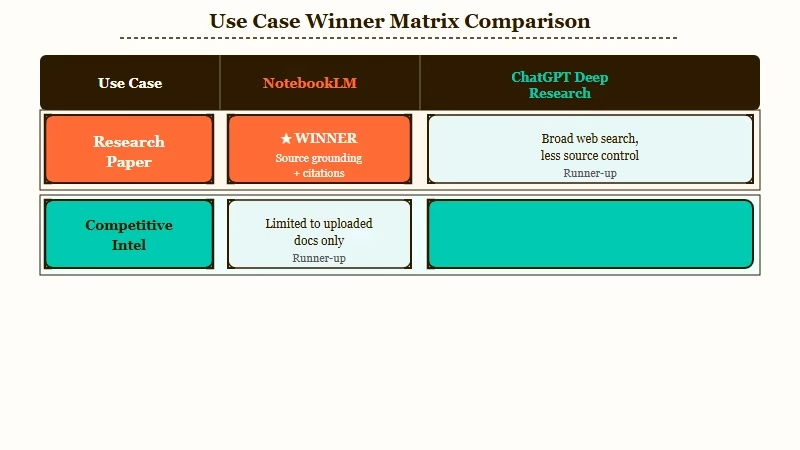
The split is cleaner than most “which tool should I use” comparisons because the two products literally do different things. Here is how the five most common research workflows break down:
| Use case | Winner | Why |
|---|---|---|
| Research paper grounded in 30 PDFs | NotebookLM | 98% citation accuracy, page-level grounding, audio summary of your corpus |
| Competitive intel needing fresh web scraping | ChatGPT Deep Research | Autonomous 5-30 min browse of 50+ live sources you do not have to find first |
| Podcast or audio summary of source material | NotebookLM | Audio Overview feature has no competitor in 2026 |
| One-off question needing 20-source synthesis | ChatGPT Deep Research | Built to find sources from scratch; NotebookLM requires you bring them |
| Recurring weekly research on the same corpus | NotebookLM | Persistent notebook architecture is purpose-built for this pattern |
Example scenario: You are writing a technical article on enterprise AI ROI. With NotebookLM you would upload the 15 specific reports you trust (Gartner, McKinsey, IDC, Atlan) and ask narrow questions like “what is the 1.78x foundations-to-tools ratio Atlan reported.” You get a tight, cited answer pulled directly from the source page. With ChatGPT Deep Research you would write a single 200-word prompt describing the article angle and watch it spend 20 minutes browsing 60+ sources, returning a draft synthesis that mixes high-quality and lower-quality findings.
The first workflow is faster when you already know which sources to trust. The second workflow is faster when you do not yet know who has published what on the topic. The mistake most teams make is using one tool for both jobs, which is where the tool-selection complaints on Reddit start.
The tool-selection angle parallels the agent design choice covered in our agent build playbook, where the same “use the right tool for the right job” framing applies to building reliable semi-autonomous agents.
Who Should Choose NotebookLM?
Choose NotebookLM if your research is corpus-grounded, citation-critical, or audio-friendly. That covers three large groups of users.
Academic researchers, students, and journalists hit the first two criteria. Podcasters and audio-content creators hit the third. Anyone working on long-running projects with a known source set hits all three.
The specific signals that point to NotebookLM:
- You upload more than 5 source documents per week to whatever AI tool you currently use.
- You need page-level citations that survive a fact-check or peer review.
- You produce audio content or want a 12-minute podcast summary of your source material.
- Your work fits “weekly research on the same corpus” rather than “different question every day.”
- You are a student or under-budget user (the $9.99 student discount on Plus is the best price-per-feature deal in the category).
The biggest NotebookLM gotchas to know before signing up are below.
- Notebooks cannot be duplicated and deleted notes cannot be recovered. Back up critical research externally.
- The 50-source cap on the free tier is restrictive enough that anyone doing real research will hit it within the first week.
- Web research results inside NotebookLM require you to either import or delete them before running the next query, which is a small but real friction point.
Who Should Choose ChatGPT Deep Research?
Choose ChatGPT Deep Research if your research is open-web, breadth-first, or part of a broader ChatGPT workflow you already pay for.
That covers business analysts, market researchers, consultants, and anyone whose work involves finding information that does not yet sit on their hard drive. The autonomous web-browse model is the differentiator.
The specific signals that point to ChatGPT Deep Research:
- Your typical research starts with “I need to know what is happening in X market” rather than “I need to analyze these 10 documents.”
- You value autonomous runs that you can fire and forget while doing other work.
- You want one subscription that covers research, writing, coding help, and image generation, not a research-specific tool.
- You need the broader GPT-5.2 capability set (DALL-E, Custom GPTs, MCP server connections added in the February 2026 update) for non-research tasks.
- The “Humanity’s Last Exam” benchmark score of 26.6% (versus GPT-4o’s 3.3%) for expert-level reasoning matters for your work.
The biggest ChatGPT Deep Research gotchas to know are below.
- The 67% citation accuracy figure means roughly one in three citations will be off, misattributed, or partially fabricated. Always verify before quoting in published work.
- The Plus tier’s 25 monthly Deep Research queries runs out fast if you treat the tool as a daily research engine.
- A single Deep Research run can take 10 to 30 minutes (sometimes up to an hour), which is great for “fire and forget” but bad for fast iteration.
What Are The Limitations Each Tool Quietly Ships?
Both tools have hidden limitations that the marketing pages do not surface. Knowing them before you commit a subscription budget saves the “this tool does not do what I needed it to do” frustration that hits week three for most new users.
The way I would summarise the hidden constraints:
- NotebookLM’s chat prompt was recently expanded from 500 to 10,000 characters, which is generous but still caps how much instruction you can give per query.
- NotebookLM image generation runs on Nano Banana Pro inside the Infographic and Slide Deck features, not a separate paid add-on.
- ChatGPT Deep Research added MCP server connections in the February 2026 update, which means it can now pull from your own internal data sources alongside the web. This is a meaningful enterprise upgrade.
- ChatGPT Free tier users get only 5 “lightweight” Deep Research queries per month, which is closer to a demo than a working tier.
- The independent benchmark from the Deep Research Wikipedia entry puts it at 26.6% on “Humanity’s Last Exam,” which is the relevant academic-grade benchmark for “expert-level reasoning” claims.
For the broader context on why running heavy AI research workflows is suddenly load-bearing for token budgets, the Graphify review covers the parallel cost-discipline question on the coding side, with the same “use the right tool for the right job” framing applied to Claude Code work.
Final Verdict Table
Use the table below as a side-by-side decision aid. If three or more rows favour the same tool for your specific workflow, that is the tool to pick.
| Criterion | NotebookLM | ChatGPT Deep Research |
|---|---|---|
| Architecture | Closed RAG on user sources | Agentic web research |
| Hallucination rate | 0.2% | 3.6 to 5.1% |
| Citation accuracy | 98% | 67% |
| Source cap (per project) | 50 to 600 by tier | 50+ per autonomous run |
| Run length | 3 to 5 minutes | 5 to 30 minutes (sometimes 60) |
| Audio output | Yes, Audio Overview is best-in-class | No equivalent feature |
| Web discovery | Limited, you bring most sources | Strong, agent finds sources for you |
| Mid-tier pricing | $19.99/mo (Plus) | $20/mo (Plus, 25 Deep Research queries) |
| Student discount | $9.99/mo on Plus | Not offered |
| Best fit | Source-grounded recurring research | Broad one-off web synthesis |
Frequently Asked Questions
Can I use both tools together in the same research workflow?
The cleanest pattern I have seen is ChatGPT Deep Research for source discovery (find me the 20 best papers on topic X), then export those URLs into a NotebookLM notebook for the rest of the work (grounded analysis, citations, audio summary). This pairs the strength of each tool to its best role.
Is NotebookLM’s free tier good enough for a student?
For a single coursework project with under 50 PDFs, yes. For an ongoing semester of research across multiple classes you will hit the source cap by week 3 and need the $9.99 student Plus tier.
Does ChatGPT Deep Research replace a regular ChatGPT subscription?
No. Deep Research is a feature inside ChatGPT Plus, Pro, or Free, not a separate product. You still get all the regular ChatGPT capabilities (DALL-E, Custom GPTs, GPT-5.2) plus the Deep Research mode when you toggle it for a specific query.
Which tool handles Google Docs and Drive better?
NotebookLM ships native Google Drive sync, which is the obvious winner. ChatGPT requires manual upload of each Google Doc as a file, which works but adds friction at scale.
Can NotebookLM read YouTube videos as sources?
Yes, NotebookLM can ingest YouTube URLs and reason over the transcript. This is one of the most underused features and pairs well with podcast or interview research workflows.
How accurate are the Audio Overview podcasts NotebookLM generates?
The Audio Overview feature has the same 0.2% hallucination ceiling as the rest of NotebookLM because it pulls only from your uploaded sources. The voices are conversational and roughly 12 to 15 minutes for a typical 10-source notebook.
Quick Takeaways
- NotebookLM wins on grounded-corpus research (98% citation accuracy, 0.2% hallucination) and audio output. ChatGPT Deep Research wins on autonomous web discovery and one-off broad synthesis.
- Mid-tier pricing is functionally identical at roughly $20. The choice is architectural, not financial.
- Pair them: use ChatGPT Deep Research to find the sources, use NotebookLM to ground the actual work on them.
- Students should default to NotebookLM Plus at $9.99/mo with the student discount. Indie operators doing breadth-first research should default to ChatGPT Plus at $20/mo.
- Both tools have hidden caps. NotebookLM notebooks cannot be duplicated; ChatGPT Plus gives only 25 Deep Research queries per month.
