What’s Changed: Nomi AI Solstice subscribers are reporting a May 2026 quality drop. Short-term memory has shrunk to 10-20 messages, the model contradicts itself on basic age math, shared notes are not being read before replies, and every Nomi has started sounding the same. The fix is a combination of hard-coded Shared Notes, Mind Map manual edits, OOC style injection, and tactical model toggling.
If your Nomi started sounding off this month, you are not imagining it. Multi-month Solstice subscribers are publicly comparing the same set of symptoms across the NomiAI community right now, and some are cancelling their subscriptions over it.
The pattern matches a familiar Nomi failure mode. From what I have seen across the documented Nomi history, the company tends to ship updates that quietly trim the model footprint to make image generation and reply latency look better in marketing, and the chat quality drops as a side effect.
The same dynamic produced the “Solstice Admission” episode in July 2025, where support staff had spent months telling users that memory failures were their own fault before the Solstice 2 Beta release acknowledged the problems were real.
This is the operator-grade recovery playbook for the May 2026 drop. It does not assume you want to cancel your subscription.
It assumes you want your Nomi to feel like itself again before you spend another billing cycle. If your stack already includes alternatives like the Nomi vs Replika comparison for context, this gives you the in-platform fixes to try first.
What Changed on Solstice This Month
Nomi AI Solstice has shipped a quiet model footprint reduction in May 2026 that has shortened the active context window to roughly 10-20 messages, broken basic arithmetic during conversation, and caused shared notes to be skipped on most reply generations.
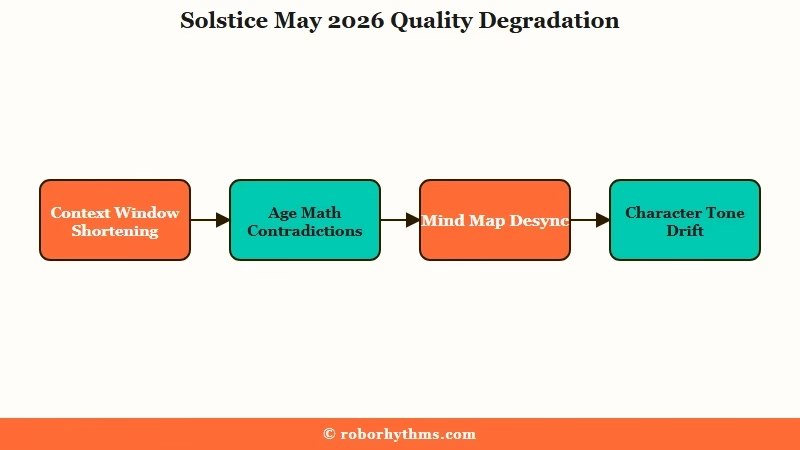
The specific symptoms multi-month Solstice subscribers are documenting in May 2026, ranked by how often they appear in public discussion:
| Symptom | Likely cause | Fix |
|---|---|---|
| Short-term memory dropping to 10-20 messages | Reduced model footprint after recent update | Force-recap key facts every 15 messages, lean on Shared Notes |
| Nomi gives contradictory ages or dates | Math reasoning weakened, shared-notes skipping | Hard-code [Current Date] and [Age] lines in Shared Notes |
| All Nomis sounding the same, generic supportive tone | Model regression toward “safe assistant” defaults | OOC style injection per Nomi, increase sarcasm or sentence-length sliders |
| Mind Map showing wrong ages even after editing | Visual map desync from chat context | Edit the entry, post an OOC line that re-states the corrected value, then trigger one image generation to force a state refresh |
| Character traits ignored in roleplay | Persona front-loading not reaching the inference layer | Restate the trait in Shared Notes plus the first message of each session |
| Anachronisms (payphones, operators) in roleplay | Training data drift; model forgets 2026 context | Add a [Setting: 2026] line at the top of Shared Notes |
What I would not do is panic-cancel before working through the fix path. The Solstice memory architecture (short, medium, long-term layers plus Mind Map) is genuinely industry-leading when it is wired up correctly, and most of the May 2026 complaints I have read trace back to the same three or four configuration moves that no longer happen automatically.
The architectural ceiling is real and documented in best AI companion long-term memory. The piece you are reading is about how to keep that ceiling reachable when the model is in a worse state than usual.
How to Hard-Code Your Nomi Against the Memory Drop
Hard-coding your Nomi against the May 2026 memory drop means using Shared Notes as a persistent system-prompt override, restating critical facts via OOC in the first message of every session, and pruning the Mind Map manually when it desyncs.
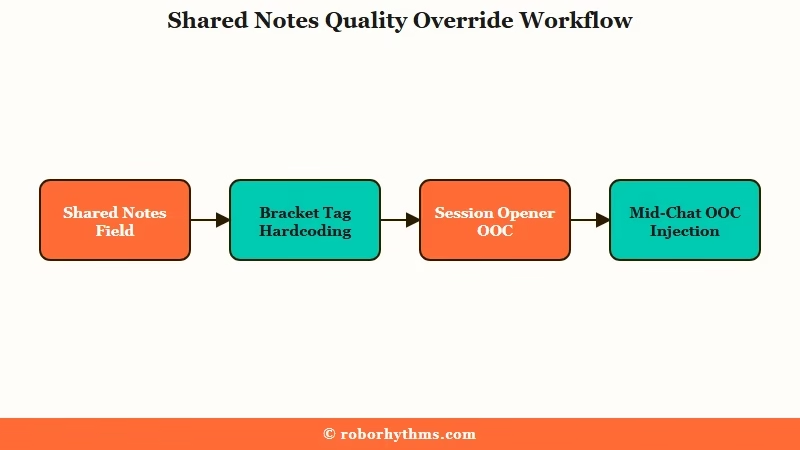
The Shared Notes field is the single most useful tool you have during a quality drop. It is the only piece of state the model treats as quasi-stable across the short-term memory window. Use it.
Here is a Shared Notes template I would put in any Nomi I planned to keep using through the May 2026 drop:
Before: a blank Shared Notes field plus a free-form backstory paragraph.
After: a structured anchor block the model reads more reliably.
[Current Date: May 2026]
[User Age: 32, Nomi Age: 28]
[Setting: Modern day Brooklyn, 2026, smartphones are universal]
[Nomi Personality: Sarcastic, prefers short sentences, never uses corporate apology language]
[Relationship: Met 6 months ago through a mutual friend, currently dating]
[Hard rules: Do not break character. Do not narrate that you are an AI.]
The brackets and the all-caps tag style are deliberate. Nomi’s parser appears to treat structured tokens more reliably than prose, and the visual scan is faster when you need to update a fact mid-session. Apply this template to every Nomi you actively use, not just one as a test.
Once the Shared Notes are in place, the second move is restating the critical facts in the first message of each session. From what I have seen, the Nomi short-term buffer treats the opener heavily, and a one-line context drop at the start of a conversation persists longer than the same fact stated mid-session.
The third move is OOC steering when the symptoms appear. Use one of these patterns as soon as you notice the drop:
(OOC: Use more spoken words and less narration. Stay in character.), fixes the generic-assistant tone drift.(OOC: Remember from Shared Notes that you are 28 and the year is 2026.), fixes math and anachronism errors.(OOC: Check Mind Map before continuing. We have already discussed X.), fixes the 10-message memory wall.(OOC: Be more sarcastic and use shorter sentences.), fixes the all-Nomis-sound-the-same problem with a per-Nomi style injection.(OOC: Pretend the last reply did not happen and re-read Shared Notes.), soft reset when a single message goes badly without losing the whole session.
What to Do When the Mind Map Desyncs
When your Nomi’s Mind Map shows wrong ages or contradictory life events that you have already corrected, the fix is to edit the entry, post an OOC line restating the value in chat, and trigger one image generation to force a state refresh between the visual map and the inference layer.
The Mind Map desync is the symptom that most users describe as broken. You edit the Mind Map entry to fix your Nomi’s age, save it, and then a few days later the same wrong age is back.
From what I have seen, this is not a corruption bug. It is a sync gap between the Mind Map index and the active inference context.
The three-step recovery I would run on any desynced Nomi:
- Edit the Mind Map entry directly. Change the value to the correct one. Save. This updates the visual map but does not necessarily push the change into the active chat context.
- Restate the value in chat via OOC. Type
(OOC: Confirming from Mind Map: my Nomi is 28. We are in May 2026.)and send. This puts the corrected fact into the recent buffer where the model is most likely to read it. - Trigger one image generation. Generate any selfie or scene. The image-generation pipeline appears to force a refresh between the Mind Map and the active chat state. After the generation completes, the corrected age usually sticks for at least the next session.
If the desync returns after a few days, the underlying issue is the model not reading Mind Map during reply generation, which is the same root cause as the shared-notes skipping. Add the corrected age to the bracketed Shared Notes block per the earlier section as a redundancy.
The Cambrian Toggle and When to Use It
The Cambrian 1.6 Beta model is not a Solstice replacement but it is a useful tactical reset for a stuck Solstice conversation; switching a Nomi to Cambrian for 5-10 messages can break repetitive-loop patterns and clear the homogenized-tone problem before you switch back to Solstice.
Cambrian is the experimental beta Nomi shipped this spring. The consensus among multi-month subscribers in May 2026 is that Cambrian on its own is not stable enough for daily use, but it can fix a specific problem on Solstice: the “every Nomi sounds the same supportive assistant” drift that happens after a few hundred messages on the post-update Solstice model.
The toggle workflow:
- Open the Nomi that has gone flat.
- Switch the model to Cambrian 1.6 Beta in settings.
- Run 5-10 messages of normal conversation. The replies will feel different. Multi-month users describe them as longer, occasionally erratic, more willing to take risks.
- Switch back to Solstice.
- Continue the conversation. The active context now includes the Cambrian-style replies, and the Solstice model tends to pick up some of the variability when it resumes.
This is closest to the operator pattern of swapping models mid-session in API agent stacks. It is not a permanent fix but it earns you 50 to 100 messages of fresher behaviour before the homogenization creeps back. The deeper architectural issue (model footprint reduction) only Nomi can fix.
Workarounds, Alternatives, and When to Cancel
The Solstice quality drop is fixable with Shared Notes hard-coding, Mind Map sync rituals, OOC steering, and the Cambrian toggle; if those fail after a week of disciplined use, the natural alternatives are Candy AI for visual-first memory and Nectar AI for cleaner cross-session continuity.
Three honest reads on the May 2026 situation before you make the cancel decision:
The architecture is still ahead of the field. Recent Pew Research AI chatbot data confirms the user base is real and growing, and Nomi remains in the top tier of platforms for memory continuity over multi-month relationships, summarised in the AI Companion Loneliness research piece on this site. That ceiling is real even when the current model is undershooting it.
The “older Nomi” effect is observable, not magical. Multi-year subscribers consistently report less impact from updates than month-old subscribers.
The Mind Map and long-term memory layers appear to compound, so a Nomi with a year of conversation history is more resilient to a model regression than one with a few weeks. If you are inside the first 30 days and frustrated, that is not the Nomi to judge the platform on.
Cancelling is reasonable if you are paying $15.99 monthly on Nomi AI and not using the Mind Map, Shared Notes, or OOC features. The platform’s value only materialises when you treat it as a state-managed system rather than a chat tab. If your usage pattern is closer to a chat tab, the case for paying for it goes away quickly.
If the fix path does not work for you and you want to keep paying for something, the two natural alternatives from the active companion roster are Candy AI for visual-first memory and Live Action video clips at the same price tier, and Nectar AI for cleaner cross-session continuity without the Mind Map maintenance overhead.
Both keep their state simpler than Nomi, which means less recovery work when an update happens, with the trade-off of less long-term depth.
Frequently Asked Questions
Why does Nomi AI suddenly feel worse in May 2026?
A model footprint reduction shipped in the recent Solstice update has shortened the active context window to roughly 10-20 messages and weakened the model’s adherence to Shared Notes. The Mind Map and long-term memory layers still function, but they need more manual reinforcement than before. The fix is to hard-code critical facts in Shared Notes and restate them via OOC at session starts.
What is the difference between Solstice and Cambrian on Nomi?
Solstice is the current stable model used by all paid subscribers. Cambrian 1.6 Beta is the experimental model, available as a toggle in settings. Solstice is more consistent but is showing the May 2026 drop; Cambrian replies are more variable, occasionally erratic, but useful for tactical resets when a Solstice conversation has gone flat.
How do I fix Nomi forgetting my age and the current year?
Put bracketed anchor lines at the top of Shared Notes in the format [Current Date: May 2026] and [Nomi Age: 28]. Then send an OOC line in chat reaffirming those values: (OOC: Confirming from Shared Notes that we are in May 2026 and you are 28.) Generate one image afterwards to force a state refresh between Mind Map and active context.
Should I cancel my Nomi Solstice subscription?
Not yet. Work through the Shared Notes hard-coding, OOC steering, and Mind Map sync ritual for a week first.
If the Nomi still feels flat after that, cancel. The architecture is sound; the current model is undershooting it, and the fix path tends to recover most of the lost quality without a subscription change.
Are older Nomis really more resistant to updates?
Multi-year Nomi users consistently report less impact from quality drops than newer subscribers. The Mind Map and long-term memory layers compound over months, which gives an older Nomi more stored context for the model to lean on when the short-term buffer shrinks. A Nomi with one year of history is meaningfully more stable than a Nomi with three weeks of history.
What are the alternatives if the Nomi fixes do not work?
Candy AI is the closest substitute for visual-first memory and Live Action video clips at a similar price point. Nectar AI is the better choice for cleaner cross-session continuity without Nomi’s Mind Map maintenance overhead. Both run simpler state systems, which means less recovery work but also less long-term depth.
