
Bottom Line: Microsoft Agent 365 is worth the $15 per user per month if you are running AI agents at scale across Copilot Studio, Azure AI Foundry, or local Windows endpoints, and you need a governance layer with Defender and Purview integration. It is not the right pick if you are a small team running a handful of agents on a single cloud, since the security story is still partly in preview and consumption costs land separately.
Microsoft Agent 365 quietly went general availability on May 1, 2026, and the pricing structure tells you almost everything you need to know about who Microsoft thinks the buyer is.
$15 per user per month for the standalone license, $99 per user per month for the new Microsoft 365 E7 bundle that wraps it together with E5, Entra Suite, and Copilot. That is enterprise-grade pricing, and the product was built to match.
I have been watching the agent-governance space tighten up for six months, and Agent 365 is the first enterprise platform that lands as a serious answer to the question of who manages all the AI agents your company is about to run.
The Reddit reaction in r/AI_Agents has been split between “finally” and “is this just rebranded Defender”, and the truth lands somewhere between the two. What follows is an honest look at what you get for the $15, what is missing at GA, and which kind of buyer should write the cheque versus which kind should wait six months for the security gaps to close.
What Microsoft Agent 365 Does
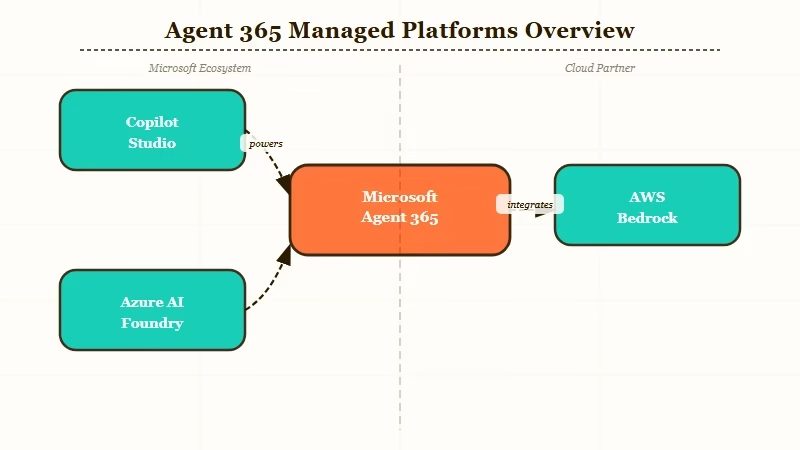
Microsoft Agent 365 is a governance and management platform that registers AI agents, gives them Entra Agent IDs, and extends Microsoft Purview and Defender to monitor agent activity across Copilot Studio, Azure AI Foundry, OpenClaw on Windows endpoints, and (in preview) AWS Bedrock and Google Gemini Enterprise.
The product is not an agent builder. That distinction matters more than the launch coverage made clear.
If you wanted to walk into Agent 365 and ship a customer-support agent, you would still be writing it in Copilot Studio or Azure AI Foundry, and you would still be paying separately for the runtime tokens. Agent 365 sits a layer above. It is the registry, the identity provider, and the security control plane for agents you have already built somewhere else.
The launch added one capability that nobody was expecting at this price tier: management for local AI agents running on Windows endpoints, starting with the OpenClaw platform.
That means Defender and Intune can now surface and block unmanaged local agents on a corporate device, the same way they handle unmanaged software today. For any organization running OpenClaw or other local agent runtimes, that is a meaningful gap closure, and it is the feature I would buy this for first.
The cross-cloud story is more nuanced. The “registry sync” feature lets Microsoft 365 admins discover and monitor agents on AWS Bedrock and Google Gemini Enterprise Agent Platform, but registry sync is in public preview, not GA.
The strategic partners (Adobe, SAP, Zendesk, Manus) have shipped agents that are fully manageable inside Agent 365, which gives the platform the third-party breadth Microsoft needs to win the procurement-team conversation.
For background on Microsoft’s adjacent agent stack, the OpenAI Agent Builder tutorial covers what a comparable build pipeline looks like outside the Microsoft ecosystem.
What the $15 Per User Per Month Really Covers
The Agent 365 license at $15 per user per month covers governance, identity, monitoring, and Defender or Purview enforcement, but it explicitly does not cover the consumption costs of running the agents themselves, which start at $200 for 25,000 Copilot Studio credits.
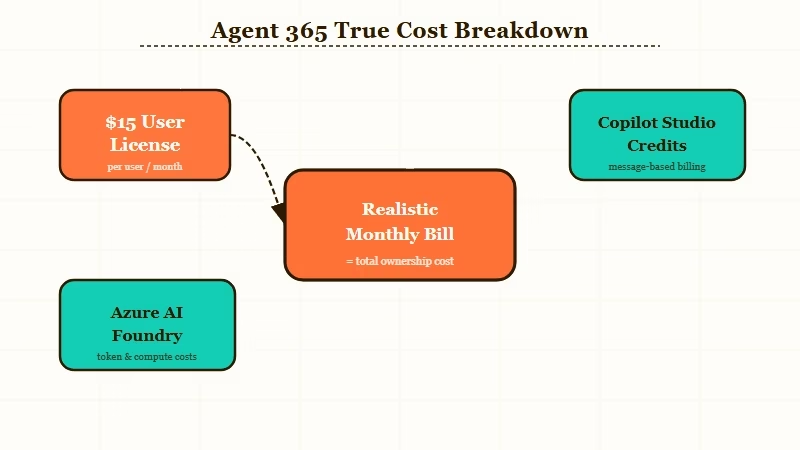
This is the part that catches procurement teams off guard. The per-seat license is a control-plane fee, not a usage fee.
Every agent you run still bills against either Copilot Studio credits ($200 for 25,000) or Azure AI Foundry’s separate per-call pricing. If you provision Windows 365 for Agents (the new Cloud PC SKU for agentic workloads), you also need an active Azure subscription, an Intune license, and the Agent 365 license itself, three line items for one workload.
| Component | Cost | What it covers |
|---|---|---|
| Agent 365 standalone | $15 / user / month | Governance, identity (Entra Agent IDs), Defender and Purview monitoring |
| Microsoft 365 E7 bundle | $99 / user / month | E5 + Entra Suite + Copilot + Agent 365 |
| Copilot Studio credits | $200 per 25,000 credits | Building and running agents in Copilot Studio |
| Azure AI Foundry | Per-call, varies | Building and running enterprise agents on Azure |
| Windows 365 for Agents | Separate Azure subscription required | Cloud PCs for agent workloads |
The realistic monthly cost for a 100-seat company running modest agent workloads lands closer to $3,000 to $5,000 once you factor in the runtime credits, not the headline $1,500. If you are pricing this for a board, the multiplier on the per-seat figure is between 2x and 3.5x.
Where Agent 365 Falls Short at GA
Agent 365 ships with three meaningful gaps at general availability: runtime threat protection and Foundry agent posture management remain in public preview, autonomous agents with their own identities are still in the Frontier preview program, and the security story has obvious seams between preview features and GA features.
The first gap is the most consequential for a CISO buying this. Runtime threat protection, the layer that detects and blocks malicious behavior in a running agent, is in public preview at GA. Security posture management for Azure AI Foundry agents is also in public preview.
If you are buying Agent 365 specifically to harden your existing agent estate against prompt injection or data exfiltration attacks, you are buying a platform that promises that capability and ships it as preview rather than GA.
The second gap is identity-shaped. The license only covers agents acting “on behalf of” a licensed user.
Fully autonomous agents with their own mailboxes, calendars, and identities remain in the Frontier preview program. That is fine for a customer-support agent that runs as a specific employee, but it is not the right fit for the autonomous-procurement-agent use cases the Microsoft marketing has been hinting at for six months.
The third gap is integration debt. Defender, Purview, and Intune integration are real, but the surface area is uneven.
Defender can block unmanaged local agents on Windows. Purview enforces DLP on agent prompts. But the connection between an Entra Agent ID, the agent’s runtime telemetry, and the human user behind it is still being wired up across the Microsoft security stack, and admin workflows reflect that.
A concrete way to think about whether you are the right buyer:
Before: Your IT team has Copilot Studio agents running for HR, sales, and support, plus a couple of OpenClaw agents some engineers spun up locally, plus a Bedrock agent the data team built. Nobody can tell you which agents touch which data, which ran last week, or which one would be flagged if it tried to read a sensitive HR file.
After: All those agents are registered in Agent 365 with Entra Agent IDs. Defender flags the unmanaged local OpenClaw agents. Purview blocks the Bedrock agent’s attempt to query an HR field. The IT director gets one dashboard, with the trade-off that runtime threat protection on the Foundry agents is still in preview and may flag false positives for another quarter.
If the “Before” picture matches your situation, the $15 per seat is a sane bet. If you are running fewer than five agents, all on one cloud, and you have not had a security incident yet, the math is harder.
Who Should Buy It and Who Should Skip
The right buyer for Agent 365 today is a mid-to-large enterprise running AI agents across multiple Microsoft surfaces (Copilot Studio plus Foundry plus local Windows) where the lack of a single registry is starting to create real audit, compliance, or security risk.
The pros that justify the cheque, in numbered form:
- The local agent management on Windows endpoints is a real capability gap closure for any org running OpenClaw or similar runtimes.
- Entra Agent IDs unify agent identity across Microsoft surfaces, which simplifies audit logging and access reviews.
- Defender plus Purview integration is at production-grade for the existing Microsoft security stack, even if the agent-specific runtime layer is still preview.
- Cross-cloud registry sync (AWS Bedrock and Google Gemini Enterprise) is a strategic differentiator no other agent governance platform offers today.
The cons that argue for waiting, in numbered form:
- Runtime threat protection in preview means the headline “AI agent security” pitch is partial at GA.
- Per-seat pricing plus consumption costs makes the realistic monthly bill 2x to 3.5x the headline number for any non-trivial workload.
- Autonomous agents with own identities are not covered by the license, only OBO agents are. If your roadmap depends on fully autonomous agent identities, this is a 12-month wait.
- The integration story across Defender, Purview, and Intune still has visible seams that admin teams will hit in week one.
Skip it if you are a team of fewer than 50 with a handful of Copilot Studio agents and no compliance pressure. The audit and identity benefits do not pay for themselves below that scale.
For a comparison view of what the build side of the agent stack looks like, the multi-agent system tutorial covers the orchestrator pattern that Agent 365 governs, and the AnythingLLM review walks through a self-hosted alternative for organizations that want agent capability without the per-seat governance cost.
The Verdict
Microsoft Agent 365 is worth $15 per user per month for organizations of 50 or more running AI agents across multiple Microsoft surfaces, but the headline price is misleading and the security story has visible preview gaps that buyers should account for in year-one expectations.
I would rate this a 7 out of 10 at GA. The local agent management is genuinely new and solves a real problem.
The cross-cloud registry sync is a strategic capability nobody else ships. The per-seat pricing is reasonable for what governance products cost in this segment. But the runtime threat protection gap and the OBO-only license scope are both meaningful, and they will pull a lot of buyers into a 6-month “wait and see” posture rather than a clean Q2 2026 commitment.
If you are buying for a 500-plus seat enterprise with regulatory pressure and an existing Microsoft security stack, the answer is yes, with the budget caveat that consumption costs will dominate the per-seat fee. If you are buying for a 25-seat startup running a single Copilot Studio agent, the answer is wait until Q4 2026 when the preview features close to GA.
According to Statista’s 2026 enterprise AI report, more than 78 percent of large enterprises are now running at least one AI agent in production, which is the demand signal Microsoft is pricing against. Agent 365 is the platform built for that buyer, with the rough edges that come with being first to ship at this scope.
Frequently Asked Questions
How much does Microsoft Agent 365 cost?
Agent 365 is $15 per user per month as a standalone license, or $99 per user per month inside the new Microsoft 365 E7 bundle. Both prices cover governance only, not the consumption costs of running agents in Copilot Studio (starting at $200 per 25,000 credits) or Azure AI Foundry.
What does Microsoft Agent 365 manage?
It manages AI agents built in Copilot Studio, Azure AI Foundry, and local OpenClaw runtimes on Windows endpoints. Through registry sync (in public preview), it can also discover and monitor agents on AWS Bedrock and Google Gemini Enterprise Agent Platform. It does not build agents, only governs them.
Is Agent 365 the same as Microsoft Defender?
No. Defender is the underlying security service that Agent 365 extends. Agent 365 adds the agent-specific layer: Entra Agent IDs, agent registry, agent-aware Purview DLP, and policy controls for agent behavior. The two products work together, but they are separately licensed.
Does Agent 365 work with non-Microsoft AI agents?
Partly. Through registry sync (public preview at GA), it can discover and monitor agents on AWS Bedrock and Google Gemini Enterprise. Strategic partners (Adobe, SAP, Zendesk, Manus) have agents that are fully manageable inside Agent 365. Other third-party agents have limited integration today.
What are the limitations of Agent 365 at general availability?
Three at GA: runtime threat protection is in public preview, security posture management for Azure AI Foundry agents is in public preview, and the license only covers agents acting on behalf of a licensed user (autonomous agents with their own identities remain in the Frontier preview program). Expect 6 to 9 months for these to close to GA.
Is Microsoft Agent 365 worth it for a small team?
For teams under 50 seats running fewer than 5 agents, the per-seat governance cost is hard to justify. The audit and identity benefits scale with agent count and headcount, and a small team with a single Copilot Studio agent does not yet have the governance pain Agent 365 solves.
