
Summary
• What Meta gains: A working agent platform delivering autonomous research and coding, $100M annual revenue eight months post-launch, and the top RLI benchmark position (last update October).
• How it’s structured: Manus relocates to Singapore, cuts China operations, and brings CEO Xiao Hong plus ~100 employees under Meta COO Javier Olivan.
• Current foundation: Runs on Claude for now, with room for Meta to replace the backbone later if internal systems reach the performance level needed.
• Why it matters: Meta buys capability that already works instead of waiting for internal systems to mature.
Meta buying Manus reads like a pivot toward what already works.
Instead of waiting for a model to mature, Meta just picked up an agent platform that crossed $100M in annual revenue eight months after launch, already delivers autonomous research and coding work, and sits at the top of Scale’s RLI benchmark for real-world output.
The price tag reportedly passes $2B, but the value isn’t theoretical. It’s production-ready.
Manus doesn’t arrive as an experiment. It comes with a CEO joining Meta’s leadership under Javier Olivan, roughly 100 employees, a relocation to Singapore, and a clean break from China operations.
It brings a system that has already proven itself, including performance while running Claude, at a moment when Meta’s own models haven’t consistently reached the same benchmark position.
This feels less like a bet on possibility and more like a shortcut to capability.
If the future of AI agents is defined by who can ship usable systems rather than who can pitch ambitious roadmaps, this acquisition signals exactly which side Meta plans to be on.
Meta wants capability now, not a long development cycle
The move reads like Meta choosing something that already works.
Manus crossed roughly $100M in annual revenue eight months after launch, delivered autonomous research and coding tasks, and holds a top position on Scale’s RLI benchmark measuring real-world work capacity.
Those scores haven’t been updated since October, but the placement still signals proven output rather than speculation.
The reported $2B+ price tag becomes easier to understand through that lens. Meta did not wait for its own systems to reach that benchmark position; it acquired one that already operates there.
The announcement itself frames this as acceleration, not exploration, which is consistent with absorbing a functioning product rather than a prototype.
The public confirmation sits here: Meta announces Manus joining to accelerate AI innovation.
Manus currently runs Claude, and that detail matters without needing embellishment.
If Meta can eventually replace that backbone with internal systems, the acquisition becomes both a shortcut and a delivery channel. If it cannot, Meta still owns a pipeline that produces results today.
The strategy works either way.
The structure of the acquisition supports deployment, not research optics
Manus was founded in Beijing in 2022, relocated to Singapore this year, and will cut all China operations and ownership ties.
That decision removes friction around deployment before integration even begins. It positions Manus for alignment with Meta’s operating structure rather than trying to retrofit it after acquisition.
The shift in location reads like groundwork for scale.
Leadership continuity matters. Manus CEO Xiao Hong will join Meta’s leadership under COO Javier Olivan, and roughly 100 employees will move with him.
That keeps the operating knowledge inside the product rather than scattering it. The deal becomes more than technology; it becomes the transfer of a functioning team.
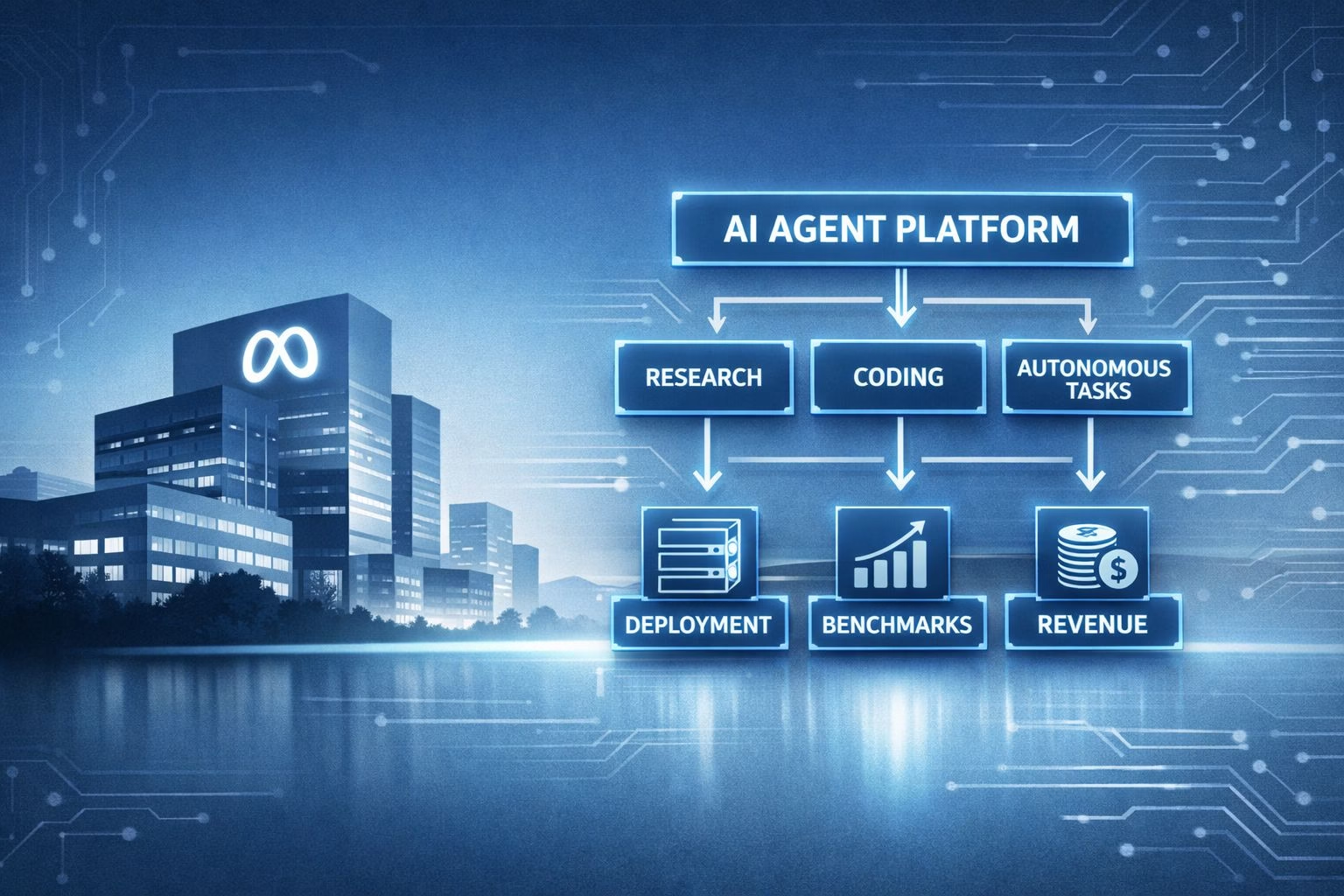
A simple breakdown of the structure:
Existing revenue and benchmark performance already proven
Team and CEO transitioning with the product
Claude powering output for now
Meta able to swap internal systems later if they reach parity
The benchmark reference comes from here: Scale’s RLI benchmark listing Manus in the top position.
Meta is buying outcomes, not narratives
The striking part is how little this resembles a vanity acquisition. Manus isn’t framed as a research trophy or a signaling move.
The revenue milestone, relocation, leadership transfer, and benchmark position all point to something already functioning at scale. That makes this feel like Meta choosing execution over promise.
Running Claude inside Manus shows the priority is output, not ideological purity.
If Meta’s internal systems reach the point where they can replace that backbone without lowering performance, Manus becomes an integration channel.
If not, the Claude-powered pipeline continues delivering value. Either path avoids a stall.
The relocation to Singapore and the decision to cut China operations makes the architecture more deployable.
Instead of waiting to sort out complexity later, the structure meets Meta where it needs to be now. It removes drag before the next stage begins.
What this move implies for the AI agent race
This acquisition implies a shift in the competitive criteria. Instead of focusing on who has the most ambitious model, the pressure turns toward who can hand over working results that justify adoption today.
Manus already proved demand by crossing $100M in annual revenue within eight months, which means the market validated it before Meta arrived.
The Scale RLI benchmark positioning adds another signal, even without updated scores since October. It still represents an external measure of real-world capability.
For Meta, absorbing that position is faster than defending their own from scratch. The value is in inheriting a slot that already carries weight.
If other companies follow this pattern, the landscape moves toward acquiring functioning agent systems rather than waiting for internal research cycles to catch up.
That turns AI agents into infrastructure rather than announcements.

Meta are just doing what Yahoo did over a decade ago by doing a Marrisa Meyer buying spree.