
TL;DR: Stop building “fully autonomous” 24/7 AI agents. The pattern that ships real work in 2026 is a semi-autonomous agent: cron jobs trigger deterministic scripts, scripts call short-context LLM turns for the steps that need judgment, and the LLM only oversees rather than executes. Five concrete patterns below, with a framework comparison table and the anti-patterns that quietly torch your token budget.
A builder on r/AI_Agents posted yesterday that he burned 378 million tokens over three months trying to ship a personal AI assistant. The thing still crashed, still misunderstood instructions, and still made the occasional security mistake. His takeaway was sharper than most of the AI Twitter hype I see: building an exciting autonomous agent is one game, building a reliable one is a completely different game.
That single post has 35 comments of indie builders saying the same thing in different words. The pattern that keeps coming back is simple. Autonomous is hype.
What you really want is a semi-autonomous agent with an alarm clock, where deterministic scripts handle the work and the LLM oversees rather than executes.
This walkthrough is a token-conscious build playbook for that semi-autonomous pattern. By the end you will know which five design patterns to copy, which framework to pick for your specific build, how to wire cron plus LLM without compound failures, and the five anti-patterns that look productive but quietly burn six-figure token bills.

Why Most Personal AI Agents Burn Tokens Without Shipping Results
Most personal AI agents burn tokens because they hand the LLM responsibility for execution rather than oversight.
The 378-million-token post is the obvious case. A more rigorous version is in our Uber AI budget writeup, where a Fortune 100 burned its entire 2026 AI budget in four months on Claude Code. Both stories share the same root cause.
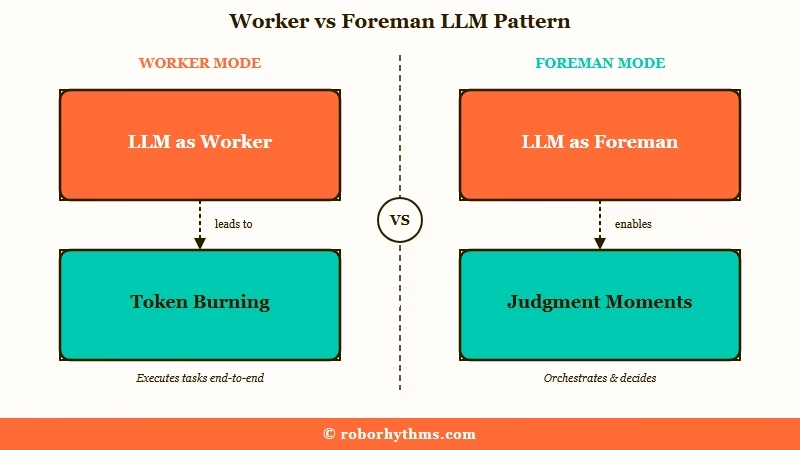
The root cause is treating the LLM as the worker rather than the foreman. A worker does the same task thousands of times and gets paid by the hour. A foreman watches a deterministic process, only steps in when something looks off, and gets paid because the workers do not need to ask permission for every step.
If you let an LLM run for hours without a deterministic guard, you pay for every reasoning step including the wrong ones, the retries, the context accumulation, and the silent drift. Three failures in a row destroy trust with the user.
Three failures in a row inside a single agent loop also burn three times the tokens. The community consensus on the Reddit thread is direct: do not put an LLM in charge of doing work.
The cost math here is brutal in the indie operator case. Burning 378 million tokens on Sonnet 4.6 at roughly $3 per million input plus $15 per million output works out to four to five thousand dollars for a tool that still crashes.
The same builder running deterministic scripts with short LLM oversight turns would have spent maybe two hundred dollars on the same three months. The wider macro context on agent capex is covered in the AI bubble crash warning.
The Five Patterns That Make a Semi-Autonomous Agent Work
Five concrete patterns make a semi-autonomous agent both reliable and token-efficient.
Each one cuts spend AND increases reliability. Pick all five for a serious build; pick three to start.
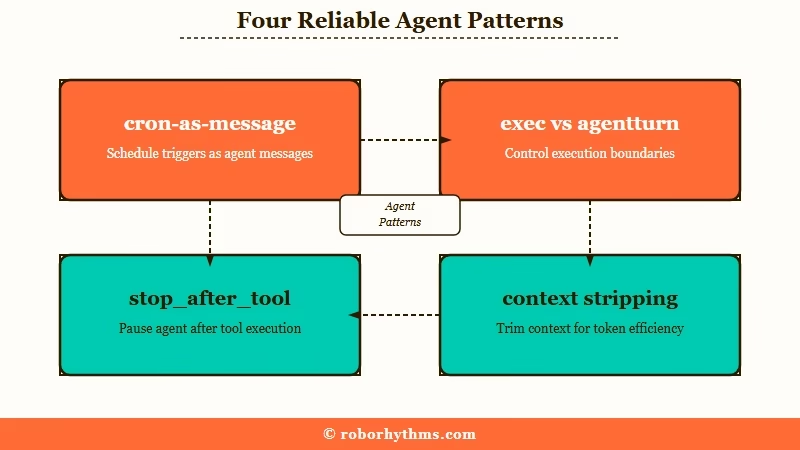
The way I would sequence them is roughly: cron-as-message first because it forces you to think in events, then exec-vs-agentturn because it forces you to identify which steps genuinely need an LLM, then early termination, context stripping, and natural-language scheduling as the polish that turns a working agent into a reliable one.
| Pattern | What it does | Token impact | Reliability impact |
|---|---|---|---|
| Cron-as-message | Cron triggers a message on the agent bus instead of calling the LLM directly | Reuses existing pipeline, no separate call | Single execution path, fewer edge cases |
| Exec vs AgentTurn | Distinguish “shell command” tasks from “judgment” tasks | Exec costs zero tokens, AgentTurn reserved for judgment | Deterministic where possible, LLM where necessary |
| stopaftertool | Agent loop breaks after a specific tool fires (Slack send, email, etc.) | Prevents post-delivery reasoning that burns tokens | Removes the “agent keeps thinking after the work is done” failure mode |
| Context stripping | Cron-triggered tasks get a minimal system prompt, no chat history | Reduces input tokens by 60 to 80% per scheduled run | Prevents context-window-pollution failures |
| NL-to-cron translation | User defines schedules in plain English, system compiles to cron expressions | One LLM call per schedule definition, not per run | Standard cron is precise, fewer timing bugs |
Here is what the first three patterns look like in actual code. The Autobot project (an open-source agentic framework that compiles to a 2MB binary and uses 5MB of RAM) ships with all three baked in.
Vague: “Run the agent every morning and have it summarise yesterday’s news.”
Specific:
# Cron-as-message: scheduler injects a message instead of calling the LLM
bus.publish("cron:daily_summary", "Summarize yesterday news from feed.xml")

# Exec for the deterministic part, AgentTurn for the judgment part
Exec("curl -s https://feeds.example.com/news.rss -o /tmp/feed.xml")
result = AgentTurn(
    "Summarize the top 5 items in /tmp/feed.xml in under 100 words each",
    stop_after_tool="send_slack",  # break loop the moment Slack send fires
    context="minimal",  # strip chat history, use bare system prompt
)
That single block hits four of the five patterns. Reuses the agent bus, separates exec from agent reasoning, breaks the loop the moment delivery happens, and uses minimal context.
The token bill for that daily run is roughly one Sonnet call of about 2,000 input tokens and 500 output tokens, or about a tenth of a cent. The same job done as a 24/7 polling agent without these patterns would easily clear a dollar per day.
For the orchestration layer that runs the cron triggers, Make.com is the boring-but-reliable choice for indie operators who do not want to run their own scheduler. For the agent itself, Dynamiq for a custom build gives you control over the loop, retries, and tool selection. Both pair cleanly with the patterns above.
Which Agent Framework Should You Pick In 2026
LangGraph is the right pick for stateful builds with direct control flow, CrewAI for role-play prototypes, AutoGen for multi-agent collaboration, and Hermes for time-driven automation.
The four are NOT interchangeable. Picking the wrong framework will cost you tokens and reliability you cannot recover.
The cost profile across the four frameworks varies by an order of magnitude on the same task. Multi-agent role-play frameworks like CrewAI compound token usage because every agent turn includes the conversation transcript so far.
State-machine frameworks like LangGraph let you control what each node sees. Hermes is the closest match to the cron-plus-LLM pattern I described above.
Here is the decision framework I would use today:
| Framework | Best for | Token profile | Failure mode to watch |
|---|---|---|---|
| LangGraph | Stateful agents with branching logic, retry budgets, named checkpoints | Moderate, controllable per node | Infinite loops in state machines if no guard counter |
| CrewAI | Role-play prototypes, “team of agents” demos for stakeholders | High, every turn includes transcript | Inconsistency that loses user trust after 2 or 3 misfires |
| AutoGen | Multi-agent collaborative reasoning on research and analysis tasks | High, conversation flows compound | Semantic ambiguity when planning and execution share the loop |
| Hermes | Time-driven automation, daily briefings, monitoring agents | Low, “Exec” jobs skip the LLM entirely | Overlapping runs if schedule fires faster than execution time |
From what I have seen building this kind of system, the right move for most indie builds is Hermes for the cron layer plus a small LangGraph state machine for any step that needs multi-turn reasoning.
CrewAI and AutoGen are great for showing investors a “team of AI agents” demo, less great for shipping a reliable production agent. The Anthropic Claude Code agent skill files are a parallel path that side-steps a framework entirely; the Claude overtaking ChatGPT in business piece covers why that path is suddenly the default at the enterprise.
How To Wire Cron Plus LLM Without Loops or Drift
Wire cron and LLM so that cron triggers an event, a deterministic script does the work, and the LLM only judges or summarises.
The order matters. Get this wrong and you end up with the 378-million-token problem.
Here is the sequence I would walk through this week if you are setting up a semi-autonomous agent for the first time:
- Write the deterministic part first. If the job is “summarise yesterday’s news”, write the bash script that fetches the RSS feed before you write any LLM code. The script must work end-to-end without any agent.
- Wrap one LLM step in a Sonnet-tier call with a hard 500-output-token cap and a stopaftertool clause that breaks the loop the moment the delivery tool fires.
- Set the cron schedule using the natural-language-to-cron translator if your framework supports it. Otherwise hand-write the 5-field cron expression and test it with a one-line dry run.
- Add a retry budget. Two retries on a transient failure (rate limit, network blip), then a hard fail with a notification to a Slack or email destination. Never silently re-run.
- Log the input tokens, output tokens, and outcome for every run to a flat JSON file. Read the log weekly to spot drift before it becomes a $200 surprise on the API bill.
The pattern that bites people on step 2 is forgetting the output-token cap. Without a hard cap, a Sonnet call can blow past 4,000 output tokens on a single summary if the input is large.
With a cap of 500, you get one tightly-written summary and the loop terminates. Same input, one-eighth the bill.
Before: Agent runs every hour, calls Opus 4.7 with full conversation history, no output cap, no stopaftertool. Daily token spend: roughly $4 to $12 depending on news volume.
After: Cron triggers a bash script every morning at 8am, script fetches RSS and pipes to a single Sonnet 4.6 call with 500-output cap and stopaftertool=”send_email”. Daily token spend: roughly $0.005 to $0.02.
That is a 200x to 1000x cost difference for the same delivered outcome. The agent-memory architecture context for the more complex multi-day version of this pattern is covered in our agent memory architecture piece.
Anti-Patterns That Quietly Destroy Your Token Budget
Five anti-patterns waste tokens and degrade reliability at the same time. Each one looks productive in the moment. Each one is the reason the 378-million-token builder ended up where he did.
The way I would prioritise fixing these: if you are seeing more than one in your current agent, the spend math is almost guaranteed to be broken and the reliability math is in the same shape.
- The fully-autonomous fallacy. Letting the LLM be in charge of an entire system without deterministic guards. Replace it with a semi-autonomous agent where scripts do the work and the LLM only oversees.
- Prompt-stuffing large data. Loading a full CSV or document into the LLM context for every tool call. Replace it with the MCP “pointer” pattern. The cost difference is documented at roughly $1.25 versus $0.001 for a 1 MB CSV analysis, a 99.92% cost reduction for the same answer. Academic backup for the broader token-reduction case is in the CodeAgents paper on arXiv, which measured 55 to 87 percent input-token reduction by codifying multi-agent reasoning.
- Stateless reactive loops without persistent memory of prior failures. The agent retries the same failing tool the same way every time. Replace it with a layered memory pattern that records why each tool call failed and avoids the same path on retry.
- Uncontrolled context accumulation across sessions. The agent’s session file grows to 200,000 tokens, every call pays the full context price. Replace it with synchronous session trimming where old messages compress into a long-term fact file like MEMORY.md.
- Naive message passing between agents in multi-agent setups. Every agent broadcasts everything to every other agent. Replace it with layered protocols where messages are filtered by priority and routed only to the agents that need them.
The token-burn risk is the most visible cost. The reliability risk is the more durable one.
A 2026 indie operator can survive a $200 surprise API bill once. Three failures in a row on a customer-facing agent kill the product.
The patterns and the anti-patterns above are the difference. The macro context on why every enterprise is suddenly hitting this wall at once is in our Cursor review, which covers the vendor-side margin pressure that is forcing the per-token-pricing reality onto every team.
Frequently Asked Questions
Is a semi-autonomous agent really an “AI agent” or just a workflow automation?
Semi-autonomous agents are AI agents because the LLM still does the judgment work. The cron job triggers the loop and the deterministic script handles the mechanical steps, but the LLM is what decides what to summarise, what to flag, and what to route. Workflow automation without an LLM is just Zapier.
How much does the cron-plus-LLM pattern save versus a 24/7 agent?
The realistic range is 50x to 500x on token cost for the same delivered outcome, based on the cost math from the Reddit thread and the framework comparisons. A 24/7 personal assistant agent on Opus 4.7 can clear $4 to $12 per day even with light use. The same job as a cron-triggered Sonnet call with hard caps lands at $0.005 to $0.02 per day.
Which framework should a complete beginner pick today?
Pick Hermes Agent if your build is time-driven (daily briefing, monitoring, scheduled reports). Pick LangGraph if your build is interactive with branching logic. Skip CrewAI and AutoGen until you have a clear multi-agent use case that justifies the higher token bill, otherwise you are paying for a role-play architecture you do not need.
What is the single most important configuration knob to set?
Output-token cap on every LLM call. A hard cap of 500 output tokens prevents the agent from running away on a single response and forces the system prompt to ask for a tight, scannable answer. This one knob saves more spend than every other optimisation combined.
Does the MCP pointer pattern work for any data type?
MCP works best for structured data the agent can query rather than load. CSVs, JSON files, database tables, and document collections all fit cleanly.
For freeform text the agent must reason over end-to-end (a single short article, a tweet thread), prompt-stuffing is still fine because the context is small. The 99.92% saving figure is specific to data the agent only needs to extract specific values from.
Quick Takeaways
- Stop building “fully autonomous” 24/7 agents. The pattern that works in 2026 is semi-autonomous: cron triggers, deterministic scripts do the work, LLM only judges or summarises.
- The single most important knob is a hard 500-token output cap on every LLM call. It saves more than every other optimisation combined.
- Pick Hermes for time-driven builds, LangGraph for stateful interactive logic. Skip CrewAI and AutoGen for production until you have a multi-agent use case that justifies the higher token bill.
- The MCP pointer pattern saves 99.92% on document-and-CSV-style tool calls versus prompt-stuffing. Make that switch before any other optimisation.
- The 378-million-token Reddit thread is not an edge case. Set output caps, retry budgets, stopaftertool clauses, and weekly log reviews from day one.
