
The Verdict: Lovable is the right pick if you are non-technical and need a full-stack working app by Friday. v0 is the right pick if you are a React developer who wants the cleanest UI code in your existing Next.js project. The choice stops mattering past about 1,200 lines per file because both tools start drifting and you need real engineering anyway.
I built the same two apps twice in May 2026, once on Lovable Pro and once on v0 Premium, to settle the comparison for myself. The first app was a freelance proposal generator with auth, a Supabase database, and Stripe billing. The second was a UI-heavy marketing dashboard with charts that pulled from an existing API.
Lovable shipped the proposal app to a live URL in about three hours with no manual code. The dashboard built on v0 took longer because I had to wire the backend by hand, but the resulting UI was noticeably cleaner and easier to maintain.
If you want the deeper history of this category, the Bolt vs Lovable comparison covers the older incumbent before v0 fully repositioned around full-stack. This piece is the May 2026 view, with both tools’ new pricing tiers and the failure modes that really matter for indie builders.
There is no public affiliate program for either Lovable or v0 as of May 2026. Every link in this article points directly to the tools with no commission attached.
What Each Tool Really Builds
Lovable builds full-stack apps end to end; v0 builds production-grade UI components that you wire into a stack of your choosing.
That single distinction is the entire game. Pick the wrong tool for your project shape and you are paying for friction.
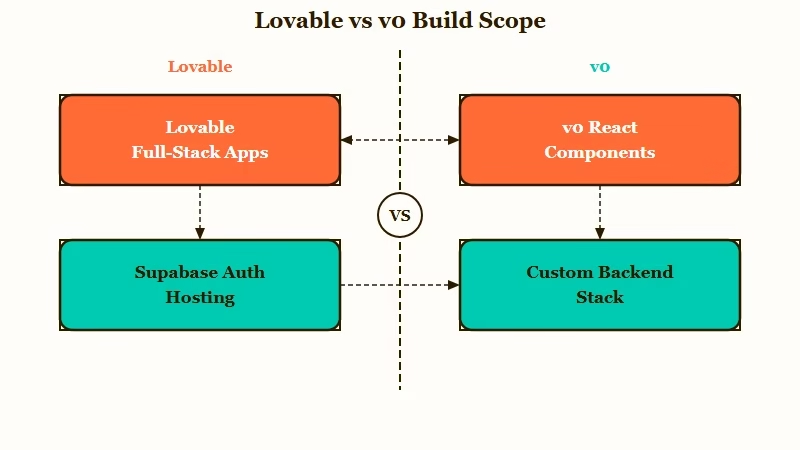
Lovable generates the frontend UI, the Supabase database schema, the authentication flow, the API routes, and the hosting on Lovable Cloud. The stack is opinionated, React with TypeScript, Vite or Next.js, Tailwind, shadcn/ui components, Supabase for backend.
You give a prompt, you get a deployed app at a Lovable subdomain. Two-way GitHub sync means the code is yours to export the moment you want it. Lovable hit a $6.6 billion valuation in December 2025 per TechCrunch, which is the market signal that the full-stack approach is landing.
v0 generates React and Next.js components using Tailwind and shadcn/ui patterns. The output reads like a senior frontend engineer wrote it. Native deployment to Vercel with CI/CD and GitHub exports.
The DNA is frontend-first even though Vercel has officially repositioned v0 around full-stack web development. That DNA still shows when you try to use it as a complete app builder.
From my testing, the practical difference is what the tool does NOT do for you. v0 will not create your Supabase tables, will not wire your auth, will not give you a working backend. Lovable will do all of those, but the code quality of the backend wiring degrades faster than the UI quality does as the project grows.
The Real Cost After the Free Tier Runs Out
The advertised subscription is not the real cost. Both tools need paid infrastructure underneath to ship a production app, and the free tiers run out faster than the marketing suggests.
Lovable Free gives 5 messages per day, capped at roughly 150 per month. The first time I tested, building a single freelance writer website consumed all 5 daily credits before I even saw a working preview. v0 Free gives $5 in monthly credits which sounds workable until your first AI-driven debug session burns $3 in one afternoon trying to fix its own mistakes.
| Tier | Lovable | v0 | What you get |
|---|---|---|---|
| Free | 5 messages/day | $5 credits/mo | Try the tool, not ship anything |
| Mid | Pro $25/mo, 150 credits | Premium $20/mo, $20 credits | Hobby builds, small apps |
| Team | Business $50/mo | Team $30/user/mo | SSO, design templates (Lovable) |
| Enterprise | Custom | Custom | SOC 2, ISO 27001 (Lovable holds both) |
The hidden infrastructure costs are what flip the math:
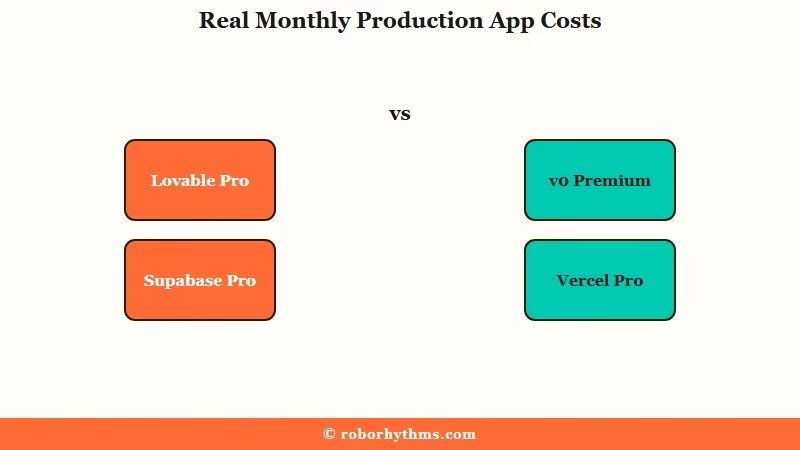
Example scenario: Building a live SaaS app with 200 monthly users. On Lovable Pro you pay $25/month plus Supabase Pro ($25/month) plus a custom domain ($12/year, roughly $1/month) for a true monthly cost around $51. On v0 Premium you pay $20/month plus Vercel Pro ($20/month) plus a separate backend ($25 Supabase or $20 Render) for a true monthly cost between $60 and $65.
The Business tier at Lovable’s $50/month is mostly buying SSO, audit logs, and the design-template library. It does not give you more AI power than Pro. From my testing, indie builders should stay on Pro for the first 12 to 18 months and only step up when an actual client demands SOC 2 attestation.
Code Quality and the 1200-Line Cooked File
v0 output is materially cleaner than Lovable output once you read the actual generated files. That gap widens as the project grows past about 1,200 lines per file.
v0 produces components that follow modern React best practices. Hooks are organized, side effects are isolated, accessibility patterns are baked in.
Reading a v0-generated component feels like reading something a senior frontend engineer wrote, because the model is heavily fine-tuned for exactly that pattern. The downside is everything stops at the component boundary, no server logic, no database query layer, no auth flow.
Lovable’s code quality is what you would call prototype grade. It works, it ships, but the structure is inconsistent. Functions sprawl, type definitions duplicate, the same business rule appears in three different files with slight variations.
From my testing, this is fine for the first iteration. By the fifth, you are spending more time chasing inconsistencies than building features.
The hard wall both tools hit is the 1,200-line cooked file threshold. Around that size, large-language-model context drift becomes noticeable. The AI starts forgetting earlier code in the same file, introducing inconsistencies, and producing fixes that break unrelated functions.
Past 150,000 tokens of context the drift becomes pronounced and unavoidable. This is not a Lovable or v0 limitation per se, it is a fundamental LLM constraint, but Lovable hits it sooner because its files tend to be larger.
The way I see it, the 1,200-line rule means both tools have the same upper bound on usefulness. Once any file in your project crosses that threshold, you stop generating with the AI and start hand-coding in Cursor or Windsurf. The AI builder gets you to a working v1; an AI coding IDE gets you to a maintainable v2.
Who Should Choose Lovable
Pick Lovable if you cannot or do not want to write the backend yourself. That is the single decision criterion that matters.
The clearest Lovable fit is a non-technical founder building a proof of concept to show investors or early users. You describe what you want, Lovable wires the database, auth, and hosting, you have a clickable app the same afternoon. The code quality limitations do not matter at this stage because the app is a sales artifact, not a long-term codebase.
The second clearest fit is the indie builder with a tight deadline who knows they will rewrite the backend later. Ship the Lovable version to validate the idea, then rewrite the data layer properly during the validation window if users like it.
From my testing, the Lovable-to-rewrite path is faster than building from scratch, as long as you treat the Lovable output as a throwaway scaffold and not a foundation.
Lovable is also the right call for teams that need SOC 2 Type 2 or ISO 27001 attestation. v0 and most other AI app builders do not currently carry those compliance frameworks. If you are selling into regulated industries, this alone decides the comparison.
Skip Lovable if you have an existing React or Next.js codebase you are extending. The Supabase opinionation will fight you, the prototype-quality code will mix poorly with your existing structure, and you will spend more time refactoring Lovable output than building features.
Who Should Choose v0
Pick v0 if you have an existing codebase and need a component generator that produces code you would ship as-is. Same single decision criterion logic, flipped.
From my testing the three clearest v0 fits are:
- A React developer adding a feature to an existing Next.js app on Vercel. You describe the component, v0 generates it with proper TypeScript types and accessibility, you paste it into your project. Round-trip in about three minutes.
- A designer or design-engineer iterating on UI before handoff. v0 can sketch the visual, generate the component, and the developer who picks it up gets clean code instead of a Figma file that needs reinterpreting.
- A team evaluating UI patterns. Generate three versions of a checkout flow, pick the one that lands, throw the others away. Cheap experiments because the component lives in isolation.
Skip v0 if you need a working backend. The “frontend wall” failure mode means non-technical users get beautiful components and no path to a working app.
You can pair v0 with a separate Supabase or Convex backend, but that is now a two-tool workflow with two subscriptions to manage. At that point, Lovable’s one-stop integration starts to look attractive again.
Frequently Asked Questions
Is Lovable free worth using?
Lovable Free gives 5 messages per day and exhausts within an afternoon of focused work on a single small project. Use it to test the editor, not to ship anything. Pro at $25 per month is the realistic starting tier for any working build.
Is v0 free worth using?
v0 Free gives $5 in monthly credits, which evaporates fast on iteration. Most users burn the entire allowance in a single AI debug session. Premium at $20 per month with $20 in credits is the realistic starting tier for production use.
Can I export my code from either tool?
Yes. Both tools have GitHub integration. Lovable offers two-way sync; v0 exports clean component code. The export friction is low; the migration friction (changing the underlying stack) is where the real cost lives.
Which produces better code quality?
v0 produces consistently cleaner React component code. Lovable produces functional full-stack apps but with inconsistent code patterns that need cleanup before shipping at scale. Past about 1,200 lines per file, both tools degrade due to LLM context drift.
Do either of them replace a real developer?
No. Both tools get you about 70 percent of the way to production. The final 30 percent (error handling, security hardening, performance optimization, complex integrations) still needs a real developer. Treat both as prototyping accelerators, not engineer replacements.
Which is better for non-technical founders?
Lovable. It is the only tool of the two that produces a working full-stack app without you writing a single line of backend code. v0 leaves you with beautiful components and no path to a functional app unless you wire the backend yourself.
