
My Take: Linus Torvalds is not complaining about AI in his Linux 7.1 RC4 announcement. He is naming an externality. AI-generated bug reports flow value to the AI vendor and the submitter while costing the unpaid maintainer hours of triage. Open-source needs an anti-noise norm before this kills upstream productivity entirely.
The Linux 7.1 RC4 announcement on May 17, 2026 contains the quote most of the tech press is treating as Linus being grumpy. Read it again as economics instead and the story changes.
Torvalds wrote on the Linux Kernel Mailing List that the security list is “almost entirely unmanageable” because of “enormous duplication due to different people finding the same things with the same tools.” He went on to call the triage burden “all entirely pointless churn” and “pointless make-believe work.”
The press read this as another tech curmudgeon being annoyed by progress. That framing misses the point. The real argument Torvalds is making, even if he is not putting it in these terms, is that AI bug-hunting tools have figured out how to externalize their cost onto open-source maintainers who never consented to absorb it.
This piece argues that the mainstream “more eyes find more bugs” frame ignores who is paying for those eyes. The open-source license model never accounted for industrial-scale machine contribution, and the next governance fight in upstream projects is going to be about formal anti-noise norms. Per The Register’s coverage, the quotes that landed are sharper than the headlines.
The Mainstream View and Why It Falls Short
The standard pro-AI-security-research frame is that more bug-hunting eyes equal a safer software ecosystem and that maintainers should welcome the flood.
That view is half right and entirely wrong about who pays.
The pro-AI-bug-hunting case is straightforward. AI tools like Anthropic’s Mythos, Google’s automated fuzzing, and a dozen smaller startups can scan codebases faster than human researchers ever could.
Each scan generates a list of potential vulnerabilities. Some are real, some are false positives, the rest are duplicates of issues already filed.
Greg Kroah-Hartman, a senior Linux kernel maintainer and not someone you would call AI-skeptical, has called AI an “increasingly useful tool for the FOSS community.” That is the steel-man version of the position. The right tooling makes the right people more productive.
The flaw in the mainstream view is that it counts the benefit and ignores the cost distribution. The benefit (better security through more bugs found) is widely shared across users of the software.
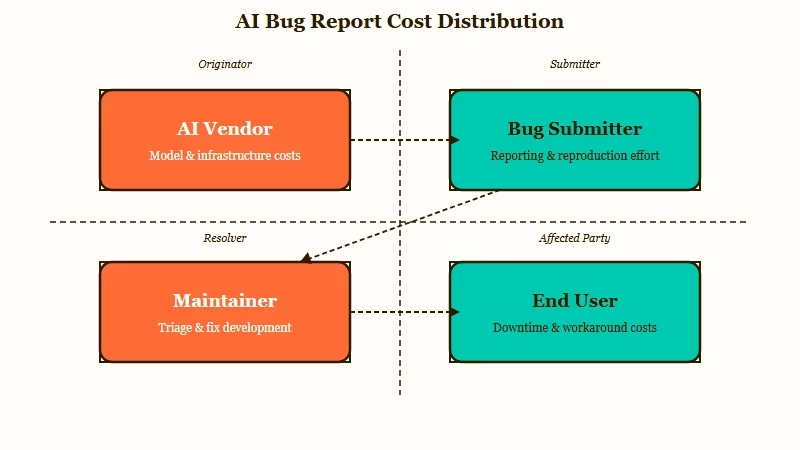
The cost (sifting through noise to find the real signal) is paid almost entirely by unpaid open-source maintainers. From my read, this is the textbook definition of a market externality, production at one node and costs at another with no pricing mechanism in between.
The way I see it, “use AI to triage AI reports” is the response most people reach for when this is pointed out. It does not solve the problem. It just adds another LLM call to a chain whose output the maintainer still has to verify by hand, because nobody is going to merge an AI-triaged AI report into the kernel without a human eyeballing it first.
What Is Really Happening Under the Hood
The economics of AI bug-hunting incentivize submission, not validation. That is the whole story. Once you see the asymmetry, every other piece of the Torvalds quote starts to make sense.
From my testing of how these incentive structures play out across upstream projects, the asymmetry is consistent: the AI vendor wins, the submitter wins, the maintainer pays. The vendor wins because they get a case study, a marketing post, and the ability to claim their tool found N CVEs this quarter.
Daniel Stenberg, the creator of cURL, recently called Anthropic’s Mythos “the greatest marketing stunt ever,” which is the quiet part out loud from a maintainer dealing with the same flood from his own project. The submitter wins because they get a bug-report bullet point for a portfolio or, if a bounty applies, actual money.
Here is the incentive map laid out plainly:
| Actor | What they get | What they pay |
|---|---|---|
| AI vendor | Marketing case study, CVE counts, market validation | Compute cost only |
| Submitter | Resume bullet, occasional bounty, signaling | Few minutes to forward output |
| Maintainer | Occasional real finding | Hours of triage per scan wave |
| End user | Slightly safer software in aggregate | Slower patch cadence as maintainers burn out |
Who loses time? The maintainer. Torvalds spelled this out in plain language, with maintainers “forwarding things to the right people or saying ‘that was already fixed a week/month ago’ and pointing to the public discussion.”
The triage labor is the cost. The maintainer is unpaid. The labor is invisible until someone like Torvalds writes it down in a release announcement.
The duplication problem is also a feature of the incentive structure, not a bug. If a hundred users run the same Mythos scan against the same kernel branch, they get a hundred copies of the same finding.
Each user has a private incentive to submit. None has an incentive to check whether someone else already filed it. The cost of duplication checking falls on the recipient.
Torvalds named one specific structural fix in the same announcement, which is to stop treating AI-detected bugs as secret on private security lists. As he wrote, AI-detected bugs are “pretty much by definition not secret, and treating them on some private list is a waste of time for everybody involved, only makes that duplication worse because the reporters can’t even see each other’s reports.”
Public visibility is the cheapest way to reduce duplication. It is also the opposite of what most enterprise security teams want, which is the heart of why this is going to keep escalating.
This is the same dynamic that drove the production-grade agent infrastructure patterns when AI agents started hitting real systems at scale. Cheap to produce, expensive to verify, costs landing on whoever owns the receiving side.
The Part Nobody Wants to Admit
Open-source license terms do not contemplate industrial-scale machine contribution, and the social norms that made MIT and GPL workable are starting to break under that weight.
The licenses were written for an era where a contribution was a costly artifact of human effort.
The MIT license, the GPL, the Apache 2.0 were all drafted in a world where producing a contribution required a person to read the codebase, form a hypothesis, and write the code.
The cost of contribution was the regulator on contribution volume. Volume was self-limiting because it cost real time to generate.
That regulator is broken now. An AI agent can read a codebase and emit a plausible bug report in seconds.
The cost on the production side has collapsed near zero. The cost on the receiving side, which is human attention and judgment, has not changed at all.
The licenses do not have anything to say about this asymmetry because the people who drafted them did not anticipate it.
What I would not miss in this story is that AI vendors know exactly what they are doing here. Mythos, Big Sleep, Sentry’s automated reporters and the smaller startups all benefit from the open-source maintainer absorbing the cost of validation.
The marketing collateral writes itself: “Our tool found X CVEs in critical open-source projects last quarter.” Nobody in those press releases ever mentions the maintainer-hours those numbers represent.
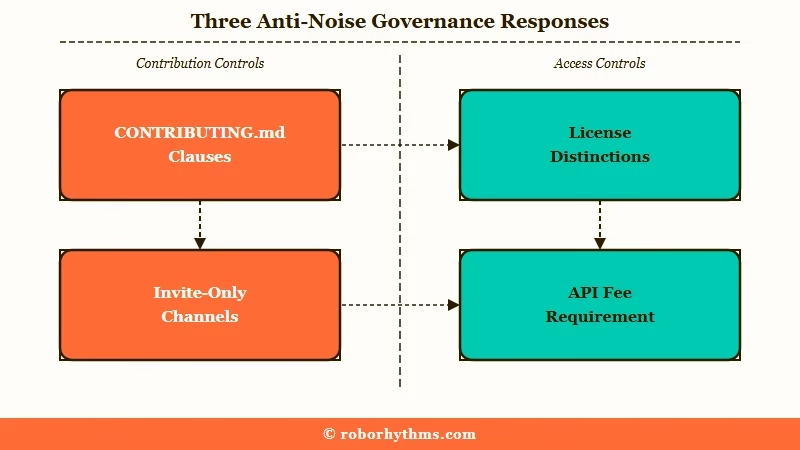
The fix is going to have to be social before it is legal. The way I see it, three responses are already taking shape across major projects:
- CONTRIBUTING.md clauses that require AI-flagged reports to come with a reproducer and a tested patch. Automatic rejection on submission if neither is present.
- Invite-only contribution channels for security-class issues. The trade is faster maintainer triage at the cost of the open-mailing-list ethos.
- License terms that distinguish human and machine submission. Charges an effective “bug submission API fee” for vendor-generated reports while keeping human contribution free.
None of these are happy, neutral, ideologically-clean solutions. Each one is a load-bearing departure from the principle that open-source contribution is unconditionally welcome.
The companion shift, which the AI-coding-agent space is already living through, is that agent reliability breaks the economics of any pipeline that costs human attention to verify past about 80 percent. Bug reports from coding agents sit exactly inside this failure mode.
Hot Take
The next big open-source governance fight is going to be about AI submission as license-restricted activity. Not about the AI itself. About the asymmetry where producing contributions cost zero and reviewing them costs everything.
Torvalds is the first marquee maintainer to name the externality in public, and he will not be the last. Within twelve months, expect at least one major project to add a CONTRIBUTING.md clause that bans bare AI-generated bug reports outright.
Within twenty-four, expect at least one license fork that distinguishes human and machine contribution as different acceptance tiers. The era of unconditional open-source welcome is over, and the Mythos marketing stunts ended it.
Vague: “AI tools should be more responsible.”
>
Specific: Maintainers who care about upstream sustainability should add a CONTRIBUTING.md clause stating that AI-flagged bug reports without a tested reproducer and a proposed patch will be auto-closed within 72 hours. Then enforce it. The signal travels fast in the maintainer network and the AI tooling vendors will adjust their default submission templates to match.
For the broader context on how AI vendors and maintainers are clashing on responsibility, the AI productivity is a management problem frame applies here too.
The same Stanford findings that showed top-quartile teams are the ones with strong review gates also explain why open-source projects with vibrant maintainer culture are the ones getting hit hardest by AI bug-report noise. They are the only places where the gate is real enough to feel the load.
