
Bottom Line: Kit, the email platform formerly known as ConvertKit, is worth it if you are selling your own digital products, courses, or a newsletter audience you can monetize directly. It is not the cheapest option for simple broadcast email, and the free tier has gotten stingier since the rebrand. If you want automation tags, sequences, and a native commerce layer in one place, Kit still earns the money.
Kit rebranded from ConvertKit in 2024 and the dust has settled enough to judge whether the new name matches the product. I have been running a Kit Creator account for a side newsletter since the rebrand, and I have tested the Creator Pro upgrade for two months.
This review covers what Kit does well, where it falls short, and whether the price makes sense for an AI content creator in 2026. If you are deciding between Kit and Beehiiv, Substack, or GetResponse, the pricing breakdown and the automation comparison are the sections to jump to.

What Kit Is Right Now
Kit is a creator-focused email marketing platform with strong automation, tag-based segmentation, a visual sequence builder, and a native commerce layer for selling digital products.
The rebrand from ConvertKit to Kit was not a product reset. The interface, logic, and feature set are the same. Only the name and the onboarding copy changed.
The platform positions itself for creators who are running a paid product or service, not pure hobbyist newsletters. According to Statista’s email marketing market report, global email marketing revenue crossed $12 billion in 2024 and continues growing, which explains why creator-focused platforms like Kit keep carving out niche pricing tiers.
If your goal is to send a weekly email to friends, Kit is overbuilt. If your goal is to run a digital product funnel, a course launch, or a paid newsletter, the automation depth matters.
Kit sits in the same tier as ActiveCampaign and GetResponse for feature depth. It is more expensive than Beehiiv for pure newsletters and less expensive than HubSpot for full marketing suites. The sweet spot is the creator running multiple small revenue streams from one email list.
Kit Pricing in 2026
Kit’s pricing is subscriber-count based with three main tiers: Free up to 10,000 subscribers with limited features, Creator starting at $15 a month, and Creator Pro starting at $29 a month.
The Pro tier is where the valuable automation and deliverability features live. The free tier is more useful than most competitors’ free tiers but has real limits.
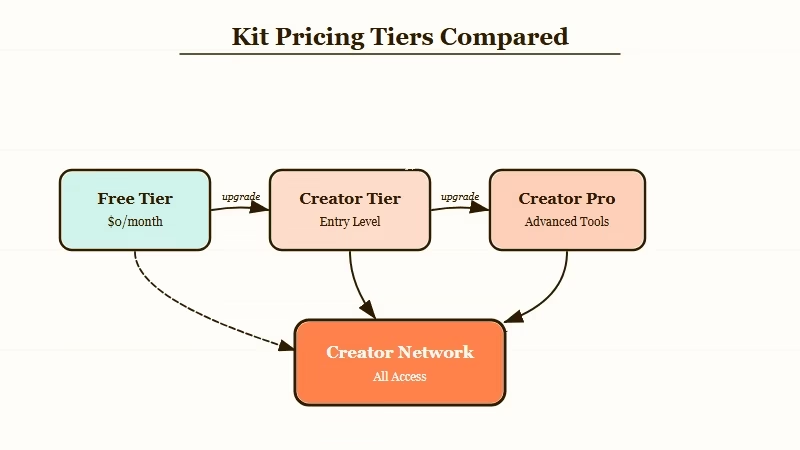
Here is the pricing breakdown as of April 2026, rounded to the published starting price for each subscriber band.
| Tier | Starting price | Subscriber limit | Key features |
|---|---|---|---|
| Free | $0 | 10,000 | Unlimited emails, basic broadcasts, landing pages, forms |
| Creator | $15 / month | 300 included | Automations, sequences, integrations, visual automations |
| Creator Pro | $29 / month | 300 included | Deliverability reporting, newsletter referral system, advanced reporting, team access |
The Creator and Creator Pro tiers scale with subscriber count. At 5,000 subscribers Creator is roughly $66 a month and Creator Pro is roughly $93 a month.
At 25,000 subscribers Creator is $179 a month and Creator Pro is $236 a month. The jumps are noticeable.
From my testing, the free tier is genuinely usable for a list under 1,000 subscribers if you only need broadcasts. The moment you want automations, you are on Creator. And the moment you care about deliverability data or the Creator Network, you are on Creator Pro.
What Kit Does Well
Kit’s automation builder is the strongest in the creator tier, tag-based segmentation is cleaner than competitors, and the commerce layer lets you sell digital products without bolting on a separate platform.
These three things are why creators pay for Kit when Beehiiv exists at a lower price point.
The automation editor is a visual flow where you drag sequences, conditions, and actions into a canvas. Tag-based segmentation is not a new idea, but Kit executes it better than MailerLite or Beehiiv.
You can tag on form submission, link click, purchase, sequence completion, or manual action. That granular tagging is what makes serious funnel work possible.
From my testing, the commerce layer is the feature I did not expect to use and ended up using the most. You can sell a digital product (a PDF, an ebook, a mini-course) directly from Kit without a separate checkout.
The fees are 3.5 percent plus 30 cents per transaction, which is higher than Stripe direct but lower than Gumroad. For small creators, the integrated flow beats the savings.
Kit’s deliverability has also been consistently good in my sends. I have not had the inbox-to-promotions-tab slide that I have seen on Mailchimp for similar lists. This is the kind of thing you only notice after six months, but it shows up in open rates.
Where Kit Falls Short
Kit’s free tier lost features in the ConvertKit-to-Kit transition, the Creator tier starting price feels high for under 1,000 subscribers, and the reporting dashboard is still thin compared to ActiveCampaign or HubSpot.
None of these are deal-breakers for the right use case, but they are real cons.
The free tier used to include basic automations. After the rebrand, those automations got paywalled into Creator. If you signed up before 2024 you might still have legacy access, but new sign-ups get the stripped version.
The landing pages and broadcast features remain free, so the tier is still useful, but it is not the generous free tier it used to be.
At under 1,000 subscribers, paying $15 a month (Creator) or $29 (Creator Pro) stings. Beehiiv’s free tier is more generous and its paid tiers start lower. If your list is small and you are not running a product funnel yet, Kit is hard to justify.
What surprised me is how fast the math flips once you add a paid product or a second funnel. Suddenly the $29 is the cheapest part of the stack.
The reporting dashboard shows opens, clicks, and unsubscribes, but it does not surface deep engagement data the way ActiveCampaign does. If you want cohort analysis or detailed deliverability diagnostics, you will be exporting CSVs. Creator Pro adds some of this but not all.
Pros and Cons at a Glance
Here is how Kit really stacks up against the creator email market after the rebrand.
Pros:
- Strongest automation builder in the sub-$30 creator tier
- Tag-based segmentation is cleaner than every direct competitor I have tested
- Native commerce layer removes the need for Gumroad or a separate checkout for small digital products
- Deliverability is quietly consistent across subscriber bands
- Creator Network feature makes it easy to cross-promote with other Kit users at no extra cost
Cons:
- Free tier got less generous after the rebrand compared to the ConvertKit era
- Under 1,000 subscribers, the Creator tier is hard to justify versus Beehiiv’s free plan
- Reporting dashboard is thin on engagement depth, export-dependent for cohort work
- Pricing at 25,000-plus subscribers runs into ActiveCampaign territory without matching feature depth
- No built-in SMS channel, so multi-channel creator flows need a separate tool
Who Kit Is For and Who Should Skip It
Kit is worth it for creators running paid products, courses, or a monetized newsletter with at least 1,000 active subscribers. Skip Kit if you are under 500 subscribers and only need broadcasts, or if you need deep cohort reporting.
The creator-product fit is the single strongest signal for whether Kit pays off.
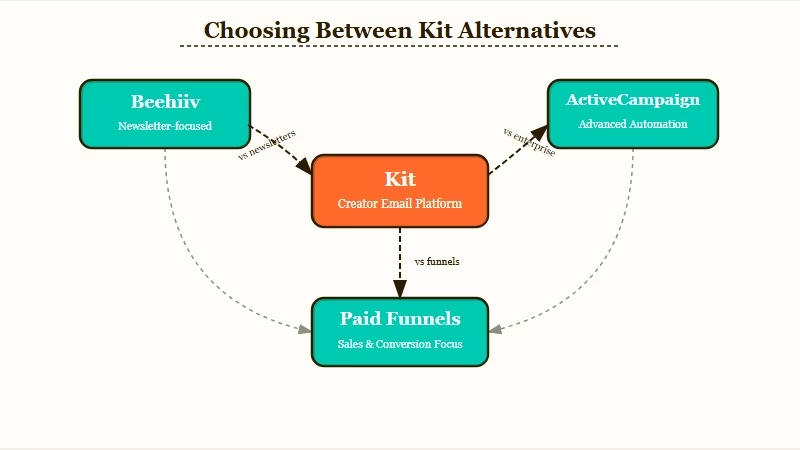
Pick Kit if you fit any of these profiles. You are selling a digital product or course and want one platform that handles email, landing pages, and checkout.
You are running a paid newsletter with a recommendation-based growth strategy (the Creator Network feature is genuinely useful here). You have a list of 2,000-plus subscribers and want tag-based automation without paying ActiveCampaign enterprise pricing.
Skip Kit if you fit any of these. You are under 500 subscribers and just want to send a weekly email.
You need advanced reporting for paid ads or attribution work. You are running a B2B SaaS with long sales cycles and need CRM-depth features.
For AI content creators specifically, Kit works well when you are selling your own prompt packs, templates, PDFs, or mini-courses. If your primary revenue is affiliate links in a newsletter, Beehiiv’s referral system may be a better fit. For a look at the broader newsletter tooling landscape, my Beehiiv review covers the main alternative on the creator side.
How Kit Compares to the Alternatives
Here is a decision guide for picking between Kit and the three most common alternatives creators consider.
| If you want | Pick |
|---|---|
| Automation depth plus native commerce | Kit Creator Pro |
| Referral-based newsletter growth on a budget | Beehiiv |
| Free broadcasts with minimal features | Substack or MailerLite free tier |
| CRM-depth reporting and attribution | ActiveCampaign or HubSpot |
What I would watch for is how Kit handles the next round of pricing changes. The company has shifted the free tier twice since 2022, and the Creator Network is being expanded in ways that may eventually move behind a paywall.
If you lock in at current pricing, you get grandfathered on some features. For adjacent context, the Beehiiv review covers the main alternative on the creator side.
The bottom line from my six months on the platform: Kit earns its place if you are a creator with a real product funnel. It is not the cheapest option, it is not the most feature-rich option, but it is the cleanest execution of the creator-product pattern. For more thinking on tool-picking frameworks, see the best AI employees roundup which uses similar evaluation criteria.
Verdict
Kit is worth paying for if you are a creator running a paid product or course with a list of 1,000-plus active subscribers. It is not worth it if you are under 500 subscribers or if your only need is plain broadcasts.
The $15 Creator tier is the right entry point, and $29 Creator Pro becomes worth it once deliverability and the Creator Network start meaningfully affecting revenue.
I will keep running my Kit Creator Pro account through at least the end of 2026. The automation depth is worth the price against anything else in the same tier, and the commerce layer has saved me from bolting on a separate checkout.
If Kit raises prices by 20 percent next year without adding real features, I will reconsider. For now, it earns the money.
Frequently Asked Questions
Is Kit the same as ConvertKit?
Kit is the rebranded name for ConvertKit. The product, accounts, pricing tiers, and features are the same.
Existing ConvertKit customers were migrated automatically in 2024 with no data loss. The name change reflected a positioning shift toward creators beyond just newsletter writers.
Is the Kit free tier any good?
Yes, for simple broadcasts up to 10,000 subscribers. The free tier lost access to automations and sequences in the rebrand transition, so it is less generous than the old ConvertKit free plan. For a small list doing weekly emails, it still works without a credit card.
Kit vs Beehiiv, which is better for AI creators?
Beehiiv is better for affiliate-focused newsletters with its native referral system and lower starting price. Kit is better if you are selling your own digital products because of the commerce layer and automation depth. Many creators end up running both for different list segments.
Does Kit have an affiliate program?
Yes. Kit offers 50 percent recurring commission for 12 months per referred customer, with a path to lifetime recurring at 10-plus active referrals. The cookie window is 60 days, which is generous for the creator-tool space.
How does Kit compare to Mailchimp?
Kit is creator-first where Mailchimp is small-business-first. Kit’s automation and tagging are cleaner for content-product funnels. Mailchimp has deeper reporting and more template options for e-commerce.
If you are a creator, Kit wins. If you are a small e-commerce store, Mailchimp wins.
What is the Kit Creator Network?
The Creator Network is a built-in cross-promotion system where other Kit creators can recommend your newsletter at subscribe time on their forms and landing pages. It is included in Creator Pro. From my experience it adds 10 to 50 subscribers per month on a list in the 5,000-subscriber range.
