
What’s Changed: Janitor AI’s auto-moderation layer started silently blocking the word “unadulterated” in late May 2026. The word is benign in standard English but co-occurs with mature themed text in training data, which triggers the platform’s word-list filter. The fix is a simple synonym swap, the longer-term move is to add a couple of workaround patterns to your bot definitions so the same trick does not bite you again on the next surprise trigger word.
A petition thread hit r/JanitorAI_Official on May 28, 2026 asking the team to remove “unadulterated” from the auto-mod programming. A second thread minutes later asked how to avoid the same block without rewriting the entire bot definition.
Both threads landed because the silent-block behaviour is the worst kind of platform friction: the generation just fails, no error, no obvious cause, and the user has to do trial-and-error word-stripping to figure out which token tripped the filter.
This article explains why a normal English word ends up on a trigger list in the first place, walks through three workarounds that work on every triggered word (not just “unadulterated”), and points to the alternative platforms that handle the same content without the block.
The context for the broader Janitor AI changes is in the JLLM quality drop piece from earlier this month, which covers the April 20 architecture swap that made the auto-mod more aggressive in the first place. This post is the narrower follow-up on what to do about a specific trigger word.
What Is Happening With The Unadulterated Block?
Janitor AI’s auto-moderator started blocking the word “unadulterated” in user bot definitions and persona text in mid-May 2026, with no error message returned to the user.
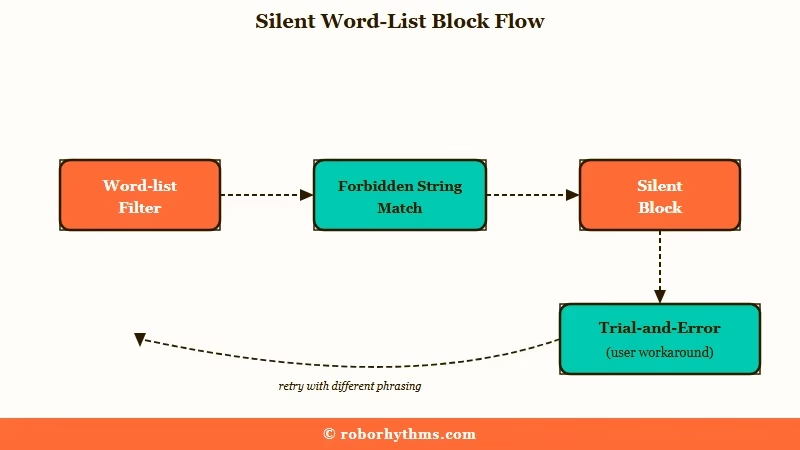
The pattern is that a generation either silently fails or returns a heavily redacted response, and the platform’s UI gives no hint that a word-list trigger fired. Community trial-and-error narrowed the cause to the literal string “unadulterated” appearing anywhere in the prompt or persona.
From what I have seen reading the petition thread and the sister post, the trigger fires on the exact lowercase token. Capitalisation changes do not seem to help, and synonyms work cleanly.
The behaviour matches the broader word-list moderation pattern, where the platform maintains a blacklist of forbidden strings and intercepts any generation containing one of them, regardless of surrounding context.
The April 20, 2026 architecture swap rewrote the comment moderator from scratch to reduce aggressive false positives while keeping hard blocks on phishing, threats, hate content, CSAM, and self-harm intent. That refactor is the reason most current blocks are word-list-driven rather than the semantic-classifier blocks that older Janitor AI versions used. The system is now faster but cruder, which is how a benign word like “unadulterated” ends up on the list at all.
The April 21, 2026 changelog also notes a bug fix for the “forbidden words” admin panel where removing a word from the list failed to save. If the team did not re-audit the full list after that bug, words added during the buggy period may still be active even though they were never intended to stay. “Unadulterated” landing on the list is consistent with that scenario.
Why Does A Normal English Word End Up On A Trigger List?
Word-list filters block strings based on statistical co-occurrence patterns in training data, not the literal meaning of the word.
“Unadulterated” means “pure” or “unmixed” in standard usage but appears alongside mature themed phrasing often enough in scraped web text that the filter treats it as a probable mature themed signal. The platform is not making a semantic judgment, it is pattern-matching on a literal string.
The same pattern affects other innocuous words across the AI companion space. Filter-evasion forums document “damn”, “love”, and even “sex” used in neutral contexts as commonly triggering blocks on stricter platforms. The way I read this is that the word-list approach trades semantic accuracy for processing speed: every prompt gets scanned in milliseconds against a static list, no LLM inference required.
The broader regulatory pressure on AI companion platforms is real. California’s SB 243 came into force in 2026 and requires chatbot providers to enforce specific safeguards around self-harm. The California SB 243 official text covers the specifics.
New York and other states have similar laws either passed or in progress. The aggressive word-list expansion makes sense in that context, the cost is occasional friction on harmless words like “unadulterated”.
| Symptom | Likely cause | Fix |
|---|---|---|
| Generation silently fails with no error | Word-list trigger on a token in bot definition | Strip prompt word-by-word, identify trigger, swap synonym |
| Heavily redacted or truncated response | Trigger fired mid-generation on output side | Re-roll the response, often passes on retry |
| Persona text not loaded | Trigger word in greeting or first-message field | Edit the bot, replace word, re-save |
| Generation works once then fails after edit | Newly typed message contains trigger | Check the latest user message for blacklist matches |
| Bot works for some users but not others | Recent word-list update added trigger | Wait 24-48 hours, the team often rolls back surprise additions |
What To Do About It Right Now
The fastest fix is a synonym swap; the durable fix is a small set of habits that survive future trigger-word surprises.
From what I have seen working with similar word-list filters across multiple platforms, the practitioner-grade approach is to stop treating each block as a one-off and start treating the platform as a system that will produce more silent blocks over time.
Here is the sequence I would walk through this week if a Janitor AI bot of yours stopped responding:
- Confirm the bot worked recently. Pull up the chat history and verify generations were succeeding within the last 7 days. If yes, this is a fresh block rather than a long-standing prompt problem.
- Strip the most recent user message and the bot’s first response, run a generation with only the persona field active. If it works, the trigger is in the message turn. If it fails, the trigger is in the bot definition or persona.
- Binary-search the failing field. Cut it in half, test, repeat. Most word-list triggers narrow down in under 10 minutes of bisection.
- Replace the triggered word with a synonym. For “unadulterated” the working swaps are “pure”, “completely”, or “clean”. The semantic meaning is preserved without the literal-string match.
- Document the trigger word in your own bot maintenance notes. The next time a generation silently fails, your first move is to check the doc, not start binary-searching from scratch.
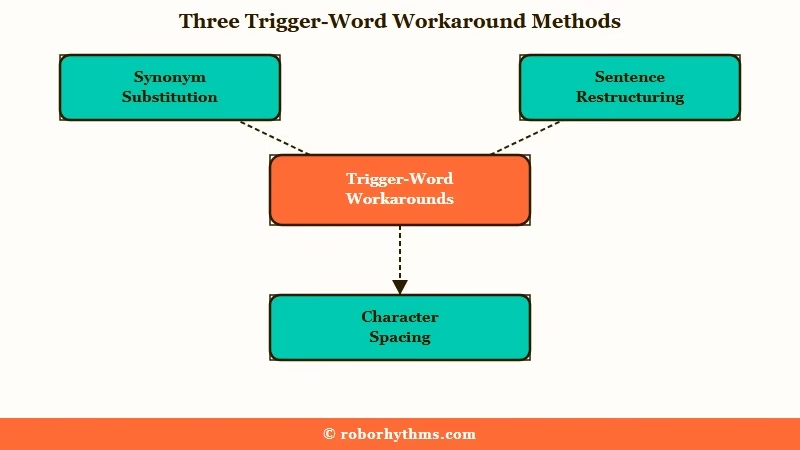
The three classes of workaround that work on every triggered word, not just “unadulterated”:
Vague: “Just rephrase the bot description until it works.”
Specific:
- Synonym substitution. Replace “unadulterated” with “pure”; replace “intense” (another common trigger) with “strong”; replace any word that fails the test with the closest neutral synonym.
- Sentence restructuring. Convert the description from a direct adjective (“unadulterated”) to an indirect phrase (“with no additives”). Same meaning, no literal trigger string.
- Character-level spacing or unicode substitution. Insert a zero-width space between letters or replace one letter with a unicode confusable. This works against literal-string filters but breaks if the platform adds semantic post-processing.
For most workflows the synonym swap is enough. The character-substitution trick is a last-resort move for cases where the surrounding meaning genuinely requires the original word and synonyms break the persona’s voice.
For broader Janitor AI troubleshooting context, our stop-Janitor-AI-repeating-responses piece covers the model-level repetition issue that hits the same users at the same time, and the JLLM grammar fix piece covers the April 20 grammar regressions some bots are still recovering from.
Which Alternative Platforms Skip The Word-List Block?
If a specific bot keeps tripping the Janitor AI word filter and rewrites do not preserve the voice you want, the cleanest move is to test the same persona on a platform with looser word-list moderation.
Three options handle the same kind of content with different filter-trigger profiles.
Nectar AI leans on customisable user-side filters rather than a fixed platform-wide blacklist, which means a bot that triggers Janitor AI’s auto-mod will usually run cleanly on Nectar with no rewrite. The trade-off is that Nectar has a smaller character library and the memory persistence is shorter on the free tier.
Candy AI is the option for users who want the platform itself to handle the moderation question rather than fighting a word filter every week. The platform is more curated and the bot library is smaller, but the failure mode is the opposite of Janitor’s. Bots either work fully or do not get created in the first place, no silent mid-generation blocks.
For the wider context on Character AI’s parallel filter pattern, the issue is the same shape on a different platform, only the trigger words and the enforcement rhythm differ. Janitor users hitting the unadulterated block today are the same users who hit Character AI’s “magic of character AI is fading” complaints six months ago.
Frequently Asked Questions
Will Janitor AI remove “unadulterated” from the trigger list?
The petition thread is fresh as of late May 2026 and has not received an official response yet. The team’s track record on rolling back accidental triggers is mixed; some surprise additions get reversed within 24 to 48 hours, others stay until enough community pressure builds. Do not wait, apply a workaround now.
Does the block only affect bot definitions or also messages?
The block fires anywhere the word appears in the prompt context, which includes the bot definition, the persona text, the greeting, your user message, and the model’s in-progress output. Stripping the word from the bot does not help if you also typed it into your message turn.
How can I tell which word is triggering a silent block?
Binary-search the failing field. Cut the suspect section in half, generate, and see if it fails again.
Repeat on whichever half fails. Most word-list triggers narrow down to the specific token in under 10 minutes of bisection. Once you find it, document it for your own bot maintenance notes.
Are the character-substitution workarounds against Janitor AI terms?
Janitor AI’s terms of service prohibit content categories rather than specific bypass methods. Replacing a word with a synonym or spacing letters in a benign word does not violate any rule the platform enforces. Using substitutions to push genuinely banned content (CSAM, threats, self-harm intent) is a different question and not what this guide covers.
What other innocuous words have been reported as silent blocks recently?
Beyond “unadulterated”, community reports across the broader AI companion space mention “damn”, “love”, “sex” used in neutral contexts, and occasionally “magic” as words that trigger blocks on strict platforms. The pattern is the same: word-list filters cannot tell context from string match.
Does the issue affect API users differently from web users?
The auto-mod fires at the platform layer, so API and web users hit the same trigger list. The difference is that API users often have better visibility into the failure (error codes, partial responses, log inspection), while web users see only a silent failure with no diagnostic.
Quick Takeaways
- Janitor AI’s auto-mod silently blocks the word “unadulterated” as of late May 2026 because the term co-occurs with mature themed text in training data, not because of its literal meaning.
- The fastest fix is a synonym swap: replace with “pure”, “completely”, or “clean” and the bot works again.
- Binary-search your failing field in 10 minutes to identify any silent-block trigger, then document the trigger in your own bot maintenance notes for the next time.
- If rewrites break the persona voice, move the bot to Nectar AI or Candy AI and skip the word-list issue entirely.
- Word-list filters are the future direction across AI companion platforms because California SB 243 and similar laws push toward fast keyword enforcement. Plan your bot maintenance habits for repeated surprises, not for one-off issues.
