
What’s Happening: Janitor AI writes too much narration and not enough dialogue mostly because the model mirrors your own input ratio and the bot’s example chats. The fix is rarely a single setting. It is a mix of writing more dialogue yourself, editing the bot’s example messages, and using blunt out-of-character commands to set a dialogue quota.
You send a one-line message to your bot, and it answers with four paragraphs of scenery, body language, and inner monologue, then two words of actual speech.
If you have ever stared at a wall of purple prose thinking “can this character just talk to me,” you are not the only one. This is one of the most common complaints in the Janitor AI community right now. The reverse issue, when Janitor AI responses come out too short instead of overloaded with narration, traces back to the same mirroring loop.
Here is the part most guides skip. The official Janitor AI help documentation says plainly that the model “mirrors you.” Your bot writing too much narration and not enough dialogue is usually a feedback loop, and you are one half of it. The ratio of description to speech in your own messages, plus the ratio baked into the bot’s setup, is what the model copies back.
That reframes the whole problem. It is not that the bot is broken or that the model hates dialogue. It is that the model is doing exactly what it was trained to do, which is match the pattern in front of it. Once you see the levers that control that pattern, you can shift the balance back toward conversation in a few minutes.
This guide walks through why it happens, then the exact fixes that move the needle, with the prompt wording and settings to use. I will also be honest about when the real fix is just switching to a different model or a different kind of companion app.
Why Janitor AI Writes Too Much Narration
Janitor AI writes too much narration because the model copies the description-to-dialogue ratio it sees in your messages and the bot’s example chats, and because some models default to verbose, flowery prose.
It is a mirroring problem first, a settings problem second.
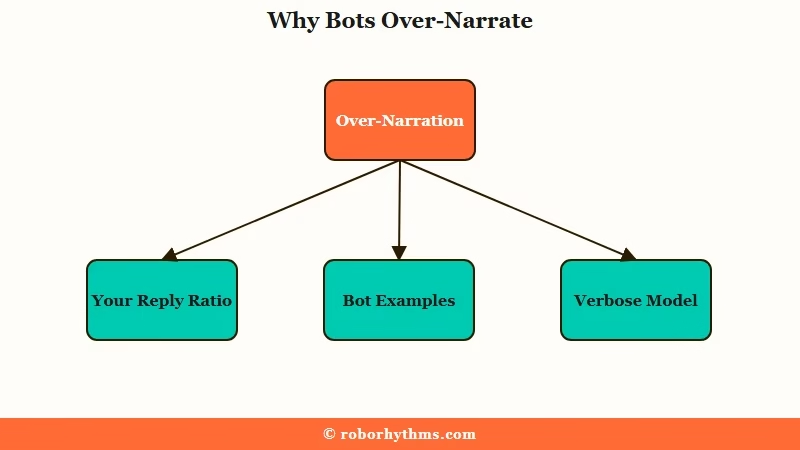
Three forces stack up here, and the way I see it the first one does most of the damage. It is the mirror effect the Janitor docs describe.
If your replies are short or heavy on actions in asterisks, the model reads that as the house style and fills its turn with matching description instead of speech.
The second is the bot’s own setup. The greeting or intro message sets the tone for the entire chat, and a narration-heavy intro locks the bot into long-form description.
The example dialogue field acts like training data the bot treats as real chat history, so if those examples are wordy and speech-light, every reply inherits that ratio.
The third is the model itself. A reasoning-focused model like DeepSeek R1 was built to prioritize logical consistency and detailed scene-setting, so it treats character descriptions almost as fixed constants and narrates around them.
This is not just anecdotal, since research on LLM verbosity bias shows the training process itself tends to reward longer, more elaborate output. Model choice matters more than most people assume.
What is a JLLM: JLLM is Janitor AI’s own in-house language model, the default engine that powers chats when you are not connected to an external proxy like DeepSeek or OpenRouter.
Why It Matters for Your Roleplay
It matters because narration-heavy replies kill the back-and-forth that makes roleplay feel alive, and they burn through your context window faster.
A bot that monologues is a bot you are reading, not talking to.
There is a quieter cost too. When a model pads every turn with description, it has less room to react to what you just said. You end up with beautiful scenery and a character who never answers your question. The conversation stops feeling like a conversation.
Long narration tangents also fill the context window with filler, which means the bot forgets earlier details sooner. If you have fought with the bot forgetting things, the two problems are linked, and the same dialogue-first habits help both. There is a deeper breakdown in our guide on Janitor AI memory problems if that is your main pain point.
The good news, and the reason I find this issue less maddening than most, is that it is one of the most fixable problems on the platform. Unlike an outage or a billing bug, the narration ratio is almost entirely under your control once you know which dials to turn.
How to Fix Too Much Narration and Get More Dialogue
The fastest fix is to write at least one full paragraph yourself, add a blunt out-of-character command setting a dialogue quota, and edit the bot’s example chats to be speech-heavy.
Here is the sequence I would run, in order of effort. If the generation settings throw an error before you get that far, clear the Janitor AI temperature deprecated error first, because none of these adjustments will stick until it is gone.
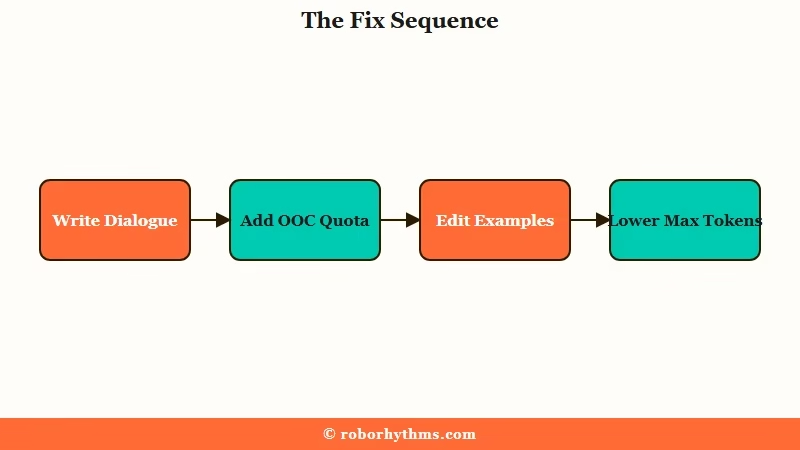
- Write more dialogue yourself first. The model copies your ratio, so if you want speech, give it speech. Veteran roleplayers report that writing one solid paragraph or more in your reply stops the bot from writing for you about 90 percent of the time. Lead your message with a line of actual dialogue before any action.
- Drop a blunt OOC command. Add a line like
(OOC: {{char}} will have at least 4 dialogue sentences in every reply, keep narration to 1-2 sentences.)Blunt and boring beats polite here, because the model can absorb a polite request into the story but reads a flat instruction as a system note. - Edit the bot’s example dialogue. If you can edit the bot, rewrite its example messages to be dialogue-forward. This is the “final lock” on tone, since the model treats those examples as the real pattern to follow.
- Trim the greeting. A narration-heavy intro message teaches the bot to narrate. Shorten it and add real spoken lines so the very first turn models the ratio you want.
- Tune the settings. Lower your max-new-tokens so the model has less empty space to fill with description. On DeepSeek, lowering temperature toward 0.4 reduces rambling and stops the bot speaking for you, while raising it toward 0.8 breaks repetitive loops.
- Switch models if nothing sticks. Some models are verbose no matter what you do. If you have tried the above and still get monologues, a less reasoning-heavy model will respond better to dialogue prompts.
What is an OOC command: OOC means out of character. It is a bracketed instruction, like (OOC: ...), that talks to the model directly about how to write instead of being part of the story.For commands you want the model to treat as administrative rather than story text, the official Janitor guidance suggests wrapping them in a system tag, written as <system>task: prioritize dialogue over narration</system>.
The docs describe this as putting the instruction in a folder the model reads as an admin task, so it does not fold the request into the scene.
Symptom, Cause, and Fix at a Glance
| Symptom | Likely cause | Fix |
|---|---|---|
| Four paragraphs of scenery, two words of speech | Model mirroring your short or action-heavy replies | Write a full paragraph that leads with dialogue |
| Bot narrates your character’s actions and thoughts | It reads asterisk thoughts as context, not private | Add ((OOC: Focus on {{char}}'s POV only, unaware of {{user}}'s thoughts.)) |
| Every reply is long and flowery no matter what | Reasoning model or high max-tokens filling space | Lower max-new-tokens, drop temperature to about 0.4 |
| Bot ignores your “stop narrating so much” | Polite phrasing absorbed into the roleplay | Use a blunt bracketed OOC quota command |
| New bot narrates from message one | Narration-heavy greeting and example chats | Edit greeting and examples to be dialogue-forward |
A Before and After Worked Example
The single biggest lever is your own message. Watch what happens when the same scene gets a different input ratio.
Before: She walks into the room and sits down.
That gives the model almost nothing to mirror except an action, so it fills the turn with its own description and you get a paragraph of the character noticing the weather.
After: "You're late," I say, dropping into the chair across from her. "I ordered for you already. Hope you still hate olives." I slide the menu away and wait.
Now the model has three lines of real dialogue and a clear tone to copy. Replies to a message like this come back dialogue-first, because that is the pattern you handed it.
When the Fix Is a Different App
If you want a companion that holds a natural back-and-forth without prompt engineering, a purpose-built chat app is the better tool.
Janitor AI is fantastic for deep, custom roleplay, but it is a tinkerer’s platform, and getting the dialogue ratio right is part of that work.
The way I see it, there are two kinds of users here. If you enjoy editing bot definitions, writing example chats, and dialing in settings, the fixes above will get you exactly the balance you want. That control is the whole appeal.
If you just want to open an app and have a character just talk with you, that constant tuning gets old fast. For that, something like Candy AI is built around natural conversation out of the box, so you get back-and-forth dialogue without rewriting example messages to get it. It remembers context across the chat and answers like a person instead of narrating around you.
Neither is wrong. I would just be clear-eyed about which kind of user you are before spending another hour fighting a bot’s narration habit.
If your problem is the broader pattern of repeated phrases rather than narration specifically, our piece on Janitor AI overused phrases covers that angle, and the OOC command reference has more steering templates.
Frequently Asked Questions
Why does Janitor AI write so much narration and so little dialogue?
The model mirrors the description-to-dialogue ratio in your messages and the bot’s example chats. Short or action-only replies, plus a narration-heavy greeting, teach it to narrate. Writing more dialogue yourself shifts the balance fastest.
How do I force my bot to talk more?
Add a blunt out-of-character command like (OOC: {{char}} will use at least 4 dialogue sentences per reply, keep narration short.) Pair it with leading your own messages with actual spoken lines, since the model copies your pattern.
Does the model I pick change how much it narrates?
Yes. Reasoning-focused models like DeepSeek R1 prioritize detailed scene-setting and run verbose by default. If dialogue prompts are not working, switching to a less reasoning-heavy model usually helps more than any single setting.
Do asterisk thoughts stay private from the bot?
No. The model reads everything inside asterisks as context, not as hidden text, which is why it sometimes narrates your character’s inner thoughts. Use an OOC note telling it to focus only on the bot’s point of view.
Will adding more to the Personality field stop the narration?
Not reliably. Personality is a loose guide the model forgets over a long chat. Example dialogue and the scenario field hold longer, so put your dialogue-ratio effort there instead.
Quick Takeaways
- Janitor AI over-narrates mostly because it mirrors your input ratio and the bot’s example chats, not because it is broken.
- Writing one full paragraph that leads with dialogue stops the bot from writing for you about 90 percent of the time.
- A blunt bracketed OOC command setting a dialogue quota beats a polite request the model can absorb into the story.
- Lower max-new-tokens and a temperature near 0.4 cut rambling on verbose models like DeepSeek.
- If you would rather not tune anything, a conversation-first app like Candy AI gives natural back-and-forth without the prompt work.
