
What’s Changed: Janitor AI added a “Similar characters” row to every character page. The platform says it reads the character’s public details, but the matches track the avatar picture and the name far more closely than the tags or the written description. The row is real, it is rolling out gradually, and there is no creator opt-out.
Janitor AI similar characters started appearing on character pages this week, and the reaction split in half within hours. Half the site loved finally having a way to find bots that are not on the trending page.
The other half opened their own bot, scrolled down, and found a row of strangers who happened to share a haircut.
Both reactions are correct, which is what makes this interesting. The feature is genuinely useful and the first version is visibly rough, and the gap between what the announcement promises and what the row delivers is the part I want to pin down.
There is a real explanation for why a brand new recommendation row looks like it is sorting by profile picture. It is not laziness and it is not a bug report anyone needs to file.
Below is where to find the row, why the matches skew visual, whether this helps or hurts small creators, and the one lever that still moves your results today.
What Are Janitor AI Similar Characters
Janitor AI similar characters is a recommendation row on each character page that surfaces other bots the system considers comparable.
It was announced on August 28, 2026 under the heading “Similar characters are here,” with the summary line “Discover more characters like the one you’re viewing, right from its character page.”
The announcement describes the matching logic in one sentence. The system uses “the character’s public details and balance similarity with variety, helping you explore familiar themes and personalities without a wall of near-duplicates.”
That phrasing sets a specific expectation. Themes and personalities are things you write down in a character definition, so a reader would reasonably expect the row to read the bot’s description and tags.
The row is the first real discovery surface the platform has added in a long time, and I rate it well above the trending page for finding anything outside the top hundred bots.
Where Do You Find the Similar Characters Row
The row sits partway down a character page and only appears when you are signed in.
Open any character, scroll past the top card and the intro, and it appears as a horizontal row with a “Load more” control at the end.
Two details explain most of the confusion about whether it exists. The rollout is gradual, described in the announcement as reaching “most people over the next few days,” so an account that does not have it yet is normal rather than broken.
The row also excludes characters you have already visited in the current session, which means it looks different on a second pass through the same page.
If you cannot see it yet, waiting is the honest advice I would give you. There is no setting to toggle, no beta flag, and no support ticket worth filing over a staged rollout.
Why Do the Similar Characters Look Wrong
The matches track the avatar image and the character name much more tightly than the written description or the tags.
A red-haired character in a Hawaiian shirt pulls up other red-haired characters, other Hawaiian shirts, and other characters who happen to share the same first name, per the thread on r/JanitorAIOfficial.
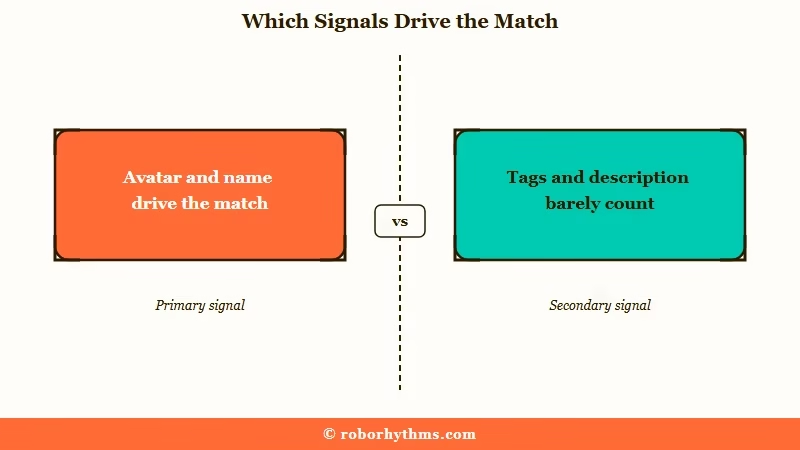
That is a different thing from matching on themes and personalities. A soft-spoken librarian and a serial killer can share a colour palette, a hair length, and a portrait crop, and a picture-led matcher will happily file them next to each other.
The mismatch that bothers me most is not the strangeness of individual results. It is that the row is presented with a single generic label, so there is no signal telling you which axis the system thinks it matched on.
Before: a bot named Lorenzo with a redhead avatar in a Hawaiian shirt, tagged as a slow-burn romance set in 1970s Italy.
After: a row containing unrelated Hawaiian shirts, unrelated redheads, and unrelated characters also named Lorenzo, with the 1970s Italy setting and the slow-burn tag doing almost no visible work.
Why Would a Recommendation System Use the Picture
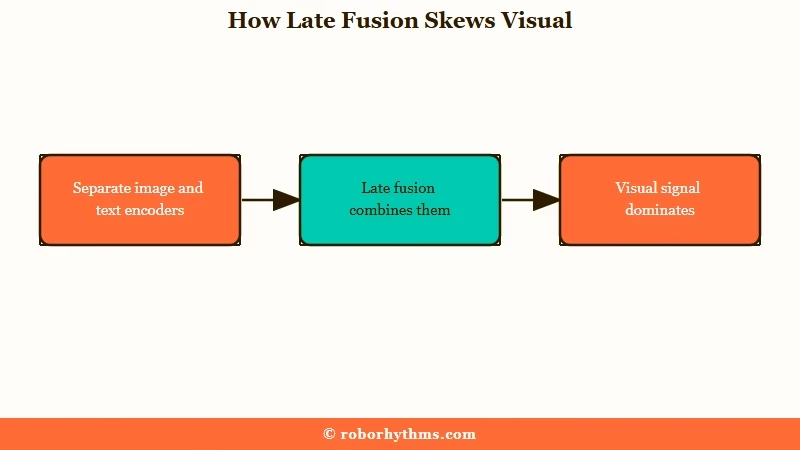
Most recommendation engines run a separate image encoder and a separate text encoder, then staple the two outputs together, and the visual signal tends to dominate.
Academic work calls the stapling step late fusion, and calls the resulting failure semantic misalignment.
The pattern is well documented outside this niche. A white wooden baby crib and a white wooden dog ramp are nearly identical in colour, silhouette, and pixel layout, so a system weighted toward vision will confidently recommend the dog ramp under the crib. Swap the furniture for character portraits and you have the Lorenzo problem exactly.
There is a blunter finding in the research worth knowing. A 2026 analysis of multimodal recommenders found that one widely used model performs almost identically whether it is fed real product image embeddings or pure random noise, meaning some systems marketed as multimodal barely read the content at all.
My read is that this is a shipping decision rather than a defect. Image similarity is cheap, it works on day one, and it sidesteps the awkward problem that user-written descriptions on this platform vary from three sentences to three thousand tokens of formatting.
Visual matching also deserves more credit than the current row is earning. In one retrieval comparison across a 44,000-image set, vector image search returned a shirt with a specific word printed on it that keyword search missed entirely, because the printed word was never typed into the item’s text data.
Pictures genuinely carry information the text field does not.
| Matching signal | What it catches well | What it misses |
|---|---|---|
| Avatar image | Art style, hair and colour palette, framing, visible clothing, text printed inside the image | Personality, tone, setting, era, the entire plot |
| Character name | Named fandom characters and direct alts of the same character | Any two unrelated bots that share a common first name |
| Tags and description | Genre, scenario, relationship type, content style | Nothing much, though it depends on creators tagging honestly |
Why a Row of Lookalikes Feels Worse Than It Should
A row of near-identical results reads as low quality even when every single match is technically correct.
Research on recommendation interfaces found that perceived variety across categories correlates positively with satisfaction, while raw item-to-item similarity correlates negatively with both satisfaction and intent to come back.
That is the counterintuitive part, and it explains the split reaction better than any complaint about accuracy. Five bots that all look like the one you are reading is the exact shape that measures worst, which is presumably why the announcement went out of its way to promise variety and “without a wall of near-duplicates.”
Labels matter more than most people expect too. Work on carousel interfaces from Amazon’s research group found that stripping the topic label off a row collapses click-through even when the recommended items are unchanged, because a label is what lets someone decide whether a row is worth scanning.
I keep coming back to that finding when I look at this row. One row labelled “Similar characters” is doing the work that three labelled rows would do far better, and the fix costs nothing algorithmically.
The longer-term risk is visible on other platforms already. The Character AI recommendation problem shows what happens when a feed stays unexplained for long enough, which is that people quietly stop looking at it.
Does This Hurt Small Bot Creators
The evidence points the other way, and most creators who weighed in welcomed it.
The one public objection, that a similar-characters row under your own bot pulls attention toward someone else, was outvoted by other creators in its own thread, with the top reply arguing it is one of the few features that helps smaller creators get discovered at all.
The research supports the majority position. Optimising a recommender for diversity across the catalogue raised how much of the library gets surfaced by several hundred percent in one study, at a cost to accuracy small enough to be a rounding error.
Similar-item rows are also one of the only surfaces that reach creators who never get promoted. A trending page rewards bots that are already winning, while a similar-characters row is reachable from any bot on the platform, including one with four chats on it.
Research from Old Dominion University on reading communities found that recommendation algorithms decide which creators a community ever encounters, which is exactly the leverage a row like this hands to unknown bots.
The counterexample is worth keeping in view though. When recommendations stay unexplained for long enough, people stop trusting the surface entirely, which is the pattern behind irrelevant bot suggestions elsewhere in the niche.
I side with the creators who welcomed it, with one caveat that is worth stating plainly. Clicks in a carousel concentrate heavily on the first item in the row, so the exposure this creates is real but steep, and being in position six is not the same win as being in position one.
What Can You Do About Bad Recommendations
Nothing on the reader side changes the row, and there is no creator opt-out, so the only real lever is the avatar.
The announcement mentions no toggle, no exclusion setting, and no way for a creator to curate which bots appear underneath their own.
That is worth sitting with if you came here as a reader rather than a creator. You cannot tune this row, you cannot dismiss it, and the platform has not said the matching will change.
If discovery is the whole reason you are on the site, Candy AI runs a curated library where browsing is the product rather than a row bolted onto it.
For creators, the practical sequence follows from how the matching behaves right now:
- Treat the avatar as a matching signal, not just decoration. A distinctive art style, palette, or composition is currently the strongest lever you have over which row your bot lands in.
- Avoid the most generic portrait conventions for your genre. A centred bust shot on a plain gradient is the single most crowded visual space on the platform.
- Give the character a specific name where the story allows it. Common first names pull in unrelated bots that share nothing else.
- Keep tags accurate anyway. Tagging is what the system says it uses, so tag quality is the thing most likely to matter more after the next iteration.
- Check what appears under your own bot occasionally, since that row is now part of how new readers experience your page.
The lever I keep returning to is the first one. Everything else on that list is good practice regardless, but the avatar is what is visibly steering results today.
| Symptom | Likely cause | Fix |
|---|---|---|
| No similar characters row anywhere | Gradual rollout has not reached your account | Wait, there is no setting to enable |
| Row appears on some pages but not others | Characters already visited this session are excluded | Open the page in a fresh session |
| Matches share a look but nothing else | Image and name signals outweigh tags and description | None as a reader, creators can change the avatar |
| Unrelated bots with the same character name | Name is being used as a matching signal | Use a more specific name on new bots |
| Row shows near-duplicates of one character | Direct alts of the same character match strongly | Expected behaviour, use Load more |
If bot discovery is the reason you keep bouncing off the platform, that frustration is older than this feature. The search tools have been thin for a long time, which the last interface overhaul made worse before it made anything better, and a single similar-characters row does not fix a library you cannot search properly.
If the hunting itself is the problem, Nectar AI is the closer fit, because building the character yourself sidesteps discovery entirely.
Neither one replaces a platform you already have months of chat history on, and switching costs more than most comparison posts admit. There is a fuller rundown of what people move to if the discovery problem is the thing pushing you out.
Frequently Asked Questions
Where is the similar characters row on Janitor AI?
Scroll down a character page while signed in. It appears as a horizontal row with a “Load more” control. If it is missing, the gradual rollout has not reached your account yet.
Why do Janitor AI similar characters look nothing like my bot?
The matching leans on the avatar image and the character name rather than the tags or description. Two bots with similar portraits get matched even when their personalities and settings share nothing.
Can creators turn off similar characters on their bot page?
No. The announcement mentions no opt-out, no toggle, and no way to curate which characters appear. Creator-controlled toggles and manual alt selection were both requested, but neither exists today.
Does the similar characters row help small creators?
Yes, on balance. It is reachable from any character page rather than only from a trending list, so it reaches bots that never get promoted. Clicks concentrate on the first row position.
Does the row show the same characters every time?
No. Characters you have already opened in the current session are excluded, so the row changes as you browse and looks different on a repeat visit to the same page.
Quick Takeaways
- The similar characters row went live on August 28, 2026 and appears partway down character pages for signed-in users only.
- The platform says it uses the character’s public details, but matches track the avatar image and the name far more closely than tags or descriptions.
- Late fusion between separate image and text encoders is the standard reason a recommendation row skews visual, and it is a shipping tradeoff rather than a bug.
- Creators have no opt-out, so a distinctive avatar and a specific character name are the only levers that move results today.
- Keep your tags accurate anyway, because tagging is what the system claims to read and is most likely to carry more weight after the next iteration.
