
What’s Changed: Janitor AI launched Janitor+ Router around July 30, giving JLLM+ subscribers about 70 third-party models with no proxy or API key setup. Credits are bought on top of the $12.99 monthly subscription, and users report the terms lock those credits behind an active subscription. As of August 1, 2026, Janitor has published no full price list.
The Janitor AI Router showed up in people’s settings menus with almost no warning. There was a newsroom post, no proper announcement, and within a day r/JanitorAI_Official had three separate threads of people asking the same question in slightly different words.
The pitch is genuinely appealing. Around 70 models including DeepSeek, Claude, GPT, Gemini, Grok and GLM, selectable from a dropdown, with no proxy URL to paste and no API key to lose. Anyone who has fought with a broken proxy at 1am understands why that sounds good.
Then people read the terms. The loudest objection has nothing to do with model quality or speed. It is about what happens to money you have already handed over.
I want to walk through the real cost math here, because the headline feature and the billing structure tell two different stories. I also want to correct one thing the community is getting wrong about the alternative everyone is recommending.
What Is the Janitor AI Router and How Does It Work
The Janitor AI Router is a first-party model router built into Janitor that lets JLLM+ subscribers use around 70 third-party models without configuring an external proxy or API key.
You pick a model in settings, and usage draws down a prepaid credit balance.
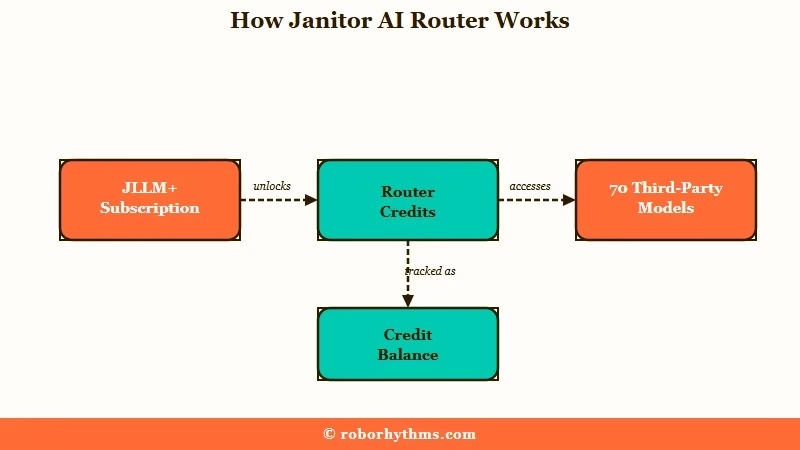
What is JLLM+: Janitor’s paid tier, written as both Janitor+ and JLLM+. It runs $12.99 a month and now gates Router access.
What is a proxy: A middleman service that connects Janitor to an outside AI model using your own API key, which you set up and paste in yourself.
The interface is the part people like. Each model shows its context window, input token cost and output token cost before you start chatting, and you can sort the list by recommended, cheapest, or largest context. That is more pricing transparency than most proxy setups give you.
Router also unlocks settings that standard JLLM and external proxies do not get. You can set up to 50 forbidden words instead of the usual 10, and you get advanced generation parameters including top-k, top-p, frequency penalty and a reasoning effort control.
If you have been fighting the Janitor AI advanced generation settings, this is a real upgrade.
Payment runs through Visa or Mastercard, credit or debit, with PayPal listed as coming later. Subscribe before August 31 and you get a one-time $5 in Router credits plus a 10 percent discount on some popular models.
What Happens to Your Router Credits If You Cancel
Users who have read the Router Credits terms report that credits stay locked behind an active JLLM+ subscription, so cancelling leaves any unspent balance unusable until you resubscribe.
That is the detail driving most of the backlash.
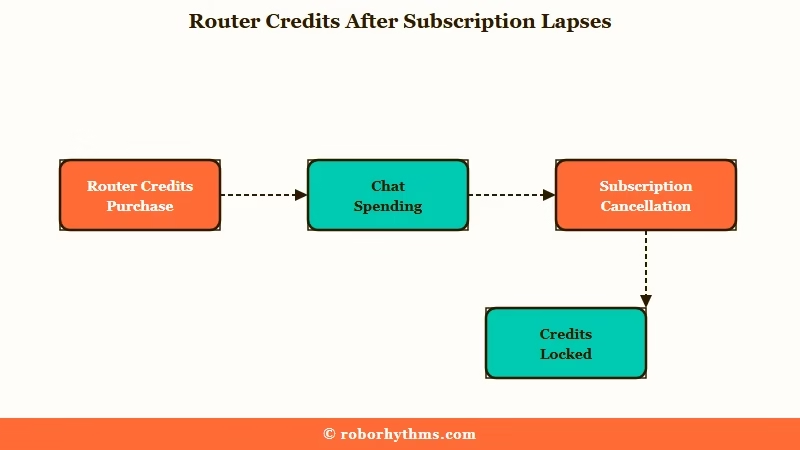
The clearest version came from a subscriber doing the arithmetic out loud. Buy $10 in credits alongside the $12.99 subscription, spend $8, cancel, and the remaining $2 sits there unreachable. Another commenter summarised it as paying a subscription to access your own money.
I need to be straight about the sourcing on this one. That reading comes from users quoting and screenshotting the Router Credits terms at janitorai.com, and the terms page currently returns an access-restricted firewall block to outside requests, so I could not verify the wording at source.
Treat it as a well-supported community reading rather than a confirmed quote, and check the terms in your own account before topping up.
What makes this more interesting than a typical pricing grumble is that the pattern has a regulatory history. Forfeiting prepaid credits when a subscription lapses has drawn enforcement action against companies in other industries, which is worth knowing before you decide how much to load.
The Maryland Attorney General’s settlement with lingerie subscription company AdoreMe barred it from causing customers to lose unused store credits when they cancelled their membership, and required restitution of unspent balances.
A federal class action filed in July 2025, Blackburn v. ClassPass USA LLC, argues that forfeiting unused credits on cancellation runs against the CARD Act and the Electronic Funds Transfer Act, which set a five-year floor on expiring prepaid stored value.
The federal framework for cancellation terms sits in the FTC’s Negative Option Rule, and the CFPB’s prepaid accounts rule governs how prepaid balances can be treated more broadly. Neither was written with AI roleplay credits in mind.
To be plain about it, none of those cases involve Janitor, no regulator has taken any action against Janitor, and I am not offering a legal opinion on whether the Router terms are enforceable. The point is narrower.
This billing pattern is contested territory elsewhere, so buying credits in large chunks carries a risk that buying tokens from a provider directly does not.
Do OpenRouter Credits Really Last Forever
No. OpenRouter’s own Terms of Service reserve the right to expire unused credits 365 days after purchase, so the common claim that OpenRouter credits last indefinitely is not accurate.
This is the part the Reddit threads got wrong while criticising Janitor.
The comparison people keep reaching for goes like this: put $10 into OpenRouter and it stays there forever, put $10 into Router and you lose it the moment you cancel.
The first half does not hold up. Section 4.2 of OpenRouter’s terms grants them the right to expire unused credits after a year, and the OpenRouter FAQ repeats it in plainer language.
Reports from r/openrouter split. Several users say balances survived a year of inactivity untouched, and at least one described logging in after roughly a year to find a $5 balance gone. A reserved right is not the same as a policy they enforce every time, which is exactly why the experiences diverge.
There are two more things worth knowing before treating OpenRouter as the frictionless option. Credit purchases through Stripe carry a 5.5 percent deposit fee with a $0.80 minimum, and credits become non-refundable 24 hours after purchase.
The way I see it, the honest framing is that both platforms impose a condition on money you have already handed over.
Janitor gates access behind an active subscription, OpenRouter reserves a 365-day expiry with a purchase fee on the way in. Knowing the specific mechanism on each is more useful than picking a villain.
| Platform | Base cost to access | Condition on unspent credits |
|---|---|---|
| Janitor+ Router | $12.99/mo subscription required | Reported locked while subscription is inactive |
| OpenRouter | None | Expiry reserved at 365 days, 5.5% deposit fee |
| DeepSeek official | None | Standard prepaid balance, no subscription gate |
| Chutes | Optional $10 or $20/mo tiers | Prepaid balance, prices have changed without notice |
How Much Does the Janitor AI Router Cost Next to a Proxy
Router stacks two charges: the $12.99 monthly JLLM+ subscription plus metered per-token credits on top, where OpenRouter, DeepSeek and Chutes all let you pay for tokens with no subscription underneath. That stacking is the core objection.
One subscriber put the practical effect at roughly $22.99 a month once you top up $10 in credits, against paying for the same tokens directly with no base fee. In the EU the subscription runs about 15 euros, which widens the gap.
The comparison below uses published rates as of August 1, 2026. Janitor has not released a full price list for Router, only live per-model pricing shown in the app, so its column reflects the structure rather than specific rates.
| Option | Monthly base | Token cost | Setup effort |
|---|---|---|---|
| Janitor+ Router | $12.99 required | Live in-app rates, 10% off some models | None, pick from a dropdown |
| DeepSeek official | $0 | V4 Pro $0.435 per 1M in, $0.87 per 1M out | API key plus proxy URL |
| OpenRouter | $0, 5.5% deposit fee | Provider rates passed through | API key plus proxy URL |
| Chutes | $10 or $20 tiers | DeepSeek V3.2 raised to $1.00 per 1M | API key plus proxy URL |
Real spending data gives this some shape. Roleplayers running DeepSeek directly report $1 to $5 a month, and one logged $2.82 for 28.1 million tokens across 1,189 requests. Frontier models are a different universe, with one user paying $0.28 to $0.29 per message on Kimi k3 at 45k context.
That gap explains why the $5 promotional credit lands so differently depending on your model. On DeepSeek it could cover a month. On a top-tier model, as one commenter put it, five dollars is gone inside an hour.
Worth remembering that direct providers are not immune to price moves either. Chutes raised DeepSeek V3.2 from $0.24 input and $0.42 output per million up to $1.00 on both without announcing it, which is covered in more detail in the Chutes proxy price increase breakdown.
Does the Router Pass Through DeepSeek Cache Discounts
Nobody knows yet, and it is the single biggest unanswered question about Router’s real cost.
A user raised it directly in the launch thread and got no answer from anyone, including Janitor.
What is a cache hit: When the model has already processed the opening chunk of your prompt and can reuse it instead of reading it again. Reused text is billed at a fraction of the normal rate. A cache miss means it had to process the text fresh.
Here is why it matters more than any headline rate. DeepSeek caches prompt prefixes automatically in 64-token chunks, with no opt-in flag and no write premium, and a cache hit on V4 Pro drops input from $0.435 per million to $0.003625 per million. That is roughly 120 times cheaper.
Roleplay is close to the perfect workload for this. Your character card and system prompt sit unchanged at the top of every single request, so after the first few messages most of your input should be hitting cache. Effective input costs can fall 80 to 95 percent against the headline rate.
If Router bills you at raw cache-miss rates while the underlying provider is serving cache hits, the markup is invisible and large. If it passes the discount through, Router is far more competitive than the threads suggest.
You can test this yourself once you have credits loaded, and I would do it before topping up a large amount:
- Start a long chat with a stable character card and do not edit the card mid-session.
- Note the credit balance, send 20 messages without changing the system prompt, then note it again.
- Divide the spend by 20 to get your real per-message cost.
- Compare that against the model’s official cache-hit rate for the same context size.
- If your per-message cost tracks the cache-miss rate after 20 messages, caching is not reaching you.
The trap is evaluating a model on its sticker price alone:
Before: GLM 5.2 shows $1.25 per million input tokens, which sounds cheap.
After: At 45k context per message on a cache miss, that is about $0.056 per message, so a 200-message week runs near $11 in credits on top of the $12.99 subscription.
Should You Use the Janitor AI Router
Router is worth it if you already pay for JLLM+ for other reasons and proxy setup has genuinely defeated you. It is not worth subscribing to JLLM+ solely to reach it.
That is the verdict the numbers support.
The fairest defence of Router is that it exists for people intimidated by proxies who would rather not leave the site to reach a better model, and that the premium buys ease of access. I think that is exactly right, and it is not a small group.
Proxy friction is real and well documented. Anyone who has hit Janitor AI proxy errors mid-scene knows the appeal of a dropdown that just works, and convenience has always carried a price.
| Your situation | What I would do |
|---|---|
| Already subscribed to JLLM+ | Try Router with the free $5, test caching before topping up |
| Comfortable with proxies | Stay on direct DeepSeek or OpenRouter, you will pay less |
| Proxy setup keeps failing | Router is a legitimate fix, budget for the stacked cost |
| Only want Router | Do not subscribe, the base fee undoes the benefit |
| Planning to cancel soon | Keep credit top-ups small until the terms are clearer |
If you are still deciding whether the underlying subscription earns its keep at all, the Janitor Plus value breakdown covers that question separately, and what JLLM really is is worth reading first if the model naming is confusing.
Will Janitor AI Remove Custom Proxies
No removal has been announced and custom proxies still work normally. The concern circulating in the threads is speculation, and I want to flag it as speculation rather than repeat it as news.
The worry is understandable. The argument runs that a paid first-party router only makes commercial sense once bring-your-own proxies go away, with venture funding pressure named as the reason it could happen regardless of intent.
The counterargument carries weight. A large share of the user base runs proxies, removing them would push those people off the platform entirely, and Janitor has previously said custom proxies would stay supported.
What I would take from it is practical rather than predictive. If you rely on a proxy workflow, it costs nothing to keep your API keys and setup notes somewhere you can find them, and the SillyTavern and OpenRouter setup guide is a reasonable fallback to have bookmarked.
What to Do If You Want Chat Without the Credit Math
If the appeal of Router is not having to think about tokens, a flat-rate companion app removes the metering entirely rather than repackaging it.
Worth saying plainly that these are different products, not a drop-in Router replacement.
Router still bills per token. You are watching a balance tick down, deciding whether a longer reply is worth the cost, and carrying the risk that unspent credit gets stranded if your subscription lapses.
For some people that accounting is fine. For others it quietly ruins the thing they came for.
Purpose-built companion platforms work on a different model, where one subscription covers your chatting and there is no separate balance to top up or forfeit.
Candy AI is the one I would point most people to if uncapped conversation without cost anxiety is the real goal, since memory and character consistency are handled for you rather than tuned through parameters.
Nectar AI is the alternative I would suggest for anyone who leans more toward image generation and visual scenes alongside the chat. Neither gives you a 70-model dropdown, so if model choice is the thing you want, Router or a proxy remains the right call.
Frequently Asked Questions
Do I need Janitor+ to use the Router?
Yes. Router is restricted to active JLLM+ subscribers at launch, which costs $12.99 a month on web. Subscribing before August 31 includes a one-time $5 in Router credits and 10 percent off some popular models.
What happens to my Router credits if I cancel?
Users reading the Router Credits terms report that credits become unusable while your subscription is inactive, and return when you resubscribe. The terms page is not publicly retrievable right now, so verify inside your own account before buying a large balance.
Is the Janitor AI Router cheaper than OpenRouter?
For most people, no. Router adds a $12.99 monthly subscription on top of per-token costs, while OpenRouter charges no base fee, though it does apply a 5.5 percent deposit fee and reserves the right to expire credits after 365 days.
How many models does the Router have?
Around 70, including DeepSeek, Claude, GPT, Gemini, Grok and GLM. You can sort them by recommended, cheapest or largest context, and each shows its context window and per-token pricing before you start a chat.
Does Router support prompt caching?
Unconfirmed. Janitor has not stated whether cache-hit pricing reaches the user, which matters because DeepSeek cache hits cost about 120 times less than cache misses. Test your real per-message spend over 20 messages before topping up.
Can I still use my own proxy?
Yes. Custom proxies and API keys work as before, and no removal has been announced. The concern that Router precedes phasing them out is community speculation, not a stated plan.
Quick Takeaways
- Janitor+ Router gives JLLM+ subscribers about 70 models with no proxy setup, at $12.99 a month plus metered credits on top.
- Users report the terms lock unspent credits behind an active subscription, and the terms page cannot currently be verified from outside, so check it in your account before loading a large balance.
- OpenRouter is not the safe haven the threads claim, since its terms reserve the right to expire unused credits after 365 days and charge a 5.5 percent deposit fee.
- Whether Router passes through DeepSeek’s cache-hit pricing is unanswered and worth more than any headline rate, so measure your real cost across 20 messages first.
- Subscribe for Router alone and the base fee cancels the benefit, but if proxy setup keeps defeating you, the convenience is a defensible purchase.
