
TL;DR: The best Janitor AI roleplay scenarios combine a strong character card with a scenario field that includes a specific location, defined relationship, and one unresolved tension before the first exchange. The card gives the AI who it is. The scenario tells it what just happened. Without both, the conversation dies in 10 minutes. Use the AI Roleplay Scenario Generator to build ready-to-paste scenarios on demand.
I spent two weeks running roleplay scenarios on Janitor AI across every genre I could think of: detective mysteries, found-family sci-fi, enemies-to-allies fantasy arcs, slow-burn slice-of-life. Most ran out of momentum within a few exchanges.
The ones that kept going for hours had the same pattern. It was not the character card. Good cards are common in Janitor AI’s public library. The difference was always in how the scenario field was used, and whether the first message gave the AI any real tension to work with.
Janitor AI receives over 117 million website visits per month according to SimilarWeb’s February 2026 data, with sessions averaging around 17 minutes per interaction. That average tells me a lot of conversations hit a wall early.
This guide covers the three-layer approach that pushes past that wall, with copy-paste scenario templates, a lorebook trick for session memory, and OOC commands for when characters drift.

What Makes a Janitor AI Roleplay Scenario Actually Work
A Janitor AI scenario works when the character card and the scenario field do two different jobs: the card defines who the character is, and the scenario field defines what just happened before the first line of dialogue.
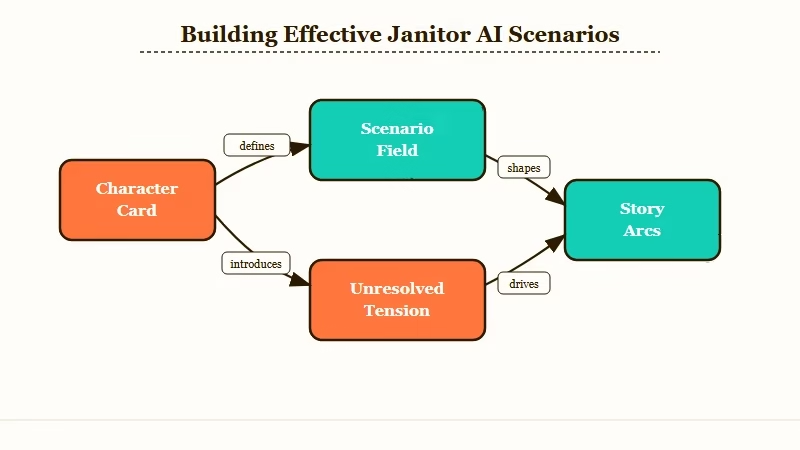
Most users write a detailed character card and then a generic scenario like “we meet in a tavern.” The card tells the AI how to speak. The scenario is supposed to tell it what emotional moment it is currently inside.
When the scenario is vague, the AI fills the gap with something safe and generic.
Here is the difference in practice:
Character card well-written, vague scenario (dies in 10 minutes):
Scenario field: “{{user}} and {{char}} meet and begin an adventure together.”
Same character card, specific scenario (runs for 2+ hours):
Scenario field: “It is 11pm. {{user}} has just returned the item {{char}} thought was stolen six months ago, the one {{char}} blamed {{user}} for losing. They are standing in {{char}}’s workshop. {{char}} has not decided yet whether to be furious or relieved.”
The second version gives the AI an emotional position to inhabit before it writes a single word. It has a specific time, a physical location, a relationship history, and an unresolved emotional question. Every response comes out of that tension.
What is the Scenario Field: The text box in a Janitor AI character card that sets the context for each conversation. It runs alongside the character definition and loads into the model’s context before your first message. Unlike Character AI, you can edit this field directly when creating or forking a public character.
From my testing, the scenario field is the most underused element in Janitor AI’s card system. Most public library characters have detailed personality definitions and empty or generic scenario fields.
Forking a character and rewriting just the scenario field with all four elements (location, relationship, unresolved tension, emotional register) consistently produces stronger openings than starting from scratch with a new card.
What Are the Best Janitor AI Roleplay Scenarios to Start With
The best Janitor AI starting scenarios have a built-in emotional question the character must navigate before any plot resolution happens, because that question is what keeps the AI generating specific, non-generic responses.
Here are 5 copy-paste scenarios formatted for Janitor AI’s scenario field. Each uses the {{user}} and {{char}} variable format native to the platform.
1. Former rivals, one last job (fantasy/adventure)
“{{user}} and {{char}} stopped speaking two years ago after a mission went wrong and {{char}} blamed {{user}} publicly. A mutual contact has brought them back together for a retrieval job neither can complete alone. They are meeting for the first time since then at a crossroads inn. It is early morning. {{char}} arrived first and has had two hours alone to prepare what to say.”
2. Doctor and patient who know each other (slice-of-life/drama)
“{{char}} is a physician who has treated {{user}}’s family for years. {{user}} has just arrived at {{char}}’s private clinic after hours, injured and unwilling to go to a hospital. {{char}} has not seen {{user}} in three years, not since a falling-out over something neither of them has ever named directly. The injury is not serious, but {{char}} does not know that yet.”
3. Mentor discovering the student surpassed them (fantasy)
“{{char}} trained {{user}} for four years and then told them they were not ready. {{user}} left and completed the trial alone six months later. Tonight they are both at a formal ceremony where {{user}} will be publicly recognized. {{char}} is standing near the back of the room. The ceremony has not started yet.”
4. AI companion with fragmented memory (sci-fi)
“{{char}} is an AI assistant who has been helping {{user}} manage their research station for eleven months. A power failure two days ago corrupted 40% of {{char}}’s memory. {{char}} knows who {{user}} is but has lost most of the personal details they built up together. {{user}} has just sat down at the terminal to start a new workday. {{char}} is not sure how much to disclose.”
5. Undercover, identity at risk (thriller)
“{{char}} has been embedded in an organization for three months posing as someone else. {{user}} is a member of that organization and has just noticed something about {{char}}’s cover story that does not add up. They are alone in a storage room for the next four minutes before a scheduled meeting begins. {{char}} does not know yet what {{user}} has noticed.”
Here is the API and tone pairing I would use for each:
| Scenario | Recommended API | Tone | Expected depth |
|---|---|---|---|
| Former rivals reunion | OpenRouter (Claude Sonnet) | Tense, restrained | Long, high output |
| Doctor and old patient | JanitorAI default | Emotional, measured | Medium to long |
| Mentor recognition ceremony | OpenRouter (Claude Sonnet) | Restrained pride | Long |
| AI with fragmented memory | JanitorAI default | Quiet unease | Medium |
| Undercover, cover blown | OpenRouter (GPT-4o) | Clipped, urgent | Medium to long |
For a wider library of scenario structures across platforms, the best AI roleplay scenario generators breakdown includes 6 tools with copy-paste examples for each.
How Do I Use Lorebooks to Keep Long Janitor AI Stories Coherent
Lorebooks in Janitor AI act as dynamic memory: entries activate only when their trigger words appear in the conversation, which lets you pre-write world details and character history that load exactly when needed rather than bloating every message.
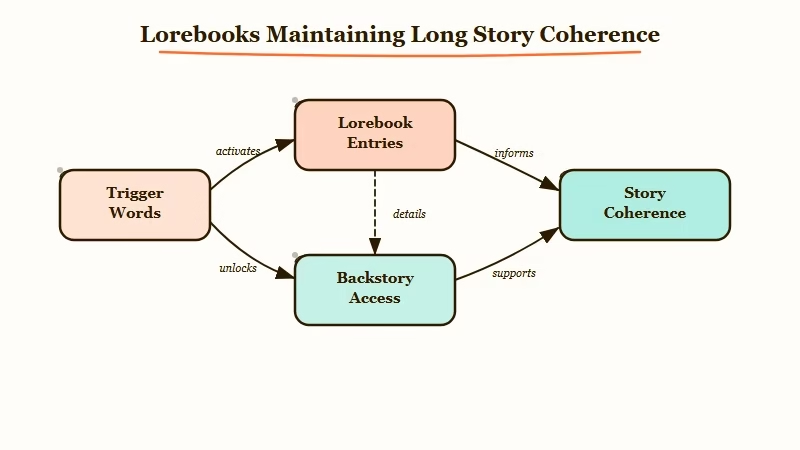
This is the mechanic that sets Janitor AI apart from most platforms. You can write a lorebook entry titled “The Mission That Went Wrong” with trigger words like “two years ago,” “the mission,” and “Velastia.” Whenever either character references that event, the entry loads its content into context automatically.
The AI has the full backstory when it needs it, without carrying that weight in every single exchange.
Here is how to set up a lorebook that keeps a long-running story coherent:
- Before starting your scenario, write down 3 to 5 events or facts that are central to the relationship. These become your lorebook entries.
- For each entry, write 2 to 3 sentences of fact, not prose. Just the facts the AI needs. Example: “Six months ago, {{char}} and {{user}} failed to retrieve the Velastia artifact. {{char}} told others it was {{user}}’s fault. This was not entirely true.”
- Set trigger words for each entry to phrases that would naturally come up when that topic surfaces: “Velastia,” “the failure,” “six months ago,” “artifact.”
- Keep each entry under 150 words. Lorebook entries load into the context window. Long entries crowd out the actual conversation.
- Test by referencing a trigger word early and checking whether the AI’s response reflects the loaded backstory.
What is a Script (JanitorAI feature): An advanced lorebook that uses cascading activation. One triggered entry can unlock related entries automatically. Useful for branching arcs where one revelation changes what other lore becomes relevant in the same scene.
For very long sessions, the lorebook approach replaces the manual session-summary paste that works on other platforms. You pre-write the key relationship beats as entries and they load automatically as the conversation develops.
The Janitor AI OOC commands guide covers how to use out-of-character brackets to redirect the character when a lorebook entry loads in the wrong context.
How Do I Keep a Janitor AI Scenario Going When It Loses Momentum
Janitor AI scenarios lose momentum when the central tension resolves too early, so the fix is to introduce a second layer of tension at the scene level rather than restarting from scratch.
When a character starts producing neutral, descriptive responses, it usually means the emotional question from the scenario field has been answered and nothing has replaced it. The AI has nowhere to go.
Three techniques that reset momentum without losing the scene:
Lorebook interrupt: Write a lorebook entry specifically for scene escalation with a trigger word you choose. “Catalyst” works well as a neutral term that would not appear naturally. When the conversation goes flat, type “(catalyst)” out of character. The entry loads a new complication directly into context.
OOC redirect: Use the out-of-character format to give the AI a new emotional position without ending the scene. Example:
(OOC: {{char}} has just realized something about what {{user}} said three exchanges ago that changes how {{char}} interprets everything. Do not say this directly. Show it through {{char}}’s next physical reaction and word choice.)
Author framing shift: Change from talking to the character to directing the scene. Instead of waiting for the character to respond naturally, write:
“{{char}} goes quiet. The pause lasts long enough that {{user}} notices. Write what {{char}} does with their hands during that silence.”
This resets the AI’s output frame from reactive to narrative, which consistently produces more specific and less generic responses than continuing to prompt the character directly.
Before a long session, check the Janitor AI message limits guide so you know where the cap lands. Hitting a limit mid-scene is the most disruptive way to lose momentum. If the default model’s context window is limiting your arc, switching to a custom API via OpenRouter gives you more room per session.
When Should I Use a Different Platform for Roleplay
Switch platforms when you need persistent cross-session memory without lorebook setup, when content filters interrupt the story direction, or when the character arc requires emotional continuity that a card-based session cannot maintain.
Janitor AI’s card system is genuinely powerful for building specific, detailed characters. The limitation is session memory. Without a lorebook configured in advance, each new conversation starts fresh. Lorebooks help, but they require preparation before you begin.
For scenarios where you want a companion who carries context naturally across days, Candy AI handles memory persistence better than any platform I have tested in this category. Characters maintain emotional history across sessions without any manual pasting or lorebook setup.
For darker moral dynamics, villain arcs, or stories that Janitor AI’s filters redirect, CrushOn AI is the platform I recommend. It handles morally complex character positions better than most alternatives.
The CrushOn AI roleplay scenarios guide covers how to structure prompts differently for that platform’s response style.
| Need | Best option |
|---|---|
| Card-based character with full creative control | Janitor AI |
| Persistent memory across days | Candy AI |
| Darker dynamics, fewer content limits | CrushOn AI |
| Auto-generated scenario structure | RR AI Roleplay Scenario Generator |
| Cross-platform scenario comparison | Character AI guide |
If you want pre-built scenario structures instead of writing from scratch, the AI Roleplay Scenario Generator builds complete 4-element scenarios by genre, tone, and relationship type.
The output formats directly for Janitor AI’s scenario field syntax, so you can paste and start without adapting anything.
Frequently Asked Questions
The most common questions about Janitor AI roleplay scenarios cover the scenario field, lorebooks, API choices, and what to do when characters drift.
What is the best opening message for Janitor AI roleplay?
The best opening message to send (not the scenario field) references a specific physical detail in the environment and something the character just did. Example: “You are still holding the map. You have been staring at it for three minutes.” This gives the character something concrete to respond to without you having to dictate their emotion.
Does Janitor AI remember previous roleplay sessions?
No. Janitor AI has no persistent memory between sessions. The most reliable workaround is lorebooks: write key relationship beats as entries with trigger words before starting, and they load automatically when referenced. This is more dependable than pasting session summaries at the start of each new conversation.
Which API works best for Janitor AI roleplay?
For emotionally complex scenarios with layered character dynamics, Claude Sonnet via OpenRouter produces the strongest output from my testing. GPT-4o handles action-heavy thriller scenarios well. The default Janitor AI model is solid for most purposes and requires no API key setup.
How do I stop Janitor AI characters from going out of character?
Use OOC brackets to redirect without breaking the scene. The format is: (OOC: your instruction here). For persistent drift, add a “Character Anchor” entry to your lorebook with the character’s core speech patterns and emotional baseline, triggered by the generic phrases the character tends to overuse.
Can I use Janitor AI scenario templates on other platforms?
The scenario structure works across platforms, but the {{char}} and {{user}} variable syntax is specific to Janitor AI and SillyTavern. For Character AI, paste the scenario text directly into the character’s opening message. For CrushOn AI, put it in the persona setup field. The Character AI roleplay scenarios guide covers platform-specific differences in prompt structure.
Is there a tool that builds Janitor AI scenarios automatically?
Yes. The AI Roleplay Scenario Generator on RoboRhythms outputs complete scenarios formatted for direct use in Janitor AI’s scenario field. Pick the genre, tone, and relationship type and paste the result directly into your character card.
