What’s Changed: Janitor AI’s models repeat stock phrases like “lopsided grin” because text generation is a self-reinforcing loop, not a bug. The usual fix, cranking the repetition penalty, often makes it worse. The reliable fixes are a sequence-level penalty, smarter sampling, and a trimmed bot definition. Here’s the full playbook.
If you spend real time on Janitor AI, you start to notice the tics. The same lopsided grin, the same smirk, the same voice dropping to barely above a whisper, reply after reply. A related response-quality snag is when Janitor AI leaves you with replies that are too short, which has its own set of fixes.
Janitor AI overused phrases are one of the most common complaints I see from people who otherwise like the platform. The model is not broken. It is doing exactly what the math tells it to do, and that is the part most fixes get wrong.
The instinct is to crank the rep penalty until the stock phrases stop. From what I’ve seen, that usually makes the writing worse, not better. Below you will find what rep penalty and frequency penalty each actually do, which values are worth setting, and how to rewrite a bot so it stops reaching for the same five descriptions.
Why Janitor AI Keeps Repeating the Same Words and Phrases
Janitor AI overused phrases come from how language models write text, one token at a time, with no global plan to avoid repeating themselves.
Each word is chosen from the immediate context, so the moment “lopsided grin” lands in the chat, it becomes part of the context that shapes the next reply.
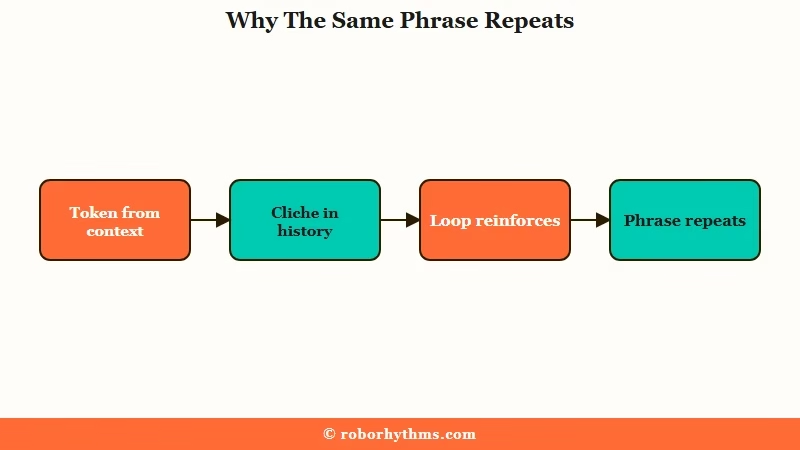
What is the next-token loop: A language model predicts each word based only on the text so far, so a phrase it already used becomes more likely to appear again, feeding itself.
That feedback loop is the whole story. Once a descriptor is in your chat history, the model sees it as a pattern worth continuing, and it leans harder on it every turn.
The way I see it, this is why editing only the latest reply rarely sticks: the phrase is still sitting upstream in the conversation, quietly pulling the model back.
There is a second cause that catches people out. When you run a model at very low temperature, you are telling it to pick the safest, most probable next word every time, and the safest word is almost always the cliché. Low-diversity settings do not make the writing tighter.
They funnel the model straight into stock phrasing. This is a cousin of the looping problem covered in repeated Janitor AI responses, but the fix is different because the symptom is different.
Why Raising the Repetition Penalty Backfires
Raising the repetition penalty often makes Janitor AI more repetitive, because the standard penalty is a blunt, multiplicative tool that punishes every token, including the stop token a model needs to end its reply.
When the model is penalized for trying to finish, it keeps writing, and padding a reply means reaching for more filler description. Most people raise it precisely when replies start repeating, which is the worst moment to raise it.
If your proxy does not hand you a sequence-level penalty like DRY, this is the point where a lot of people stop fighting the samplers. Candy AI keeps character voice consistent server side, so there is no penalty slider to tune in the first place.
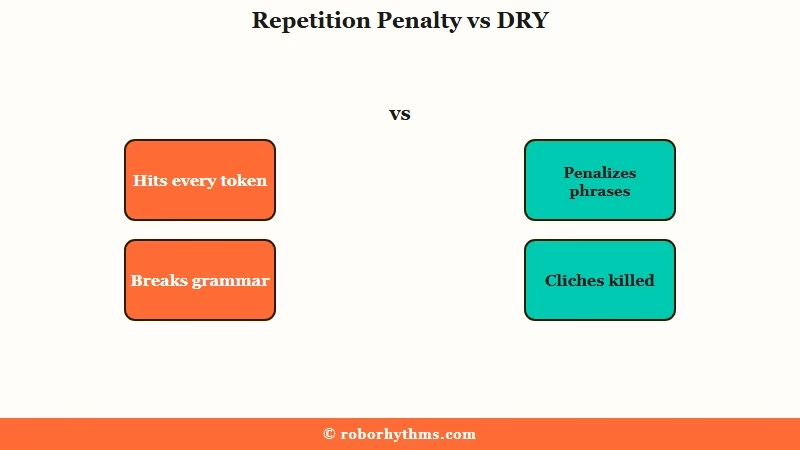
This is the single most useful thing I learned digging into the problem. The classic repetition penalty does not understand phrases.
It nudges down the probability of individual words, so it will happily punish “the” and “and” alongside “lopsided,” which is how you end up with stilted grammar on top of the clichés you were trying to kill. If your fixes have started breaking sentence structure, that overlaps with the symptoms in our JLLM grammar fix guide.
The tool that genuinely targets stock phrases is a sequence-level penalty.
What is the DRY sampler: DRY (“Don’t Repeat Yourself”) penalizes repeated multi-word sequences based on their length, so it kills “lopsided grin” as a phrase while leaving normal grammar untouched.
DRY is the difference between a scalpel and a hammer. It looks at strings of tokens, not single words, so it can crush a recurring three-word descriptor without touching the connective tissue that makes a sentence readable.
If you only change one thing after reading this, switch from a heavy repetition penalty to DRY.
The Settings That Genuinely Reduce Repetition
The settings that reduce Janitor AI repetition are a moderate temperature, min-p truncation, a sequence-level DRY penalty, and a low or disabled classic repetition penalty.
Here is how I’d set each one, and what each setting does.
| Setting | Recommended value | What it does |
|---|---|---|
| Temperature | Around 0.85 | The JLLM baseline. Low enough to stay coherent, high enough to avoid funneling into the safest cliche. |
| Min-p | 0.05 to 0.1 (local backends only) | Confidence-based truncation that keeps text coherent even at high temperature, where top-p tends to collapse into noise. |
| DRY penalty | On, moderate (local backends only) | Penalizes repeated phrases by length. The real fix for stock descriptors. |
| Repetition penalty (rep penalty) | 1.0 to 1.1, or off | Blunt and multiplicative. Set high it breaks grammar and stop tokens, making replies longer and more repetitive. |
| Frequency penalty | 0.4, or off when DRY is on | Scales with how often a word has already appeared, so a word used five times takes a harder hit than one used once. Pick either frequency or presence penalty, never both, and leave repeated phrases to DRY. |
| Max new tokens | 700 to 800 | Enough room for a full reply without forcing the model to pad with filler description. |
One honest caveat that most guides skip. If you use the built-in JLLM, your main levers are temperature and max new tokens. The sequence-level samplers are not exposed there at all.
Which samplers you actually get after connecting a proxy or custom API depends on the backend behind it, not on the act of connecting one. Local inference runners such as KoboldCpp and TabbyAPI expose DRY, min-p and XTC, the inverse-greedy sampler that occasionally drops the single most likely word to force fresher phrasing.
Janitor’s own Generation Rules panel, which opens once you are on a proxy, gives you forbidden words, Top K, Top P, repetition penalty and frequency penalty. Whether those last two do anything depends on the model behind the proxy.
DeepSeek’s API no longer supports frequency penalty or presence penalty, so on a DeepSeek proxy that slider moves and nothing changes. The research on min-p sampling is worth a read if you want the mechanism behind why it holds up at high temperature (arXiv paper on min-p sampling).
There is a different complaint that gets mixed up with this one: the bot repeating your own messages back at you. That is usually not a sampler problem.
It happens when your definition or example dialogue contains lines written in your character’s voice, so the model treats writing both sides of the scene as the pattern to continue. Strip your own turns out of the example dialogue, and on a proxy check that the stop sequence marking the end of the bot’s turn is still set.
The fix people pass around most often is a bracketed instruction dropped straight into the chat, along the lines of (OOC: {{char}} never speaks or acts for {{user}}.).
People stack frequency and presence penalty together and then wonder why the output gets strange. Presence penalty is a flat hit the first time a word shows up, frequency penalty grows with every repeat. Pick one, keep it gentle, and let DRY do the heavy lifting on phrases.
How to Fix Janitor AI Repetition Step by Step
The fastest path is to clear the pattern from your chat, then adjust settings, then trim the bot definition if it keeps coming back.
From what I’ve seen, the loop breaks about half the time at step one, so work in this order before touching anything advanced.
| Symptom | Likely cause | Fix |
|---|---|---|
| Same physical descriptor every reply (“lopsided grin”) | Phrase is in chat history, feeding the next-token loop | Delete every message with the phrase, enable DRY |
| Clichés got worse after you raised the repetition penalty | Penalty punishing stop tokens and grammar | Lower the repetition penalty, switch to a DRY sequence penalty |
| Flat, samey prose even on fresh chats | Temperature too low, picking the safest word | Raise temperature toward 0.85, pair with min-p |
| Text turns garbled when you raise temperature | Top-p truncation breaks at high temperature | Switch truncation to min-p at 0.05 to 0.1 |
| Long, repetitive replies that pad description | Bot definition over 1,300 tokens | Trim to 1,000 to 1,300 tokens, move lore to a lorebook |
- Swipe once or twice. Sometimes the model just needs a different roll of the dice.
- Delete the messages that contain the repeated phrase, not just the latest reply. The descriptor lives in the history, so leaving older copies in place keeps feeding the loop.
- Drop a steering note into chat memory, in brackets, such as [vary all physical description; never reuse a gesture or phrase from the last three messages].
- Lower your repetition penalty and turn on DRY if your setup exposes it.
- Nudge temperature to around 0.85 and switch truncation to min-p at 0.05 to 0.1 if your backend exposes it.
- If the clichés survive all of that, the problem is the bot definition, and you fix it by trimming (next section).
- As a last resort on a deeply stuck chat, start a fresh conversation to wipe the reinforced pattern entirely.
Here is what the change looks like in practice.
Before: Every swipe returns a version of the same line. “He shoots you a lopsided grin, his voice barely above a whisper.”
After: With DRY enabled and the bracketed steering note in chat memory, the same prompt returns “He tilts his head, one eyebrow climbing, and lets the silence stretch a beat too long before he answers.”
Same scene, same character, different machinery underneath. The point is not that the second line is poetry. It is that the model stopped reaching for the cliche because you removed the conditions that made the cliche the safest choice.
Trim Your Bot Definition and Move Description Into a Lorebook
Overstuffed bot definitions are a hidden source of overused phrases, because the model re-reads the same dense description every single turn.
The sweet spot I’d aim for is a total definition between 1,000 and 1,300 tokens. Go over that and replies turn verbose and repetitive. Go under 1,000 and the personality reads flat.
The cleaner structural fix is a lorebook. Instead of cramming every physical detail and backstory beat into the always-on definition, you move static description into keyword-triggered entries that only fire when relevant.
Done well, this can shave a 2,500-token definition down to a few hundred active tokens, which frees the model to focus on the current scene instead of parroting a fixed character sheet. If your entries are not firing, our lorebook troubleshooting guide covers the usual culprits.
One detail people get backwards. Insertion order runs 0 to 100, and a higher number places the entry closer to the live conversation, which gives it more attention, not less.
A lot of stock-phrase spam comes from a description entry sitting at a high insertion order, effectively shouting its adjectives over the actual scene. If a character keeps repeating one specific descriptor, check whether a lore entry is pinning it near the front of the prompt. This interacts with how much the model can hold at once, which ties into our Janitor AI memory guide.
What to Use If You’d Rather Not Babysit Settings
If fighting samplers and trimming token budgets is not how you want to spend your evening, a platform that handles writing quality and memory server-side will feel like a different hobby.
The repetition problem on Janitor AI is fixable, but it is genuinely fiddly, and not everyone wants to run a proxy to get there.
When people ask me where to go when the tinkering stops being fun, I point them to Candy AI. It keeps character voice and memory consistent without asking you to touch a single sampler, which sidesteps the whole repetition spiral rather than patching it.
For anyone who specifically wants writing variety and the option to switch between models for different tones, Crushon AI gives you that range out of the box.
Neither one replaces what you like about Janitor AI if you enjoy the control. They are the answer to a different question: what do I use when I want varied, in-character writing without the maintenance.
Frequently Asked Questions
Why does Janitor AI keep using the same phrases?
Janitor AI repeats phrases because language models generate text one token at a time and treat a phrase already in the chat as a pattern to continue. Once “lopsided grin” is in your history, it becomes self-reinforcing until you remove it and change your settings.
Does lowering the temperature stop the repetition?
No, lowering temperature usually makes it worse. Low settings push the model toward the safest, most probable word, which is almost always the cliche. A moderate temperature around 0.85 paired with min-p gives you variety without garbled text.
Should I raise the repetition penalty to fix overused phrases?
Generally no. The standard repetition penalty is blunt and can punish stop tokens and basic grammar, which lengthens replies and adds more filler. A sequence-level DRY penalty targets repeated phrases directly and is the better tool.
What is the DRY sampler and does Janitor AI support it?
DRY penalizes repeated multi-word sequences by length, killing stock phrases while leaving grammar intact. The built-in JLLM does not expose it, and a proxy only gives you DRY if the backend you point at implements it, which local runners like KoboldCpp and TabbyAPI do and hosted endpoints like DeepSeek’s API do not.
How long should my Janitor AI bot definition be?
Aim for a total definition between 1,000 and 1,300 tokens. Above that, replies get verbose and repetitive. Below 1,000, personalities read flat. Move static description into a lorebook to keep the active token count lean.
What does rep penalty mean in Janitor AI?
Rep penalty, short for repetition penalty, lowers the probability of any token that has already appeared in your chat. It applies to every token equally, including the stop token and ordinary grammar words, which is why a high value gives you longer, stranger replies instead of fresher ones. The settings table above keeps it low or off and hands the job to a DRY sequence penalty at a temperature around 0.85.
What is frequency penalty in Janitor AI?
Frequency penalty scales with how often a word has already appeared, so a word used five times takes a harder hit than one used once. Presence penalty is different: it applies one flat hit the first time a word shows up. Pick one of the two, keep it gentle, and leave repeated phrases to DRY, which is the setting that actually targets stock descriptions.
Quick Takeaways
- Janitor AI’s overused phrases are a self-reinforcing token loop, not a glitch, so deleting every copy of the phrase from your chat history matters more than editing the latest reply.
- Raising the classic repetition penalty usually backfires; switch to a DRY sequence penalty and keep the old penalty low or off.
- Set temperature near 0.85, frequency penalty near 0.4, repetition penalty between 1.0 and 1.1, and cap new tokens around 700 to 800.
- Trim your bot definition to 1,000 to 1,300 tokens and move static description into keyword-triggered lorebook entries.
- If the tinkering stops being fun, a server-side platform like Candy AI sidesteps the repetition problem instead of patching it.
