
What’s Changed: Janitor AI did not ban fight scenes. The no-gore rule everyone is panicking about lives in the image guidelines, so written combat and violence are still fine when they serve the story. Here is what the rules really permit and how to write intense scenes without tripping moderation.
If you write Janitor AI fight scenes, you have probably seen the line that gore is not allowed and assumed your detailed brawls and battle arcs are suddenly off limits. That worry is spreading through the community right now, and almost all of it comes from a misread of the rules.
What settles most of the worry is simple. The gore and graphic-violence restriction lives in the image guidelines, not in the rules for written chat. Text roleplay and uploaded visuals are held to two completely different standards.
The short version is reassuring. Written fight scenes are still allowed when they serve a story, and the panic is aimed at the wrong rule rather than at your writing.
Stick with me and you will know exactly what you can write, what gets restricted, why the confusion keeps happening, and how to make a fight scene land hard without crossing a line.
What’s Happening With Janitor AI Fight Scenes
Janitor AI fight scenes are still allowed in text. The gore and graphic-violence limits that triggered the panic apply to images and avatars, not to written roleplay that serves a story.
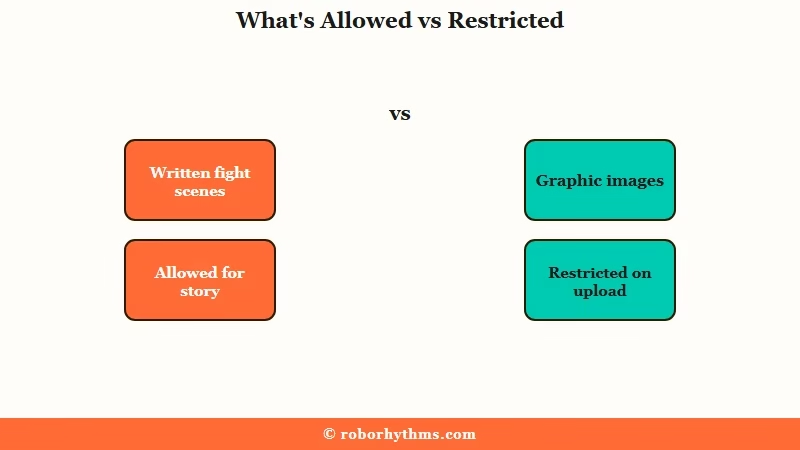
The spark was a popular thread where someone asked whether realistic, detailed fights were banned because the rules said gore was not allowed. The top reply, which the community upvoted hard, pointed out that they were reading the simplified version of the rules. The full content guidelines spell out that the restriction targets images.
What the official violence guidance permits in writing is broad. Combat, fights, torture, abuse, and criminal scenarios like murder or kidnapping are allowed in text when they are clearly fictional and serve the narrative rather than being glorified or used as instructions. That is a different world from the blanket ban most people assumed.
This matters at scale because of how many people are confused at once. Janitor AI pulls roughly 130 million visits a month with more than 15 million registered users according to Similarweb traffic data, so a single misread rule turns into thousands of worried posts in a weekend.
What I find striking is that the people most spooked are the ones writing the most ambitious story arcs, which is exactly backward.
Why the Gore Rule Confuses Everyone
The confusion comes from the simplified rules, which list “no gore and violence” without flagging that the line is an image guideline. The full guidelines make the text-versus-image split clear.
The image guidelines are strict and specific. They prohibit graphic gore in visuals, including ongoing executions or graphic bloodshed, stabbings or shootings of visible characters, unhealed exaggerated wounds, and detached body parts like severed heads. None of that list governs what you type into a chat.
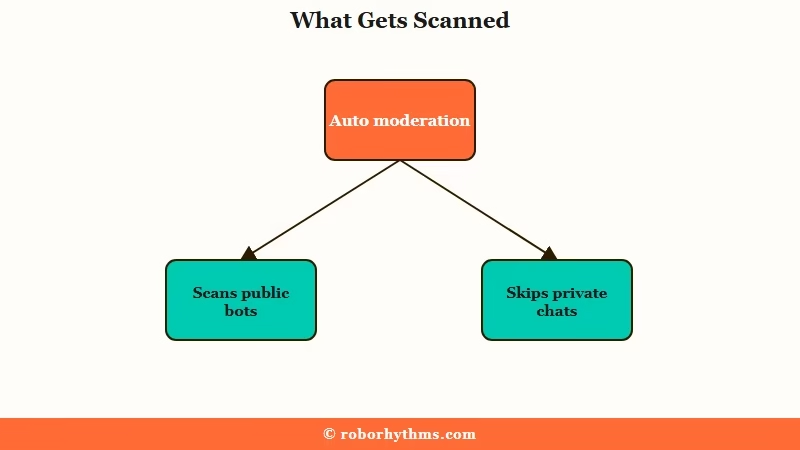
There is a concrete reason the two are treated differently, and it is the detail most write-ups miss. Janitor AI runs automated moderation through a third-party service that scans characters, images, and comments, but it reportedly does not scan the prompts or model responses inside your private chats. The way I read it, that scanning gap is the real mechanism behind why text gets more room than images.
What is Clavata: The third-party moderation service Janitor AI uses to automatically scan public-facing content like characters, avatars, and comments for policy violations.
Here is the clean version of who-checks-what so you can stop second-guessing every scene.
| Content type | What is allowed | What is restricted | How it is checked |
|---|---|---|---|
| Written chat and bot text | Fights, combat, injury, and dark themes that serve the story | Content presented as real instructions or glorified harm | Private chats are not scanned by the automated moderator |
| Images and avatars | Stylized or implied action without graphic detail | Graphic bloodshed, severed parts, open wounds, visible killings | Automated scanning plus a placeholder-then-removal penalty |
That image penalty is worth knowing before you upload anything edgy. An avatar that breaks the guidelines gets swapped for a placeholder once, and a second violation removes the character entirely.
The rules around uploads are far less forgiving than the ones around your writing, which is why I keep heavy content in text and treat images conservatively.
For the full picture on that side, the breakdown on why image uploads get blocked and the wider notes on how Janitor AI handles moderation both go deeper than I can here.
How to Write Fight Scenes That Stay Within the Rules
The safest approach is to keep intense action in your writing, label heavy bots clearly, and skip graphic gore as images. Strong combat comes from craft, not shock value.
In my experience, the scenes that get flagged or feel flat are rarely about the rules at all. They are either uploaded as graphic images, or they lean on shock instead of tension. Here is the sequence I would follow to write hard-hitting fights that stay clean.
- Keep the violence in text and avoid uploading graphic images of wounds or killings.
- Write for impact through momentum and consequence, not through gore for its own sake.
- Tag heavy bots with a clear content warning so other users opt in knowingly.
- Place that warning high on the bot card, not buried at the bottom.
- Keep the framing fictional and story-driven rather than instructional.
Step four has a hidden technical reason. If you bury a content warning low in a long character bio, the search filter may not detect it, so the bot does not get categorized properly. Putting it high is what lets the system read your label at all.
The craft side is where most fight scenes win or lose. A community prompt that gets passed around for better combat focuses on momentum, environmental leverage, and what one writer called the invasive proximity of a fight, the breath and heat of it, with the idea that the silence between hits is its own weapon. Compare the two approaches.
Before: “They fought hard. Fists flew and he was hurt badly, blood everywhere, then he won the fight.”
After: “He ducked under the first swing and felt the wind of it brush his ear. Concrete bit into his shoulder as they slammed against the wall, close enough that he could smell copper and adrenaline. For one beat neither moved, and that silence was louder than any punch.”
The second version is more intense and more readable, and it never needs a single graphic image. If your scenes still come out passive or stiff, the deeper fixes in fixing weak Janitor AI roleplay will do more for you than loosening any rule.
What is the Dead Dove tag: A content warning, borrowed from a TV gag, that signals a bot contains exactly the heavy themes it describes so readers are never blindsided.
Here is the quick map from the common worry to what is really going on and what to do about it.
| The worry | The reality | What to do |
|---|---|---|
| “Gore is banned, so my fights are illegal” | The gore rule is an image guideline | Keep detailed action in text |
| “I will get banned for a violent story” | Fictional, story-driven violence is allowed in writing | Frame scenes as narrative, not instruction |
| “My dark bot keeps getting hidden” | Warnings placed too low are missed by the filter | Put the content warning high on the card |
| “I need graphic images for impact” | Graphic visuals trigger removal | Build tension through writing instead |
What About Your Chat Privacy
Janitor AI stores your chats, and it recently removed the old no-human-eyes promise from its safety page. Staff say the underlying policy did not change, but moderators can review chats if they suspect rule-breaking.
The privacy policy is clear that user content, including the conversations you generate, is collected and stored. The way I read it, that is normal for a service that lets you return to old chats, but it is worth knowing rather than assuming everything vanishes when you close a tab.
The wrinkle is the safety page. It used to promise that your chats stayed private with no human eyes and no data mining, and that wording was removed during a redesign. Staff have said the actual privacy practices did not change and it was a presentation update, while the community now treats it as devs being able to look only when they suspect a violation.
One panicked thread claimed police would pull your chat logs over a fight scene, and it got downvoted into the ground for good reason. Writing fictional combat is not a crime, and a story scene is not the kind of thing that invites real-world scrutiny. If the storage side bothers you, the closer look at how private your chats are lays out what is and is not kept.
Where to Go If You Want Fewer Limits
If the image limits or moderation feel too tight for the stories you want, a purpose-built companion platform gives you more room for visuals and roleplay in one place.
Janitor AI is generous with written content, but the image rules are firm and the moderation around uploads is unforgiving. If you want detailed visuals and intense roleplay without juggling two different rule sets, a dedicated platform is the simpler path.
Candy AI is the one I point most people to here, since it pairs creative roleplay with built-in image generation so you are not fighting an upload filter to set a scene.
If you want a second option with strong memory for long story arcs, Nectar AI holds character continuity well across sessions. Both keep your fictional content in one place instead of split across rule sets.
Frequently Asked Questions
Are fight scenes allowed on Janitor AI?
Yes. Written fight scenes are allowed when they serve a story and stay fictional. The restriction people cite is part of the image guidelines, so detailed combat in text is within the rules.
Is gore banned on Janitor AI?
Graphic gore is banned in images and avatars, not in written chat. Visuals like open wounds, severed parts, or visible killings are prohibited, while text can explore violent themes for narrative purposes.
Does the no-violence rule apply to text or images?
It applies to images. The image guidelines prohibit graphic violence in visuals, but the written content rules allow combat and dark themes when they are fictional and serve the story rather than glorifying harm.
Will I get banned for violent roleplay on Janitor AI?
Not for fictional, story-driven combat in text. Bans target real instructions, glorified harm, and prohibited image uploads. Keeping violence in writing and tagging heavy bots clearly keeps you within the rules.
Does Janitor AI read my private chats?
Janitor AI stores your chats and removed its old no-human-eyes promise during a redesign. Staff say practices did not change, and moderators generally review chats only when they suspect a rule violation.
What is the Dead Dove tag on Janitor AI?
It is a content warning that signals a bot contains exactly the heavy themes it describes, so readers opt in knowingly. Placing it high on the bot card also helps the search filter categorize the bot correctly.
Quick Takeaways
- Written fight scenes are allowed on Janitor AI when they serve a story; the gore ban is an image rule.
- The image guidelines prohibit graphic bloodshed, severed parts, and visible killings, and a second upload violation removes your character.
- Private chats are not scanned by the automated moderator, which is why text has more room than visuals.
- Tag heavy bots and place the warning high on the card so the search filter reads it.
- If the image and upload limits feel too tight, a built-in companion platform like Candy AI gives you visuals and roleplay without the two-rule juggle.
