
What’s Changed: Tipsy Chat updated its Terms of Service on August 7, 2026, and the new document lets the company “access, review, screen, edit, modify and delete” anything you write. Its privacy policy, untouched since January 2, 2025, still promises end-to-end encryption on your chats. Both cannot be true.
Search “is Tipsy Chat safe” and the top result is a thread about creator sponsorship emails. That thread answers a completely different question from the one most people are asking, and Google’s own AI summary of the query ends by asking whether you got a collaboration email or you just want to try the app.
Nobody on that first page answers the second version.
So here is the second version, answered properly. Tipsy Chat is a roleplay app with 1M+ installs on Google Play, a 4.1 rating from about 32,013 reviews there, and 4.5 from roughly 6,347 on the App Store. It is a real product from a real company, not a scam.
The problems are smaller and more specific than “is it a scam”, and they sit in documents almost nobody opens. Four of them are worth knowing before you move a year of roleplay onto this platform. That gap between the marketing and the paperwork is the thing that bothers me most about this app.
Is Tipsy Chat Safe to Use
Tipsy Chat is safe in the ordinary sense: the app works, the company exists, and payments go through the normal app store rails.
The risks are contractual rather than criminal, and they concern who can read your chats, who you are contracting with, and how fast the currency drains.
Safe enough is where I land, with four conditions attached. The app is not malware, the website passes reputation checks, and money you spend buys what it says it buys.
None of the four conditions is a dealbreaker on its own.
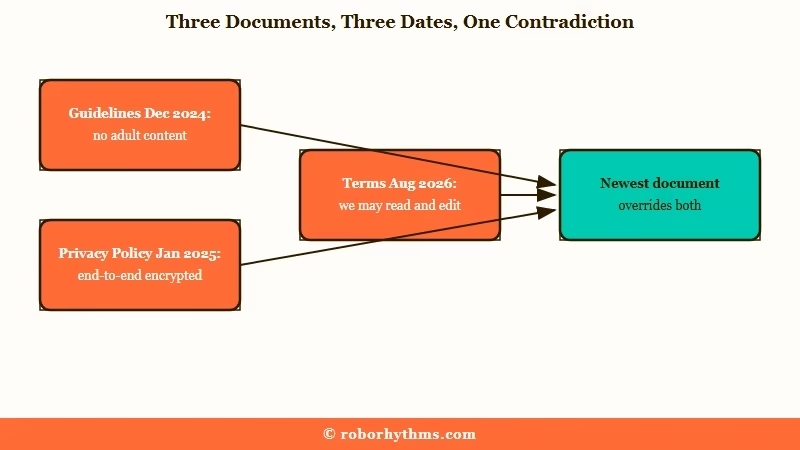
What the app does not do is match its own promises. The company’s three governing documents were last touched on three different dates, and the oldest one makes the boldest claim.
| Document | Last updated | What it tells you |
|---|---|---|
| Community Guidelines | December 21, 2024 | No obscene or pornographic content allowed |
| Privacy Policy | January 2, 2025 | Chats are protected with end-to-end encryption |
| Terms of Service | August 7, 2026 | The company may access, review, edit and delete your content |
Read top to bottom, the reassuring claims live in the two documents that have not been revised in over a year and a half. The binding one is the newest, and it says something different.
Does Tipsy Chat Really Use End-to-End Encryption?
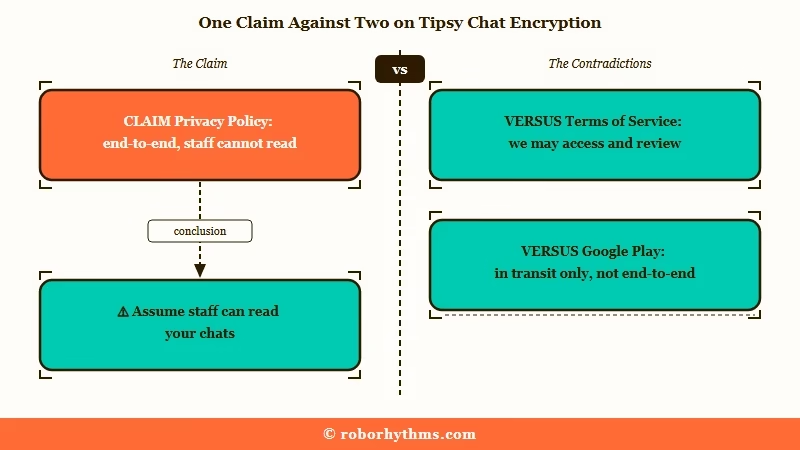
No. The privacy policy says “We use end-to-end encryption to keep your personal chats between you and the characters you choose,” but the Terms of Service reserve the right to access and review that content, and Google Play’s data safety panel lists only “Data is encrypted in transit.”
The word that trips me up is end-to-end. In transit encryption is standard HTTPS, it is genuinely good, and every serious app has it. It means nobody can read your messages while they cross the network.
End-to-end means something stronger: the company itself cannot read them, because it does not hold the keys. That is the promise the privacy policy makes.
The Terms of Service, updated seven months after that policy, say the opposite in plain language. The company “may access, review, screen, edit, modify and delete your Content at any time and for any reason, including to provide and develop the Services.” You cannot reserve the right to review something you are cryptographically unable to read.
Google Play settles it from a third direction. The data safety panel the developer fills in for that listing claims encryption in transit and nothing beyond it.
What is end-to-end encryption: A scheme where only the sender and recipient hold the decryption keys, so the service carrying the messages cannot read them even if compelled.
Treat your Tipsy Chat conversations as readable by the company. Nothing about that is unusual for this category, and the same reasoning drives safety questions about Zeta AI. The promise is the odd part.
Who Runs Tipsy Chat and Who Do You Chase for a Refund
Four different entities appear across Tipsy Chat’s paperwork and store listings: a Singapore company, a Hong Kong distributor, a Cyprus payment processor, and an individual developer account on Google Play.
Four names for one app is more corporate structure than I expect from a chat app, and it matters the moment something goes wrong.
The privacy policy and terms both name LIGHTSPEED INTELLIGENCE PTE. LTD. in Singapore, alongside Waffo.com Limited in Hong Kong, described as “an authorised distributor of our products.”
The Terms add a third: payments “may be processed by” LIG. AI LTD, registered in Nicosia, Cyprus. Cyprus payment intermediaries are common in this category because mainstream processors are cautious about adult-adjacent platforms.
The Apple listing names the seller as LIGHTSPEED INTELLIGENCE LTD. The Google Play listing is published under an individual developer account rather than any of the corporate entities, with a ProtonMail address as the published contact.
None of that is illegal, and none of it means your money disappears. It does mean that a billing dispute has no single obvious counterparty, and the entity that took your payment may not be the entity named in the terms you agreed to.
Can Under 18s Use Tipsy Chat
Every document Tipsy Chat controls sets the floor at 18. Apple rates the app 18+. Google Play rates it Mature 17+, so the Android store will hand the app to a 17-year-old that the company’s own terms forbid from using it.
This is the one I would push back on hardest. The Terms say “You represent that you are over the age of 18” and “The Company does not permit those under 18 to use the Service.”
The privacy policy says the services “are not designed for minors under 18.” The community guidelines say “we do not allow people under 18 to use our services.”
Three documents, one number, no ambiguity. Then the Android storefront rates it Mature 17+ and the gate moves a year.
There is a second gap inside the privacy policy itself. It promises that if the company discovers “an individual under 18” gave it personal information, it will close the account and delete that information “to the extent required by COPPA.”
COPPA covers children under 13. For a 16-year-old, the extent required by COPPA is nothing at all, so the remedy names a law that does not reach most of the minors the sentence is about.
This is not a hypothetical population. Pew Research Center puts AI chatbot use among US teens 13 to 17 at 64 percent. A 17+ rating on an app whose terms say 18+ is a gap that gets used.
What Happens to Characters After You Delete Your Account
A public character you create can outlive your account. The privacy policy reserves the right to keep a sufficiently popular character running after you delete your data and your profile.
The remedy the policy offers is what caught my eye. Here is the clause: “If a Character you create and set to ‘Public’ reaches a certain threshold of popularity, we reserve the right to preserve that Character’s characteristics and to keep that Character active on the Services, even if you otherwise delete your data and your account.”
The stated business reason is reasonable on its face, since a popular character is mid-conversation with thousands of people and deleting it breaks their chats. The instruction that follows is the striking part.
The policy tells you: “To ensure that we do not retain information about you when this occurs, please avoid submitting any such information as part of the Character creation flow if you are creating a ‘Public’ Character.”
That is the company saying account deletion will not undo a public character, so the only real protection is not putting anything personal into one. Useful advice, and it needs reading before you build, not after.
How Much Does Tipsy Chat Cost in Gems
Gems are the in-app currency and every message spends them. Packs run from $1.49 to $199.00, and the per-gem rate does not reward bulk the way you would expect.
The per-gem math is where this gets strange, and it is the part I check first on any token-based app. These are the packs and subscription tiers listed on Apple’s own in-app purchase panel, with the rate worked out.
| Pack | Price | Gems per dollar | Verdict |
|---|---|---|---|
| 500 Gems, first purchase | $1.49 | 336 | Best rate on the board, one time only |
| 1000 Gems | $5.90 | 169 | Worst rate, skip it |
| 2000 Gems | $9.99 | 200 | Cheaper per gem than the pack below it |
| 4000 Gems | $19.90 | 201 | Flat against the 2000 pack |
| 8000 Gems | $38.90 | 206 | Marginal gain |
| 15000 Gems | $69.90 | 215 | Marginal gain |
| 50000 Gems | $199.00 | 251 | Best repeat rate, still under the $1.49 starter |
Two things fall out of that table. The $1.49 starter pack pays about 336 gems per dollar while the $199.00 pack pays about 251, so the cheapest one-time offer beats the largest bundle by roughly 34 percent per gem.
The second is the $5.90 pack at 169 gems per dollar. It is the worst rate listed, and the $9.99 pack directly above it in size gives about 18 percent more gem for each dollar. Spending less money there buys you less currency per dollar, which is the reverse of how bulk pricing normally works.
Subscriptions sit alongside the packs at $4.90 for “Get a Taste”, $14.90 for “Standard” and $44.90 for “Premium”, with a Deluxe tier referenced in the subscription FAQ.
Free use runs on daily check-ins. The subscription FAQ confirms it: “You can use our app for free by earning gems through tasks such as daily check-ins.”
The check-in pays 50 gems and a single image generation runs about 80, so one day of free currency does not cover one picture. At the pack rates above, 80 gems costs somewhere between 32 and 47 cents depending which pack funded it.
Text replies on the cheaper models run roughly 11 to 12 gems each, which turns a 50-gem daily check-in into about four messages. Memory-heavy replies and the premium models cost considerably more per turn.
The company flags a billing quirk in its own FAQ, in its own words: “(*Note that PayPal is a little different, so please read through the instructions carefully to avoid the potential of double billing.)”
If the gem drain is what pushes you off the platform, a flat monthly subscription is the usual fix. Candy AI charges a fixed rate rather than metering each message, which removes the arithmetic entirely.
Does Tipsy Chat Have a Filter
Its documents prohibit adult content and the app permits it in practice. The Terms list material that “is obscene or pornographic” among prohibited content, while the running app applies no visible filter.
This contradiction is the one I cannot resolve for you, and it is the single most important thing a switcher should understand. The community guidelines, dated December 21, 2024, state that “Tipsy.chat will never support the use of the software for obscene or pornographic content while ensuring a certain degree of freedom.”
The Terms of Service back that up, listing obscene or pornographic material inside a long block of prohibited content that also covers bestiality, incest, and any sexual content involving minors. Those last categories are hard prohibitions on any platform and are not in question here.
What is in question is the ordinary adult content in between. In practice the app ships with no visible filter on that material, a gap documented across the switching threads where people compare it against Character AI.
Both things being true at once has a practical cost. You build an account under terms that prohibit what the app permits in practice, which leaves enforcement entirely at the company’s discretion and gives you no way to predict where the line sits.
That is a different posture from platforms that publish where the line sits. Compare it against how Clank World’s filter rules split by surface, or against Janitor AI’s safety record.
If you want a platform whose permissions are stated plainly rather than inferred, the roundup of chatbots without content filters is the better starting point.
Are the Tipsy Chat Collaboration Emails Real
They come from Tipsy Chat’s own outreach, not from an impersonator, but they are template emails sent at high volume with almost no targeting. No confirmed financial loss has been reported from them.
My position is that this is bad marketing rather than a scam, and the distinction matters because this single issue is what pollutes the search results for everyone asking about the app. Creators receive a near-identical message offering a “One-time Paid Video”, a “Long-term Partnership”, and “a special VIP avatar for you on Tipsy.chat”.
The tell is the sender. Across one r/Scams thread, the same template arrives signed Jason, Julia, Riley, kaia and Leta. One recipient noted having 16 followers on TikTok, which rules out any real audience review before sending.
Nobody in that thread reports losing money, and nobody confirms the emails are fraudulent. They read like phishing because volume outreach with rotating first names is exactly the shape phishing takes.
Here is how to handle one:
Before: “Hi, I’m Jason from Tipsy.chat and I love your content. We’d like to pay you for a video and set up a special VIP avatar for you.”
After: Check the sending domain resolves to tipsy.chat, ask for the contract, deliverables and payment terms in writing before recording anything, and walk away from any request to pay a fee, share account credentials, or install software to claim the deal.
That test costs nothing and works on legitimate outreach and fraud alike.
What Is a Tipsy Chat Invitation Code
An invitation code is a referral link in six-character form. It gives the sender a gem bonus when you sign up, and it is not a discount on anything you buy.
A code is a referral, and I would not treat it as a coupon. Hunting for one is a popular pastime among new signups, most of them under the impression it unlocks a discount.
Here is the irony. Tipsy Chat’s own community guidelines ban exactly this behaviour, listing “No advertising, self-promotion, spam, code giveaways, or irrelevant link sharing” among the community rules.
Code giveaways are nonetheless the dominant form of Tipsy Chat content on Reddit, to the point where a genuine written review of the app can attract nothing but bare codes in the replies. The rule exists and the practice ignores it.
Use a code if someone gives you one, since the bonus gems are real. Just do not go looking for one expecting money off.
What to Do If You Still Want to Try It
Try it with a throwaway approach: a fresh email, the $1.49 starter pack rather than a subscription, nothing personal in any public character, and no assumption that your chats are private to you.
Skip it entirely if the paperwork bothers you, and here is the sequence I would follow if it does not:
- Sign up with an email address you do not use elsewhere, since the entity chain makes deletion requests harder to chase.
- Buy the $1.49 starter pack first and nothing else, because it is the best per-gem rate available and it tells you within an hour whether the burn rate suits you.
- Keep every character you create private until you understand the popularity clause, since public characters can survive account deletion.
- Put no real names, locations, or identifying details into a character description, following the policy’s own advice.
- Decide at the end of that first pack whether the per-message cost is sustainable, and stop there if it is not.
| Concern | What the documents say | What to do |
|---|---|---|
| Chat privacy | End-to-end encryption promised, review rights reserved | Assume staff can read chats |
| Age floor | 18 in all company documents, 17+ on Google Play | Do not rely on the store rating |
| Deleted characters | Popular public characters may be kept | Keep characters private |
| Refunds | Non-refundable outside Apple, PayPal double-billing warned | Pay through the app store rail |
| Filter | Prohibited on paper, absent in practice | Expect discretionary enforcement |
If the metered pricing is the dealbreaker rather than the policies, Nectar AI is the closest alternative for image-heavy roleplay without counting gems per picture.
Frequently Asked Questions
Is Tipsy Chat safe to use?
Yes in the ordinary sense. The app is legitimate, the company is real, and payments run through Apple and Google. The caveats are contractual: the terms let staff review your chats, and the age floor differs between the company’s documents and the Android store.
Can Tipsy Chat staff read my chats?
Assume yes. The Terms of Service reserve the right to “access, review, screen, edit, modify and delete” your content at any time, and Google Play’s data safety panel lists encryption in transit only, not end-to-end.
Is Tipsy Chat free?
There is a free tier funded by daily check-in gems worth about 50 a day. That covers roughly four messages on the cheaper models and does not cover a single image generation, which runs about 80 gems.
Does Tipsy Chat have a content filter?
Its terms and community guidelines prohibit obscene or pornographic content. The running app applies no visible filter to it. Enforcement appears discretionary, so neither the rules nor the experience reliably predicts the other.
Are the Tipsy Chat sponsorship emails a scam?
No confirmed fraud has been reported. They are high-volume template emails signed with rotating first names and sent with little targeting, which is why they read as phishing. Verify the sending domain and never pay a fee to claim one.
Can a 17 year old use Tipsy Chat?
Not under its own rules. All three of the company’s documents set the minimum at 18, though Google Play rates the app Mature 17+ and will install it for a 17-year-old.
Quick Takeaways
- Tipsy Chat’s privacy policy promises end-to-end encryption while its newer Terms reserve the right to read and edit your chats, so treat conversations as visible to staff.
- Every company document sets the age floor at 18, but Google Play rates the app Mature 17+, which opens a one-year gap on Android.
- The $1.49 starter pack is the best value per gem on the entire ladder, beating the $199.00 bundle by about 34 percent.
- A public character you build can stay live after you delete your account, so keep anything personal out of character descriptions.
- Buy the cheapest pack first and judge the burn rate inside an hour, which is the test I would run before committing to any subscription.
