
What’s Changed: The safety question about Emochi is not really about viruses. Its own privacy policy says your chats and images train its models, while the data form it filed with Google Play never mentions chats at all. Those two documents come from the same company.
Emochi went from a niche character chat app to more than ten million Android downloads, and most of that growth came from people leaving somewhere else. The app is fast and the free tier is usable. Then somebody asks whether it is safe, and page one of Google gives four different answers.
Part of that confusion is real. Emochi behaves differently depending on where you live, which is why one person swears there is no filter while another watches every scene get sanded down. The rest of the confusion comes from nobody reading the paperwork.
I read the paperwork. There are two of them, they disagree with each other, and three of the most important lines in the privacy policy are literally empty brackets.
So this piece covers the things a virus scan will never tell you. What Emochi collects, who can see it, and how hard it is to leave.

Is Emochi AI Safe to Use?
Emochi AI is ordinary software with unusually loose data terms. It stores your chats, uses them for model training, and ignores Do Not Track, and the two data disclosures it has published do not agree with each other.
Nothing about the install itself raises a flag. The app ships from a company called FlowGPT and updates regularly. The Google Play listing carries a 4.6 rating across roughly 1.02 million ratings, with over ten million downloads.
The risk sits in what happens after you start typing. Character chat pulls people into writing things they would never put in a public post, and Emochi’s policy treats that text as ordinary product data. It is stored for as long as your account exists, and it feeds model training.
That is the trade most people make without reading it. If the idea of your roleplay logs sitting in a training set bothers you, the anime-focused readers who leave over exactly this usually land on Nectar AI, which is built around the same character-card format.
I still keep Emochi on my phone, but I keep it on a throwaway email.
What Data Does Emochi Collect and What Does It Not Declare?
Emochi’s privacy policy describes collecting chat content, uploaded images, cell tower identifiers and payment records. The Data Safety form it filed with Google Play declares only your name, email, crash logs and app interactions. Four categories appear in one document and not the other.
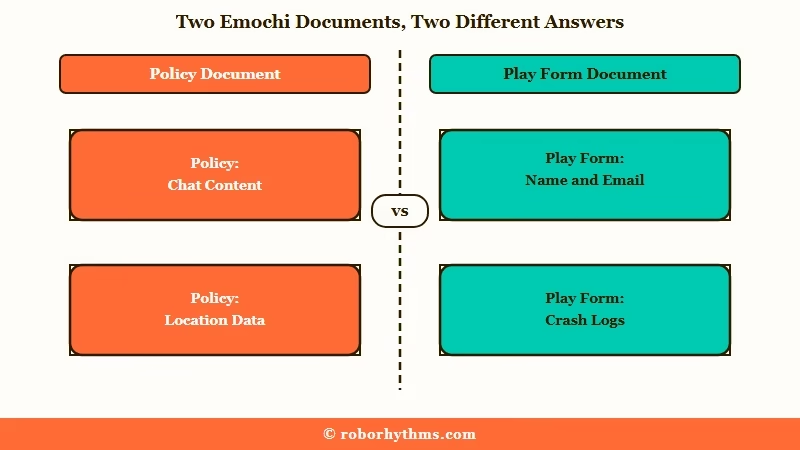
Every Android developer fills in a Data Safety form, and Google shows it on the listing page. Emochi’s form is short. It declares personal info (name and email) for account management, app info and performance for analytics, and app activity for advertising or marketing, plus device IDs shared for analytics.
Now set that next to Emochi’s own privacy policy. The policy says chat content and uploaded images are stored on company servers.
It also says the app gathers PLMN and cell identification codes for the device’s location, and that payment records get collected through third party processors.
What surprised me is how wide the gap is. Google’s taxonomy has categories for messages, photos, location and financial info, and none of the four appears on Emochi’s Data Safety form.
| Data type | In the privacy policy | On the Play Data Safety form |
|---|---|---|
| Name and email | Yes, at registration | Yes, for account management |
| Chat content | Yes, stored on servers, used for training | Not listed |
| Uploaded photos | Yes, photo album permission requested | Not listed |
| Location | Yes, cell identification codes and IP | Not listed |
| Payment records | Yes, through third party processors | Not listed |
A short form is not proof of bad faith. Plenty of developers fill these in carelessly, and Google lets the form be a summary rather than a transcript.
Still, the Data Safety card is the only thing most people ever look at, and on this app it is the more flattering of the two documents.
What Does the Blank Section in Emochi’s Policy Mean?
Three spots in Emochi’s model training clause are empty square brackets. The sentence reads that it may use anonymized data “including [], [], and []” to train its models. A fourth blank sits where the third party SDK list belongs.
This is not a rendering glitch on my end or a stripped-out table. The page source carries the characters as literal text inside a font tag, four times, in a document last updated on 17 June 2026.
Read the sentence as published and it names zero categories of training data while appearing to name three. The section that should tell you which advertising and analytics kits are embedded in the app is a single empty bracket.
Before: “Emochi may use anonymized and aggregated user data (including [], [], and []) to train and refine our models.”
After: “Emochi may use anonymized and aggregated user data (including chat text, uploaded images, and device identifiers) to train and refine our models.”
That second version is what the blanks were meant to hold. Fill them in and a reader can decide whether their own chats are in scope. Leave them empty and the sentence commits to nothing.
I do not think anyone hid anything here. A template got shipped without being filled in, and it has stayed that way long enough to be the published policy.
Can Emochi See Your Chats and Does It Train on Them?
Emochi trains on your chats. The privacy policy says uploaded content is stored on company servers and used “for the purposes of providing services to you and training models to improve our services.” There is no opt out short of deleting the account.
“Can other users read your chats” is one of the most common questions new Emochi users ask, and it comes up unanswered in community threads fairly often. The answer splits in two.
Other users cannot read your private conversations. The company can hold them, and by its own description it does.
The policy is unusually direct about training. It also promises something most competitors do not: California residents can request confirmation of “whether your data has been used for model training in the past 12 months.” That is a real audit right, and it is worth using if you live there.
What is missing is the other half. There is no setting that turns training off, no tier that buys you out of it, and no statement about whether chat logs survive in backups after deletion. My rule with any app in this category is to assume the text is permanent, and Emochi gives me no reason to relax it.
Encryption is thin too. The Play listing says data is encrypted in transit, which covers the trip from your phone to the server. It makes no claim about encryption at rest, and nothing anywhere describes end to end encryption.
Why Does Google Say Emochi Has No Malware?
Google’s AI Overview says security checks found no malware in Emochi and cites NowSecure. That report contains no malware verdict at all. Its only “none detected” line refers to AI detection, while its other rows flag dangerous permissions and sensitive data collection.
Search the question and Google answers it above every real result, sourcing the reassuring part to a mobile security scanner called NowSecure. That scanner does publish an Emochi Android report. It says something close to the opposite.
The summary rows read: permissions detected, sensitive data collection and sharing found, network connections detected, privacy declarations not detected, AI none detected.
The single clean row is the one about AI, and the scanner flags 18 permissions Apple and Google class as dangerous, among them camera access, audio recording, and reading and writing external storage. The sensitive data it observed is a build fingerprint and a WiFi IP address.
One row genuinely is good news, and it should be said plainly. “Privacy declarations: not detected” means the scanner found no discrepancy between what the app declares and what it does, which is a pass rather than a failure. This is the row that annoys me, because it sits one line below the summary that Google turned into a clean bill of health.
The “AI none detected” line has a boring explanation worth knowing. Scanners look for models running on the device, and Emochi runs everything on its servers, so there is no AI in the app binary to find. It tells you nothing about what happens to your text after it leaves the phone.
Why Do People Get Different Answers About Emochi’s Filter?
Emochi rolls out filters by region, so two people on the same version get different behaviour. That is why one person reports no restrictions while another finds every scene sanitised, and why the app’s answers about safety never line up.
Almost no review mentions this. The platform does not ship one global configuration. Ratings, filters and available models vary by market, and the community has worked this out the hard way in threads about the filter appearing overnight for some accounts and not others.
Once I understood that, the contradictory reviews stopped being contradictory. A reviewer in one country tests the app honestly and publishes that there is no filter.
A reader in another country installs it, hits a wall, and concludes the review was paid for. Both were right about their own install.
It also means safety advice about Emochi does not travel. Whether adult content is reachable, which models you can pick, and how aggressively your public characters get screened all depend on where you are. Anyone telling you flatly that the app is filtered or unfiltered is describing one region, usually their own.
Is Emochi Safe for Teens and What Is the Age Limit?
No. Emochi’s policy bars anyone under 16 from registering, Google Play rates it for 18+, and the catalogue is user generated with light automated screening. The three numbers do not match, and the content is written for adults.
The policy references COPPA and says the service is not directed at children under 13, then sets its real floor higher: it does not knowingly collect data from anyone under 16 and does not allow under-16s to register. Google Play rates the listing for 18+ with a “users interact” flag, and the iPhone listing carries 17+.
Three documents, three different numbers, and none of them is checked at the door. There is no ID check and no age estimation, just a policy line, which puts Emochi in the same position as most of this category.
The practical floor is whatever a teenager types into a form.
The age rating causes a second confusion that catches adults too. An 18+ rating describes what you might encounter, not what you may publish, and people get their public characters pulled while pointing at the rating as if it were permission. Private characters are treated differently from public ones, and the screening applies to the public catalogue.
That screening is blunt in both directions. Ordinary characters get hidden with no notification and no stated reason, while worse material stays up, a complaint that runs through the shadowban threads. My read is that an automated classifier is doing this with no appeal path behind it.
| Concern | What is true | What to do |
|---|---|---|
| Malware or a hacked app | No scan has flagged malicious code, and none has tested for it either | Install from Google Play only |
| Chats used for training | Stated in the policy, no opt out | Keep identifying details out of chats |
| Other users reading chats | Private chats are not visible to other users | Nothing needed |
| Location tracking | Cell identifiers and IP described in the policy | Deny optional permissions at install |
| A character vanishing | Creators can delete characters and your logs go too | Save anything you care about outside the app |
| Under-16 use | Barred by policy, unverified in practice | Do not install it for a teenager |
How Do You Delete Your Emochi Account and Data?
Delete your characters before you delete your account. Account deletion removes your login, but people who deleted accounts have found their published characters still live on the platform, and a deleted account gives you no way to take them down afterwards.
Google requires any app offering account creation to offer account deletion, both in the app and through a web page, a requirement TechCrunch covered at launch. Emochi’s Play card carries the “you can request that data be deleted” label and the policy points you at an account page in settings plus a support email.
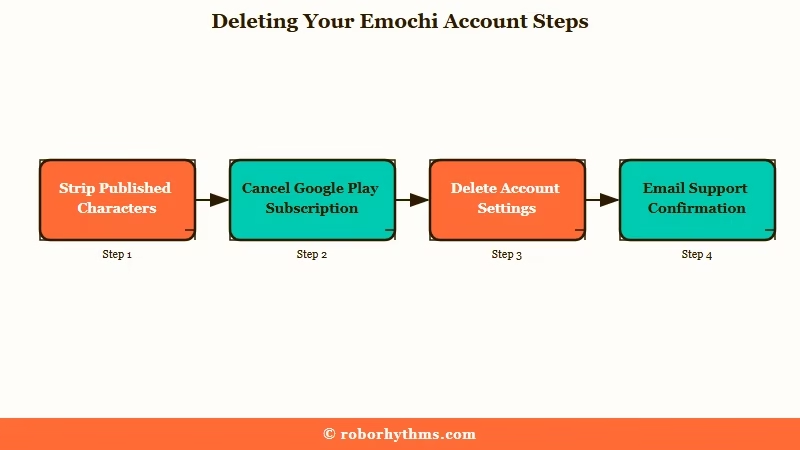
The order matters more than the button. In the thread about leaving, the practical advice is to strip your characters first so there is nothing left behind, because creations have outlived the accounts that made them. Here is the sequence I use before leaving any character platform:
- Export or copy any chat logs you want to keep, since nothing survives deletion.
- Open each character you published and delete it, or blank out its fields and save.
- Confirm the characters no longer appear in search while logged out.
- Cancel the subscription in Google Play, not just in the app.
- Delete the account from the account page in settings.
- Email the support address asking for confirmation that the data was erased.
Step six is where expectations need setting. A complaint filed with Google in April 2026 reports deletion emails going unanswered for over 34 days.
Emochi’s own policy promises a 45 day response window, so 34 days of silence is slow rather than a broken promise. Plan on the request taking six weeks.
One more thing about permanence worth knowing before you invest months in a character. The logs belong to the character rather than to your account, so when the creator of a character deletes it, the conversations attached to it go too, and support declined to restore them even on the top paid tier.
The same thing happens at the model level in the Emochi free tier, where models get retired under free users with no warning.
Is the Emochi App on iPhone Made by the Same Company?
No. The original iPhone app was pulled in January 2026, and the two Emochi apps now in the US App Store come from MESORA PTE. LTD. and from an individual developer. Neither is FlowGPT, whose privacy policy this article describes.
This is the part that catches people. Search the App Store for Emochi and you get EMOCHI World: AI Story Chat, published by a Singapore company, and a second listing that appears as “mochii – Emochi alternative” in the US while carrying the title “Emochi AI – mochii” in the UK and Australian stores under a different individual seller.
The Android app is the continuous one. It never left Google Play, it is still published by FlowGPT, and it is the app the privacy policy above governs.
An iPhone user reading that policy and installing what the App Store returns has quite likely agreed to somebody else’s terms.
I would not install either iPhone listing without checking the developer name on the listing page first. Which of these is the real successor is a longer story, and the iPhone app story covers the identity question in full.
Should You Keep Using Emochi or Switch?
Keep Emochi if you want a strong free character chat and you treat every message as permanent and public. Switch if you want your logs to stay yours, an export path, or a company whose two data disclosures agree.
Emochi earns its users. The free tier is genuinely usable rather than a trial wearing a costume, the writing quality is high for the price, and the catalogue is enormous. None of the findings here suggest anyone is out to hurt you.
What I hold against it is control. You do not decide whether your text trains a model, and you do not decide whether the character you built a year of chats around stays up.
The paperwork that should settle both questions has blanks in it. That is the thing that would move me off a platform.
For readers who want the same anime and character-card format with clearer terms, Nectar AI is the closest match and the one I point card-focused people toward. For readers who want the memory and the long-running relationship to survive, Candy AI is the better fit. If you would rather audit the platform you are already on, the Janitor AI safety check applies the same checks there.
My honest position is that Emochi is fine for throwaway roleplay and a poor place to put anything you would mind losing. That is a narrower verdict than either “it is safe” or “stay away”, and it is the one the documents support. The full Emochi review covers the models, the pricing and the retirement problem in depth.
Quick Takeaways
- The privacy questions about Emochi are not about viruses. Chats and images are stored and used for model training, with no opt out.
- Its Google Play Data Safety form omits chats, photos, location and payment data, all four of which its own privacy policy describes collecting.
- Three blanks sit in the policy’s model training clause and a fourth where the third party SDK list should be, unfilled since the 17 June 2026 update.
- Filters and ratings vary by region, which is why reviews of Emochi contradict each other and why safety advice about it rarely transfers.
- Delete your published characters before deleting your account, keep a copy of anything you care about, and expect a support reply to take about six weeks.
