
What’s Changed: Updated 24 September 2026 to answer whether Candy AI is legit, including who runs it and what appears on your card statement. The breach record has not changed, and Candy AI is still absent from Have I Been Pwned.
Candy AI is legit, and it is safe to use if you assume staff and outside vendors can read what you type. A registered Malta company, EverAI Limited, runs it and bills your card under that name, and no breach of its user data is on public record. Its own privacy notice, though, lets outside AI providers receive your messages and lets staff pull chats at random for quality checks.
If legitimacy was the question holding you back, Candy AI lets a free account send 5 messages and generate one image before it asks for payment.
I care more about what a policy commits to in writing than what a homepage claims, so this piece works from Candy’s terms, its privacy notice, its help centre and the public breach record.
You will finish it knowing exactly which risks are real, which are imaginary, and which settings to change before you spend money.
Is Candy AI Legit or a Scam
Candy AI is a registered business with a named owner, and the scam reports about it mostly describe aggressive pricing and hard refunds.
Its terms of service name the operator as EverAI Limited, incorporated in Malta and listed with the Malta Business Registry under number C107181, at 56 Central Business Centre in Santa Venera. Those terms, last revised on 22 September 2026, send disputes to the courts of Malta.
Candy does not name its leadership on its own site. In January 2025, Bellingcat identified EverAI’s chief executive as Alexis Soulopoulos, a co-founder of the Australian pet-sitting platform Mad Paws.
On a card statement the charge appears under the name EverAI, according to Candy’s help centre. That keeps the Candy brand off a shared statement, so check any EverAI charge you do not recognise against your Candy account before reporting it as fraud.
The same Bellingcat investigation found Candy AI ads running on MrDeepFakes, a deepfake pornography site, from mid-December 2024 until Bellingcat asked EverAI about them in January 2025. EverAI said the promotion came through its own affiliate programme, that it had cut ties with the publisher, and that it does “not condone or promote the creation of deepfakes”.
What People Mean When They Call Candy AI a Scam
Most scam claims about Candy AI are complaints about paying more than expected. The rest come from the review sources themselves, which are shakier than they look.
- Paying twice. A subscription covers unlimited chat plus 100 tokens a month, and images, video, voice and new custom characters all draw on those tokens, a point Candy’s help centre covers in its own article on why subscribers get asked to buy more. One Reddit user put a single month at almost $67, and a Trustpilot reviewer on an annual plan wrote that wanting to watch a video meant “they immediately wanted more money”.
- A free tier that ends almost at once. Free accounts get 5 messages in total across every character, and one Reddit user described being “asked to upgrade” after two. The full breakdown is in what Candy AI’s free tier includes.
- Refunds that rarely apply. The standard refund covers card payments only, and a subscription refund is refused once more than 20 tokens have been used, even inside the 24 hour window, while a token pack refund is refused after any use. EU and UK buyers also get a separate 14 day withdrawal right on their first purchase.
- Astroturfing in both directions. The most visible Reddit thread on whether Candy is safe carries a comment calling it a scam that has been “heavily botting and astroturfing Reddit” and saying the site was “banned/delisted from Google”, yet Candy’s own community guidelines page still appears in Google for that same question. Across those Candy threads, many replies push rival apps such as Secrets AI, DarLink AI and AmorvixAI.
- A Trustpilot page that is not Candy’s. The Trustpilot page Google shows for whether Candy AI is legit showed Candy AI at 2.2 from nine reviews on 24 September 2026, but the profile is registered to the domain arthur-cleron.fr and describes the product as a customer-service chatbot for businesses. The reviews on it read like real Candy users, and nine reviews on a mismatched profile say little either way.
I would call Candy AI legit but expensive in practice. The complaints above are reasons to budget before subscribing, and Candy’s refund rules are the ones to read twice.
Has Candy AI Ever Been Breached
Candy AI has not been hacked in any publicly recorded breach.
Have I Been Pwned indexed 1,038 breached services on 24 September 2026, and Candy AI is not among them. Three comparable companion apps are documented, and their numbers are not small.
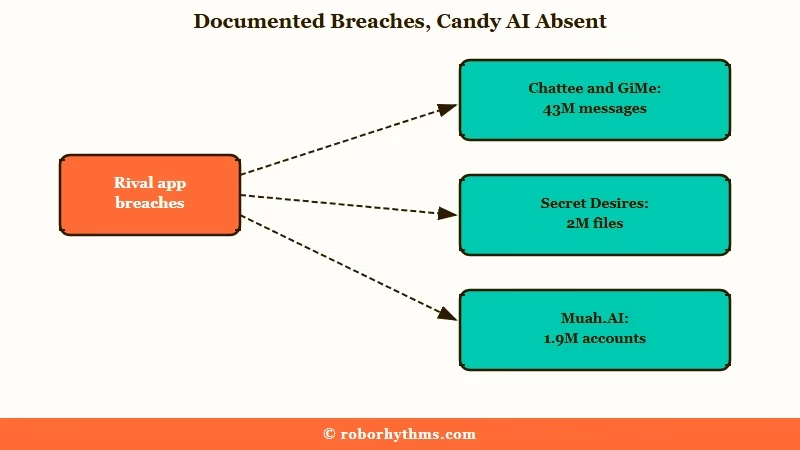
That absence matters to me less than most people assume. A missing entry proves nothing was publicly indexed, not that nothing ever happened, and cloud storage exposures often never reach a credential index at all. It is genuine evidence, just narrower evidence than a clean bill of health.
The comparison is where the useful information sits. These are the companion platforms with confirmed exposures since 2024.
| Platform | What was exposed | Scale | Date |
|---|---|---|---|
| Chattee Chat and GiMe Chat | Private messages, photos, videos, IP addresses, device IDs | 43 million messages, 600,000+ media files, 400,000+ users | Aug 2025 |
| Secret Desires | Generated images and videos, including face swaps of real women | ~2 million files | Nov 2025 |
| Muah.AI | Email addresses, AI prompts, stated fetishes | 1,910,261 accounts | Sep 2024 |
| Candy AI | No publicly recorded incident | None on record | n/a |
The Chattee case is the one worth understanding, because nothing clever was involved. Researchers found an open server with no authentication, so anyone holding the link could stream users’ private messages in real time.
It stayed reachable for roughly three weeks after discovery.
What Candy AI Collects and How Long It Keeps It
Candy AI keeps account data for three years after your last activity and payment records for ten.
Those numbers come from its privacy notice, not from an estimate. Most reviews of this platform never quote a retention period at all.
Ten years of payment records is the line I would flag first for anyone worried about discretion. The retention itself is ordinary, since tax law drives it, but the pairing is what people miss. Your subscription history outlives your chat history by seven years.
The collection list is broader than the signup form suggests. Alongside your email and nickname, the platform records your companion’s configured traits, your prompts, and the outputs generated from them.
Payment processors also capture card brand, last four digits, bank details, and in some cases cryptocurrency wallet addresses.
One genuine point in Candy AI’s favour sits here. Debug logs holding user IDs and timestamps are deleted after 30 days, which is a real, dated commitment that plenty of larger companies decline to make.
| What you want gone | What the policy commits to | What to do |
|---|---|---|
| Chat history | Deleted “without undue delay” on request, no fixed deadline | Request deletion in writing, then re-check the account |
| Account data | Three years after last activity | Delete the account rather than abandoning it |
| Payment records | Ten years, non negotiable | Use a card you are comfortable being on file |
| Debug logs | Automatic purge after 30 days | Nothing needed |
Who Reads Your Candy AI Chats
Your conversations are not private from the company or from its vendors.
The privacy notice states that third party language model providers and hosts “may receive the content of your messages exchanged with our chatbot.” It does not name which providers those are.
Candy’s homepage says it encrypts data in transit with TLS 1.2 or later, and some reviews repeat that as proof that chats are private. That encryption only protects a message on its way to Candy’s servers, where Candy and its outside AI providers can still read it. The privacy notice itself mentions encryption only for your password.
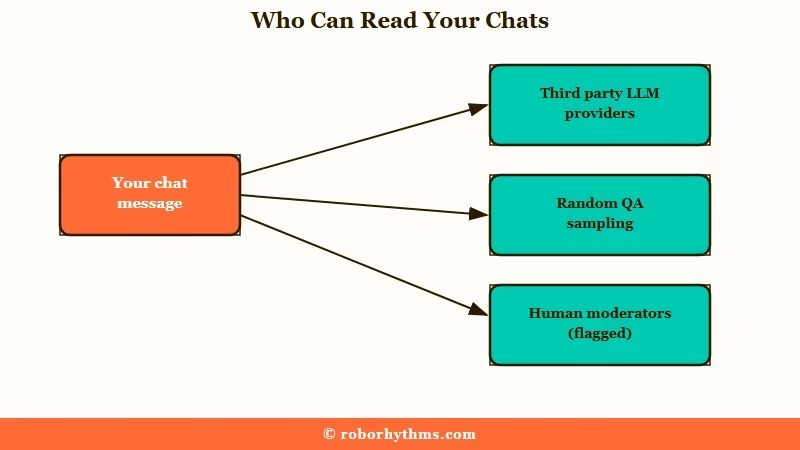
The random QA clause is the part I keep coming back to. Candy AI states that “Content data are randomly queried in order to perform quality assurance,” which means a chat can be pulled for human review without being flagged for anything. Most readers assume review only follows a rule violation.
Flagged content goes further. Human moderators see the action taken, the timestamp, the originating IP address, and your account history alongside the content itself.
Training is the third layer, and there is no way out of it. The independent VerifyWise transparency index scored Candy AI 53 out of 100, a grade C, ranking it 89th of 211 apps assessed in August 2026. Its lowest category score was zero out of four on training data use, because conversations feed model development with no opt in and no opt out anywhere in the documents.
What VerifyWise measures: It grades what a company discloses in its public policies. It is not a security audit and does not test actual practice.
That distinction cuts both ways. A C grade says Candy AI’s documents are only partly forthcoming, and a competitor with vaguer policies could score worse while being run more carefully.
What Candy AI Leaks Means When People Search It
Searches for Candy AI leaks are looking for pirated images, not a breach.
The phrase follows the pattern used for subscription content generally, closer to how people search for leaked paid photo sets than how they search for a security incident.
I don’t buy the breach panic attached to this phrase. The search results tell the story plainly: where leak content ranks at all, it sits on image sharing sites reposting Candy AI character output, and none of the results is news coverage.
Searches for “candy ai hacked” have stayed flat at roughly 10 to 30 a month across the past year, which is not what demand looks like after a real incident.
What is being redistributed is generated output that somebody else paid for. Character personas from the platform get scraped and reposted, then indexed under the word leak.
The same pattern now covers Candy Shorts, Candy’s scripted video series, where “leaked” episode links mostly lead to spam pages. The first two episodes of every series play free on Candy’s own site, as the Candy Shorts guide explains.
There is a practical consequence worth naming. Downloading reposted content from those sites carries the ordinary risks of unmoderated file sharing, and the images are ones you could generate yourself in the tool for the price of a subscription.
If the appeal was seeing what the platform produces, Candy AI’s image tools do that on demand with your own prompts and no repost site in the middle.
Candy AI itself runs in the browser, and its Get App button only adds a shortcut to your home screen, so the real service never asks you to install a file. The virus risk sits with downloads that borrow the name, and on 24 September 2026 an app listed on Google Play as Candy AI was a love-quotes app from an unrelated developer.
Why the Refund Rules Matter Before You Pay
Candy AI’s refund window is 24 hours and closes after 20 tokens.
Both numbers are in the terms of service. Neither appears on the pricing page.
Twenty tokens is a low bar, and my read is that the threshold is deliberate. A single evening of testing image generation will clear it, and once cleared the standard refund is denied even inside the 24 hour window. Refunds are also card only, so paying by crypto forfeits the option entirely.
Cancellation has a second trap, and Candy’s own documents disagree about it. The terms of service, revised 22 September 2026, say leftover tokens expire when the final billing period ends and cannot carry over to a new subscription.
A help centre article from 25 August 2026 says the opposite, that the balance stays on the account and works again once you resubscribe. The terms are the binding document, so plan as if the tokens will be gone.
Before: buy a token bundle in week one to explore properly, then cancel in month two with 400 tokens unused. Under the terms those tokens expire at the cycle end, and no refund applies.
After: run the subscription alone for a full cycle first, buy tokens only in a month you know you will finish, and cancel with the balance near zero.
Readers in the EU and UK have more room. Statutory withdrawal gives 14 days from the initial purchase, minus a prorated deduction for what was consumed, though it does not extend to renewals.
Cancelling does not refund anything by itself. Candy’s help centre says a cancellation only stops future renewals, and a refund still has to be requested from support within 24 hours of the payment.
Deleting the account cancels the subscription as well, according to the same help centre, though the standard route is My Profile, then Settings, where the Unsubscribe button sits at the bottom. While a plan is active you cannot remove your only saved card, and if you saved a backup card, the terms let Candy charge it when a renewal on the main card fails.
How to Use Candy AI Safely
The safe setup is about what you type, not about the platform’s security.
Given that outside vendors can receive message content and chats are sampled for review, the sensible posture is to treat conversations as readable rather than sealed.
I still clear my own chat history on this class of app every few weeks, purely out of habit. It costs nothing and shrinks what any future incident could expose.
- Register with an email alias that is not tied to your main identity, and never reuse a password from another account.
- Keep real world identifiers out of the chat itself, including your full name, employer, address, and anything a stranger could search.
- Pay by card rather than crypto, so a refund stays possible inside the 24 hour window.
- Buy tokens only in a month you intend to spend them, since the terms say cancellation wipes the balance.
- Cancel through My Profile, then Settings, before the renewal date, and look for EverAI rather than Candy when you check the statement.
- Delete the account rather than abandoning it, because walking away starts a three year retention clock instead of a deletion request.
- Use Candy through its website or the home-screen shortcut its Get App button creates, and skip any download that borrows the name.
- Never upload a photo of a real person, which breaches the community guidelines and is the exact behaviour that made the Secret Desires leak so damaging.
The rule on real photos is not boilerplate. Regulators have moved quickly on this, and a judge declined to block Minnesota’s ban on apps that generate explicit images of real people in August 2026.
A Safer Setup if Privacy Is Your Priority
No mainstream companion app offers a training opt out, so the choice is about degree.
Candy AI’s disclosure is average for the category rather than unusually bad, and its 53 out of 100 sits well above the companion category baseline.
I would not switch on privacy grounds alone. The documents are mediocre across every option on the market, and swapping to a platform with vaguer terms buys the feeling of a fix without the substance of one. If the decision is to stay, Candy AI is the option in this category that at least writes its retention windows down.
Two comparisons are worth reading before deciding. The Secret Desires comparison covers a platform that did leak, which is the more instructive contrast, and the Candy AI review covers whether the paid tier holds up past the first month.
For a broader sweep of options there is a rundown of alternatives with the same paywall detail.
If the training clause is the dealbreaker, Nectar AI is the alternative worth a look, though its policy documents deserve the same reading before you commit rather than a leap of faith.
Anyone weighing this against a non companion chatbot will find similar tensions elsewhere. The Janitor AI safety breakdown runs the same exercise on a platform with a very different architecture.
Quick Takeaways
- Candy AI is legit: EverAI Limited, registered in Malta as C107181, runs it, and card statements show the charge as EverAI.
- Candy AI has no publicly recorded breach, while Chattee Chat, Secret Desires, and Muah.AI all do.
- The real exposure is contractual, since unnamed third party providers can receive your message content and chats are sampled at random for human review.
- Conversations train the models with no opt out, which is why VerifyWise scored the platform zero out of four in that category.
- Refunds close after 24 hours or 20 tokens, and the terms say unused tokens expire when the paid period ends, even though a help article says they survive, so buy tokens only in a month you will finish.
- Searches for Candy AI leaks are hunting reposted images, not a hack, and generating your own avoids the file sharing risk entirely.
