What Happened: A team at Multiverse Computing trained a hybrid quantum-classical Llama 3.1 8B on the 156-qubit IBM Quantum System Two, cut perplexity by 1.4 percent, and used 6,144 extra parameters out of 8 billion to do it. The result looks small in headline terms and large in what it proves about the hardware path forward.
Most coverage leads with the 1.4 percent perplexity drop. The number that matters is buried two pages deep in the paper itself, and it explains why quantum vendors keep pouring money into this exact architecture. The way I read this, the result is the first real foothold on a long climb, not the headline win it has been framed as.
The IBM quantum hardware in question is a 156-qubit IBM Heron r2 chip running inside the System Two stack. On a college astronomy multiple-choice question about which Jovian planets have rings, base Llama 3.1 8B picked the right answer 25 to 35 percent of the time depending on sampling temperature.
The same model with a small quantum circuit attached picked it right 60 to 90 percent of the time on the same prompt. Same weights, same question, different output distribution.
This is the Live Science coverage of the arXiv paper Multiverse Computing posted on May 7, 2026. Authors are Borja Aizpurua, Sukhbinder Singh, Augustine Kshetrimayum, Saeed S. Jahromi, and Roman Orus.
The entire quantum-side intervention cost 6,144 added parameters on top of an 8 billion parameter base. That is roughly one part in a million, and it is the number worth slowing down for.
Below is what the result proves, what it does not prove, and what to watch.
What IBM and Multiverse Computing Built
Multiverse Computing’s quantum-enhanced Llama 3.1 8B is the first end-to-end demonstration of a production-scale pretrained LLM running on real superconducting quantum hardware for autoregressive language generation.
That is the team’s own framing, and it is more carefully worded than most coverage gives it credit for.
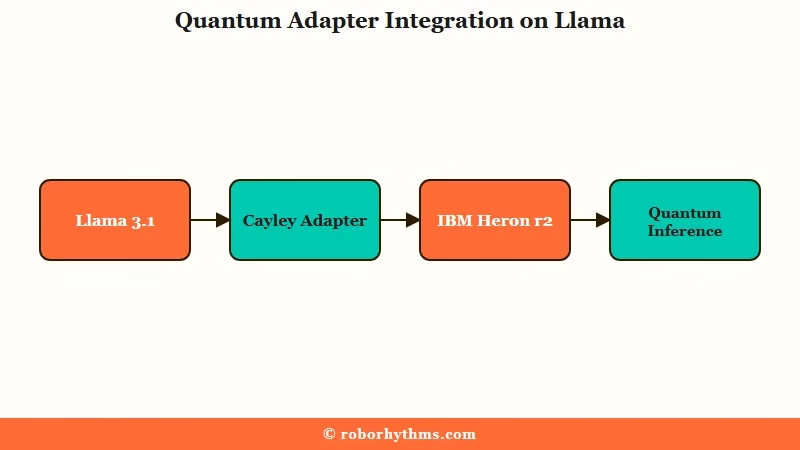
The way I read the architecture, it is a Cayley-parameterized unitary adapter (CUA). Base Llama 3.1 8B weights stay frozen, exactly like a free-tier AI agent stack using LoRA. A small set of trainable parameters get inserted into one of the model’s layers and trained on a classical computer while the base weights stay immobile.
The trained parameters then get encoded onto a quantum processor and executed there during inference. The paper does not call this a fine-tune in the usual sense. It calls it a quantum-classical hybrid adapter, and the math (block-diagonal unitaries, Cayley parameterisation) is structurally different from LoRA’s low-rank matrices.
What is perplexity: A score that measures how confidently a language model predicts the next word, with lower scores meaning fewer surprises and better predictions on standard text.
The hardware specifics matter for the latency story. The IBM Heron r2 backend the team used (a node called ibm_basquecountry) ran the inference with a median 2-qubit CZ error of 1.78 times 10 to the minus 3 and a 1-qubit SX error of 2.45 times 10 to the minus 4. Generating a 129-token response on the quantum processor took about 90 minutes inside a Qiskit Runtime session.
A full Llama 3.1 inference pass over 1,328 circuits ran for 4 hours and 24 minutes. That is the latency reality today, and it is the part most headlines glossed over.
Before: Base Llama 3.1 8B picks the wrong Jovian-rings answer 65 to 75 percent of the time and confidently selects “Saturn” instead of “all of the above,” with WikiText perplexity of 8.877.
After: The same model with a CUA attached drops WikiText perplexity to 8.752 and picks “all of the above” between 60 and 90 percent of the time across three sampling temperatures.
| Measurement | Base Llama 3.1 8B | Quantum-enhanced Llama 3.1 8B |
|---|---|---|
| WikiText perplexity | 8.877 | 8.752 |
| Added trainable parameters | 0 | 6,144 |
| Jovian rings correct (T = 0.2) | 25 percent | 90 percent |
| Jovian rings correct (T = 0.7) | 35 percent | 60 percent |
| Jovian rings correct (T = 1.0) | 35 percent | 60 percent |
| Gene-flow biology question | wrong (Hardy-Weinberg) | correct (genetic homogeneity) |
Why This Is a Bigger Deal Than It Sounds
A 1.4 percent perplexity drop is too small for an end user to feel, but the paper documents a noise wall, a compression-repair result, and a 2,730x parameter-efficiency win versus LoRA that together explain why quantum vendors are pouring money into this approach.
The headline number is the floor of what this proves, not the ceiling.
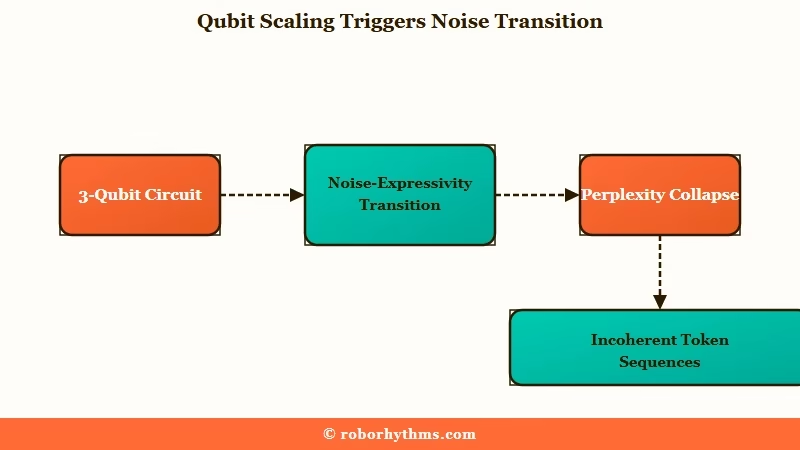
What I noticed first when I read the supporting tables is the noise wall. The team scaled the quantum circuit from 2 qubits up to 3, and at 3 qubits the model’s perplexity increased 35-fold, with the output collapsing into incoherent token sequences. They call this a “sharp noise-expressivity phase transition.”
In plain English, today’s hardware noise level is good enough for tiny quantum circuits inside an LLM and catastrophic for anything bigger. Adding more qubits to the current generation of IBM hardware makes the model worse, not better. That single finding is what frames the IBM Starling 2029 roadmap as load-bearing rather than aspirational.
What is a qubit: The quantum equivalent of a classical bit. It can hold 0, 1, or both at once through superposition, which lets quantum circuits explore many possibilities in parallel.
The second result that surprised me is the compression-repair test. On a smaller SmolLM2 model, the same Cayley adapter recovered 83 percent of the performance lost during extreme classical compression on the LAMBADA benchmark. This reframes the near-term use case completely.
The application is not “make the frontier model smarter.” It is “make a tiny compressed model behave like a much larger one.” That is the same problem builders ship around today with quantisation, distillation, and the wider parameter-efficient fine-tuning toolchain.
Here is the part that explains why classical-only researchers are paying attention. Per the paper’s own math, the block-diagonal unitary adapter reached half of the theoretical maximum improvement of a full dense matrix while using roughly 2,730x fewer trainable parameters than a comparable LoRA layer (6,144 versus 16.77 million).
That is a per-parameter learning efficiency no classical low-rank method has matched.
The catch is the same noise wall above. Classical LoRA scales to millions of parameters because GPUs are quiet. Quantum circuits cannot yet, because quantum hardware is loud.
What This Means for You
For an everyday AI tool user, this changes nothing about ChatGPT, Claude, or Gemini in 2026. For anyone building on open-weight models, it points to a near-term direction worth tracking.
No frontier model is shipping with a quantum dial this year, and there will not be one before IBM’s fault-tolerant Starling lands.
What I would do with this news today is small. Bookmark it as a directional signal and keep building on classical infrastructure. The 90-minute quantum inference for a 129-token response is not in the same universe as the sub-second latency a chat app needs.
That gap closes only when error correction becomes cheap enough to scale circuits past 3 qubits without the noise-wall collapse. The public roadmap for that lands in 2029 at the earliest. If you are already comparing frontier models like GPT-5.5 against Claude Sonnet 4.6, this paper does not nudge the comparison.
The open-weight angle is the part operators should watch closely. Multiverse used Llama specifically because it is open-weight and they could touch the layers, the same way Ollama and Kimi K2.5 stacks are the testbeds for nearly every new fine-tuning method that ships. Closed-weight providers cannot run this experiment because they will not let researchers slot adapters into a frozen middle layer of their proprietary models.
Three practical takeaways I would file away if you are building right now:
- The compression-repair finding is the most actionable result. If you are already compressing a model to fit on a smaller GPU or local device, the future option of recovering most of the lost performance via a tiny external adapter is a real path, even if the adapter is classical for now and quantum later.
- Latency is the gating constraint, not accuracy. A 1.4 percent perplexity improvement at 90 minutes per response is not a usable product. A 1.4 percent improvement at 90 milliseconds is.
- Open-weight models are pulling further ahead as research substrates. Each new method that lands on Llama or SmolLM2 first widens the gap between what closed-weight providers ship and what is open to anyone working on the same architecture.
What Comes Next for Quantum AI Training
IBM has a public timeline that maps directly to when this paper’s bottlenecks lift. The 2-qubit ceiling holds until the chip and the error correction beneath it improve enough to push past the 3-qubit noise wall.
Per IBM’s own roadmap, the Loon processor (2025) is the test bed for qLDPC error-correction codes. Kookaburra (2026) is the first modular processor that begins to scale qubit counts past the current ceiling. Starling (2029) is the planned first large-scale fault-tolerant quantum computer, projected to run 20,000 times more operations than today’s machines.
Aizpurua and co-authors explicitly position the current paper as a “hardware-feasibility milestone” rather than a quantum-advantage claim. Their own framing for what the 2-qubit circuits run today is the most honest part of the entire story. Every circuit in the paper is classically simulable.
The point is not that the quantum machine did something a classical one could not. It did anything useful at all inside a production LLM, and nobody had shown that before. The way I read the result, that is a small but real foothold on the hardware path forward.
The headline 1.4 percent perplexity number undersells the parameter-efficiency win and oversells the user-facing impact. The piece of this release worth putting on the strategic AI calendar is the 2029 Starling date, the same way the Anthropic 2028 China AI paper put the compute lead on the calendar earlier this month.
The first concrete next step for the field is a 6 to 12 qubit run on a noise-corrected backend. If that experiment moves the perplexity needle further without collapsing the way the 3-qubit attempt did, the timeline accelerates. If it does not, the work stays academic until at least the Kookaburra generation.
