Bottom Line: Higgsfield AI pricing on November 23, 2026 starts at $9 a month for Basic, with Plus at $49 and Ultra at $129 at list price, plus a free plan with no monthly credits. Video is where the money goes: our Pro account ran through 595.82 of its 600 credits in 12 days, and a dozen video clips took 338 of them.
Higgsfield AI pricing is a credit meter dressed up as a plan menu. Every plan hands you a monthly pile of credits, and each model draws from it at its own rate, so the same $49 can buy four long clips or a hundred short ones.
Our own account shows how fast that meter moves. The Pro plan we started on November 9, from an older lineup explained below, cost $29 for 600 credits, and ten Kling 3.0 clips on the first morning took 268 of them. On November 21 the balance read 4.18.
Everything below carries a date, because Higgsfield changes its prices often enough that an undated number goes stale within weeks.
You will see every plan, what each model charges per clip and how long a month of credits lasts. That last number matters more to me than the sticker price.
What Is the Current Higgsfield AI Pricing for Every Plan?
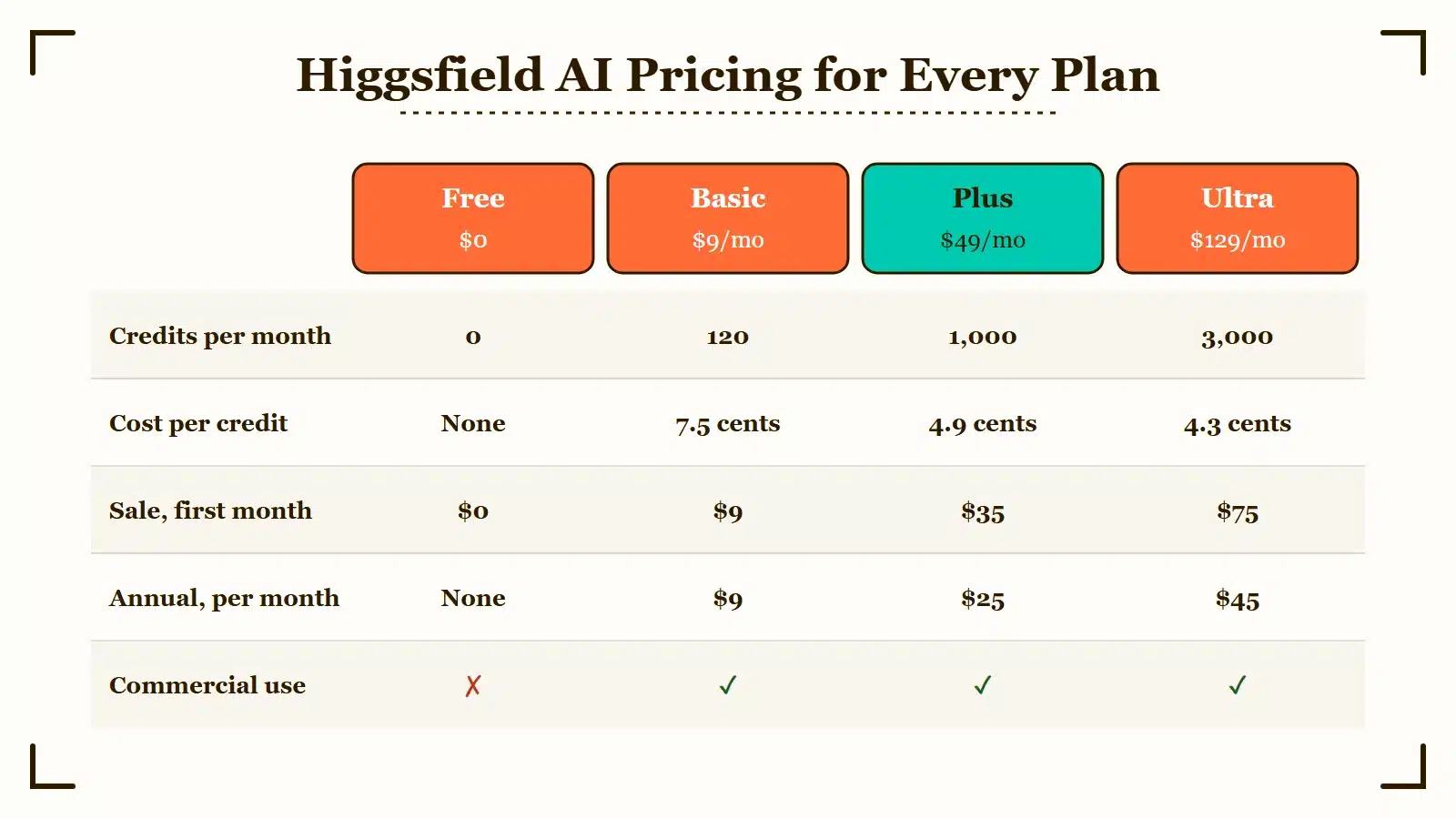
Higgsfield AI pricing on November 23, 2026 is $0 for Free, $9 for Basic, $49 for Plus and $129 for Ultra per month at list price, with 0, 120, 1,000 and 3,000 credits a month.
| Plan | List price per month | Credits per month | Cost per credit at list |
|---|---|---|---|
| Free | $0 | 0, one generation at a time | No credits included |
| Basic | $9 | 120 | 7.5 cents |
| Plus | $49 | 1,000 | 4.9 cents |
| Ultra | $129 | 3,000, with 6,000 and 9,000 options | 4.3 cents |
Prices checked on Higgsfield’s pricing page, November 23, 2026, before VAT and local taxes. The Black Friday prices below end on November 24.
The monthly sale prices hide their catch in small print. Plus shows $35 for the first month and “renews at $49”, and Ultra shows $75 that renews at $129, so I treat the list price as the real monthly price. Basic stays at $9 on either billing option.
Annual billing is where the bigger cuts sit, at $25 a month for Plus and $45 for Ultra during the sale. Before the sale, on November 10, Higgsfield’s in-app checkout listed annual billing at $39 a month for Plus and $99 for Ultra.
You can compare the same cards under the Pricing tab on Higgsfield before you pay, and that page opens on annual billing by default.
The free plan gives you no monthly credits and one generation at a time, and its outputs are not licensed for commercial use. Every paid plan includes commercial use.
New accounts get a small welcome balance, and ours received 10 credits when it was created on October 9.
Why Do Higgsfield Prices Look Different on Other Sites?
Higgsfield prices differ across sites because the company runs more than one price list and frequent short sales, and signed-in accounts can see offers that visitors do not.
Our own plan is an example. The Pro plan we pay for, $29 for 600 credits, came from a Basic, Pro and Max lineup that the pricing page showed on November 10, with Max at $79 for 1,800 credits.
On November 23 Higgsfield’s pricing page lists Basic, Plus and Ultra, and no Starter plan appears, even though many guides still list one.
Sales move just as fast. The pricing data Higgsfield’s checkout returned on November 23 lists 16 dated promotion windows between July 28 and November 24, 2026, each running from half a day to about ten days.
In one r/HiggsfieldAI thread, a paying Ultra subscriber saw a $79 Ultra offer while logged out and a $150 upgrade to 6,000 credits once logged in.
Support’s replies, as the post summarises them, said publicly advertised promotions are not necessarily available to every account.
The company behind these prices is large and growing quickly. TechCrunch reported in August 2026 that Higgsfield raised $400 million at a $5.4 billion valuation and had 30 million users across 200 countries.
How Many Credits Does a Higgsfield Video or Image Cost?
A Higgsfield video costs from about 7 credits for a silent 5-second Kling 3.0 clip to 240 credits for a 15-second Seedance 2.5 clip at 1080p. A single image costs between 0.12 and 4 credits.
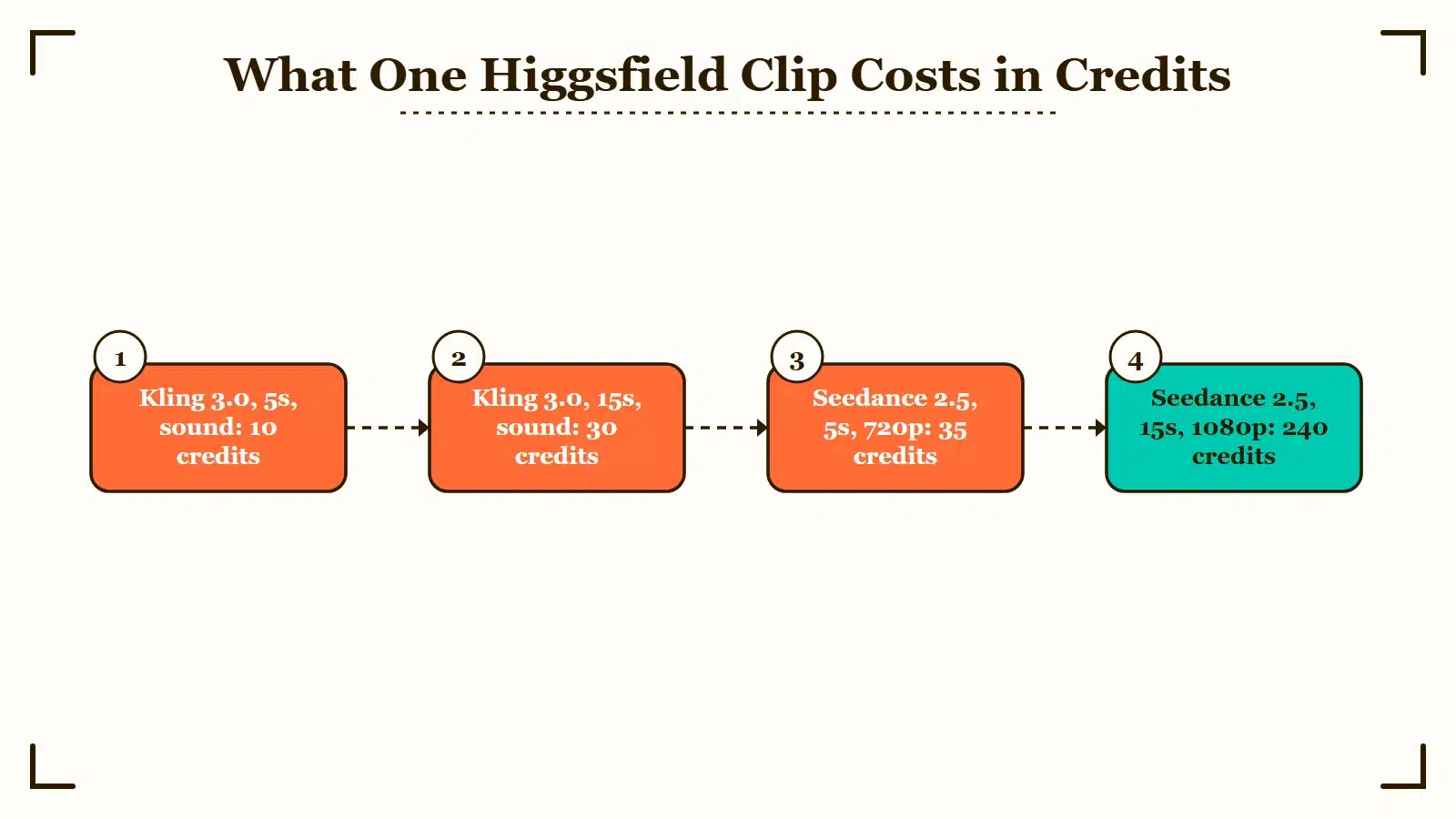
Four settings move the price: the model, the resolution, the length and whether the clip has sound. Higgsfield shows the credit cost before you generate, and the model table on its pricing page lists a rate for each model.
| Video model and setting | Credits per clip | Dollars at the Plus list rate |
|---|---|---|
| Kling 3.0, 5 seconds, with sound | 10 | $0.49 |
| Kling 3.0, 15 seconds, with sound | 30 | $1.47 |
| Kling 4.0, 5 seconds, 1080p | 18.75 | $0.92 |
| Seedance 2.5, 5 seconds, 720p | 35 | $1.72 |
| Seedance 2.5, 15 seconds, 1080p, with audio | 240 | $11.76 |
| Google Veo 3.1, 4 seconds | about 40 | $1.96 |
Images cost a small fraction of a clip each, from under a cent to about 20 cents.
| Image model | Credits per image | Dollars at the Plus list rate |
|---|---|---|
| GPT Image 2.6, low to high quality | 0.75 to 2 | 4 to 10 cents |
| Nano Banana Pro | 2, or 4 at 4K | 10 to 20 cents |
| Higgsfield Soul 2.0 | 0.12 | under 1 cent |
Credit costs come from Higgsfield’s pricing page model table (November 23, 2026) and the cost previews on our account (November 10 and 23, 2026). Dollar figures use Plus at $49 for 1,000 credits, or 4.9 cents per credit.
Higgsfield re-priced GPT Image 2.6 between November 20 and 21. A medium 2K image cost our account 1 credit before the change and 1.75 after, while high quality fell from 2.75 to 2.
The silent price is the one that bothers me most. The model table lists Kling 3.0 at about 7 credits per 5 seconds, which is the price with sound switched off. With sound on, the cost preview priced the same clip at 10 credits for 5 seconds and 30 for 15.
Resolution is the other quiet multiplier. Seedance 2.5 costs 35 credits for 5 seconds at 720p and 80 at 1080p, so one step up in resolution more than doubles the bill.
The plan cards run the same math at the cheapest setting.
Before: “Plus comes with 1,000 credits, and the plan card says that buys 67 Seedance 2.5 videos.”
After: “The 67 figure only holds for 5-second clips at 480p, which cost 15 credits each. At 720p the same 1,000 credits buy 28 five-second clips, and at 15 seconds and 1080p they buy 4.”
Veo 3.1 is the priciest model per second in that table, and our Veo 3 comparison covers how its output stacks up against Sora 2.
If you are weighing Higgsfield against a model maker’s own app, our Higgsfield vs Kling comparison walks through that choice.
How Long Do Higgsfield Credits Last on a Paid Plan?
A month of Higgsfield credits can run out in days once you make video, and our 600-credit Pro month fell to 4.18 credits in 12 days, with 12 video clips using 338 of those credits.
| What our account made, November 9 to 21 | Jobs | Credits | Share of the 600 |
|---|---|---|---|
| Kling 3.0 video clips | 10 | 268 | 45% |
| Seedance 2.5 video clips, 5 seconds at 720p | 2 | 70 | 12% |
| GPT Image 2.6 images | 137 | 202.5 | 34% |
| Seed Audio 1.0 sound clips | 35 | 50.2 | 8% |
| Voice change and one character sheet | 3 | 5.12 | 1% |
| Total | 187 | 595.82 | 99% |
Source: our account’s credit history, read November 23, 2026. The plan’s next 600 credits arrive on December 9.
What surprised me was how front-loaded the spending was. The ten Kling clips went out within two hours of the plan starting, and they took 268 credits, 45% of the month, before the plan was a day old.
Images are cheap enough to ignore one at a time. Our 137 images averaged about 1.5 credits each, yet together they cost 202.5 credits, a third of the month.
At that pace, a 1,000-credit Plus plan covers about 20 days of the same work, and 3,000-credit Ultra about two months. If most of your work is long-form, our long-video generator guide compares tools built for longer clips.
Do Higgsfield Credits Roll Over or Expire?
Higgsfield subscription credits expire at the end of each credit cycle, so nothing rolls over, and one-time top-up credits expire 90 days after purchase.
Higgsfield’s pricing FAQ, read November 10, 2026, says “Subscription credits do not roll over and expire at the end of each credit cycle.”
Annual plans do not hand you a year of credits up front either, because Higgsfield’s FAQ says annual credits “refresh every 30 days from the subscription start date.”
Our own account shows the rule at work. When the previous one-month plan ended on November 8, an entry labelled “Subscription Cancelled” removed the 22.51 credits still left.
Top-up packs follow a different clock. Section 9.6 of Higgsfield’s terms of use, read November 10, makes them valid for 90 days and spends them after your subscription credits. On November 23 the checkout priced 500 credits at $26 and 1,000 at $49.
Annual billing lowers the monthly price and changes nothing about expiry, which is the trap I would warn a new subscriber about first.
Every 30-day batch still expires on schedule, so a quiet month on an annual plan is a month of credits thrown away. Team and Scale are the exception, since both list unused first-month credits as rolling over.
Cancelling does not cut the current month short. Higgsfield’s pricing FAQ says you can cancel anytime in account settings and “your plan will remain active until the end of the current period.” Section 10.4 of the terms rules out prorated refunds for that period.
Why Does Higgsfield Feel So Expensive?
Higgsfield feels expensive because the plan cards count the cheapest clips and unlimited generations work only on the website, in a slower queue. A finished clip also keeps its charge even when the result disappoints.
Higgsfield does get one thing right, and I will say it up front: per clip, its Kling 3.0 price is low, at about 49 cents for 5 seconds with sound at the Plus rate.
The frustration comes from everything around that price, and these are the five pressure points.
- Plan cards count the cheapest settings. The Plus card’s “67 videos Seedance 2.5” matches the 15-credit price of a 5-second clip at 480p, and at 720p the number drops to 28.
- Unlimited stays on the website. A footnote on the pricing page says unlimited models and free generations “are not accessible on MCP/CLI, Canvas or Supercomputer.” MCP and CLI are the routes that let an AI assistant or a script run Higgsfield, and all 137 images our account made through the MCP were paid in credits.
- Unlimited jobs wait longer. The pricing FAQ says unlimited generations run in the standard queue while credit jobs always run in the priority queue. In one r/HiggsfieldAI warning post, an Ultra subscriber found the unlimited queue so slow that they burned through 6,000 credits on the first day.
- A finished clip is a paid clip. Higgsfield’s pricing explainer, updated October 24, says failed jobs are usually refunded automatically, but “if a generation finishes, the credits aren’t returned, even if you don’t like the result.” Our ledger shows how rare refunds are, with five in the account’s first month, all failed images, worth 2.75 credits in total.
- Refunds are narrow. Section 9.3 of the terms allows a refund within seven days of an initial purchase only if no credits were used, excludes renewals, and allows a service fee of up to 6%.
That queue gap is why I count credits as the real budget. Unlimited is a bonus for patient work on the website, while anything with a deadline runs on credits.
Which Higgsfield Plan Should You Buy?
Plus is the Higgsfield plan most people should buy, because 1,000 credits cover about 100 short Kling clips with sound a month, while Basic suits image-only work and Ultra suits daily video.
| If you mostly make | Plan that fits | What the credits cover |
|---|---|---|
| Thumbnails, covers and other stills | Basic, $9 | 120 credits, about 60 Nano Banana Pro or 68 GPT Image 2.6 images |
| A few short clips a week plus images | Plus, $49 | 1,000 credits, about 100 five-second Kling 3.0 clips with sound |
| Daily video or client work at 1080p | Ultra, $129 | 3,000 credits, about 37 five-second Seedance 2.5 clips at 1080p |
Plan prices at list, checked November 23, 2026.
My pick for most people is Plus, with annual billing only once you know you will use the credits every month. Start Higgsfield on a monthly plan, see what your own mix burns in the first month, then decide.
Basic is the cheapest plan but the dearest per credit at 7.5 cents, and its card lists access to selected models only, so it suits images more than video.
If Kling is the only model you use, our Kling AI review covers what Kling’s own plans charge.
What Do Higgsfield Team Plans and the API Cost?
Higgsfield Team costs $79 per seat a month at list price with 1,000 credits per seat, Scale costs $215 per seat with 2,500, and the API is billed separately from a prepaid dollar balance.
Team covers 2 to 9 members in one shared workspace and credit pool, and Scale covers 5 to 15. During the Black Friday sale the page shows $55 and $120 per seat on a five-seat default, and Enterprise pricing is custom.
The API is a separate product. Higgsfield’s help center article on the API, updated September 24, says it “runs on its own account balance in US dollars” and that “the minimum top-up is $5,” and it never touches plan credits.
The Higgsfield MCP sits in between, because it spends your normal plan credits while the pricing page footnote shuts MCP and CLI use out of unlimited.
I would budget an AI agent’s Higgsfield use exactly like manual credit spend, because that is what it is.
Quick Takeaways
- Higgsfield’s list prices on November 23, 2026 are $9 for Basic, $49 for Plus and $129 for Ultra a month, with 120, 1,000 and 3,000 credits.
- Video drives the bill, and a 15-second Seedance 2.5 clip at 1080p costs 240 credits, about $11.76 at the Plus rate.
- Subscription credits expire every cycle, annual plans refresh every 30 days, and top-up credits last 90 days.
- Unlimited generations only work on the website, never through MCP or CLI, and they wait in a slower queue.
- Start monthly on Plus, watch what one month of your own work costs in credits, then choose the plan.
