
Bottom Line: HeyGen is the strongest AI avatar generator in 2026 for short-form social, multilingual translation, and rapid script-to-video work, but the Premium Credit system eats most teams’ Creator plan inside the first week. Use it on the Creator tier for Avatar III and short Avatar IV clips. Skip it if you need 30+ minutes of Avatar IV per month, in which case the real cost lands closer to $80-120 not $29.
The pitch is straightforward: $29 a month for an AI avatar that talks in 175+ languages and lip-syncs cleanly. The reality is more complicated.
The pricing page is honest about the headline number; it is the credit math behind Avatar IV that quietly doubles or triples the bill for anyone using the part of HeyGen that justifies paying for it in the first place.
I wanted to write a review that took the credit system seriously instead of glossing over it. Most “HeyGen review 2026” pieces lean on the avatar realism (which is real) and skip the math (which is how most teams burn through their plan inside 10 minutes of Avatar IV footage).
The way I would frame this for someone deciding right now: HeyGen earns its place at the top of the AI avatar category, and the Creator plan is the right entry point. Just budget for the credit top-ups before you sign up, not after.
What HeyGen Actually Is in 2026
HeyGen is an AI avatar video generator that turns a script and a digital presenter into a polished talking-head video in 175+ languages, with three avatar generations available across free and paid tiers.
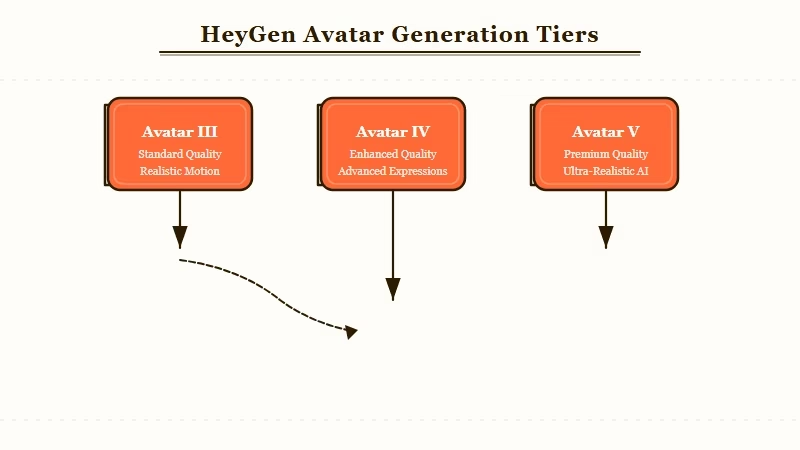
Avatar III is the workhorse model. Avatar IV adds micro-expressions and full-body motion. Avatar V (introduced 2026) generates a personal digital twin from a 15-second reference recording.
The use case it owns is short-form video at scale: marketing clips, product explainers, training videos, social posts, multilingual localisation. Drop in a script, pick an avatar, pick a voice, render in minutes. You skip the camera, the lighting, the editing, and most of the production cycle.
From what I’ve seen on the avatar realism specifically, Avatar IV and V are the cleanest in the category right now. Synthesia is closer than the gap looked a year ago, but on micro-expression naturalness HeyGen still wins side-by-side. The “is this an avatar or a person” test still tips toward HeyGen on first viewing.
The catch, and it is the whole story of this review, is that you do not get unlimited access to Avatar IV. You get unlimited Avatar III and a small allowance of Premium Credits for Avatar IV. Run out of credits, and the part of HeyGen you paid for stops working until the next billing cycle.
How Much HeyGen Costs Once the Credits Run Out
HeyGen’s headline pricing is Free, $29 Creator, $99 Pro, $149+ Business, but Avatar IV consumes 20 Premium Credits per minute of video, so the Creator plan’s 200 credits cover exactly 10 minutes of Avatar IV per month.
Past those 10 minutes you either downgrade to Avatar III or buy a top-up pack ($15 for 300 credits is the standard one).
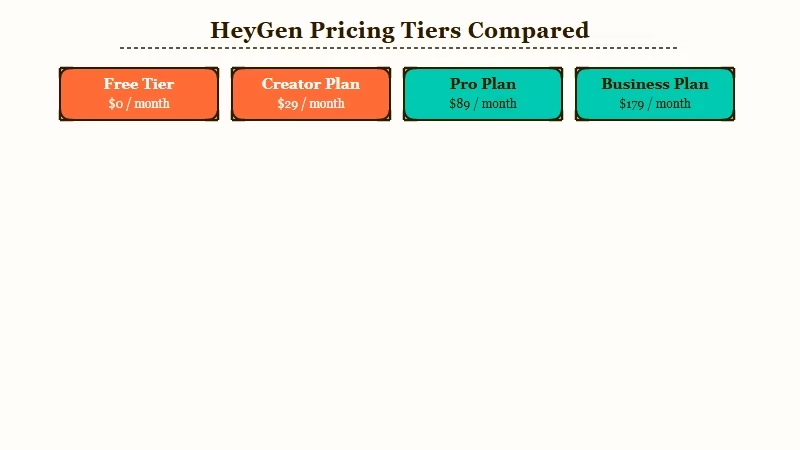
Here is the full pricing breakdown with the credit math worked out.
| Plan | Monthly price | Premium Credits | Avatar IV minutes/mo | What else you get |
|---|---|---|---|---|
| Free | $0 | 0 | 0 | 3 videos/mo, 3-minute cap each, 720p, HeyGen watermark, 500+ stock avatars |
| Creator | $29 ($24 annual) | 200/mo | 10 min | Unlimited Avatar III, 1080p, 1 voice clone, no watermark |
| Pro | $99 ($79 annual) | Higher pool | Roughly 30-50 min | Multiple custom avatars, advanced features |
| Business | $149 + $20/seat | 2,000-4,000 | 100-200 min | 4K rendering, 5 custom avatars, SSO, team management |
| Enterprise | Custom | Negotiated | Unlimited (negotiated) | Unlimited custom avatars, priority support, SOC 2 |
The two numbers nobody on the pricing page foregrounds: 1 Premium Credit equals 3 seconds of Avatar IV, and unused credits do not roll over.
A team that generates 15 minutes of Avatar IV in one busy week and then nothing for three weeks loses the same money as a team that paces evenly. The credit pool resets every month whether you used it or not.
For benchmarking, the AI video market is tracked by Statista as a $12B category by 2027, and HeyGen sits in the top tier alongside Synthesia for avatar-driven content specifically.
The credit system is the thing that makes the platform economics work at $29; without it the entry plan would be closer to $79.
Where HeyGen Wins and Where It Falls Short
HeyGen wins on avatar realism, language coverage, and rendering speed; it falls short on long-form video coherence and on the gap between sticker price and real cost.
The two halves of that sentence are both true and they are the reason most reviews end up confused.
A concrete worked example on how the same “$29 plan” turns into two very different bills:
Before (the marketing assumes): A solo creator pays $29 monthly, generates 5-6 minutes of HeyGen content per week, all in Avatar III, never touches the credit pool. Real cost: $29 flat.
After (most teams actually): A small marketing team pays $29 monthly, generates 30 minutes per week in Avatar IV because that is the avatar quality the brand needs, blows through 200 credits in 10 days, buys two $15 top-up packs to get through the month, and realises the real cost is $59. Multiply across two team members and the team is paying closer to $120 to do what they thought was a $58 plan.
The fix is to plan the credit budget against actual avatar usage, not against the headline plan price.
Six things HeyGen does better than the alternatives:
- Avatar IV and V realism. Sync, lip motion, and micro-expressions are the cleanest in the category. Side-by-side against Synthesia, HeyGen wins on the “is this real” test for short clips.
- 175+ language coverage with lip-sync translation. Drop English audio in, get it dubbed and lip-synced in Spanish, German, Mandarin, or Hindi without re-recording. Synthesia’s 160+ is close but the lip-sync quality on HeyGen edges ahead.
- Video translation as a first-class feature. Upload an existing video, get it translated, get the avatar’s lips re-synced to the new language. This single feature is why HeyGen’s enterprise side is growing.
- Speed. Script to rendered 1080p video in under 10 minutes. Faster than Synthesia, dramatically faster than any traditional video production workflow.
- Avatar V from a 15-second recording. The personal digital twin generation no longer requires a long studio session. 15 seconds of decent reference video produces a usable avatar.
- API access and integrations. Pro tier at $99 unlocks the API, which means content automation pipelines, scheduled video generation, and integration with tools like Zapier or n8n become trivial.
Five honest weaknesses:
- The credit system trap. The single biggest reason teams cancel is they did not budget for top-ups and the headline price was misleading.
- Long-video coherence drops after 60 seconds. Gestures repeat. Avatar movements get robotic. Anything over a minute starts to feel uncanny on close inspection.
- Random text artifacts and stuck exports. Issues at 97% rendering, random captions appearing in non-caption mode, and browser compatibility problems still surface in 2026.
- No credit rollover. Months where you under-use cost the same as months where you hit the limit.
- Free tier is barely usable for evaluation. 3 videos a month at 720p with a watermark is enough to see the avatar walks and talks; it is not enough to make a real buying decision. The Creator plan is the real free trial.
The way I read this is that HeyGen is doing what category leaders usually do: charging a premium for the part of the product that wins on technical merit (Avatar IV/V realism) while letting the cheaper tier subsidise discovery.
If you accept that, the platform is the right pick for short-form avatar video in 2026. If you fight it, you will overspend and end up frustrated.
For comparison, the HeyGen vs Synthesia breakdown covers when each one wins by use case, and the best AI video generator for long videos roundup covers where to look when you need 30+ minutes per video instead of the 60-second sweet spot HeyGen is built for.
If your work leans more cinematic than avatar-driven, the Sora 2 vs Runway Gen-4 comparison is the next door over.
Who Should Buy HeyGen and Who Should Not
Buy HeyGen Creator if you are a solo creator or small team doing short-form social content, marketing clips, or multilingual localisation. Skip HeyGen entirely if you need 30+ minutes per month of Avatar IV at the $29 price point.
The decision matrix I would use, sorted by real-world use case:
| Use case | Verdict | Notes |
|---|---|---|
| Short-form social (TikTok, IG, Shorts) | Buy Creator | 200 credits is plenty for 60-second clips |
| Marketing clips for landing pages | Buy Creator or Pro | Depends on how many; Pro at $99 if more than 15 per month |
| Multilingual video translation | Buy Pro | Translation is what HeyGen does best; need the credits |
| Long-form training videos (5+ min each) | Skip, or Business+ | Avatar coherence drops past 60s; budget for credits |
| Live customer-service avatars | Wait for LiveAvatar maturity | The real-time avatar is still early as of 2026 |
| API-driven automation | Buy Pro | API access starts at $99 with per-credit metering |
| Cinematic B-roll / film work | Skip | HeyGen is talking heads; Sora 2 or Runway is the right tool |
| 4K rendering | Buy Business | 4K is gated to the $149+ tier |
A real-world decision example: a Shopify store owner generating 3 product explainer videos per week (avg 45 seconds each) is the bullseye Creator-plan customer.
200 credits cover the Avatar IV portion comfortably, no top-ups, no surprise costs. Same plan handed to a corporate training team trying to ship 4 hours of onboarding content per month is the worst-fit scenario; the credit math turns the $29 plan into a $200+ effective bill once top-ups are counted.
The Verdict on HeyGen for 2026
HeyGen earns its place at the top of the AI avatar category in 2026 on technical merit, and the Creator plan is the right entry point for almost everyone doing short-form avatar video.
The credit system is a real friction, but for the workloads HeyGen is genuinely best at, the friction is manageable if you budget for it upfront.
The reason I would still recommend it over Synthesia for most readers is the language coverage and the price-to-quality ratio at the Creator tier. Synthesia is the better pick for SOC 2-bound enterprises and structured training workflows.
HeyGen is the better pick for solo creators, marketing teams, and anyone whose top use case is multilingual localisation. Both are well above the third option in the category as of mid-2026.
The thing I would change about HeyGen if I could is the credit communication on the pricing page. The math is buried in the help docs, and the page itself reads as if Creator gives you unlimited everything.
If HeyGen were upfront about “200 credits = 10 minutes of Avatar IV” right next to the $29 price, half the complaints I see in user threads would disappear and the platform would still convert well.
For the right workload, HeyGen is worth paying for. The credit system is the price of admission, not a deal-breaker; just go in with eyes open.
Frequently Asked Questions
Is HeyGen worth paying for in 2026?
HeyGen is worth paying for if you generate short-form avatar video, need multilingual translation, or want rapid script-to-video output, and you stay within roughly 10 minutes of Avatar IV per month on the Creator plan. If you need substantially more premium avatar footage, the real cost lands closer to $79-120 once top-up credits are factored in.
How does HeyGen’s Premium Credit system work?
HeyGen charges 1 Premium Credit per 3 seconds of Avatar IV video, which works out to 20 credits per minute. The Creator plan includes 200 credits, equal to 10 minutes of Avatar IV footage monthly. Unused credits do not roll over, and top-up packs cost about $15 for 300 additional credits.
Is HeyGen better than Synthesia?
HeyGen wins on avatar realism, language coverage (175+ vs 160+), and price at the entry tier, while Synthesia wins on structured editing, SOC 2 compliance, and predictable enterprise pricing. Most solo creators and small marketing teams will prefer HeyGen; most regulated enterprises will prefer Synthesia.
Can I use HeyGen for free?
HeyGen’s free tier allows 3 videos per month at 720p with a HeyGen watermark, each capped at 3 minutes. The free tier is enough to evaluate the avatar quality but not enough to do real work. The Creator plan at $29 (or $24 annual) is the realistic starting point.
What is the difference between Avatar III, IV, and V?
Avatar III is the standard tier and is unlimited on Creator plans and above. Avatar IV adds micro-expressions and full-body motion and consumes Premium Credits. Avatar V (introduced in 2026) generates a personal digital twin from a 15-second reference recording and is the latest realism upgrade.
Does HeyGen have an API?
Yes, HeyGen offers API access starting at the Pro tier ($99/month) with credit-based metering at roughly $0.50 to $0.99 per credit depending on the volume tier. The API is suitable for content automation pipelines and integration with tools like Zapier and n8n.
