What’s Changed: Minnesota’s nudification law took effect on August 1, 2026, and it fines the platform up to $500,000 for each image, not the user. A federal judge refused to pause it. xAI responded by tightening Grok’s image filters far beyond Minnesota, which is why plainly safe prompts now fail for users on the other side of the world.
The Grok Minnesota law story matters to you for one reason: if you opened Grok Imagine this week and watched a request for two fully clothed people hugging come back moderated, that statute is why.
You did not do anything wrong, and the filter genuinely did tighten.
Most coverage stops at “Elon Musk sued Minnesota.” That skips the part that explains your blocked prompt, which is buried in how the law defines one term.
Minnesota’s statute never defines “intimate part” on its own. It borrows the definition from the state’s criminal sexual contact law, a rule written to describe illegal physical touching, and that definition covers the inner thigh, buttocks, and breast of any person.
An AI edit of someone in shorts can land inside a law most people assume is about nudity.
Here is what the law says, why one state changed a global product, what still works, and where to go if your use case was never about real people in the first place.
What Is the Minnesota Law Behind Grok’s Image Block?
The Minnesota law is Minn. Stat. 325E.91, passed as House File 1606, which bans platforms from letting users “nudify” images of identifiable real people and fines the platform owner up to $500,000 per violation.
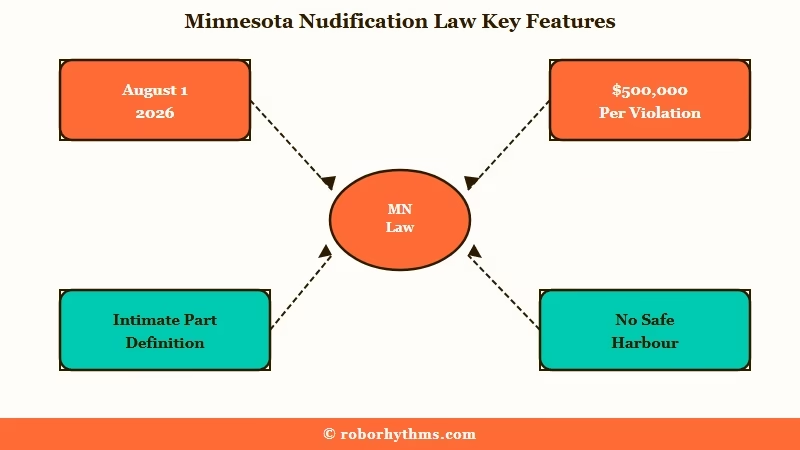
Governor Tim Walz signed it on May 7, 2026, after it cleared the legislature 197 votes to 1. It took effect on August 1, 2026. You can read the official bill summary from the Minnesota House if you want the statutory language directly.
The liability lands on whoever “owns or controls a website, application, software, program, or other service.” That is the design choice that makes this law different from the deepfake statutes that came before it, which mostly went after the person who shared the image.
My read is that one cross-reference does more work than the rest of the statute combined. Because “intimate part” comes from Minn. Stat. 609.341, the ban reaches images of shirtless men, people in swimsuits, and people in shorts, none of which most readers would file under nudity.
Three more details compound it. There is no requirement that the image ever be shared, so a private picture nobody else sees carries the same penalty.
Consent does not help either, which means editing a photo of yourself still counts. And there is no safe harbor, so a platform that deploys strong safeguards and gets bypassed by a determined user is still on the hook.
Why Does a Minnesota Law Affect Grok Users Everywhere?
Running different content rules per state means maintaining different model behavior per state, which is expensive and fragile. Blanket-filtering everyone is cheaper than geofencing correctly, so a single state’s penalty structure sets the ceiling for every user.
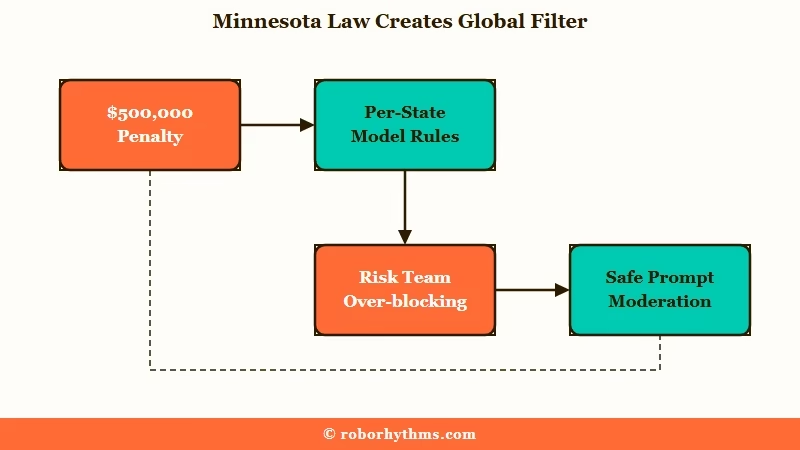
Stack the four structural facts together and the engineering answer writes itself. Up to $500,000 per generation, counted at creation rather than publication, with consent irrelevant and no credit for trying hard.
Under that math, a false negative costs half a million dollars and a false positive costs one annoyed subscriber. I don’t buy the idea that this was theater. Any competent risk team lands in the same place, which is to over-block and argue about it later.
xAI did do some genuine geofencing. It said it would withhold Grok Imagine’s editing feature from Minnesota users specifically, and it had already built regional blocks after Malaysia and Indonesia cut off Grok entirely, with the Philippines moving the same way.
The broad tightening that landed around August 1 is separate, and it is the one users everywhere noticed. This is the same pattern that hit another platform earlier this year, and our writeup on state-level blocks on SpicyChat covers how that rollout played out.
| Jurisdiction | Status | What triggered it | What users see |
|---|---|---|---|
| Minnesota | Feature withheld | Minn. Stat. 325E.91, effective Aug 1, 2026 | Image editing unavailable |
| Rest of the US | Heavily filtered | Blanket policy, not a local law | Safe prompts moderated |
| Malaysia, Indonesia | Fully blocked | National regulator action | No access to Grok |
| Everywhere else | Heavily filtered | Same blanket policy | Safe prompts moderated |
What Can Grok Still Generate Right Now?
Original characters and scenes still work. Anything anchored to a real, identifiable person is heavily restricted, and the filter now catches ordinary prompts like kissing, hugging, and a fully clothed character bending over.
The false positives are the part people find hardest to accept, because the blocked prompt often has nothing to do with nudity. Words that describe clothing or closeness are enough to trip it.
The text and voice side narrowed over the same period, where Grok’s Unhinged mode quietly left the personality list.
If your work is legitimately safe and keeps getting flagged, the practical move is to stop feeding the filter the words it is watching for and to describe the scene instead.
Vague: “two characters kissing on a beach in swimsuits”
Specific: “two original illustrated characters standing at the shoreline at sunset, windswept hair, warm rim lighting, wide cinematic framing, faces turned toward each other”
Same scene, no trigger words, and the second version gives the model more to work with. This only helps where your intent was already within the rules.
If it were me, I would stop retrying a blocked prompt with small tweaks. Repeated near-identical attempts read as probing to the moderation system, and that is a fast route to a penalty.
Nothing here is a route around the law, and no toggle unlocks real-person imagery. The NSFW and Spicy switches never disabled the core protections against nonconsensual imagery, and attempting to work around those still ends accounts.
Why Did My Grok Account Get Banned?
Bans are coming from three directions right now: terms of service enforcement on real-person edits, suspensions carried over from a linked X account, and automated flags for suspicious activity, which VPN traffic can trigger.
The error string most people are hitting reads “Authentication Failure: User is Blocked,” and it arrived alongside the Grok Imagine 2.0 rollout and a ban wave across SuperGrok and SuperGrok Heavy accounts.
That wave landed on paying tiers, which puts the renewal question in front of the fix. Our read on whether SuperGrok still earns its $30 a month covers the tiers and the cancel path.
My take is that xAI is not the passive party this narrative usually assumes. Its own court filing says the company suspended more than 50,000 accounts in 2026, filed more than 70,000 reports to the National Center for Missing and Exploited Children, and that those reports contributed to at least 244 arrests.
The same filing describes xAI suing one of its own users for breach of contract after he bypassed the safety controls.
| Symptom | Likely cause | Fix |
|---|---|---|
| “Authentication Failure: User is Blocked” | ToS enforcement or ban wave | Contact support with your account email, do not create a second account |
| Grok dead after an X suspension | Suspension carries over to Grok | Resolve the X suspension first, Grok access follows |
| Sudden lock after travel or VPN use | Automated suspicious-activity flag | Sign in from your usual network and device, then appeal |
| Safe prompts moderated repeatedly | Blanket filter false positive | Rewrite the scene without clothing or contact words |
| Credits gone with nothing generated | Moderated attempts still bill | Stop retrying variants, log what failed |
Whether VPN use alone causes bans is genuinely unsettled. User reports flatly contradict each other, with some insisting VPNs are never the trigger and others reporting a lock within days of connecting through overseas servers.
Treat it as an unquantified risk while the picture stays murky.
Do Blocked Generations Still Use My Credits?
Yes. Grok draws from a shared weekly usage pool, and a generation that gets blocked by moderation still consumes the compute it took to attempt, so the credits come off your balance either way.
This is the complaint that turns irritation into cancellations, and I understand why. Paying for a tier and watching the allowance drain on outputs you never received is a different kind of frustrating from a feature just being unavailable.
The trap compounds with retries. Ten attempts at a prompt the filter will never pass costs ten times the credits and can register as spam, which is how people end up penalized on top of being out of pocket.
I keep a short note of which phrasings burned credits without producing anything, which sounds tedious but pays for itself within a week.
Our breakdown of wasted Grok Imagine credits goes deeper on where the allowance disappears to, and the piece on how Grok Imagine moderation works covers the filter behavior itself.
Will These Restrictions Be Lifted?
Possibly, and the date to watch is August 19, 2026. That is when a federal court in St. Paul hears xAI’s request for a preliminary injunction against the Minnesota law.
xAI filed suit against Attorney General Keith Ellison on July 27, 2026, arguing the statute is an overbroad, content-based restriction on speech. On July 31, U.S. District Judge Donovan W. Frank denied the company’s emergency request for a temporary restraining order.
The reasoning was about timing rather than the merits. The judge noted that xAI waited nearly three months between the May signing and its filing, which sat badly with a claim of urgent, immediate harm.
Frank converted the motion into a request for a preliminary injunction and set a briefing schedule. Ellison’s office responds by August 12, xAI replies by August 17, and the hearing follows on August 19.
My take is that this hearing matters more to your day-to-day Grok experience than anything xAI ships in the meantime. Granting the injunction would ease the pressure that produced the blanket filter in the first place, and the filters would likely loosen within weeks. A denial hardens everything.
One caution on expectations. Even a win for xAI in Minnesota leaves the UK information regulator’s inquiry, the Baltimore suit, and multiple class actions untouched, so the filters are unlikely to snap back to where they were.
What Should You Do If You Only Wanted Fictional Characters?
If your use case was original characters rather than real people, you are collateral damage in a filter built for a different problem, and a purpose-built companion platform will serve you better than waiting for Grok to loosen up.
The way I see it, this describes most of the people complaining. They were writing scenes with invented characters, got swept up in a filter aimed at nonconsensual imagery of real humans, and now cannot do the thing they were paying for.
For that group, Candy AI is the straightforward move, because it is built around original characters with persistent memory rather than image edits of real photographs. The legal exposure that reshaped Grok does not apply the same way to a platform whose entire premise is invented people.
If you want something closer to illustrated and anime-styled companions, Nectar AI covers that end well. Both are worth a look before renewing a subscription you are currently unable to use, and our roundup of Grok Imagine alternatives has the wider list.
If you would rather cancel outright, cancel through the channel you bought it from. Deleting your xAI account does not stop app store billing, which catches people out constantly.
- On the web, go to grok.com, open Settings, then Billing, click Manage, and choose Cancel SuperGrok.
- On iPhone, open Settings, tap your name, tap Subscriptions, select SuperGrok, then Cancel Subscription.
- On Android, open the Play Store, tap your profile icon, go to Payments and subscriptions, select SuperGrok, then Cancel subscription.
- If you subscribed through X Premium, cancel that separately on x.com, since X Corp bills it.
- Residents of the EU, UK, and EEA have a statutory 14-day right of withdrawal and can request a full refund by emailing support@x.ai.
Payments are non-refundable by default outside that withdrawal window, so the earlier you act in a billing cycle the better.
Frequently Asked Questions
Is the Minnesota nudification law in effect right now?
Yes. It took effect on August 1, 2026, and a federal judge denied xAI’s emergency request to pause it on July 31. It remains enforceable at least until the preliminary injunction hearing on August 19.
Does the Minnesota law apply to me if I live somewhere else?
The law itself only binds platforms operating in Minnesota. The filter you are hitting is xAI’s own blanket policy, applied broadly because running different model behavior per state is impractical.
Does the law only cover nude images?
No. It defines “intimate part” using Minnesota’s criminal sexual contact statute, which covers the inner thigh, buttocks, and breast. Images of people in swimsuits or shorts can fall inside it.
Can I get a refund for credits lost to blocked generations?
Not by default, since payments are non-refundable. Residents of the EU, UK, and EEA can invoke a statutory 14-day right of withdrawal by contacting support@x.ai within that window.
Will deleting my Grok account stop the charges?
No. Subscriptions bought through Apple or Google Play keep billing after account deletion. You have to cancel in the store where you purchased it.
Quick Takeaways
- Minnesota’s law fines the platform up to $500,000 per image and counts creation rather than sharing, which is why xAI over-blocked instead of geofencing.
- The statute borrows “intimate part” from a criminal touching law, so it reaches swimsuits, shorts, and shirtless photos, not just nudity.
- Blocked generations still consume your weekly credits, and retrying a doomed prompt multiplies the loss and risks a penalty.
- The August 19 preliminary injunction hearing in St. Paul is the date that decides whether the current filters ease or harden.
- If you only ever wanted original characters, move to a platform built for them rather than waiting out someone else’s lawsuit.
