
Bottom Line: Graphify is a free, MIT-licensed knowledge graph builder that meaningfully cuts Claude Code token usage on codebases of 100+ files, with verified reductions of 49x on daily tasks and up to 71x on large repos. It is worth installing if you work in a real-size codebase. The viral 55k-star count hides a fragile PreToolUse hook that breaks on Claude Code v2.1.117 and later, plus several gotchas around staleness and Java legacy code.
The token bill for working in a large codebase with Claude Code can sneak up fast. Article 1 covered Uber’s COO admission that the company burned its full 2026 AI budget by April, mostly on Claude Code. Graphify is one of the very few open-source tools that targets the underlying problem instead of just measuring it.
Graphify shipped on April 5, 2026, hit 55,100 GitHub stars in roughly seven weeks, and crossed 450,000 PyPI downloads in the first 26 days. The numbers are real and the project is alive, but the “71x token reduction” headline does not survive contact with a normal-sized workday without three caveats most viral coverage skips.
This review walks through what the tool really does, where the 71x figure comes from versus the more honest 6.8x to 49x range, the version-compatibility bug that quietly broke installs in late May 2026, and who should install it today versus who should wait for the next minor release.

What Does Graphify Do With Your Codebase?
Graphify is a two-pass knowledge graph builder that turns any folder of code, SQL schemas, scripts, docs, papers, images, or videos into a queryable graph for AI coding assistants.
The first pass uses Tree-sitter static analysis across 40+ languages to extract functions, classes, and imports as EXTRACTED nodes with 1.0 confidence. The second pass optionally calls an LLM (Claude or Gemini) to add semantic INFERRED links for the conceptual relationships static analysis misses.
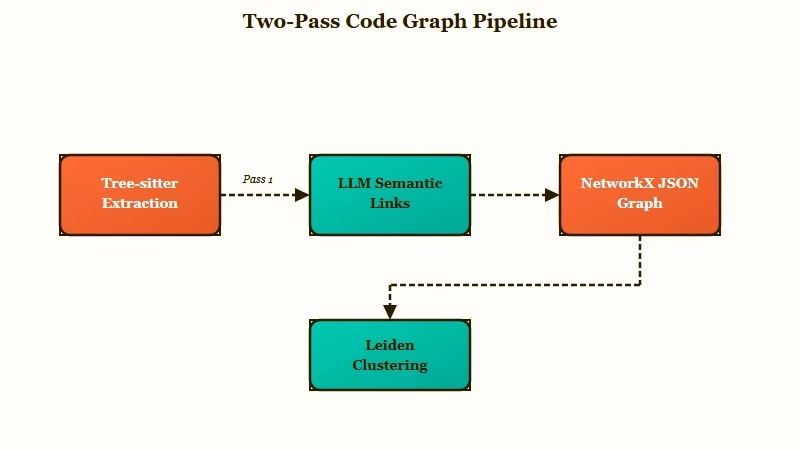
The graph stores as NetworkX-compatible JSON. From what I have seen reading the repo source and the third-party teardowns, the most load-bearing piece is the Leiden clustering step that groups related files into “communities” (e.g. a payment/ cluster across 30 files).
The agent then navigates by structural relationship rather than brute-force grep through every file. The Leiden algorithm itself comes from a 2019 paper in Scientific Reports that fixed several known failure modes in the older Louvain method.
A “smart-grep” PreToolUse hook makes the entire thing automatic from the agent side. When Claude Code is about to call grep or glob, the hook fires first, checks for a local graph, and injects a reminder to consult GRAPH_REPORT.md before the search runs. That is how the token savings land: instead of grepping the whole repo to find the auth flow, the agent reads the structural summary and then targets only the 4 to 6 files in the auth community.
There is a clean parallel to the token-conscious agent patterns in our agent build playbook. Graphify is the codebase-aware version of the same principle: skip the fully autonomous LLM-as-grepper pattern, use a deterministic structural lookup, and let the LLM only judge the result.
How Does the Installation and Setup Work in Practice?
Graphify installs via pip install graphifyy (note the double y in the package name), followed by graphify install to wire the agent integration.
The double-y package name is the single most common installation mistake reported in GitHub issues. The CLI itself remains graphify, only the PyPI distribution name has the extra letter.
The five-step setup is straightforward enough to share verbatim:
- Install the Python package:
pip install graphifyy(orpipx install graphifyyif you prefer isolated installs). - Wire the Claude Code integration:
graphify claude install(this writes the CLAUDE.md directive and registers the PreToolUse hook). - Initialise the graph for the current repo:
/graphify .runs inside Claude Code (or/graphify documents .for multi-modal sources). - Verify the graph wrote a
GRAPH_REPORT.mdand an associated.graphify/directory in the repo root. - Open a Claude Code session in the repo and watch the PreToolUse hook fire on the first grep-style call.
The CLAUDE.md directive itself is a single short paragraph telling the agent: if a knowledge graph exists for this project, consult it first, read GRAPH_REPORT.md for god nodes and community structure before searching raw files. That paragraph is the entire “configuration”, everything else is automatic.
Before: Claude Code on a 500-file repo starts from zero context and pathologically greps through dozens of files trying to find where the auth flow lives. Each search call burns a few hundred to a few thousand input tokens. After ten grep cycles the agent is at 30,000 tokens before writing a line of code.
After: Claude Code consults
GRAPH_REPORT.md, sees theauth/community cluster of 6 files, targets the search there, and lands on the right function in one or two calls. Same answer, roughly 1,700 input tokens versus 123,000 naive on the documented benchmark.
Where Does the 71x Token Savings Claim Come From?
The 71x figure comes from a single specific benchmark on a large monorepo where naive Claude Code consumed about 123,000 tokens for a query Graphify answered in about 1,700.
It is real, but it is the upper bound on a curve that includes much more modest savings for smaller tasks. The honest range across the multiple sources I read sits between 6.8x for code reviews and 49x for daily coding tasks in 500+ file repos.
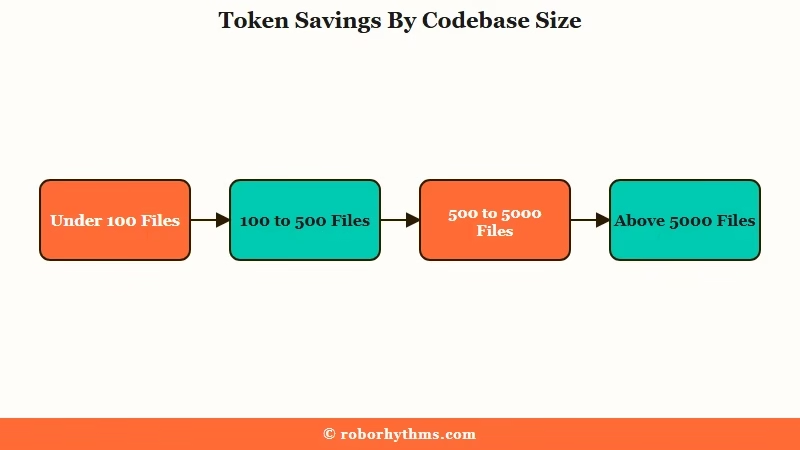
The pattern that matters for an indie operator is the relationship between codebase size and the savings ratio. Under 100 files, Graphify barely helps because naive grep is already fast and cheap.
Between 100 and 500 files, the savings start landing in the 6x to 15x range. Above 500 files in a single project, the savings cross 30x. The 71x number is real but it is the tail of the distribution, not the middle.
| Codebase size | Realistic token savings | Worth installing? |
|---|---|---|
| Under 100 files | 1x to 3x | Probably not, naive grep is already cheap |
| 100 to 500 files | 6x to 15x | Yes, clear win for daily coding |
| 500 to 5,000 files | 30x to 49x | Yes, this is the sweet spot |
| 5,000+ files | Up to 71x, but build times become a problem | Use per-sub-package indexing instead |
The macro framing for why this matters at all is in our Uber AI budget writeup. Engineers on the Claude Code rollout were averaging $500 to $2,000 in monthly token bills, with the CTO himself spending $1,200 in a two-hour personal demo. A 6x token reduction on the modest daily case alone moves a $500 monthly bill toward $80.
What Breaks on Claude Code v2.1.117 and Later?
Issue #578 documents that Claude Code v2.1.117 removed the dedicated Grep and Glob tools and routed search through the Bash tool instead, which silently broke Graphify’s PreToolUse hook.
The original hook matched on tool names “Glob|Grep” and never fires on the new architecture. If you installed Graphify before late May 2026 and recently updated Claude Code, the smart-grep redirection is now a no-op.
The fix is on the maintainer’s roadmap but had not landed when I read the issue thread. The workaround for now is to either pin Claude Code to v2.1.116 or earlier (not great), or to manually consult GRAPH_REPORT.md at the start of each session and skip relying on the hook (still saves tokens, just removes the automation).
A few other limitations to know about before you install:
- The graph is a build-time snapshot. Real-world codebases change daily, and Graphify does not auto-update unless you wire it into a git pre-commit hook. Stale graphs silently degrade.
- Legacy Java codebases produce noisy communities. The Leiden algorithm groups files that share common library calls like Logger, which is technically correct but operationally useless because almost everything imports Logger.
- The
getarchitectureoverview_toolcan return up to 131,000 characters (roughly 33,000 tokens) for large repos, which itself becomes a token budget trap if you call it without limits.
- Path-only output is the default. Unlike
grepyou do not get the matching line numbers without a follow-up call, which is a small friction point during debugging sessions.
The macro context on why every coding-agent tool is suddenly hitting these compatibility cliffs is in our Cursor review, which covers the same vendor-side pressure that is forcing rapid breaking changes across the entire space.
Who Should Install Graphify and Who Should Skip It?
Install Graphify if you run Claude Code on a real codebase (100+ files) and have a monthly token bill above $50. Skip it if you only use Claude Code on small projects, on prototype-stage repos that change hourly, or on legacy Java monoliths where the clustering produces noise instead of structure.
Those three categories cover the cases where the tool genuinely earns its install slot versus where it adds setup overhead for no real win.
The way I would test it in 48 hours is to install on a single mid-sized project (something between 200 and 1,000 files), run a week of normal coding, then compare your Anthropic dashboard token totals against the same week prior. If the daily token bill drops by at least 5x, keep it. If it drops by less than 2x, the project is too small for Graphify to earn its place.
Reddit reactions are sharply split. The endorsers describe it as a “second brain” for managing complex repos and onboarding new projects, with one ADHD-focused user calling it the first agentic tool that gives them durable context across sessions.
The skeptics push back on what they call shady growth tactics around the GitHub star count and missing credit for early PR contributors. Both reads are defensible. The technical quality of the tool stands on its own merits, the community drama is real but does not affect the token savings.
| Pros | Cons |
|---|---|
| Free and MIT-licensed, zero paid tier required | Build-time snapshot goes stale unless wired into git hooks |
| 6x to 49x token reduction in the sweet spot range | PreToolUse hook silently broken on Claude Code v2.1.117+ until patched |
| 40+ language support via Tree-sitter | Legacy Java codebases produce noisy Logger-clustered communities |
| Multi-modal input (SQL, PDFs, images, video) | Path-only output by default, no line numbers |
| God Nodes + Surprising Connections surface structural insights grep cannot | 131k-char architecture overview tool is itself a token trap |
| Active dev (55k stars, 450k downloads in 26 days) | Sharply divided community sentiment on contribution credit |
Frequently Asked Questions
Is Graphify free to use?
Graphify is free and MIT-licensed for the open-source CLI and Claude Code integration. There is no paid tier and no usage cap. Hosted enterprise integrations like the OpenClaw bundle are separate offerings with their own pricing.
Does Graphify work with Cursor or other AI coding tools?
Graphify ships with first-class Claude Code integration and reads the same graph from Cursor, OpenCode, Codex, and Gemini CLI sessions. The PreToolUse hook is Claude Code specific, but the underlying GRAPH_REPORT.md and graph files are tool-agnostic.
What is the exact PyPI package name?
The package is graphifyy with two y’s, not graphify. The CLI command and the GitHub repo use the single-y spelling. The double-y on PyPI is the most common install mistake reported in GitHub issues.
How long does the initial graph build take?
On a 500-file project the initial build typically lands under a minute. On 5,000-file repos the build can run 5 minutes or more, in which case the recommended approach is to index per sub-package rather than the whole monorepo at once.
Does it work on private repos and proprietary code?
The graph is built locally and stored in the repo’s .graphify/ directory. Nothing leaves the machine during the Tree-sitter extraction pass. The optional second-pass LLM enrichment sends source snippets to whatever model you pointed it at (Anthropic, Google, or local), so that step inherits whatever data-handling policy the chosen LLM provider applies.
What is the alternative if I am on Claude Code v2.1.117 and the hook is broken?
Manually consult GRAPH_REPORT.md at the start of each session and reference the relevant community before asking Claude Code to search. You lose the automatic interception but keep most of the token savings because you are still steering the agent to the right cluster instead of letting it grep blind.
Quick Takeaways
- Graphify is free, MIT-licensed, and meaningfully cuts Claude Code token usage on codebases of 100+ files. The 71x headline figure is the upper bound of a 6x to 49x normal range.
- Install via
pip install graphifyy(two y’s) thengraphify claude install. Five minutes end-to-end on a fresh repo.
- The PreToolUse hook is silently broken on Claude Code v2.1.117 and later until the maintainer ships the fix. Manual
GRAPH_REPORT.mdconsultation is the interim workaround.
- The sweet spot is 500 to 5,000 file repos. Skip it under 100 files (naive grep is fine) and use per-sub-package indexing above 5,000 files.
- Pair it with the token-conscious agent patterns piece for the broader operating model: deterministic structural lookups first, LLM judgment only on the result.
