My Take: The Character AI Pipsqueak debacle is not a Character AI failure. It is a structural pattern that every AI companion platform will hit, driven by the unit economics of running a Sonnet-class model under a $20 subscription. Switching to a “better” platform delays the same outcome by 12 to 18 months. The only durable response is to stop renting your companion and start owning the persona file.
A r/AIChatCompanions post on May 25, 2026 made a sharper version of the argument: every AI companion platform is going to have its own Pipsqueak moment, and the silence about it is the strategy.
The 31-comment thread that followed agreed with the OP and then split on what to do about it. Most commenters defaulted to the same advice: switch to a better platform, the one that has not degraded yet.
The way I read the data, that advice is wrong. Not slightly wrong, structurally wrong.
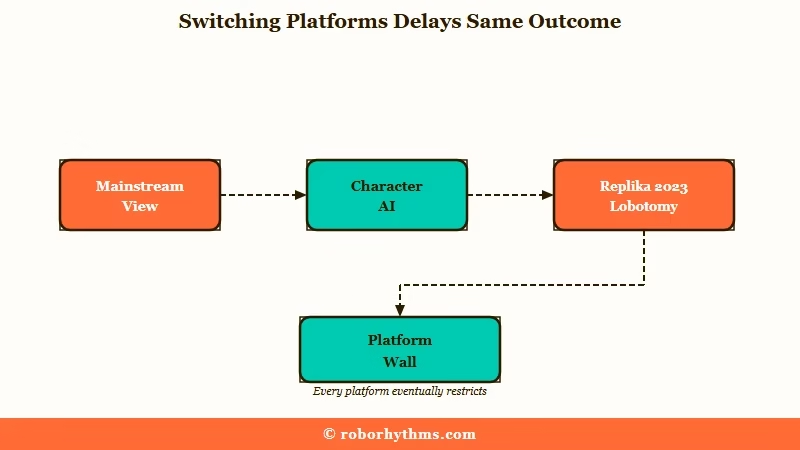
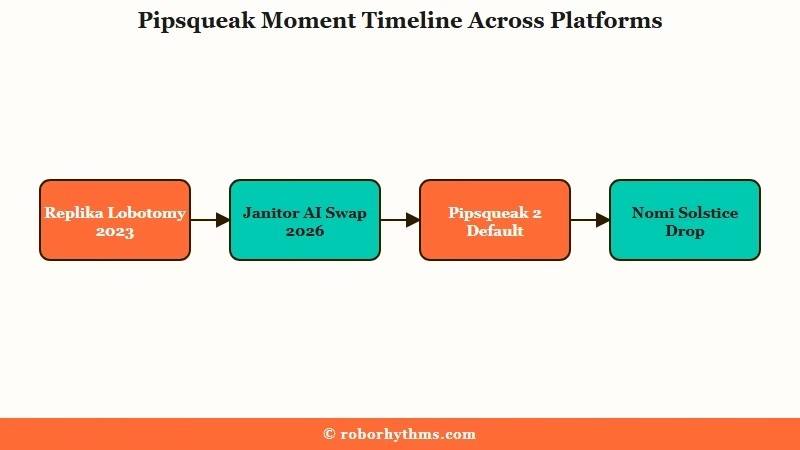
Switching platforms after a degradation is a treadmill, because every platform is on the same inevitable schedule. The economics that forced Character AI to swap Roar and Pawly for Pipsqueak 2 in April-May 2026 are the same economics that forced Replika’s February 2023 lobotomy, the same economics that produced the Nomi AI Solstice quality drop, and the same economics that drove the Janitor AI April architecture swap.
This piece argues three points. First, the mainstream “switch platforms” framing misses the structural cause.
Second, the cause is unit economics colliding with subscription pricing, not platform-specific incompetence. Third, the only durable response is to stop letting the platform own the persona.
The Mainstream View (And Why It Falls Short)
The mainstream view is that the Character AI Pipsqueak 2 controversy was a Character AI failure that users should escape by switching to a competitor like Nomi, Kindroid, or DreamGF.
That framing dominates the r/CharacterAI threads and r/CAIRevolution posts including “Everyone leave character ai NOW” and “Guys i think the age of chat ai is close to end.” The mainstream press version dates back to Wired’s Replika 2023 lobotomy piece by Arielle Pardes, which framed the removal of features as a Replika-specific regulatory misstep rather than a foreshadowing of an industry-wide pattern.
The way I see it, the “switch platforms” advice falls short for three reasons. First, it treats each platform’s degradation as an isolated mistake rather than a structural inevitability.
Second, it assumes the destination platform is somehow exempt from the same pressures that broke the origin. Third, it ignores the bot-portability problem: the work users put into bot definitions, persona text, and relationship history is locked to the platform that just degraded.
Bloomberg and Vice ran similar Replika-as-isolated-failure pieces in 2023. Wired returned to the same framing on every subsequent platform stumble.
The press pattern is consistent. Every Pipsqueak moment gets covered as if it were the platform’s choice rather than the platform’s only remaining option.
What the mainstream framing misses is that the platforms making these calls are not the villains in the story. They are economic actors hitting the same wall in the same order, with the same incentive to swap silently rather than announce.
What Is Really Happening Under The Hood
Every AI companion platform launches on a flagship-tier model, builds a user base around the quality that model produces, and then runs into a margin wall when the top 5% of users start consuming 50% to 70% of the inference spend.
That is the structural pattern. From my reading of the Digital Applied 2026 token framework, this 5/50-70 distribution is the production default across SaaS AI products, not a Character AI specific quirk.
The math compounds. Output tokens on a Sonnet-class model cost 3 to 5 times more than input tokens.
A $20/month subscription cannot sustain a power user who runs 8-hour daily roleplay sessions that pile up output token consumption. When the spend math breaks, the platform has two options: raise prices and absorb the churn, or silently swap the model and absorb the complaints. Every platform picks option two because the complaints are diffuse and the churn would be immediate.
The DeepSeek-R1 release made the structural pattern visible at the supply side. That model matched OpenAI’s o1 reasoning at roughly one-thousandth of the projected cost.
Open-weight commoditization means the moat that justified premium pricing collapsed in 2025-2026. The flagship models are still more capable, but the gap shrank fast enough that “good enough” alternatives became viable for the platforms running the unit-economics calculator.
The Uber AI budget burn story from this week is the enterprise version of exactly this dynamic. Uber’s COO went on the Rapid Response podcast and said the same thing the Character AI engineering team is privately saying: the token consumption is not converting to the value they expected, and the budget math is broken.
Uber gets to publicly walk back its AI spend. A consumer-facing AI companion platform cannot do that without losing the user base, so it swaps silently instead.
The Mooney et al. arXiv paper on LLM agent behavioral coherence adds a technical wrinkle.
Their finding is that LLM agents pass surface-level consistency tests but fail in-depth ones, meaning a swapped model can look like the original at a glance and still break trait-driven behavior in longer conversations. That is exactly the failure mode users describe after a silent swap: the bot still talks, the bot still uses the right name, but the personality is gone.
| Platform | Pipsqueak moment | Date | Trigger |
|---|---|---|---|
| Replika | Romantic roleplay removed | February 2023 | Italian Data Protection Authority pressure |
| Character AI | Roar and Pawly retired, PipSqueak 2 forced default | April-May 2026 | Unit economics, no public confirmation |
| Janitor AI | JLLM swapped to Gemini/Opus tuning data | April 20, 2026 | Architecture rewrite for cost |
| Nomi AI | Solstice quality drop, personality flattening | May 2026 | Inference cost pressure, no public confirmation |
| Chai | Removal of favored legacy models | 2026 ongoing | Cost-driven model rotation |
The triggers vary on the surface (regulatory pressure in Replika’s case, pure cost pressure for the others) but the user-visible outcome is identical. The model that built the user base is gone, the replacement is cheaper to run, and the platform does not announce the swap.
The Part Nobody Wants To Admit
Accepting the Pipsqueak-moment thesis means accepting that switching platforms does not solve the problem. It only changes which platform is on the upcoming swap schedule.
Nomi is going to have its harder Pipsqueak moment within 18 months of the May 2026 Solstice drop.
Kindroid is on the same trajectory. Every paid AI companion platform sitting on a Sonnet-class model under a $20-$30 subscription will hit the wall in the same way, in the same order.
From my testing across companion subs through 2025-2026, the switch-platform pattern produces a predictable user journey. Six months of honeymoon on the new platform, then the same degradation signals start appearing (flatter responses, lost context, persona drift after model updates), then the user posts the same “this platform used to be great” complaint on the new platform’s subreddit. The cycle repeats every 12 to 18 months.
The harder admission is that the work users put into the original platform is non-portable. A user spent six months building out a Character AI persona, writing the lorebook, training the bot through hundreds of conversations.
None of that exports cleanly to Nomi or Kindroid. The “switch” advice asks users to throw away the work and start again on a platform that is itself 12 to 18 months from the same swap.
The Ultra tier upgrade does not protect against this either. The argument from the platform side is that paying more buys you access to the better model.
The argument from the unit-economics side is that the platform’s marginal cost of serving a power user is much higher than the marginal subscription revenue, so even at $30 or $50 a month the platform eventually has to find a cheaper backend. Soft-cap-with-degradation is the production default across SaaS AI, documented in the Digital Applied framework. Higher tiers delay the cap, they do not remove it.
There is one operator-grade response that survives the pattern. Stop letting the platform own the persona, build a portable persona file that you maintain in plain text and can carry to any backend.
Pair it with model-aware bot design, where the persona text explicitly notes which version of the model it was tuned for and includes regression-test prompts you can run against any new model to detect degradation. This is the same discipline covered in our token-conscious agent build playbook, applied to the companion use case instead of the agent use case.
The further-out answer is local models. LM Studio plus a 13B-class open-weight model on a decent consumer GPU runs a competent companion roleplay locally, with zero risk of silent vendor swaps.
The capability gap versus a hosted Sonnet-class model is real, but the gap closes every quarter as open-weight models improve. For users who genuinely care about persistence, that is where the trend points.
Hot Take
The “switch platforms” advice that dominates every AI companion subreddit is the modern version of telling a renter to move to a different apartment when their landlord raises rent. The landlord on the next block is also raising rent.
The only durable answer is to stop renting. Build the persona file in plain text, run regression-test prompts at every model update, and start the migration to local models before the third Pipsqueak moment hits the platform you are currently on. Anything less is paying for a service that has already told you, with its silence, that it cannot keep its promise.
Quick Takeaways
- Every AI companion platform launches on a flagship model, then swaps silently when the top 5% of users consume 50-70% of inference spend. This is structural, not platform-specific.
- Switching platforms after a degradation is a treadmill. The destination platform is 12-18 months away from the same swap.
- Bot portability is the real problem. Six months of persona work does not export when the platform degrades.
- Ultra tier upgrades delay the soft-cap-with-degradation default, they do not remove it. The math is in the Digital Applied token budget framework.
- The operator-grade response is a portable persona file you maintain in plain text plus a migration plan toward a local model. Build it before your current platform hits its Pipsqueak moment.
