
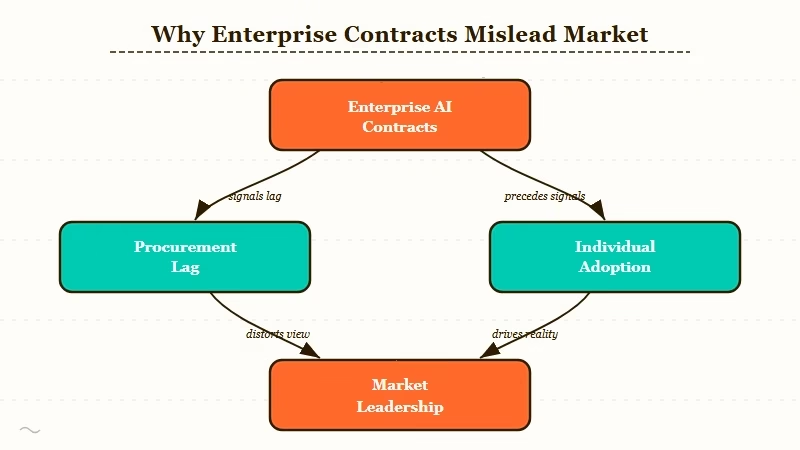
My Take: Enterprise AI contracts are lagging indicators of market interest. By the time a procurement committee signs a multi-year AI deal, the actual winning tools have already formed habits with individuals. Everyone celebrating the enterprise AI revenue race is watching the wrong race.
The AI industry spent April 2026 applauding Anthropic’s $30 billion ARR milestone and the enterprise contract surge that drove it. I understand the appeal of that narrative. Big numbers from brand-name enterprise clients make compelling headlines.
But I keep coming back to the same question: when did enterprise procurement committees become a reliable signal of where technology goes?
The answer is they never were. And the AI industry’s infatuation with enterprise ARR is setting up a lot of builders for a rude correction.

The Mainstream View (And Why It Falls Short)
The mainstream view is that enterprise AI is the dominant commercial opportunity in 2026, and the evidence is growing ARR numbers from Anthropic, OpenAI, and their enterprise-focused competitors.
The argument is coherent on its face. A16z’s State of AI report for 2025 argued that enterprise contracts represent “the primary monetization path for foundation model providers” and that consumer AI adoption, while visible, has a “fundamentally different unit economics profile.”
The report pointed to higher retention, lower churn, and multi-year commitments as evidence that enterprise was the real prize.
This view now dominates boardroom conversations, VC pitches, and the trade press. When Anthropic’s $30B ARR landed, the celebration was universal.
The flaw in this view is not in the revenue numbers. Those are real. The flaw is in confusing revenue at a given moment with durable competitive position over time.
Enterprise procurement does not reflect what tools people genuinely use. It reflects what tools IT departments approved in the previous procurement cycle.
The median time from a technology becoming genuinely useful to it appearing in a Fortune 500 procurement contract is roughly 18-24 months.
By the time a 1,000-person enterprise signs a multi-year Claude API contract, the individual developers in that same organization have already been using Cursor, Claude Code, and n8n for a year.
What Is Really Happening
The tools building genuine competitive moats in 2026 are the ones that formed daily habits with individual users first. Enterprise adoption is following, not leading.
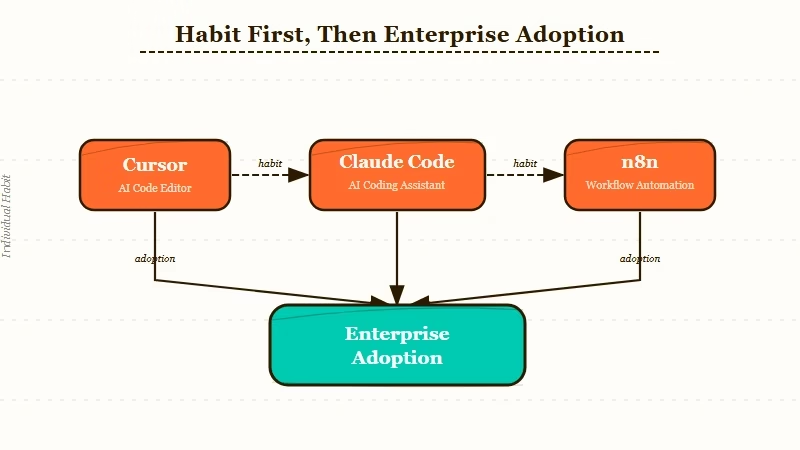
Here is what I’ve seen in the actual adoption patterns of AI tools over the past two years. The tools that broke through were never enterprise-first:
- Cursor became the dominant AI coding tool by capturing individual developers who used it on their own machines and brought it into work. Enterprise licenses followed after the habit was formed.
- Claude Code (including the version running this workflow) gained its foothold with solo builders and technical founders before enterprise developers started asking IT to procure it.
- n8n reached 50,000+ GitHub stars from individual builders running self-hosted automations before enterprise teams started standardizing on it for internal AI pipelines. We covered the n8n vs Make.com comparison earlier today. The tools winning that comparison are winning because individuals chose them first.
The enterprise contracts are not evidence that enterprise AI is the real market. They are evidence that individual adoption already happened and procurement eventually caught up.
This matters because it inverts the product strategy most founders and teams are running. If you build for the CTO buying cycle, you build for a long sales process, compliance requirements, and security reviews.
If you build for the developer who adopts on their own machine tonight, you build for habit, delight, and genuine problem-solving.
The second group is where the real compounding happens.
The Part Nobody Wants to Admit
Enterprise AI ARR is fragile in a way that individual habit-based adoption is not, and the fragility is structural, not cyclical.
Enterprise contracts renew at the discretion of procurement committees, not the people who use the product daily. I’ve seen this pattern destroy promising enterprise software companies: a platform becomes indispensable to the users inside a company but gets cut in a budget cycle by a CFO who never touched it.
Individual adoption does not work like this. Once someone uses Cursor or Claude to write code every day for three months, the switching cost is personal, not contractual.
What this means for the current AI market is uncomfortable: Anthropic’s 1,000+ enterprise clients at $1M+ annual spend represent a concentrated revenue base that is one budget cycle or one transformative GPT-5 release away from repricing. The individual developers who formed Cursor habits are not going anywhere.
I’d also argue that the compounding failure modes of AI agents in production hit enterprise deployments harder than individual deployments.
When an AI workflow fails for an individual developer, they fix it in 20 minutes. When the same failure hits an enterprise deployment with IT approval requirements and change management processes, it sits for weeks.
Enterprise AI contracts create organizational debt that individual tools do not.
The part nobody wants to admit is that the AI companies celebrating enterprise ARR today may be building the most fragile revenue bases in tech history: large contracts, concentrated buyers, and zero individual habit formation anchoring any of it.
Hot Take
Enterprise AI is not a business. It is a bridge loan. The companies that will own AI in 2030 are the ones that individual developers, creators, and solopreneurs are choosing today with their own credit cards.
