What Happened: A nine-member advisory jury in Oakland rejected Elon Musk’s lawsuit against OpenAI in under two hours on May 18, 2026, ruling he filed his charitable-trust claims past the three-year statute of limitations. Judge Yvonne Gonzalez Rogers immediately adopted the verdict as her own. Musk has committed to a Ninth Circuit appeal.
As of May 19, 2026, the Musk vs OpenAI verdict is the most discussed AI story of the week. It deserves more than the “Musk lost on a technicality” framing that is making the rounds.
The jury took 90 minutes. Three weeks of trial testimony from Sam Altman, Greg Brockman, Satya Nadella, and Musk himself. Ninety minutes to deliberate.
That ratio alone tells you the jurors did not see this as a close call, even if Musk’s team is selling it that way on the post-verdict press tour. This piece walks through what the verdict held and the part Musk is leaving out when he calls it a “calendar technicality.”
The framing also matters for what comes next. If you use ChatGPT or follow OpenAI’s restructuring saga, the downstream effects matter more than the courtroom drama.
What Happened in the Oakland Courtroom
The Musk vs OpenAI verdict is a substantive defeat dressed as a procedural one.
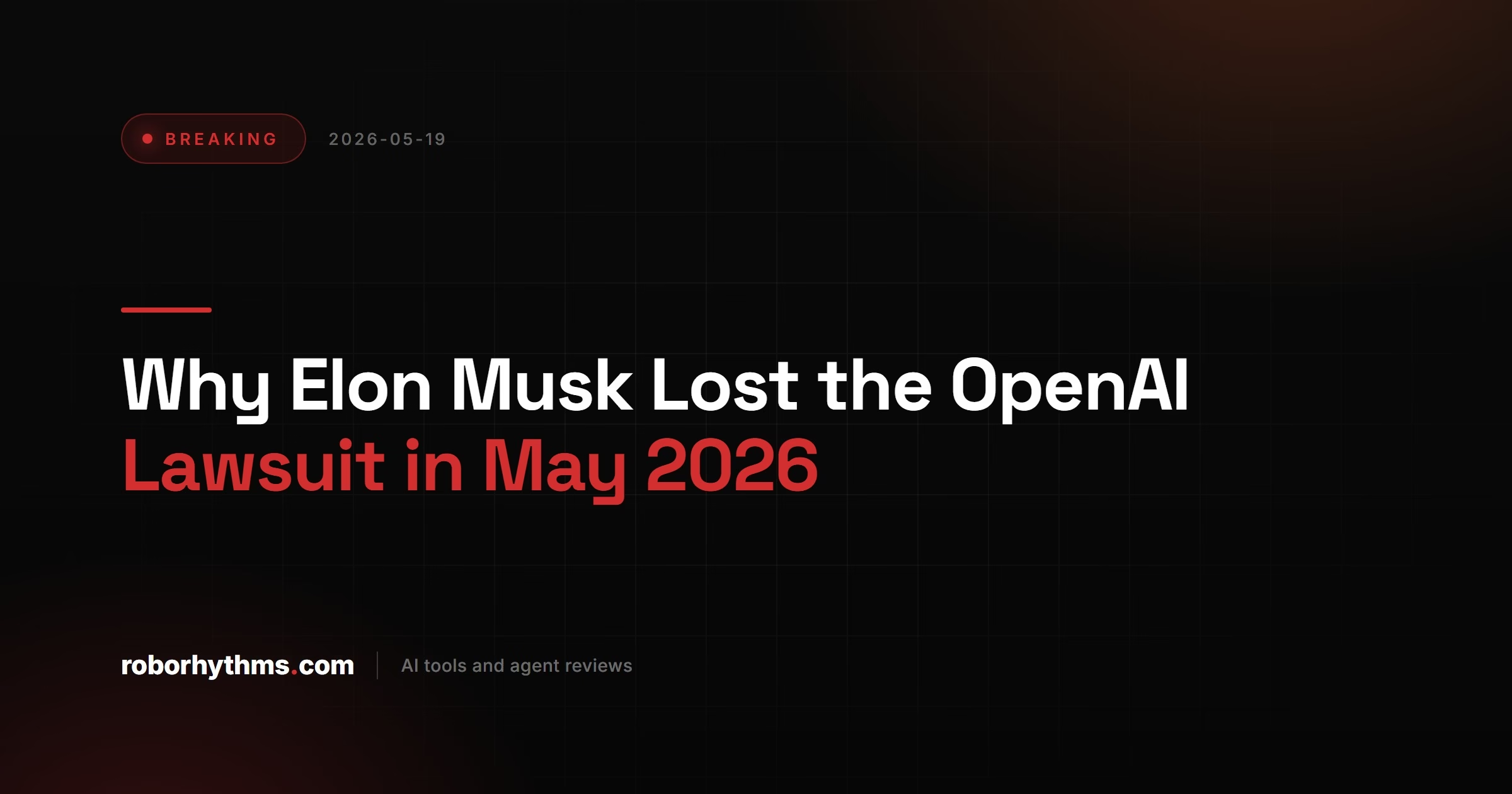
A federal jury found Musk’s lawsuit time-barred under California’s three-year statute of limitations, dismissing every claim against Sam Altman, Greg Brockman, OpenAI, and Microsoft.
The jury began deliberating at 8:30 a.m. on Monday, May 18, 2026, at the U.S. District Court for the Northern District of California. They returned by 10:23 a.m., per NPR’s verdict coverage.
Less than two hours after a three-week trial that featured testimony from the biggest names in the AI industry.
What is an advisory jury: A non-binding jury whose findings the trial judge can adopt or reject. In federal equity cases there is no constitutional right to a jury, so the judge uses one only as a guide.
Judge Yvonne Gonzalez Rogers did not reject. She adopted the nine-member panel’s findings as her own ruling within hours.
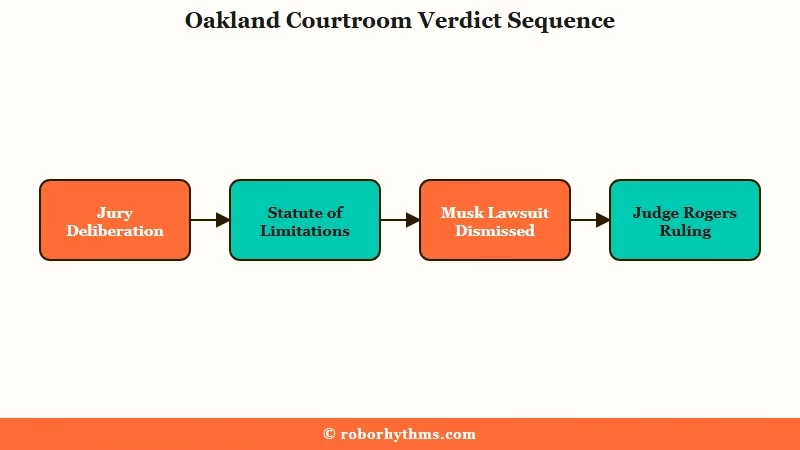
Musk had sought up to $180 billion in disgorgement, asking the court to force OpenAI and Microsoft to dump their profits into the original nonprofit foundation. All of that is gone.
From what I have seen in coverage of similar nonprofit-to-for-profit disputes, that disgorgement claim was always the most ambitious piece of the suit. It was also the most likely to scare off late-stage investors before today.
The dismissed claims include breach of charitable trust, unjust enrichment, and Microsoft aiding and abetting the alleged breach. Musk’s attorney Marc Toberoff told reporters the team plans to appeal to the Ninth Circuit. OpenAI’s lead trial lawyer William Savitt called the suit a “hypocritical attempt to sabotage a competitor” in MIT Technology Review’s coverage.
Why This Is a Bigger Deal Than the Press Release Suggests
The verdict reshapes three things at once. OpenAI’s restructuring path, xAI’s market positioning, and the legal precedent for AI founders pivoting from nonprofits to for-profits all shift today.
OpenAI was already racing toward a public-market valuation north of $850 billion, per March 2026 reporting. The $180 billion disgorgement claim was the single biggest overhang on that path.
With it gone, the way I see it the IPO timeline accelerates by quarters, not years. Investors who were waiting for legal certainty no longer have a reason to wait.
xAI sits in a strange spot. Musk’s company recently merged with SpaceX into a $1.25 trillion combined entity, and its public positioning leaned heavily on the “we are the real open-mission AI lab” framing that this lawsuit was designed to validate.
The verdict undercuts that pitch. The legal record now shows that Musk himself proposed folding OpenAI into Tesla as a for-profit before he left the board in 2018.
That is not a footnote. It is the central reason the court found no charitable trust to enforce in the first place.
For the broader Silicon Valley AI-founder-feud genre, the ruling sets a quiet precedent. The verdict implicitly tells future donors to nonprofit AI labs that “unrestricted donations” mean exactly that.
Anthropic, Mistral, and other labs structured around stated missions are watching this. From my read, the talent-recruitment narrative for mission-driven AI labs gets weaker after today, not stronger.
What This Verdict Means for ChatGPT Users
For ChatGPT and Microsoft Copilot users, the practical consequence is fewer constraints on OpenAI’s commercial roadmap. That cuts both ways, and you should care about which direction.
OpenAI no longer has a $180 billion existential threat looming over every product decision. That removes a quiet brake on aggressive monetization, paid-only features, and the final dropping of “Open” from any meaningful product behavior.
If you have been wondering when the cheaper tiers might shrink or the free tier might tighten further, the legal cover for those decisions is now stronger. The same competitive pressure is visible in Anthropic’s Claude Cowork for small business.
The flip side is product velocity. With the lawsuit overhang gone, OpenAI can commit to roadmap items that previously had to be hedged.
I would expect the GPT-5.6 release window to firm up, agentic features to push past their current preview status, and enterprise contracts to move faster. The pattern I would watch is whether the next twelve months bring more aggressive pricing on the consumer side and more capability on the enterprise side.
That is the natural shape of a company that just shed its biggest legal risk.
Microsoft sits in the most comfortable seat of any defendant. The court tossed every claim against it without serious resistance.
What I would not miss in this story is that Microsoft is now functionally untouchable as an OpenAI partner under the current legal theory. Other Big Tech sponsors watching from the sidelines, Google with Anthropic and Amazon with Anthropic plus its own bets, just got a clearer signal that strategic investment in mission-driven AI labs is not the legal land mine some early commentators feared.
| Practical impact | What changes for you | Timeline to watch |
|---|---|---|
| OpenAI pricing | Higher floor on consumer tiers, more enterprise gates | Next 6 months |
| Product velocity | Faster GPT-5.6 and agentic rollouts | 2026 H2 |
| xAI competitive pitch | Weakened “we are the real Open AI” framing | Immediate |
| Microsoft partnership | Locked in, larger Azure-OpenAI integrations | Ongoing |
| Anthropic and others | Slightly weaker mission-lock narrative, stronger commercial freedom | 12 to 18 months |
Here is a quick worked example for ChatGPT users who want to think through what this changes:
Before the verdict: “OpenAI might dial back the free tier soon to manage costs.” That was already happening, but every decision had to factor in a $180 billion legal threat that demanded the company look mission-aligned and restrained.
After the verdict: “OpenAI will dial back the free tier on its own commercial schedule.” The mission-alignment optics constraint is much weaker, so the decision happens when the unit economics say it should, not when the litigation calendar permits.
The broader competitive context shows up in two recent stories worth reading: Claude overtakes ChatGPT in business and Anthropic surpassing OpenAI’s valuation. The lawsuit was the last legal brake on OpenAI’s response to those pressures.
What Comes Next at the Ninth Circuit
Musk’s appeal goes to the Ninth Circuit Court of Appeals, and the statute of limitations question is harder to overturn than his “technicality” framing suggests.
This is where I would temper any expectation that the verdict gets undone.
California’s three-year statute of limitations on breach of charitable trust claims is well-established. The legal question on appeal is when Musk’s “discovery” of the alleged breach occurred.
The defense argued, and the jury agreed, that Musk knew about OpenAI’s for-profit pivot in 2019 at the latest, since Microsoft’s first major investment was public. Musk filed in February 2024.
Five years past the trigger. The appeal will have to argue the trigger was later, and the trial record makes that argument hard.
The decade-old Altman ouster fight is the long-running backdrop to this case.
Musk’s quote is worth quoting because it shows the contradiction. He told the press, per CNBC’s verdict report, “There is no question that Altman and Brockman did in fact enrich themselves by stealing a charity. The only question is WHEN they did it.”
That second sentence is the problem. If Musk thinks they enriched themselves at all, he had to sue within three years of when he reasonably should have known. By his own framing, he knew.
From what I have seen in similar charitable-trust appeals, that admission alone makes the Ninth Circuit a steep climb.
What is the Ninth Circuit: The U.S. Court of Appeals for the Ninth Circuit, headquartered in San Francisco, reviews federal district court decisions from California and eight other Western states. It is the largest federal appellate court in the country.
Here are the four factors I would watch as the appeal moves forward:
- Oral-argument scheduling. Expect 12 to 18 months out from May 2026, which puts arguments in mid-to-late 2027.
- Substantive vs procedural ruling. If the Ninth Circuit upholds on statute-of-limitations grounds alone, no precedent shifts for future nonprofit-to-for-profit pivots.
- Remand scenario. If the court reverses on the merits, the case returns to trial in 2027 or 2028 and the legal overhang returns with it.
- Mootness. By the time the appeal is decided, OpenAI may already be public and the for-profit conversion may be complete. The relief Musk sought may be moot regardless of who wins on paper.
The smart money I am watching from court-watchers and AI-policy analysts puts the upholding probability above 70 percent.
For builders and operators, my take is treat this verdict as final for planning purposes. The appeal will run, headlines will surface, and Musk’s X feed will continue.
Strategically, OpenAI’s competitive constraints are now what they look like today, not what they might revert to in three years. The Musk vs OpenAI verdict was never just about charity. It was about who controls the narrative of which AI lab has the legitimate mission, and the consolation prize for the rest of the industry is a clearer commercial path with one fewer billionaire-lawsuit overhang.
