
Quick Answer: ElevenLabs is the best AI text-to-speech tool available in 2026 if voice quality is your primary requirement. The free tier exists but cannot be used commercially. Paid plans start at $5/month and unlock voice cloning, commercial rights, and access to 29 languages. This review covers pricing, voice cloning quality, realistic use-case limitations, and who should pay for it.
ElevenLabs has become the default answer when someone asks which AI voice tool actually sounds human. I’ve used it across narration projects, YouTube scripts, and client voice-over work, and the quality gap between ElevenLabs and most competitors is real and obvious.
The voices don’t have that synthetic hitch you hear in cheaper tools.
The part most reviews skip: the free tier prohibits commercial use. You can test the voices, you can hear what Professional Voice Cloning sounds like, but you cannot ship any of that audio in a product, video, or client deliverable until you’re on a paid plan.
That changes the value calculation significantly.
This ElevenLabs review covers what I’ve found across the main use cases, where it earns the subscription cost, and where the pricing model creates friction you’ll want to know about before signing up.
What Is ElevenLabs and How Does It Work
ElevenLabs is an AI voice platform that converts text into synthetic speech using deep learning models trained on thousands of hours of human voice recordings, producing output that rivals professional voice actors in quality and naturalness.
The platform serves three distinct user groups. Content creators use it to narrate videos, podcasts, and audiobooks without hiring talent. Developers integrate it via API to power voice interfaces, customer service agents, and accessibility features.
Enterprises license it for dubbing and localization workflows across 29 languages.
The core technology is a speech synthesis model that handles intonation, pacing, emotional tone, and pronunciation in ways older text-to-speech systems do not. When you type a sentence, it does not produce flat robotic audio. It interprets the phrasing and delivers something close to how a human would actually read it.
Two distinct voice cloning modes exist: Instant Voice Cloning (IVC) requires just a short audio sample and produces a usable voice in minutes.
Professional Voice Cloning (PVC), available from the Creator tier, uses longer recordings and produces a voice that is genuinely difficult to distinguish from the original speaker.
What is Professional Voice Cloning: A high-fidelity voice replication method that uses extended audio samples to train a personal voice model, producing output indistinguishable from the original speaker in controlled conditions.
ElevenLabs Pricing and Plans in 2026
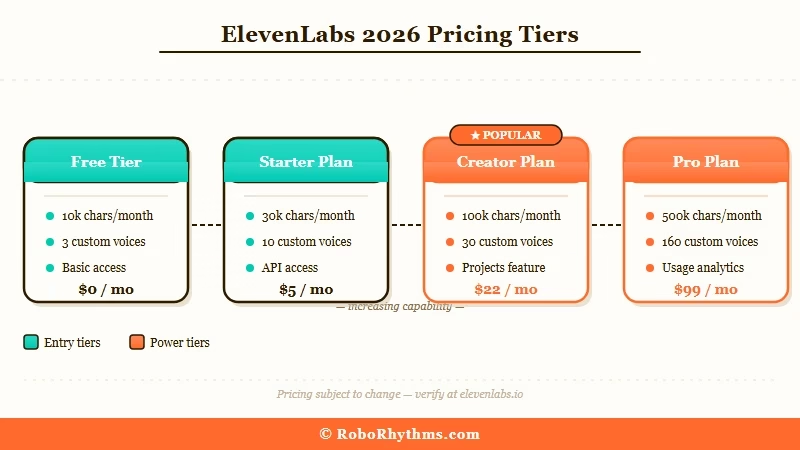
ElevenLabs pricing in 2026 starts at $0 for a testing-only free tier and scales through six tiers to an enterprise contract, with annual billing offering two free months across all paid plans.
Here is how I’d think about which tier you actually need:
| Plan | Price | Characters/Month | Key Unlock |
|---|---|---|---|
| Free | $0 | 10,000 | Testing only, no commercial rights |
| Starter | $5/month | 30,000 | Commercial rights, Instant Voice Cloning |
| Creator | $22/month | 100,000 | Professional Voice Cloning, higher quality models |
| Pro | $99/month | 500,000 | Priority processing, API access at volume |
| Scale | $330/month | 2,000,000 | Agency and high-volume production use |
The character limit is where most people miscalculate. A 10-minute narration script runs roughly 12,000 to 14,000 characters. The Starter plan’s 30k monthly allowance covers about two to three videos, fine for a light workflow, not enough for daily production.
Most working creators land on Creator ($22/mo) once they understand the volume math.
One thing worth knowing: annual plans include two free months. On Creator, that cuts the effective monthly cost from $22 to roughly $18. If you’re planning to stay, commit to annual.
Voice Cloning Quality
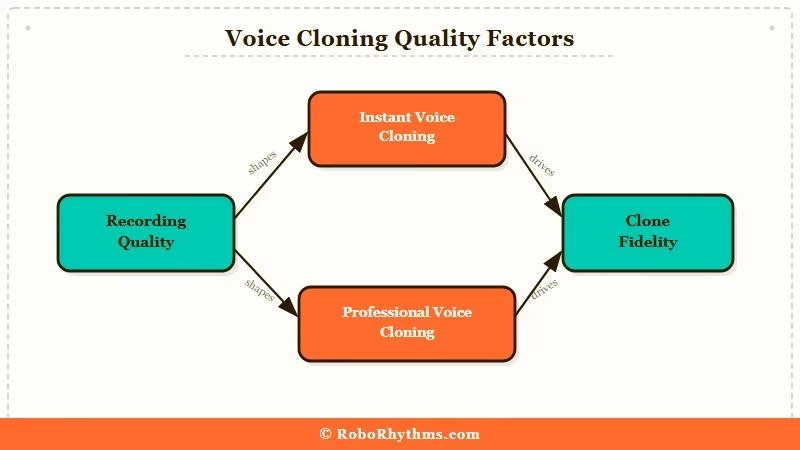
ElevenLabs’ voice cloning produces the most natural-sounding AI voice replicas available in 2026, with Professional Voice Cloning at Creator tier delivering results that are indistinguishable from the source recording in most listening tests.
From my testing, Instant Voice Cloning (IVC) with a 60-second sample produces something usable but imperfect. You’ll hear the voice, but phrasing that the original speaker would handle with natural variation can come out slightly flat.
For internal use or rough cuts, IVC is fine.
Professional Voice Cloning with longer recordings is a different output. The model captures cadence, emphasis patterns, and breathing habits that IVC misses. I ran a 10-minute recording through PVC and the resulting voice handled novel sentences with the intonation I’d expect from the original speaker.
That level of fidelity is what puts ElevenLabs in a different category from competitors.
The practical workflow looks like this:
- Record a clean audio sample (minimum 1 minute for IVC, 10+ minutes for PVC)
- Upload to ElevenLabs’ Voice Lab under your account
- Name the voice and select quality settings
- Generate output from the Voices tab, your cloned voice appears alongside the platform library
The input quality matters more than most guides acknowledge. Background noise, inconsistent volume, and compression artifacts all degrade the clone.
Record in a quiet room on a decent microphone and the output will be noticeably better than the same script recorded on a laptop mic.
Text-to-Speech Performance
ElevenLabs’ text-to-speech output sits at the top of the AI voice market for naturalness and pronunciation accuracy, with 29 supported languages and adjustable stability and similarity controls for fine-tuning delivery.
The library voices, the ones available to all paid users without cloning, are genuinely good.
I use “Rachel” and “Bella” for most narration work because they handle pacing variation well and don’t have the synthetic mid-sentence pause some other models produce.
What works well versus what doesn’t:
Strong performance:
- Long-form narration with natural paragraph flow
- Emotional variance in conversational scripts
- Technical vocabulary and proper nouns in English
- Multilingual dubbing for European languages
Weaker areas:
- Inconsistent pronunciation of uncommon proper nouns (tool names, brand names, regional spellings)
- Emotional extremes, very excited or very distressed delivery sounds less convincing
- Non-Latin scripts and Southeast Asian languages lag behind English quality
The controls matter for getting the best output. The stability slider determines how consistent the voice stays across the clip; lower stability adds variation but can become unstable.
Similarity controls how closely the output matches the original voice sample. From my testing, stability around 0.7 and similarity around 0.8 hits the sweet spot for most use cases.
ElevenLabs Pros and Cons
ElevenLabs’ main strengths are unmatched voice quality and Professional Voice Cloning. Its main weaknesses are the no-commercial-use restriction on free tier and the cost jump once you hit high character volumes.
Pros:
- Best-in-class voice naturalness. No other mainstream TTS tool produces output this close to human speech consistently.
- Professional Voice Cloning is genuinely impressive. At Creator and above, you can clone a voice that passes casual listening tests.
- 29 languages supported. European language quality is strong; good for localization workflows.
- Strong API with good documentation. Developer experience is solid and SDKs are available for major languages.
- Sound effects and music generation built in. The platform extends beyond TTS into audio production tools.
- Annual plans include two free months. Effective cost is meaningfully lower on annual billing.
Cons:
- Free tier is testing-only. No commercial rights means the free plan is a demo, not a usable product.
- Expensive at scale. $330/month for 2M characters prices out solo creators who need volume.
- Character limits require planning. Running out mid-project means an overage charge or waiting for the month to reset.
- Non-English language quality is uneven. Southeast Asian and complex script languages fall noticeably behind the English output.
- Voice cloning quality depends heavily on input. Poor-quality recordings produce poor-quality clones, which is a real barrier for users without recording setups.
- No built-in script editor. You paste text into a plain field, no formatting tools, no batch processing on lower tiers.
Who Should Use ElevenLabs and Who Should Skip It
ElevenLabs is the right choice for content creators, developers, and agencies where voice quality is a differentiator and who produce enough audio to justify the character limits.
This platform makes sense if:
- You produce YouTube content, podcasts, or audiobooks and need narration that doesn’t sound AI-generated
- You’re building a product with voice output and need API access to high-quality TTS
- You want to clone your own voice for content at scale
- Multilingual dubbing is part of your workflow
Skip it if:
- You only need occasional voice-overs and cannot justify $5+/month for a low-volume workflow
- You need real-time conversational voice (ElevenLabs is not optimized for sub-100ms response latency)
- Your primary language is a lower-priority language for the platform (quality varies significantly)
- You expected the free tier to cover client work (it cannot be used commercially)
For developers building voice-powered AI agents into automation workflows, pairing ElevenLabs with Make.com for the trigger layer lets you run voice generation on a schedule or event-based conditions without writing orchestration code.
Verdict
ElevenLabs earns 8.5 out of 10. The voice quality is the best available at any price point in 2026, and Professional Voice Cloning at $22/month is genuinely impressive value if you use it.
Those two things justify the subscription for anyone who produces audio content regularly.
What holds it back from a higher score is the pricing cliff and the no-commercial-rights restriction on free. The free tier is a demo, not a free plan. And the jump from Creator to Pro ($22 to $99) is steep enough that heavy users face a difficult tier decision.
The honest recommendation: start on Creator at $22/month. It covers most production use cases and the character limit is workable. Go annual for the two free months.
| Criterion | Score |
|---|---|
| Voice naturalness | 9.5/10 |
| Voice cloning quality | 9/10 |
| Language support | 8/10 |
| Pricing and value | 7.5/10 |
| API and developer experience | 8.5/10 |
| Free tier usefulness | 4/10 |
| Overall | 8.5/10 |
Frequently Asked Questions
Is ElevenLabs free to use?
ElevenLabs has a free tier with 10,000 characters per month and up to 3 custom voices. The critical limit: free plan audio cannot be used for commercial purposes. If you plan to use the output in videos, products, or client work, you need the Starter plan at $5/month minimum.
How much does ElevenLabs cost in 2026?
Starter is $5/month (30k chars), Creator is $22/month (100k chars, Professional Voice Cloning), Pro is $99/month (500k chars), and Scale is $330/month (2M chars). Annual plans include two free months on all tiers.
How good is ElevenLabs voice cloning?
Instant Voice Cloning (Starter and above) produces a usable clone from a 60-second sample. Professional Voice Cloning (Creator and above) requires longer recordings but produces output that passes casual listening tests. Input audio quality significantly affects clone quality.
What languages does ElevenLabs support?
ElevenLabs supports 29 languages as of 2026. English, Spanish, French, German, and other major European languages deliver the highest quality. Southeast Asian and complex script languages are supported but quality is noticeably lower.
Can I use ElevenLabs for commercial projects?
Yes, but only on paid plans. The free tier explicitly prohibits commercial use and requires attribution. Starter ($5/month) and above include full commercial rights.
What is the difference between Instant and Professional Voice Cloning?
Instant Voice Cloning works from a short sample (1+ minute) and is available from Starter. Professional Voice Cloning requires longer recordings (10+ minutes) and is available from Creator tier. PVC produces significantly more natural output, especially on novel phrasing the original speaker did not record.
