
Bottom Line: DreamGen is one of the most capable AI roleplay platforms available right now, especially for writers who want persistent lore, multi-character scenes, and real control over narrative direction. It has a real learning curve and context drift is a known issue on longer sessions. If you want tap-and-chat simplicity, this is not your app. If you want a platform that rewards real creative investment, DreamGen is worth trying.
DreamGen has been getting a lot of attention in the roleplay AI space in 2026, and from what I’ve seen, the praise is mostly earned. It sits in an interesting position between Character AI’s guardrails and NovelAI’s technical demands.
The core pitch is this: drop in your world lore, your characters, your plot rules, and DreamGen will thread all of it through every scene consistently. It calls itself a narrative partner, not just a chatbot. That framing is accurate.
This review covers how it performs in practice, where it falls short, and whether the $7.83 to $48.30 monthly cost is justified depending on how you use it.
What Is DreamGen and Who Is It For?
What is DreamGen: An AI-powered creative writing and roleplay platform that lets users build scenario codexes, run multi-character scenes, and steer narrative direction. It is aimed at writers and roleplay enthusiasts.
DreamGen is a narrative-first AI platform designed for structured storytelling, not casual conversation.
It launched in 2025 and has steadily built a community around its core differentiator: the Scenario Codex. Before you start writing, you define the plot, the setting, the tone, character relationships, and hidden lore. DreamGen carries all of that forward into every scene, without you having to re-explain it each time.
From what I’ve seen, the people who get the most out of DreamGen treat it like pre-production on a story. They spend time building their world before they start writing. If you skip that step and jump straight into a scene, the output feels generic.
Who should skip it: anyone looking for a quick, light chat companion or a simple AI girlfriend app. Those use cases are better served by something like Candy AI, which handles casual conversation and memory without needing setup. DreamGen is for people who want creative control over a narrative arc.
What Features Make DreamGen Different?
DreamGen’s standout features are the Steering system, the Scenario Codex, and its two distinct writing modes.
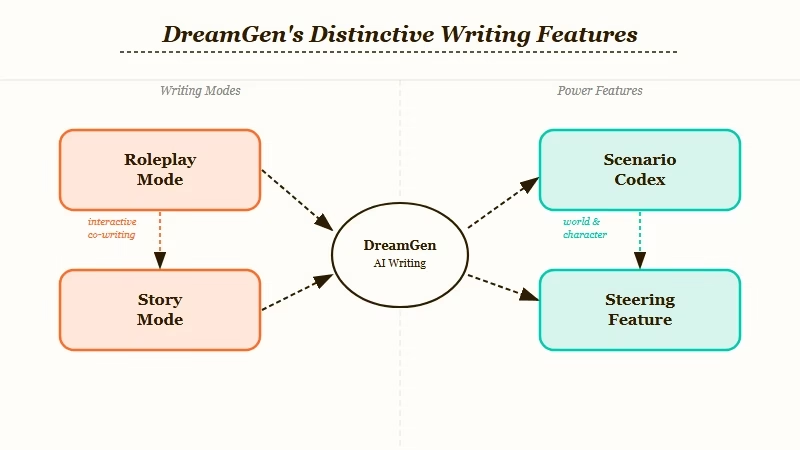
The two modes are where I’d start anyone new to the platform. Roleplay Mode handles dialogue-driven scenes and keeps character voices distinct. Story Mode switches to third-person prose for plot progression.
I’d recommend starting in Roleplay Mode while you get familiar with the system, then switching to Story Mode when you want to write longer narrative arcs.
The Steering feature is the one I find most impressive. If the AI starts getting repetitive or drifts off-tone, you can push it toward “creative chaos” for one response to shake things up, then pull it back toward strict adherence. That kind of granular control is rare in this category.
On most platforms, you just prompt around the problem and hope for the best.
Multi-character scenes are also genuinely functional here, not just a marketing claim. You can have three or four characters in the same scene with distinct voices, separate motivations, and consistent backstories. For anyone writing ensemble roleplay or ensemble fiction, this is the main reason to choose DreamGen over alternatives like SpicyChat AI.
Example scenario: You are 25 messages into a pirate story. Your captain starts sounding polite and modern rather than rough-edged. With DreamGen’s Steering dial, you push one response toward creative chaos to break the pattern, then snap it back to strict adherence for the next. On Character AI, you would have to write several prompts trying to correct the drift manually.
One real limitation worth knowing: context drift hits around 20 to 30 messages even on paid plans. Characters forget inventory items, relationships reset, and plot threads lose coherence.
It is a known issue, and the workaround is to re-anchor the codex manually at key moments. Not ideal, but manageable if you know it is coming.
How Much Does DreamGen Cost?
DreamGen uses a credit-based pricing model with four tiers, ranging from free to $48.30 per month.
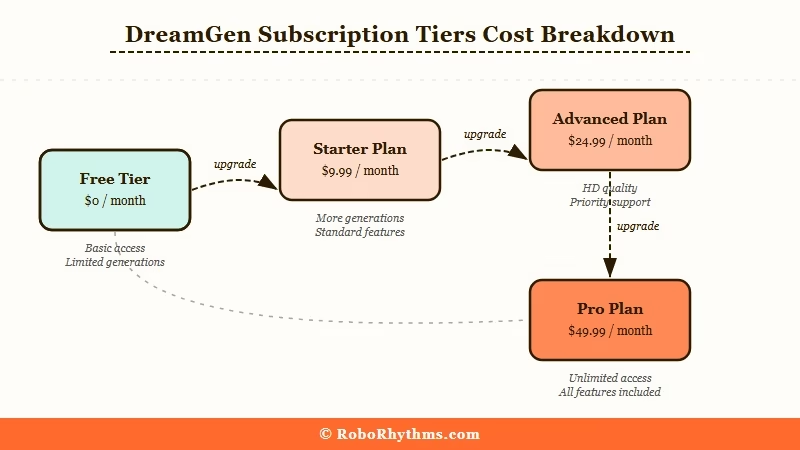
Here is how I’d think about the tiers before spending money:
| Plan | Price | Context Window | Credits |
|---|---|---|---|
| Free | $0 | Limited | Limited daily credits |
| Starter | $7.83/mo | 4,000 tokens | 375/month + 45/day |
| Advanced | $19.35/mo | 8,000 tokens | 2,250/month + 75/day |
| Pro | $48.30/mo | 30,000 tokens | 2,250/month + 75/day, 20% off credit packs, priority image generation |
The context window matters more than the credit count here. The 4,000-token Starter window is tight for complex scenarios with multiple characters. In my experience, the Advanced tier at 8,000 tokens is where the platform starts to feel comfortable for longer sessions.
The Pro tier’s 30,000-token window is for serious writers who want minimal drift across very long scenes.
Image generation costs extra credits on all plans, which is worth knowing upfront if you want visuals alongside your scenes. The credit math can feel metered if you are a heavy user.
| Tier | Best For | Skip If |
|---|---|---|
| Free | Testing the interface | You want to do serious writing |
| Starter | Casual sessions, short scenarios | You run multi-character setups regularly |
| Advanced | Regular writers, mid-length arcs | You want the longest sessions without drift |
| Pro | Power users, long-form serial storytelling | Budget is a concern |
What Are the Pros and Cons of DreamGen?
DreamGen has genuine strengths for serious writers and real limitations that casual users will feel immediately.
From what I’ve seen across the platform, the pros are concentrated in the features that matter most to writers, while the cons cluster around friction points that casual users will hit on day one.
Pros:
- The Steering feature gives you active control over AI behavior mid-scene, something few platforms offer.
- Two distinct modes (Roleplay and Story) match the actual workflow of different writing styles.
- The Scenario Codex keeps lore, characters, and plot consistent across long sessions better than most competitors.
- Multi-character scenes with distinct voices work without constant re-prompting.
- Unrestricted creative content is available for verified 18+ users, with clear policies that prohibit harmful content categories.
- Active community on Discord with regular feedback loops to the development team.
Cons:
- Steep learning curve compared to tap-and-chat apps. Many users bounce on the first night.
- Context drift hits around 20 to 30 messages, even on paid plans. Characters lose track of plot details.
- Image generation costs extra credits and is not included in the base monthly price.
- Free tier is limited enough that you cannot properly evaluate the platform without paying.
- Credit system can feel restrictive during creative flow, especially on the Starter tier.
Is DreamGen Worth It? Verdict
DreamGen is worth it for structured creative writers and roleplay enthusiasts. It is not worth it for casual users who want a simpler experience.
From what I’ve spent time with on this platform, the gap between DreamGen and simpler companions is real and intentional. This is not a product that tries to be everything to everyone. It makes a clear bet on people who want to build worlds, not just have conversations.
If you write serialized roleplay, fantasy fiction, or ensemble narratives, the Scenario Codex and Steering features are genuinely useful tools. The $7.83 Starter tier is a reasonable entry point to test whether the format works for you.
If you want something that requires less setup and delivers emotional engagement out of the box, Nomi AI or a platform like Candy AI will serve you better. Those tools prioritize the relationship experience over narrative control.
The context drift issue is real and worth acknowledging. DreamGen has not fully solved it. For very long sessions, you will need to manually re-anchor your codex. That is a friction point that the platform should address in future updates.
The AI companion market is growing fast, and DreamGen has carved out a legitimate niche. It is not for everyone, and it does not pretend to be. That clarity is a point in its favor.
Frequently Asked Questions
Is DreamGen free to use?
DreamGen offers a free tier with limited credits and context. Paid plans start at $7.83 per month and unlock 4,000-token context windows and 375 monthly credits. The free tier is enough to test the interface but not enough for meaningful sessions.
How does DreamGen compare to Character AI?
DreamGen offers significantly more narrative control than Character AI, including a Scenario Codex, Steering, and multi-character scenes. Character AI is simpler to start but offers less creative depth. DreamGen has fewer content restrictions for 18+ verified users.
What is the context limit on DreamGen free tier?
The free tier does not publish an exact token limit, but it is notably shorter than the Starter plan’s 4,000 tokens. For any scenario with a detailed codex, you will hit the limit quickly. Paid plans are required for serious use.
Does DreamGen Allow Unrestricted Creative Content?
DreamGen allows unrestricted creative content for verified users aged 18 and over. It prohibits certain content categories including anything involving minors. The platform positions itself as a flexible but not lawless creative space.
Is DreamGen good for beginners?
DreamGen has a learning curve. Users who treat it like a basic chatbot often have a poor first experience. If you are new to AI roleplay, start with Character AI alternatives first, then come back to DreamGen once you understand how scenario-based platforms work.
What are the best DreamGen alternatives?
The closest alternatives are NovelAI (more technical, stronger prose models), SpicyChat AI (simpler setup, similar content flexibility), and Candy AI (better for companion-focused use cases). See our best AI roleplay scenario generators guide for a broader comparison.
