
My Take: The MIT Media Lab “Your Brain on ChatGPT” study is real, the EEG findings are real, and the panic on Reddit is misplaced. The data does not say AI makes you dumber. It says cognitive offloading without prior skill development weakens the networks that would have done the work. That distinction is the whole story, and almost every popular write-up misses it.
The viral pitch on Reddit, in The Atlantic, on Time, and in roughly every LinkedIn essay this month is that the MIT Media Lab proved AI makes you dumber. The pitch is wrong.
The MIT study, Your Brain on ChatGPT: Accumulation of Cognitive Debt, is a preprint from June 2025 that measured EEG activity in 54 people writing essays with three different tool setups. The real finding is more specific and more useful than the headlines.
This matters for anyone using AI tools in 2026 because the takeaway shapes the workflow. If the lesson is “AI rots your brain”, you stop using it.
If the lesson is “outsource only what you already understand”, you build a workflow that compounds skill instead of replacing it. Those are different prescriptions, and only one of them is supported by the data.
This piece walks through the mainstream framing, the contrarian read of the same study, and the part of the data that almost nobody quotes. I have no affiliate skin in this game; this is a take, not a recommendation.

The Mainstream View (And Why It Falls Short)
The mainstream view is that the MIT study proves LLM use atrophies your brain. The study does not say that, and the authors explicitly warn against that reading.
The cleanest articulation of the mainstream view came from Time’s June 2025 coverage, which framed the study as evidence that ChatGPT “drives” the brain into the back seat. The piece was widely shared and the framing stuck. Across follow-on coverage in Laptop Mag, Medium long-reads, and a cycle of LinkedIn posts, the same shape repeated: brain scans show LLM users have weaker neural connectivity, therefore LLM use makes them dumber.
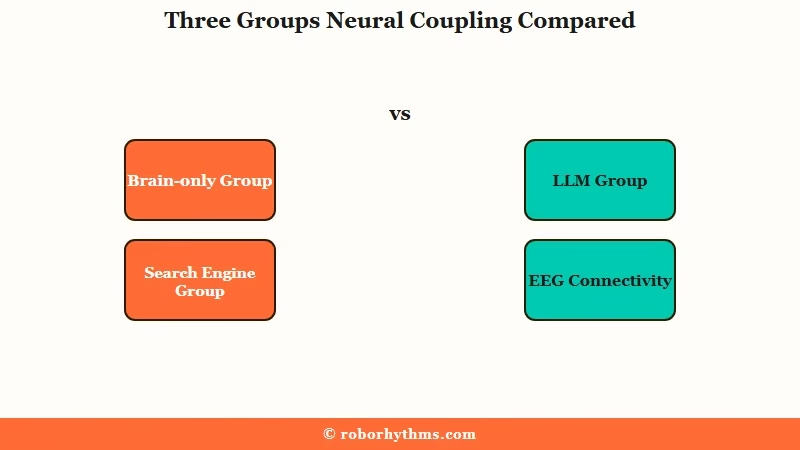
The framing is wrong in a precise way. The MIT study put 54 participants into three groups (Brain-only, Search Engine, LLM), measured EEG activity over four months of essay writing sessions, and found that brain connectivity scales down with the amount of external help.
That part is true. The Brain-only group showed the widest-ranging neural networks, the LLM group showed the weakest coupling, and so far the mainstream read tracks.
What the mainstream read drops is what the authors say next: the data does not prove LLMs make people “dumber”, “stupid”, or cause “brain rot”. The authors flag this in the paper itself.
The study measures cognitive load during essay writing, not intelligence. It measures one task, uses 54 people from one geographic area, and has not been peer-reviewed. The press release version of “AI atrophies your brain” is several leaps further than the data supports.
Time, The Atlantic, and the Medium pieces are not lying; they are doing what publication economics rewards. “Study shows AI changes which brain networks you engage” is a less clickable headline than “AI rots your brain”. The mainstream view is not a lie, it is a compression that loses the load-bearing nuance.
What’s Actually Happening in the Data
The MIT study shows that LLM-assisted writing engages weaker brain networks during the task. The under-reported half of the same study shows that people who built the skill first, then added an LLM, performed better than people who used the LLM from the start.
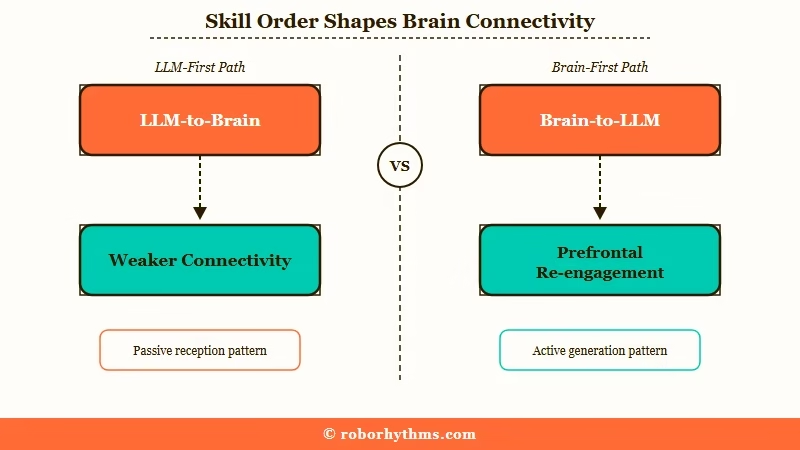
The way I read the MIT paper, the most interesting finding is not the headline. It is the Session 4 “switch” result.
After three sessions with the same tool setup, the researchers had the LLM group try writing without tools and the Brain-only group try writing with an LLM. What happened next is what the popular coverage skips.
The LLM-to-Brain participants (who had developed dependence on the LLM) showed weaker neural connectivity and under-engagement of alpha and beta networks. Their cognitive musculature had atrophied. Predictable.
The Brain-to-LLM participants (who had built the writing skill first, then added an LLM) showed higher memory recall and re-engaged the occipito-parietal and prefrontal areas. They used the LLM more effectively because they knew what to ask for and what to verify. From what I see in the data, this group is the future of productive AI use, and it is the group nobody is talking about.
The other under-reported finding is essay ownership. The LLM group reported low ownership of their own essays, and could not quote their own writing minutes after producing it. The Brain-only group could.
This is not a story about intelligence; it is a story about agency and engagement. The brain remembers what it had a hand in producing, and it does not remember what it merely prompted into existence.
What I take from all this is that the MIT study is doing something the popular coverage is not equipped to handle: it is measuring how different tool-use patterns produce different cognitive outcomes from the same underlying intelligence.
The intelligence is not changing; the outcome is. That is a useful finding and it gets buried under panic.
The Part Nobody Wants to Admit
The honest read of the MIT study is that cognitive offloading is fine if you build the skill first and outsource second. It is a problem if you outsource before you have the skill. The reason nobody says this out loud is that it puts the responsibility on the user instead of the technology.
The framing that protects everyone’s ego is “AI makes us dumber”. The framing the data supports is “AI exposes which skills you really built versus which ones you skipped”. One of these is comfortable; the other names you.
If you used Google for 20 years to remember phone numbers, your phone-number-memorization muscle atrophied. That was not Google’s fault; it was the predictable outcome of offloading a skill you no longer needed because the tool was always available.
The MIT data is doing the same thing for essay writing and reasoning. If you outsource your first-draft thinking to an LLM, the thinking-during-first-draft muscle atrophies, and that is not the LLM’s fault either.
The reason this is uncomfortable is that it implies a hierarchy of legitimate AI use. There is a “right” way and a “wrong” way, and the right way is what the Brain-to-LLM switch group did: build the skill, then layer the tool on top. The wrong way is what the LLM-from-the-start group did: skip the skill, never engage the underlying networks, end up with weaker outputs and worse memory of your own work.
I would argue this maps cleanly to what I see in indie builders and content operators in 2026. The ones who built writing chops, coding chops, or design chops before AI existed are using AI to compound that skill.
The ones who treated AI as the first interface for those skills are stuck producing output they cannot improve or defend because they never internalized what good looks like. Same tool, different outcomes. The difference is sequencing.
| Cognitive offloading pattern | What the EEG shows | What you produce | What the MIT study finds |
|---|---|---|---|
| LLM-from-start (no prior skill) | Weakest neural coupling, alpha/beta under-engagement | Low ownership, cannot quote own work | Atrophy of the network you never built |
| Build skill first, then add LLM | Re-engaged prefrontal and occipito-parietal areas | Higher memory recall, better cited output | Compounding effect, the productive path |
| Brain-only throughout | Strongest, widest-ranging networks | Highest ownership, best recall | Maximum cognitive engagement, slowest output |
Hot Take
The MIT brain study is right and the panic is wrong. AI is not making you dumber; AI is showing you, in EEG receipts, which skills you built and which you skipped.
If you skipped the skill, the AI will not save you, and the brain network you never developed will not magically appear when the tool stops working. Build first, outsource second. There is no shortcut, and the people selling you one are either uninformed or selling you the wrong product.
What This Means for How You Use AI
The practical version of the contrarian read is a workflow rule: build the skill manually, then add the AI layer.
- Write something hard without AI first. Whatever the skill is (writing, code, design, sales copy), do the first 50 reps without an LLM. Get to “competent but slow.” This is where the underlying neural networks form.
- Add the AI layer to compound speed, not to replace the work. Once you can produce a competent first draft, use the LLM to compress your iteration cycle. You will recognize when the output is wrong, and you will know how to fix it.
- Verify every claim the LLM makes about a topic you do not already know. This is the cognitive-offloading trap most users fall into. If you do not have a prior model of the topic, you cannot evaluate the output. The MIT study’s LLM group is what this looks like at scale.
- Refuse to use AI for the skill you are currently trying to learn. This is the sequencing rule from the Brain-to-LLM switch result. The participants who built the skill first benefited from the LLM. The ones who skipped the skill never engaged the network in the first place.
A few related pieces cover this same pattern at different scales. The piece on why the AI productivity gap is a management problem, not a model problem covers the Stanford research that maps to the same point at the organizational level. The piece on agent tool hallucinations is what verification looks like in production.
The recent Gemini Enterprise Agent Platform coverage is the platform layer where this user-side discipline ends up mattering, and the Writesonic review covers the writing-tools angle where the sequencing rule shows up most cleanly.
The mainstream view will keep saying AI makes you dumber. The MIT study will keep saying something more useful and more specific. The gap between those two messages is where the disciplined operators in 2026 are going to separate from everyone else.
